You open your apartment closet and find a single sad rod, one wire shelf, and a lease that says any holes come out of your security deposit. This is exactly the situation renter friendly closet organization is built for: systems that use tension, gravity, hooks, and freestanding furniture instead of screws and anchors. These 17 no-drill closet organization ideas will roughly double what your closet holds, and every one of them comes out cleanly when you move — no drilling, no spackling, no deposit deductions.
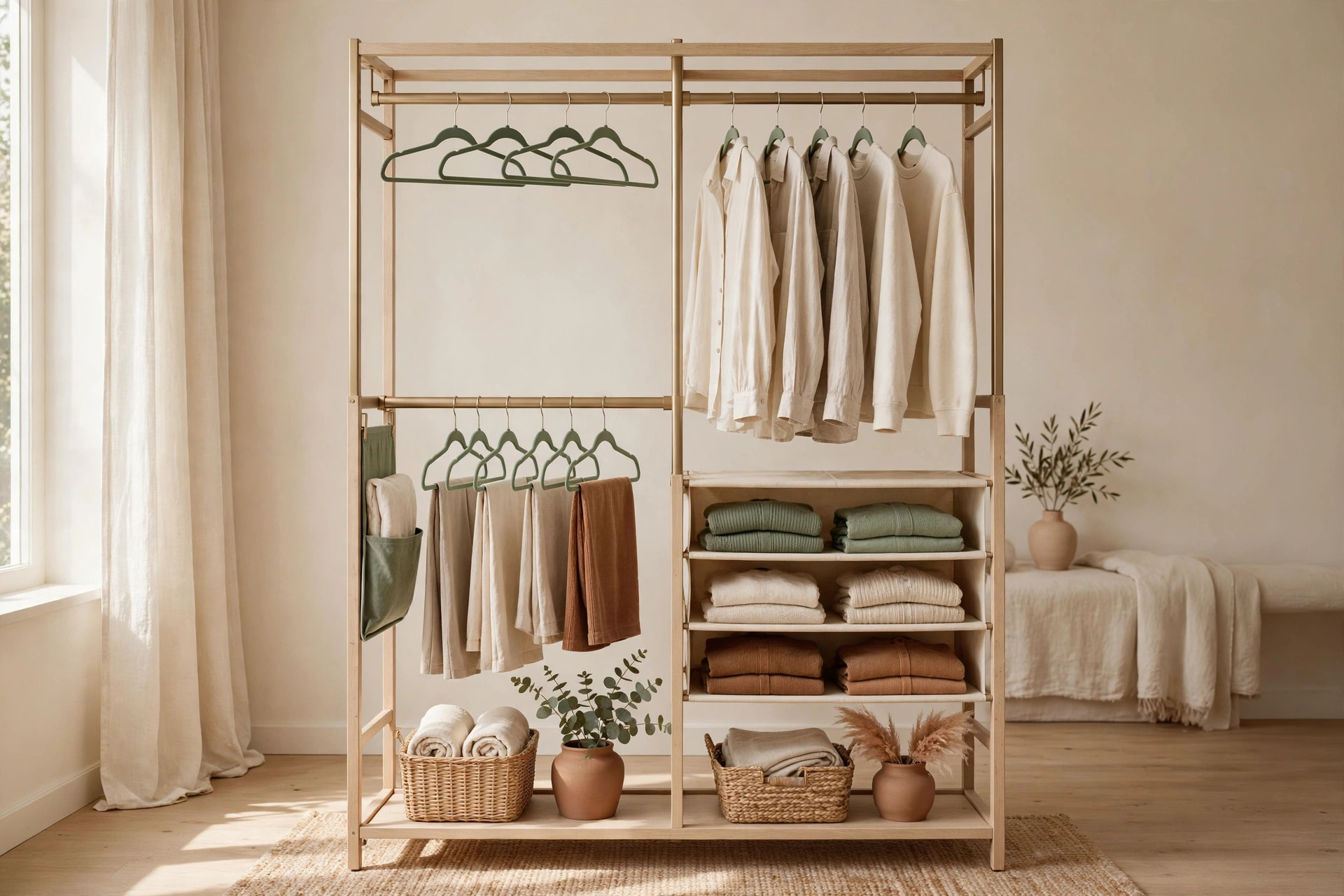
The renter’s rulebook: what “no damage” really means for closets
Most leases ban holes, anchors, and adhesive damage — but say nothing about tension rods, over-the-door hardware, or freestanding furniture. That’s your playbook: furnish the closet, don’t install into it. If your “closet” is an open wardrobe corner, our Studio Apartment Organization: How to Create Zones in One Room guide shows how to zone it so these same ideas work without walls.
1. Audit the rod, shelf, and anchor points you’re starting with
Before buying anything, measure your closet: interior width, depth, rod-to-floor distance, and rod-to-shelf distance. A standard reach-in runs 24 inches deep with a rod 60–65 inches off the floor — that tells you whether a double-hang extender clears your longest items. Photograph the closet empty and note every scuff for move-out proof.
2. Build your no-drill toolkit before you buy a single bin
Your whole mounting system is four things: tension (rods), gravity (hooks over doors or rods), adhesion (removable strips used within their rated weight), and floor space (freestanding units). Anything needing “just one little screw” is off the list — that screw is a deposit deduction waiting to happen. If your closet doubles as a laundry nook with a stacked washer-dryer, read our 16 Small Laundry Closet Organization Ideas That Actually Fit first; that layout has its own rules.
Double-hang rod extender: the single highest-impact $25 change
One full-length rod in a 24-inch-deep closet wastes the entire lower half. A double-hang extender — a second rod that hangs from the existing rod on straps or hooks — turns that dead air into a full second tier for roughly the price of two pizzas. This one change does more than all the bins and dividers combined.
3. Hang an extender rod to double your rail space overnight
Hang an extender rod about 40 inches below your main rod (or 30 inches above the floor for pants and skirts). No tools — its arms hook over the existing rod. You now have a top tier for shirts and jackets and a bottom tier for pants, skirts, and short dresses. Park full-length coats and long dresses at one end of the top rod.
4. Sort by category, not by color, on your new tiers
Put all tops on the upper tier, all bottoms on the lower tier. Getting dressed becomes a two-stop trip. Keep long items — dresses, jumpsuits, long coats — on the main rod in the left third, with the extender in the remaining two-thirds. If an item fits neither tier, ask: does it earn its space, or does it belong under the bed?
Slim velvet hangers (reclaim 30%+ of rod space)
Bulky plastic and wood hangers are eating your closet. A standard plastic tube hanger is about 0.2 inches thick; slim velvet is roughly half that. Multiply by 60 hangers and you’ve reclaimed over half a foot of rod — free space, no drilling.

5. Swap every hanger for slim velvet — all of them, at once
Partial swaps create chaos: mixed hangers snag and slide differently. Do the whole closet in one 20-minute session. Velvet grips fabric so silks and camisoles stop sliding to the floor, and the slim profile hangs everything in an even line. Donate the old hangers — “just in case” ones migrate back onto the rod.
6. Hang S-hooks off the rod for bags, belts, and tomorrow’s outfit
Metal S-hooks (about $5 for a 10-pack) turn dead rod space into accessory storage: one for a crossbody bag, one for tomorrow’s outfit so you’re not digging in the morning, one for belts. They lift off with no trace and move with you. Keep them at the rod’s end so bags don’t crush clothes.
Tension rods for scarves, nooks, and light second rails
Tension rods are the renter’s power tool: rubber-footed rods that wedge between two walls or inside a frame, hold with friction, and leave zero marks. Respect the weight limit — light loads only, never a winter coat collection.
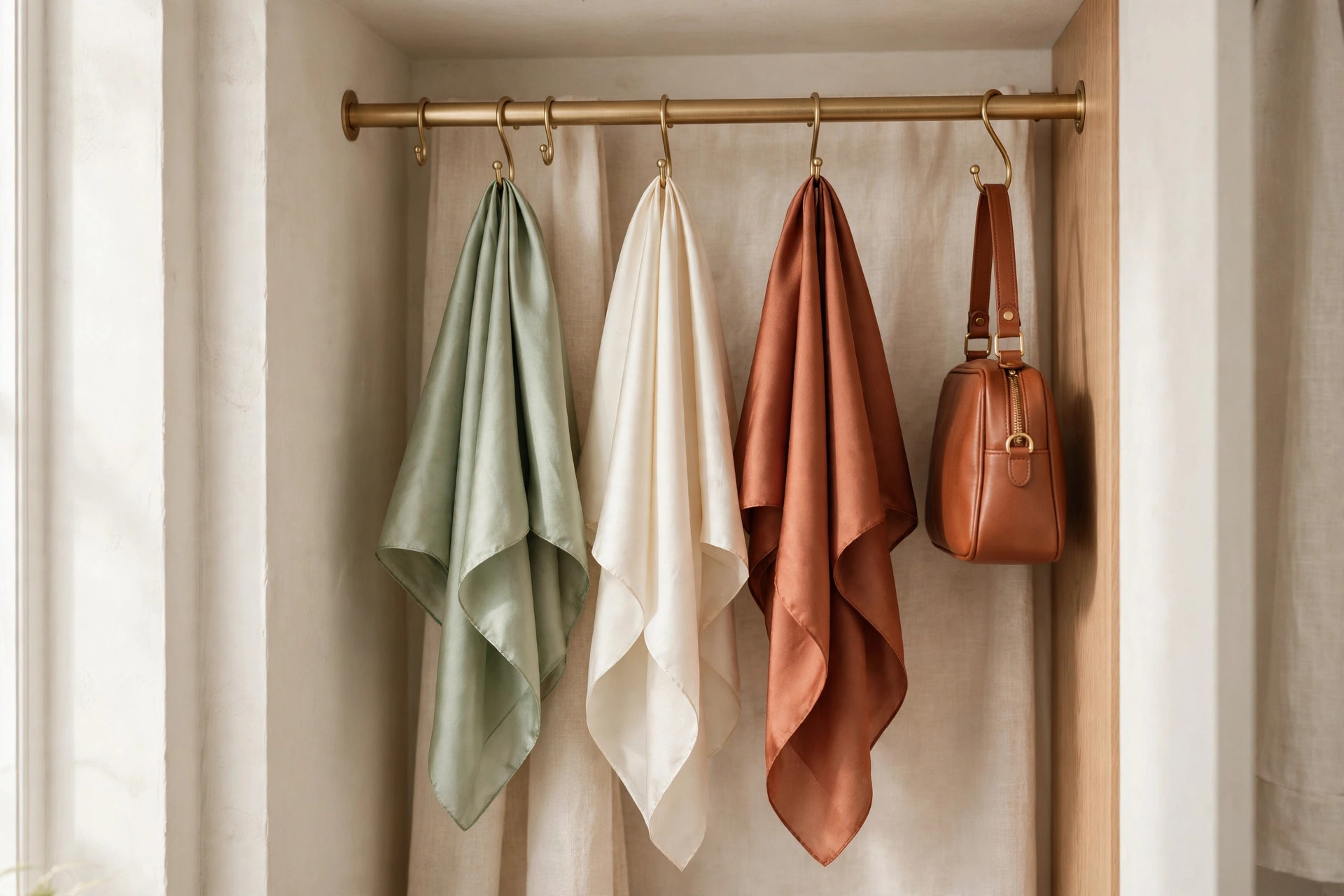
7. Brace a tension rod across a wide closet as a light second rail
In a closet wider than 36 inches, a heavy-duty tension rod (rated 15–20 pounds, about 3/4 to 1 inch in diameter) spans the space behind or in front of the main rod for light items: scarves, lightweight cardigans, tomorrow’s outfit. Twist until snug — a rod that spins freely will slide under load. Check it monthly; humidity and vibrations loosen tension.
8. Turn dead corners into scarf and belt stations with short tension rods
The 6-inch gap between closet wall and side frame is wasted space until you wedge a short 12–18 inch tension rod in it, vertically or horizontally. Drape scarves, loop belts, hang hats by their straps. These little nook rods also reach the dark corners where a full organizer won’t fit.
Over-the-door organizers: shoes, accessories, bags
The back of the closet door is roughly 20 by 60 inches of unused real estate. Over-the-door organizers hook over the door top — no screws — and most doors have enough clearance. Test first: drape a dish towel over the door top; if it still shuts, the organizer fits.
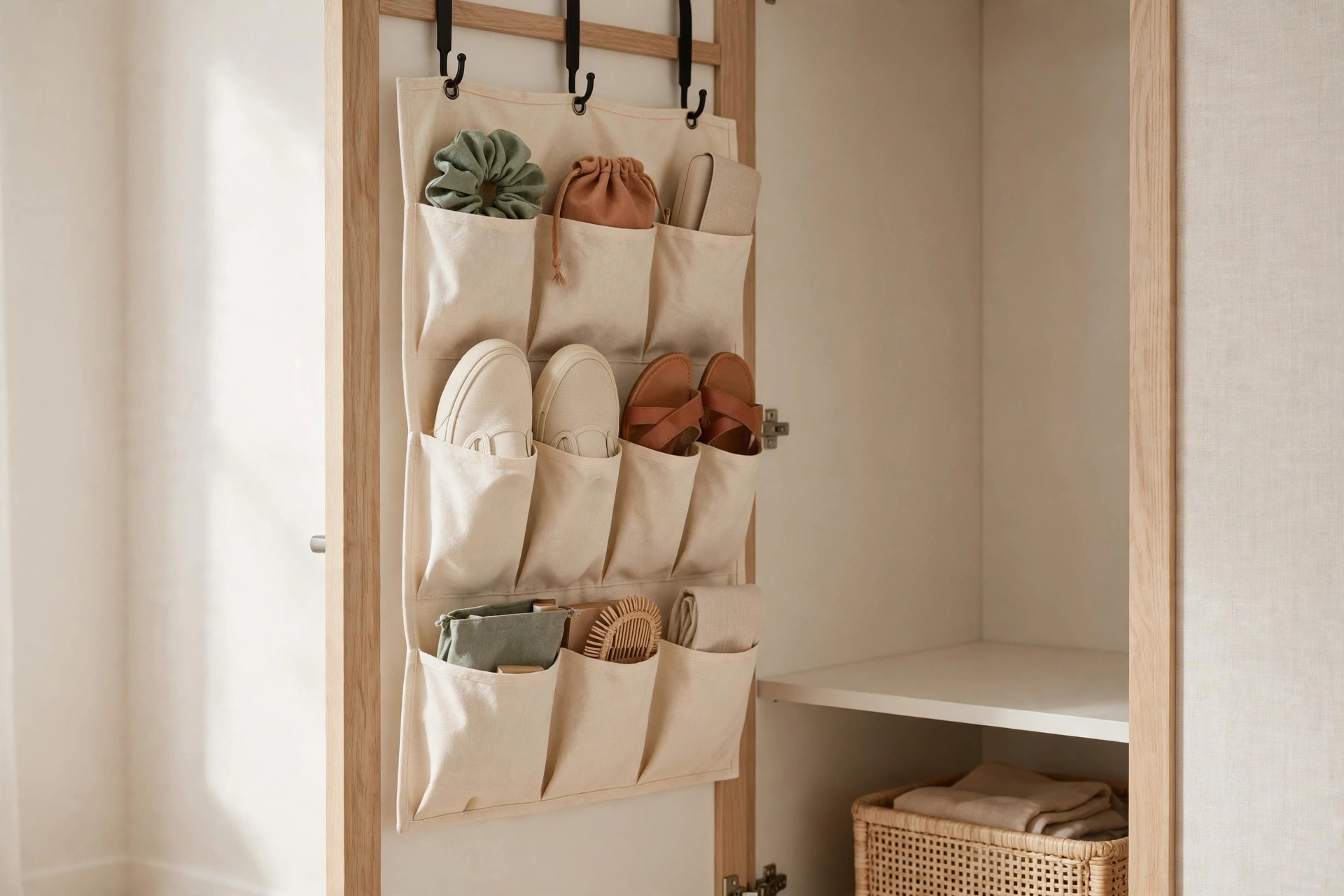
9. Hang an over-the-door shoe organizer with clear pockets
A clear-pocket organizer holds 24 pairs of flats, sandals, and sneakers on the door’s back — and pockets work for far more than shoes. Lower pockets for sunglasses, rolled socks, underwear; middle pockets for daily accessories. Clear pockets matter: opaque canvas becomes a black hole where items get forgotten.
10. Add an over-the-door hook rack for bags, robes, and tomorrow’s outfit
A 5-hook over-the-door rack handles the bulky stuff pockets can’t: totes, gym bag, robe, your everyday jacket. Moving daily-use items to the door frees rod space for clothes — and the door’s back, not the bedroom floor, becomes your default landing spot.
11. Line the inside of the door with removable adhesive hooks for jewelry and sunglasses
A row of removable adhesive hooks (rated 1–3 pounds) on the inside of the door becomes a jewelry and sunglasses station for under $10, peeling off cleanly at move-out. Hang necklaces by their clasps so they don’t tangle, and leave one hook empty — the one you’ll use every morning for what you’re wearing.
Freestanding drawer units and cube storage on the floor
Your closet floor is prime real estate most renters surrender to a shoe avalanche. Freestanding units simply stand there — no mounting, and they move with you.
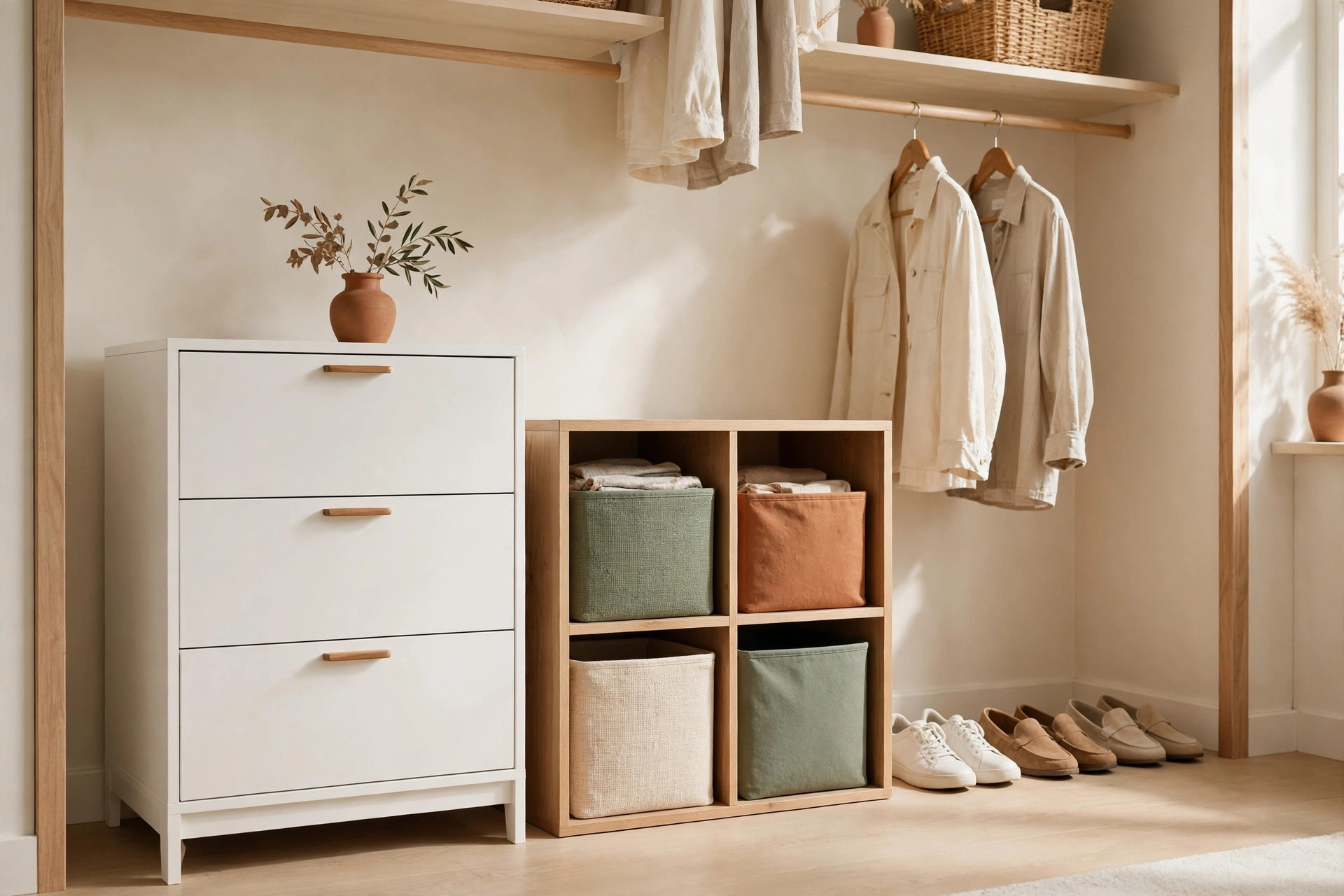
12. Slide a rolling drawer cart into the awkward space under the short rod
The 30 inches of floor under a double-hang bottom tier fits a narrow rolling cart (10–14 inches wide) with 3–4 drawers: underwear, socks, workout clothes, pajamas — the soft stuff that skips hanging. Wheels matter: pull it out to reach the back, roll it aside to clean, roll it onto the moving truck.
13. Stand a cube shelf on the floor for shoes, bins, and folded denim
A freestanding 2×2 or 2×3 cube shelf turns the closet’s bottom 24–36 inches into real storage: shoes in lower cubes, folded jeans and sweaters in fabric bins above. Keep it 2–3 inches narrower than the closet so it slides out for cleaning. If the floor is already full, overflow goes under the bed — our 17 Under Bed Storage Ideas for Small Bedrooms covers that move.
Hanging fabric shelves: what they’re actually good for
Hanging fabric shelves — canvas cubbies that drape over the rod — are the most over-promised closet product on the market. Genuinely useful, but only for a narrow set of jobs. Use them wrong and they sag into a wrinkled mess.
14. Use hanging fabric shelves for folded knits and tees — not for everything
Fabric shelves suit lightweight, wrinkle-tolerant items: folded t-shirts, knit sweaters, leggings, pajamas. One cubby per category, folded to the cubby’s width so nothing spills over the edges. They fail for heavy items (denim, boots), tall items (they compress everything below), and anything you need to see — middle cubbies turn invisible.
15. Stabilize each cube with a rigid bin or cardboard insert
The number-one failure is sagging sides. Slide a rigid fabric bin, a cut-to-size cardboard panel, or a thin cutting board into each cube: walls stay square, items stay visible, the unit stops leaning. Dedicate the top cube — hardest to reach — to off-season items you touch twice a year.
Move-out plan: what lifts out cleanly in under an hour
The whole point of renter-friendly organization is reversibility. A closet full of no-drill solutions should disassemble in 45–60 minutes with no spackle, no paint, and no landlord conversation. Plan the teardown when you set up — not when the moving truck is idling.
16. Photograph the empty closet and label every piece as you install it
Those move-in photos from idea #1 are your deposit insurance. As you add each piece — extender rod, cube shelf, adhesive hooks — snap one photo and keep original packaging or a labeled parts bag together. Reversing the order at move-out means nothing gets left behind or damaged in a junk drawer.
17. Do a 45-minute dry-run teardown two weeks before move-out
Two weeks before moving day, take everything down and put it back up once. You’ll learn which tension rod seized, which adhesive strip needs replacing, and whether the cube shelf fits through the door when loaded. The real teardown then takes under an hour — not a midnight panic with a hairdryer and a putty knife you don’t own.
Mistakes to avoid
Buying before measuring. A double-hang extender that doesn’t clear your longest dress is a $25 regret. Measure rod height, closet depth, and your longest hanging item first.
Overloading tension rods. A tension rod rated for 10 pounds holding 15 pounds of wet denim will fail — possibly at 2 a.m., onto your shoes. Light items only; heavy stuff belongs on the freestanding floor unit.
Using adhesive strips past their weight rating. Strips are rated per strip, not per wish. A 3-pound hook holding a 5-pound bag peels paint on the way down — exactly the damage you were avoiding.
Installing “temporary” screws. There is no such thing as a temporary screw in a rental. One hole becomes three (“just to level it”), and spackle never quite matches.
Ignoring the door swing. A beautiful cube shelf that blocks the bifold door from closing is furniture in the wrong room. Measure the swing arc before you buy.
Frequently asked questions
How do renters organize closets without drilling?
Use the four no-drill methods: tension (rods wedged between walls), gravity (over-the-door organizers and rod hooks), adhesion (removable strips within their rating), and floor space (freestanding carts and cube shelves). A double-hang extender plus slim velvet hangers handles most hanging clothes; the door back and floor handle the rest.
Can I use command strips in a rental closet?
Yes, on smooth painted walls and door surfaces — but stay within the stated weight rating and pull the tab straight down, slowly, on removal (never outward). Overloaded hooks and rushed removal are the two things that damage paint.
What is the cheapest way to double closet space as a renter?
A double-hang extender rod ($20–$30) plus a full swap to slim velvet hangers ($15–$25 for a multi-pack). Together they typically double usable hanging space for under $50, with zero tools.
Will a tension rod damage my closet walls?
A properly sized rod leaves no marks on most painted drywall — the rubber end caps spread pressure. Problems come from overtightening soft or fresh paint, or rods that slip and scrape. Twist until snug, not straining, and add a felt pad under each end cap on delicate paint.
How do I organize a closet with no rod at all?
Some rentals have only a shelf, or nothing. Start with a freestanding garment rack for hanging clothes, add a cube shelf beside it for folded items, and use the shelf for bins. You lose nothing at move-out — the whole setup walks out the door with you.
Conclusion
No-drill closet organization isn’t a compromise — it’s a system of tension rods, over-the-door hardware, slim hangers, and freestanding furniture that outfits a rental closet without touching the walls. Pick the double-hang extender first, swap your hangers second, then work outward. Save this pin for later, and browse our closet organization ideas when you’re ready for the next space.