Two toothbrushes, three bottles of shampoo, a hair dryer, and a tube of toothpaste with no cap — and that is before your roommate even wakes up. The best small bathroom storage ideas shared bathroom roommates actually use are not really about storage at all. They are about territory. When two or more people share one small bathroom, the counter becomes a battlefield and the towel rail turns into a damp pile nobody claims. The fix is not a bigger bathroom. It is a system where every person has a labeled zone and a caddy they can carry in and out. These 16 ideas end the counter wars for good.
The shared-bathroom audit: who owns what, and what fights for space
Before you buy a single bin, find out what is actually causing the mess: nobody knows whose shelf is whose, so everything lands on the counter.
1. Empty the bathroom completely and sort by person
Take everything out — every bottle, brush, and tube — and sort it into one pile per person on the bed or the hallway floor. Toss anything expired, empty, or left behind by someone who moved out months ago. Most shared bathrooms hold 30 to 40 percent more product than anyone uses in a week, and that surplus is what eats your counter space.
2. Map the real estate before you assign it
Measure the counter, the shelf space, the inside of the cabinet door, and the under-sink area, then sketch a rough map on paper. Mark one zone per person and one shared zone for things everyone uses, like hand soap and toilet paper. A fair split in a two-person bathroom is usually a 12-inch counter strip each, with the middle left clear as a shared landing zone.
One caddy per person: the system that ends the counter wars
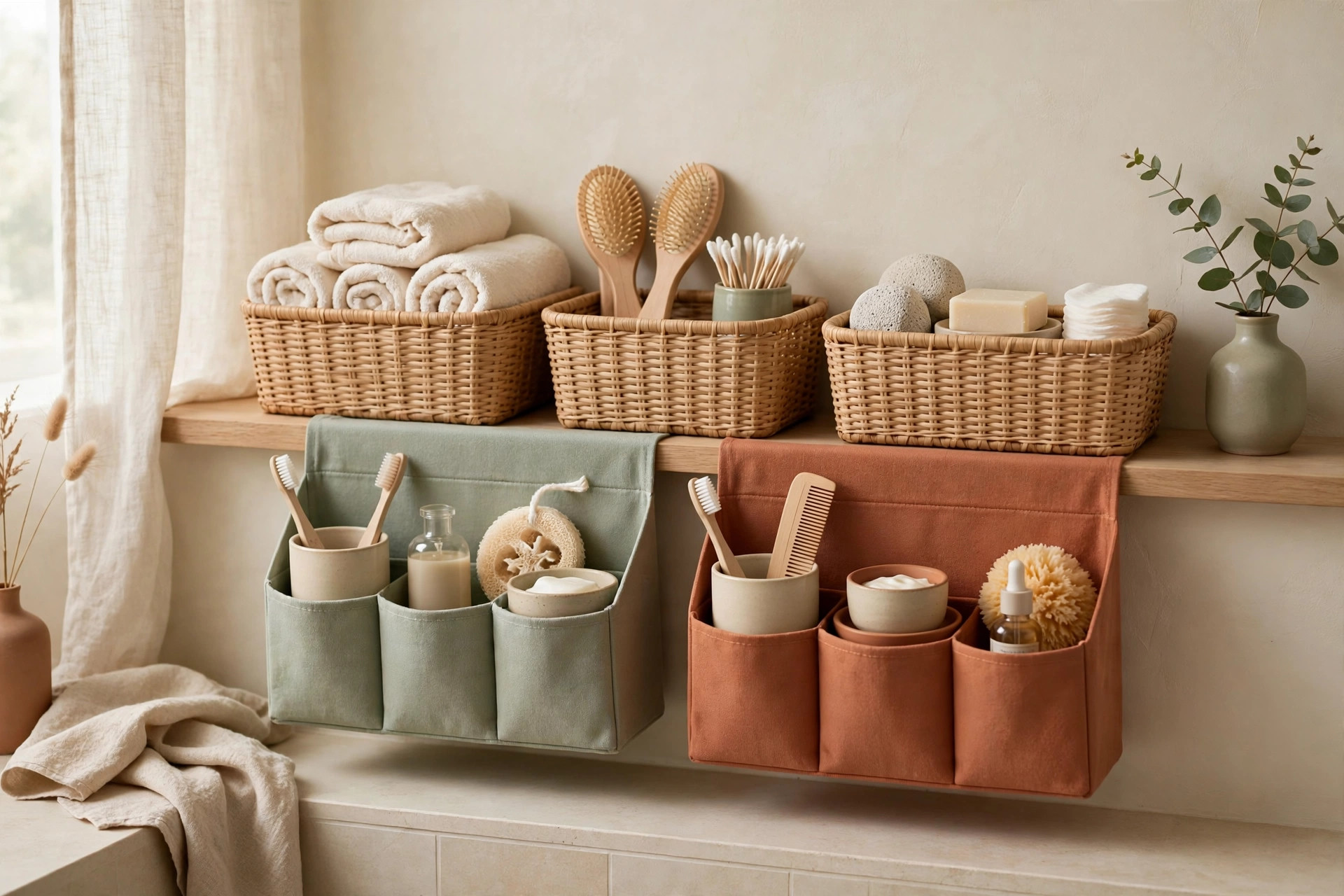
Instead of every person’s products living permanently in the bathroom, each person keeps daily items in a portable caddy in their own bedroom and carries it in for their routine.
3. Give everyone a shower caddy they carry in and out
Choose a handled caddy about 10 by 7 by 6 inches — big enough for a toothbrush, toothpaste, cleanser, deodorant, and one or two styling products, small enough to carry with one hand. Plastic caddies with drainage holes work best because they dry out between uses and wipe clean in seconds.
4. Use a different caddy color or material per person
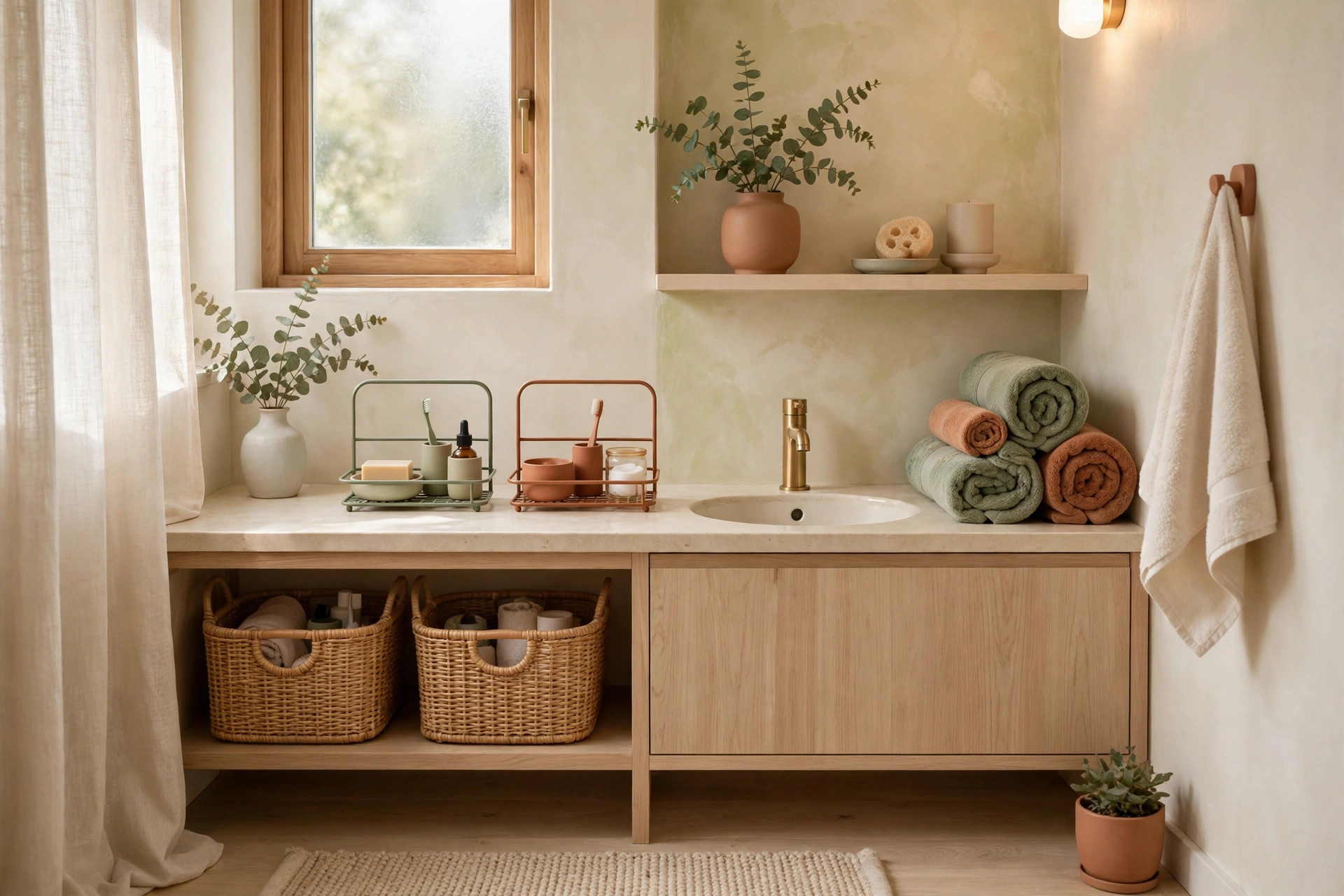
Pick a different color, pattern, or material for each person — one woven basket, one matte black plastic tote, one sage-green bin — and stick with it everywhere. The color becomes the person’s identity in the bathroom, which makes it obvious at a glance when something is in the wrong place.
Labeled zones: shelf, hook, and drawer per person
A shelf that is “sort of yours” will be colonized within a week. Labels and assigned hooks turn a vague agreement into a boundary nobody has to argue about.
5. Label every shelf with a name, not just a color
Use a label maker or waterproof vinyl labels to put each person’s name directly on the front edge of their shelf, drawer, or cabinet section. Names beat colors because guests, kids, and new roommates can read them without being told the code. Labeling takes ten minutes and prevents a hundred small arguments.
6. Assign one hook and one towel ring per person
Mount one adhesive or screw-in hook per person at different heights — higher for taller people, lower for kids — and give each person their own towel ring or robe hook beside it. Heavy-duty adhesive hooks rated for 3 to 5 pounds hold a robe or a full wash bag without a single hole in the wall. Our guide to 16 Small Bathroom Storage Ideas for Renters (No Drilling) has more renter-safe mounting ideas that work in shared spaces too.
Over-the-door storage for towels and robes
The back of the bathroom door is free real estate. It holds towels, robes, and overflow products without taking an inch of counter or wall space, and it needs no drilling.
7. Hang a multi-hook over-the-door rack for robes and towels
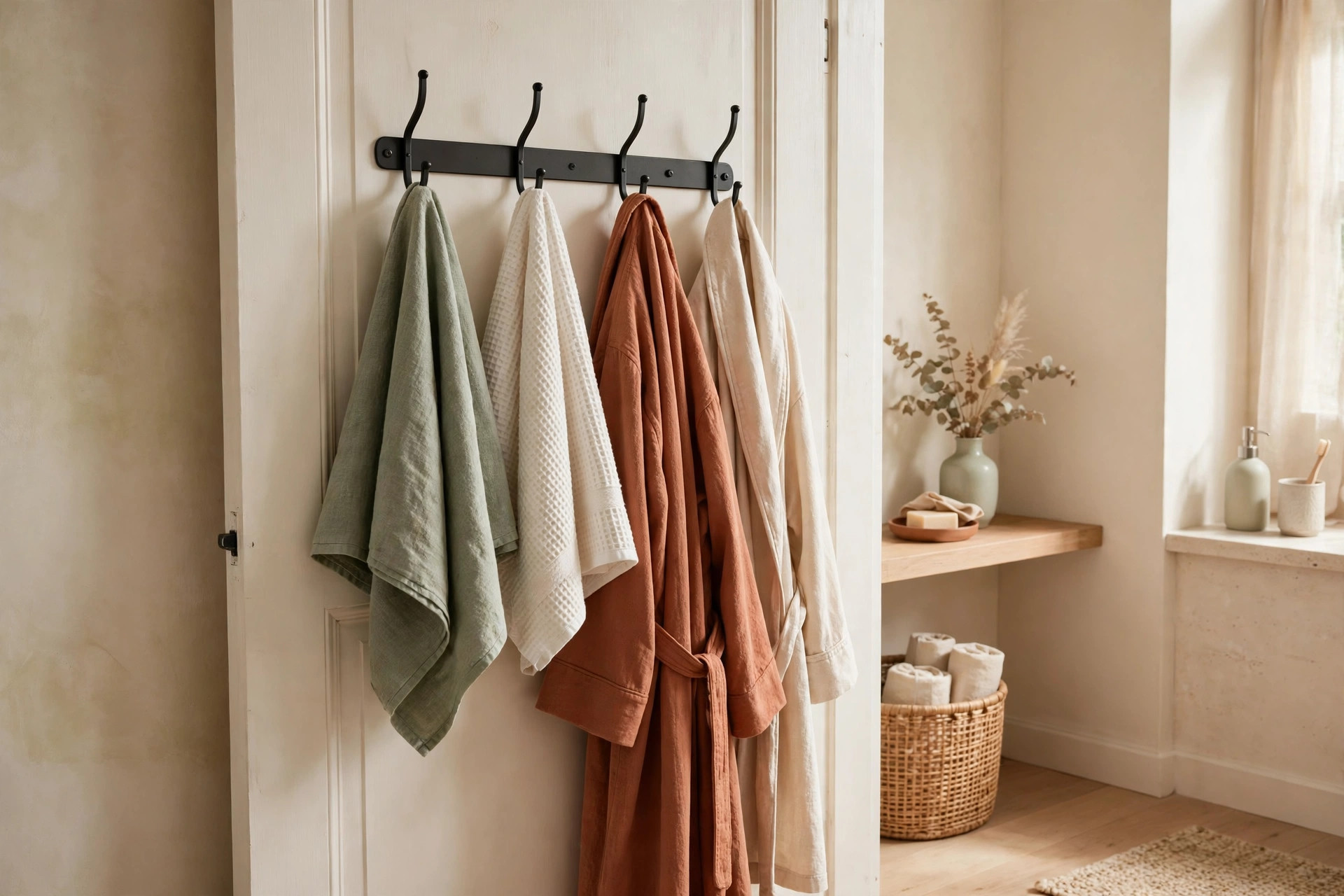
A standard over-the-door rack with 5 to 7 hooks fits a door up to 1.75 inches thick and holds two robes, two towels, and a wash bag without crowding. Hang it on the inside of the door so it is hidden when the door is open, and assign hooks by position — top hooks for the tallest person, bottom hooks for kids.
8. Add an over-the-door pocket organizer for overflow products
A clear-pocket organizer with 12 to 24 pockets turns the door into a vertical cabinet. Use the top rows for each person’s backup products — spare razors, extra toothpaste, travel-size bottles — and the bottom rows for shared supplies like cleaning wipes and spare toilet paper. Clear pockets matter: when you can see what is inside, you stop buying duplicates of things you already own.
Shower caddies: one per person, hung not piled
The shower shelf is where shared bathrooms fail fastest. Three people’s shampoo bottles piled on one corner shelf will fall, leak, and breed mildew. One caddy per person, hung at their own height, fixes it.
9. Hang a suction or tension-pole caddy for each person
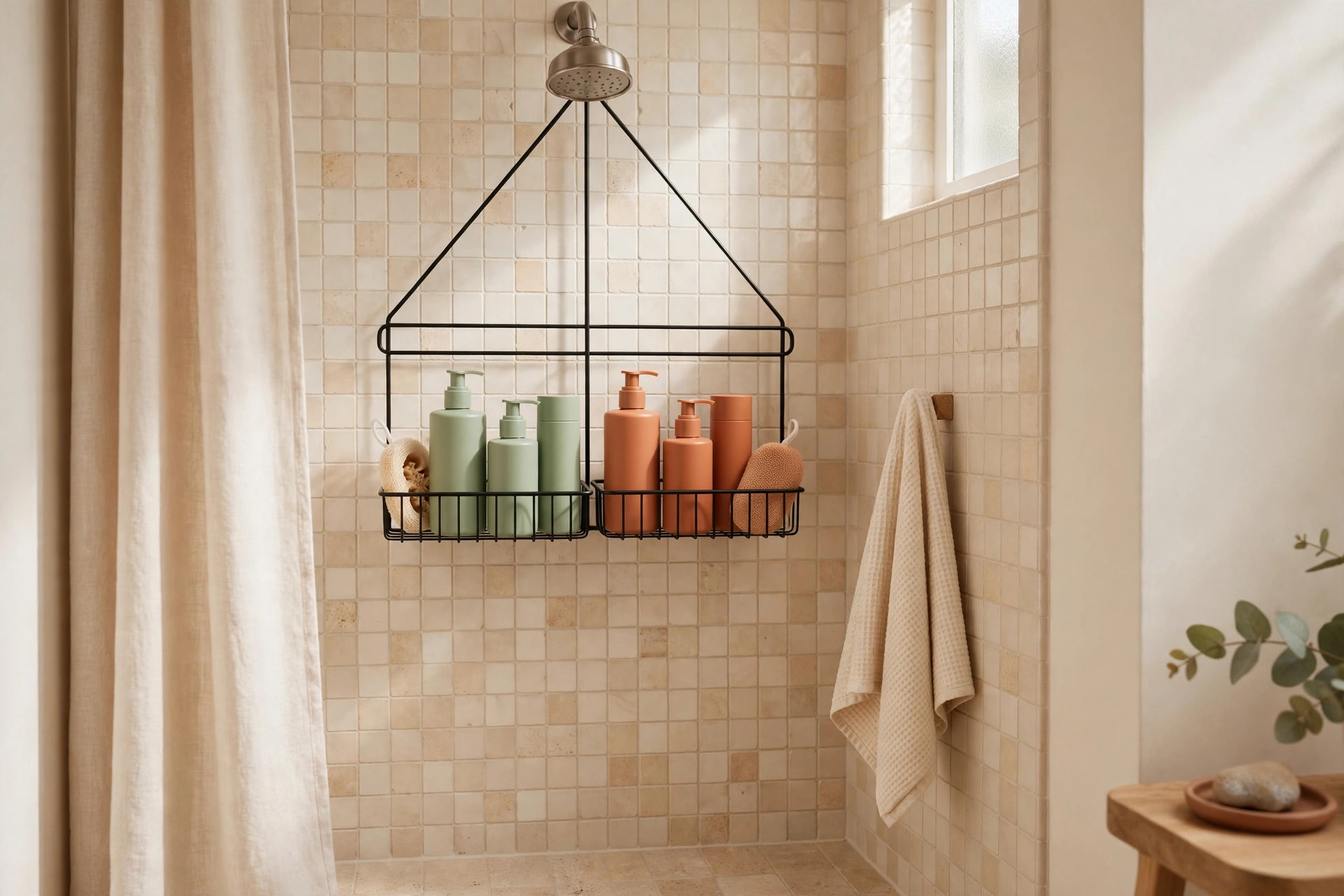
Give each person their own hanging shower caddy — a suction-cup basket for tiled walls, or a tension-pole caddy with two or three baskets if you have more than two people. Suction caddies rated for 5 to 7 pounds hold a full-size shampoo, conditioner, and body wash without slipping, as long as the tile is smooth and you press the cups onto a clean, dry surface. Our roundup of 16 Shower Storage Ideas for Small Bathrooms (No Drilling) compares suction, tension-pole, and over-the-showerhead options side by side.
10. Cap each person at three shower products
Three bottles per person is the rule that keeps shower caddies from overflowing: one shampoo, one conditioner or body wash, and one personal item, like a face wash or a razor. Anything beyond that — hair masks, scrubs, treatments — lives in the person’s caddy in their bedroom and comes into the shower only on the days it is used.
Under-sink division: bins that keep products separate
The under-sink cabinet is usually the biggest storage space in a small bathroom, and the most wasted — one dark hole where everything gets shoved to the back. Divided bins turn it into a filing cabinet.
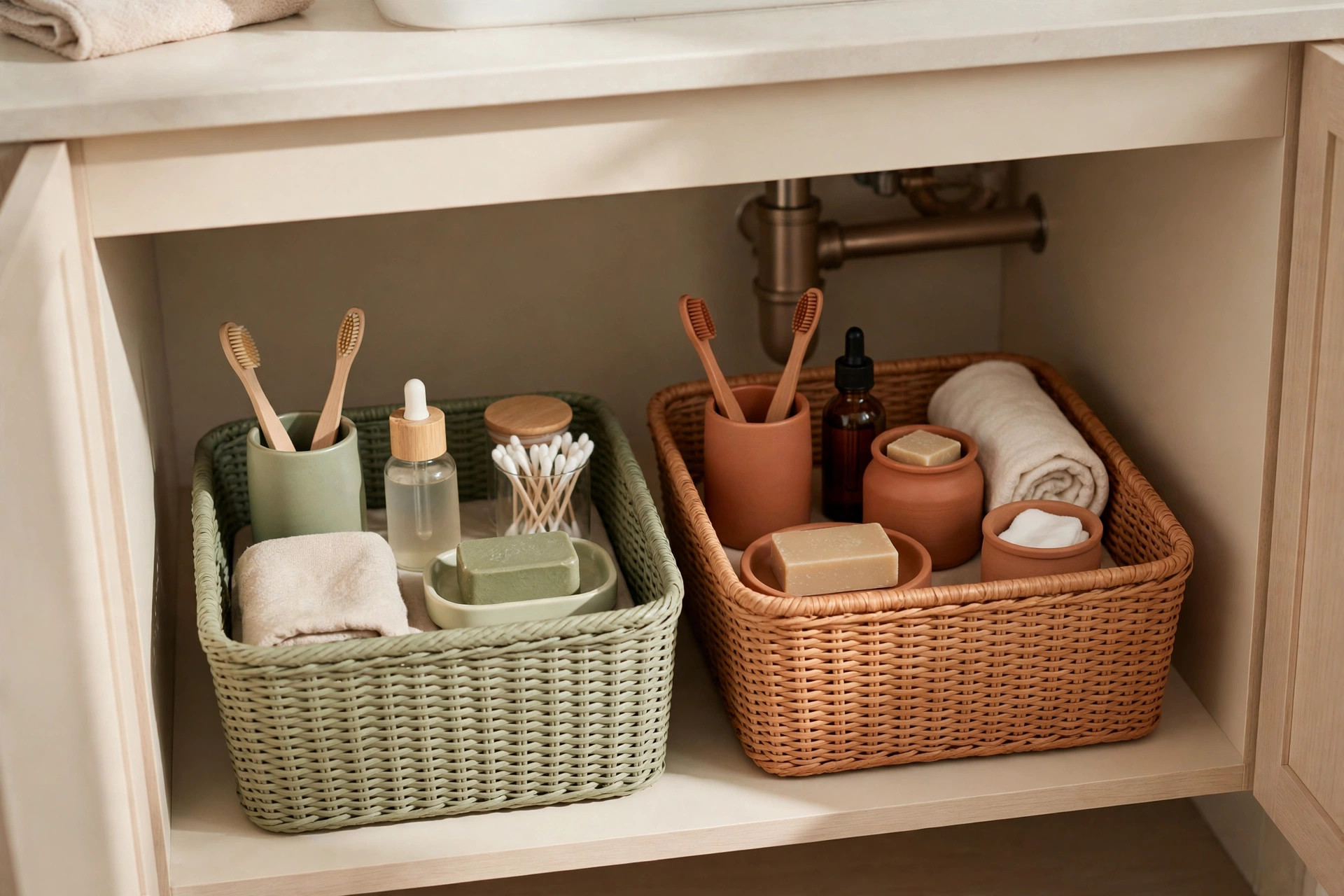
11. Give each person a labeled bin under the sink
Measure the inside of your under-sink cabinet first, because the pipes steal more space than you expect. Then fit one stackable bin per person, roughly 10 by 6 by 6 inches, plus one narrow shared bin for cleaning supplies. Label each bin with the person’s name and keep only that person’s backup stock inside — refills, extra contact lens solution, spare razors.
12. Add a tension rod and a pull-out tray inside the cabinet
A spring tension rod fitted horizontally across the cabinet, about 6 inches below the top, holds spray bottles by their triggers and frees the floor of the cabinet for bins. Pair it with a small pull-out tray on the cabinet floor so nothing gets lost at the back. If you cannot reach it without emptying the front, you will never use it.
The towel system: color-coded and always dry
Nobody knows which towel is theirs, damp towels pile up on the floor, and the rail never has enough space. A color-coded system with a drying rule solves all three problems at once.
13. Assign one towel color per person and stick to it
Buy two bath towels and two hand towels per person, all in that person’s color — sage for one, terracotta for another, navy for a third. Color-coding removes every “is this mine?” conversation, and it makes it obvious who left their towel on the floor. Our guide to 16 Small Bathroom Towel Storage Ideas That Keep Towels Dry and Handy has more drying and folding systems for bathrooms with limited rail space.
14. Give every towel a drying spot with airflow
A towel that cannot dry will smell within a day, no matter whose it is. If the rail is full, add adhesive hooks on the back of the door or a small over-the-door towel bar so each towel hangs flat with air on both sides — never folded over another towel. In a windowless bathroom, crack the door after showers or run the extractor fan for 20 minutes.
The nightly 2-minute shared reset
No system survives without maintenance — but shared bathrooms need only two minutes a night, done by whoever showers last or on a rotating schedule.
15. Run a 2-minute reset every night before bed
Set a phone alarm for the same time each night. The reset is simple: each person returns their caddy to their room, wipes the counter with a damp cloth, hangs their towel on their own hook, and puts any stray item back in its labeled zone. Two minutes is genuinely enough when the system is in place, because there is nothing to decide — everything already has a home.
16. Do a weekly 10-minute zone check on Sundays
Once a week, spend ten minutes checking the system itself: are the labels still readable, is anyone’s bin overflowing, has a product migrated to someone else’s shelf? Toss empties, move strays back, and restock the shared bin with toilet paper and hand soap. If a zone keeps failing — a shelf that is always cluttered, a hook nobody uses — change the zone, not the person. The system should fit the people, not the other way around.
Mistakes to avoid in a shared bathroom
The most common mistake is buying storage before agreeing on the system. A beautiful set of matching baskets will not help if nobody knows whose basket is whose. Agree on zones and labels first, then buy containers to fit.
The second mistake is the “shared” shelf — one shelf where everyone puts their daily products. It always becomes one person’s shelf within a month. There is no truly shared shelf in a bathroom; there are shared supplies (soap, toilet paper, cleaning products) and personal zones. Keep them separate.
The third mistake is buying oversized organizers. A 12-inch-wide bin in a 10-inch cabinet, a three-tier shelf that blocks the mirror, a caddy too tall for the cabinet door to close — measure twice, buy once. And skip the matching-set trap: identical bins look tidy in the store, but identical bins are exactly what make a shared bathroom confusing.
Frequently asked questions
How do you organize a bathroom shared by three or more people?
Give each person a caddy and a labeled zone, plus a second tier of storage — an over-the-door organizer or a narrow rolling cart — so zones do not shrink to nothing. Cap each person at three shower products and two towels, and rotate the nightly reset.
Can a shared bathroom stay organized without drilling holes?
Yes. Adhesive hooks, suction shower caddies, over-the-door racks, tension rods, and freestanding caddies cover almost every need without a drill. The caddy system itself needs no mounting at all.
What is the best way to stop counter clutter in a shared bathroom?
Remove everything from the counter except what is actively in use. Daily products live in each person’s caddy in their own room; the counter holds only the caddy in use plus shared hand soap. A nightly 2-minute reset keeps the rule from slipping.
How do you share a small bathroom with different morning schedules?
Stagger by 15 minutes: the first person showers with their caddy, then clears the counter for the next. A small mirror in the bedroom or hallway lets the second person do makeup or hair outside the bathroom, cutting the morning bottleneck in half.
How many towels should each person have in a shared bathroom?
Two bath towels and two hand towels per person — one in use, one in the wash. Color-code them, and give each towel its own hook or rail space so it dries fully between uses.
The takeaway
A shared bathroom does not need more space. It needs clear ownership: one caddy per person, one labeled zone per person, one towel color per person, and a nightly reset that takes two minutes. Start with the audit, assign the zones, and let the system do the arguing for you. Save this pin for later, and browse more ideas in our small-spaces category when your next shared room needs the same treatment.