A bike leaning against the hallway wall eats floor space, blocks the door, and leaves tire marks on the paint. In a small apartment with no garage, that daily obstacle course is the real problem — not the bike itself. Here are 15 bike storage ideas small apartment living actually makes room for, from wall mounts and ceiling hoists to freestanding stands and renter-safe tricks that leave zero holes. Pick the one that fits your wall, your ceiling, and your lease, and your bike stops being clutter. Whether you ride every day or only on weekends, the right spot means no more tripping over wheels, no more grease on the floor, and a bike that is ready to grab and go.
Measure first: your bike, your wall, your door swing
Every good bike setup starts with a tape measure, not a shopping cart. A standard adult bike is roughly 68 to 72 inches long. A horizontal wall mount needs a clear wall at least that wide; a vertical mount needs about 24 inches of width but roughly 6 feet of ceiling height. Measure the bike’s length, handlebar width, and the pedal that sticks out furthest — that pedal is what scrapes walls and catches sleeves.
1. Map the bike zone before you buy anything
Tape out the footprint on the floor with painter’s tape: the bike’s length and width, plus 12 inches of clearance for walking past it. Live with the outline for a day. If you keep stepping on it, that spot is wrong — and you learned it for free instead of after drilling holes. Also check the wall for a stud and open every nearby door fully, so a hanging bike never blocks a door swing.
Wall mounts: horizontal vs vertical hanging
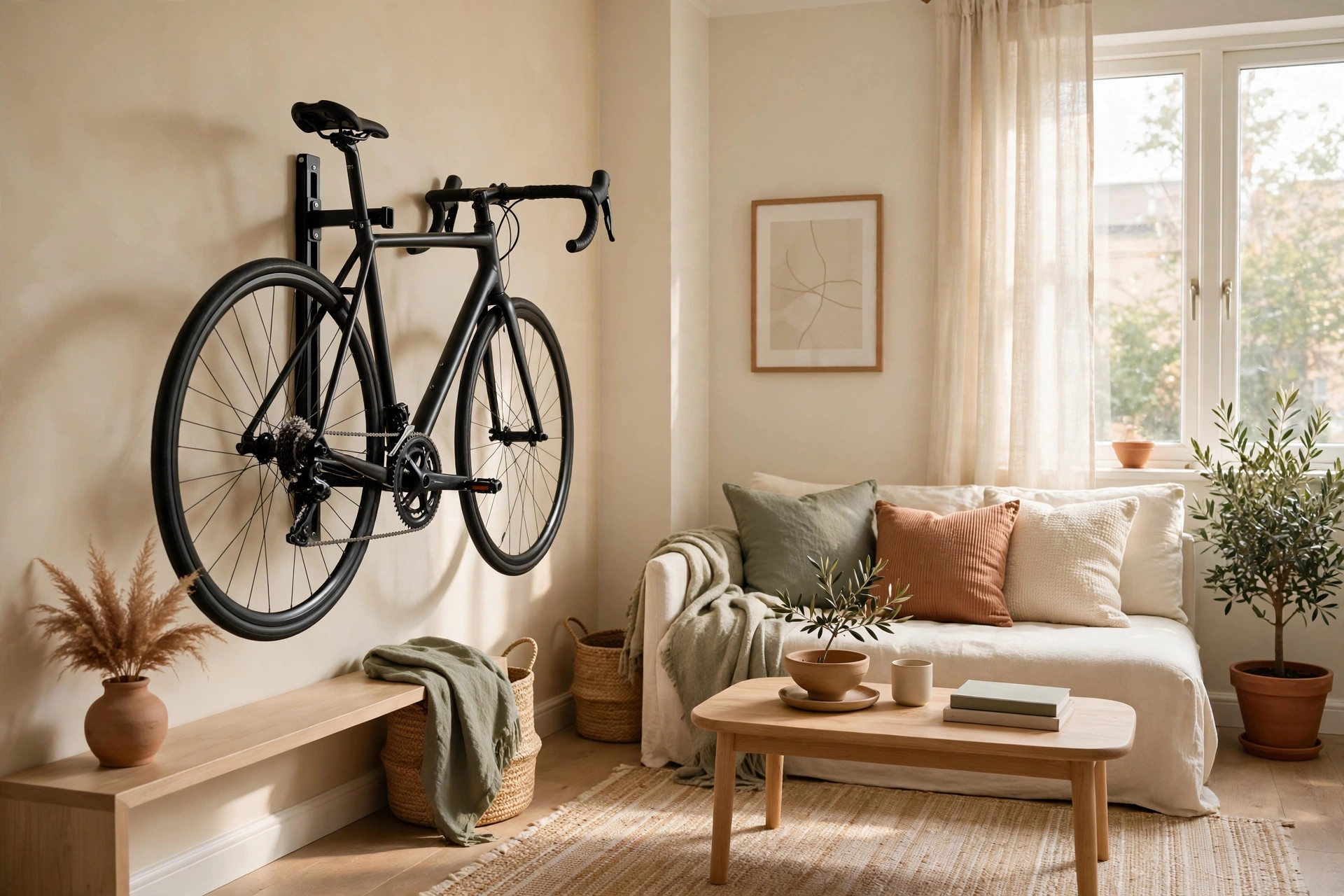
Wall mounting is the most popular indoor bike storage idea for a reason: it gets the bike completely off the floor and uses wall space that was doing nothing. Horizontal mounts hold the bike parallel to the wall, like a picture on its side. They look tidy but need a long, clear wall. Vertical mounts hold the bike upright by its front wheel and need far less wall width, but enough ceiling height for the bike’s full length.
2. Hang it horizontally on a long, clear wall
A horizontal wall mount with two padded arms cradles the top tube and holds the bike flat against the wall. Mount it so the wheels sit about 12 to 18 inches off the floor — high enough to sweep underneath, low enough to lift the bike on and off without a struggle. This works best where one long wall is free.
3. Hang it vertically to save wall width
A vertical hook or rail mount grabs the front wheel and lets the bike stand upright, taking up about as much width as a coat rack. This is the answer for narrow hallways and the strip of wall beside a door. Add a small adhesive felt pad where the tire touches the wall to stop scuff marks. For more ways to claim height instead of floor space, see these vertical storage ideas for small apartments.
Ceiling hoists for high ceilings and tall rooms
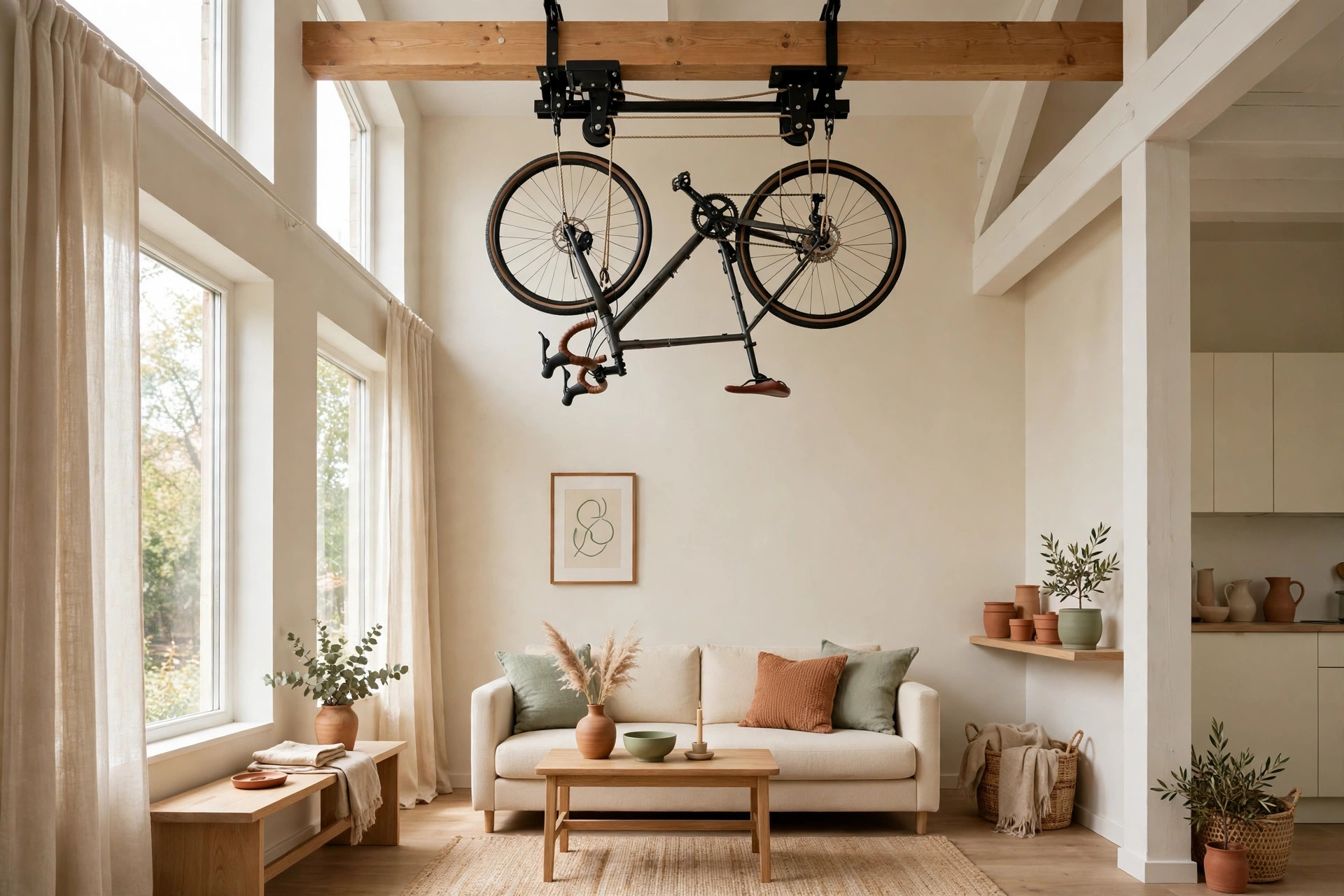
If your ceilings are 9 feet or higher, the ceiling is the most underused storage surface in your apartment. A ceiling hoist lifts the bike flat above head height, out of the way entirely. This suits a bike you ride a few times a week rather than daily, because hoisting takes a few seconds longer than grabbing a bike off a wall hook.
4. Install a pulley hoist for a seasonal or second bike
A pulley hoist uses two hooks — one under the saddle, one under the handlebars — connected by rope and pulleys to a wall cleat. Pull the rope, the bike rises flat to the ceiling, and you tie off the rope. It costs little, holds the bike level, and frees an entire wall. Reserve this spot for the bike you ride least.
5. Use fixed ceiling hooks for a bike you ride weekly
Two heavy-duty ceiling hooks screwed into ceiling joists, spaced to match your bike’s frame, hold it upside down by its wheels or frame. This is simpler and cheaper than a pulley system, but you lift the bike’s full weight overhead each time, so it suits lighter bikes. Test the joist location with a stud finder first, and never trust a hook in plasterboard alone.
Freestanding stands that don’t touch the walls
Not every apartment allows drilling, and not every wall has a usable stud. Freestanding stands solve both problems: they hold the bike upright on the floor, they move when you rearrange, and they leave the walls untouched. Their trade-off is floor space, so pair one with a corner or a strip of dead space beside furniture.
6. Park it in a two-bike gravity stand
A gravity stand leans against the wall and uses the bike’s own weight to stay stable, with arms that hold one bike above another or two side by side. It needs no screws and assembles in minutes. Measure your ceiling before buying a two-tier version: the top bike needs its full height plus clearance to lift it on and off.
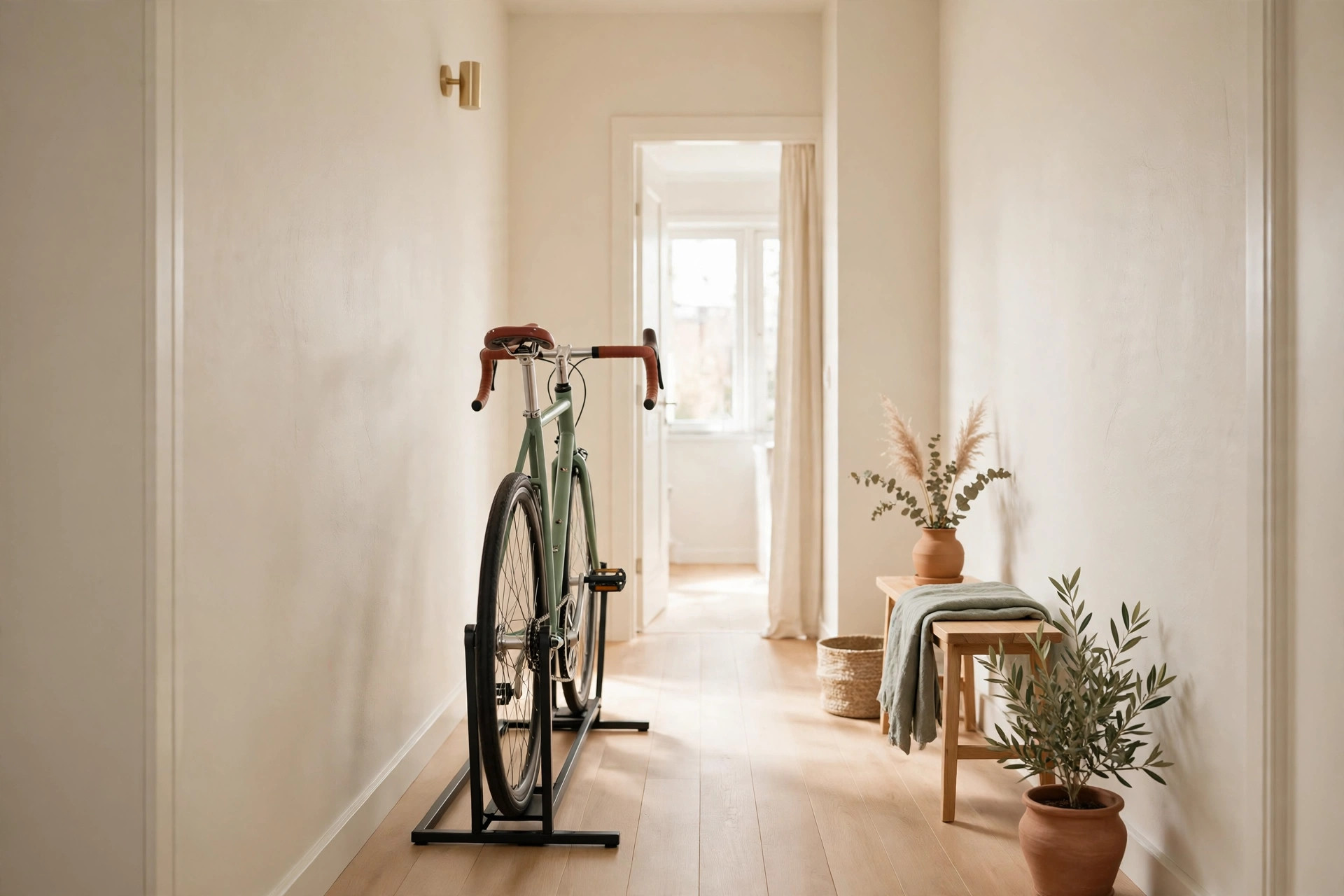
7. Use a single vertical floor stand by the door
A vertical floor stand grips the rear wheel and holds the bike upright in about 2 square feet of floor. Place it in the dead space beside the front door or at the end of a hallway, so the bike is parked the moment you walk in. Check that the front wheel clears any nearby light switch or thermostat.
Balcony and hallway bike storage rules
Balconies and shared hallways look like free storage, but both come with rules. A balcony exposes the bike to rain, sun, and temperature swings, which wear tires, rust chains, and fade paint. A shared hallway is often a fire escape route, and many buildings ban storing anything there. Check your lease and building rules before either option, and never block a shared corridor.
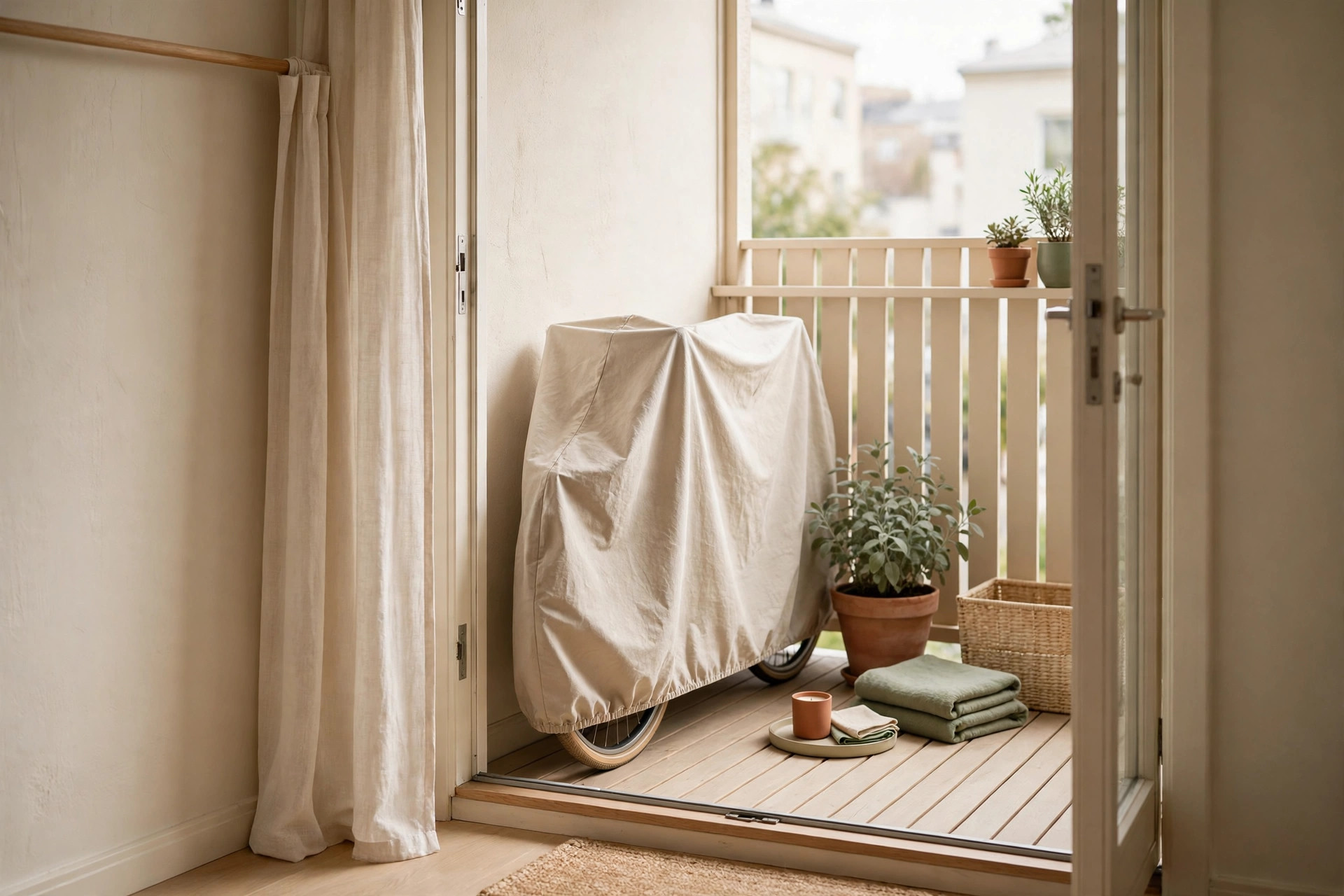
8. Give a balcony bike a cover and a vertical rail mount
If your balcony is your only option, mount the bike vertically on the balcony wall with a weather-rated mount and cover it with a fitted bike cover. The cover is non-negotiable: uncovered outdoor storage ages a bike in a single season. Keep the chain lightly oiled and bring the bike inside during storms. For weatherproofing the rest of your outdoor gear, these apartment balcony storage ideas cover sealed containers and renter-safe setups that survive real weather.
9. Claim a hallway nook instead of the hallway itself
A recess beside your front door, the wall under a staircase, or the end of your own entry hallway can hold a vertical stand without blocking anyone’s path. The rule is simple: if a neighbor, a stroller, or a firefighter could not pass comfortably, the spot is not yours to use.
Renter-safe options that leave zero holes
Renter-friendly bike storage relies on grip, tension, and gravity rather than screws. The best no-drill options hold a bike securely without touching the wall at all, or use removable adhesive rated for the load — and you should be honest about that rating, because a bike weighs far more than a picture frame.
10. Set up a tension pole rack between floor and ceiling
A tension pole rack presses between the floor and ceiling and carries two or four bike arms that slide to any height. No holes, no adhesive, and it moves with you to the next apartment. It needs a flat ceiling and a solid floor, and you should check the tension monthly, since poles can settle slightly over time.
11. Lean on a freestanding rack and adhesive wheel guards
Combine a freestanding floor stand with removable adhesive pads where tires or handlebars meet the wall. The stand does the holding; the pads only prevent scuffs. Skip adhesive hooks for the bike itself: most are rated for a few pounds, and a 25 to 35 pound bike will peel them off the wall, usually at night.
Keeping floors clean: trays, mats, and quick wipe-downs
A bike brings the street inside: wet tires, mud, chain grease, and grit that grinds into wood floors. The fix is a parking spot with a defined floor, not a bigger doormat. Every bike in a small apartment deserves a tray or mat under its wheels, plus a quick wipe-down routine after wet rides.
12. Park both wheels on a boot tray or rubber mat
A boot tray or rubber-backed mat at least as long as your bike’s wheelbase catches drips and mud before they reach the floor. Choose one with a raised lip so water stays in the tray, and empty it after rainy rides instead of letting it turn into a puddle. For vertical storage, a smaller tray under the rear wheel plus a wall pad where the tire rests does the same job in less space.
13. Build a 60-second wipe-down station
Hang a rag and a small spray bottle of diluted all-purpose cleaner beside the bike’s parking spot. After a wet or muddy ride, wipe the tires, the frame’s lower tubes, and the chain area before the dirt dries. Sixty seconds now saves a floor scrub later, and it keeps grit off your hands the next time you grab the bike.
The daily-grab setup: helmet, lock, and lights in one spot
The best bike storage fails if the accessories live somewhere else. A daily-grab setup puts your helmet, lock, lights, and gloves within arm’s reach of the bike, so leaving the apartment takes one stop instead of four. This is where a small entryway zone earns its keep.
14. Hang helmet, lock, and lights on one entry hook rail
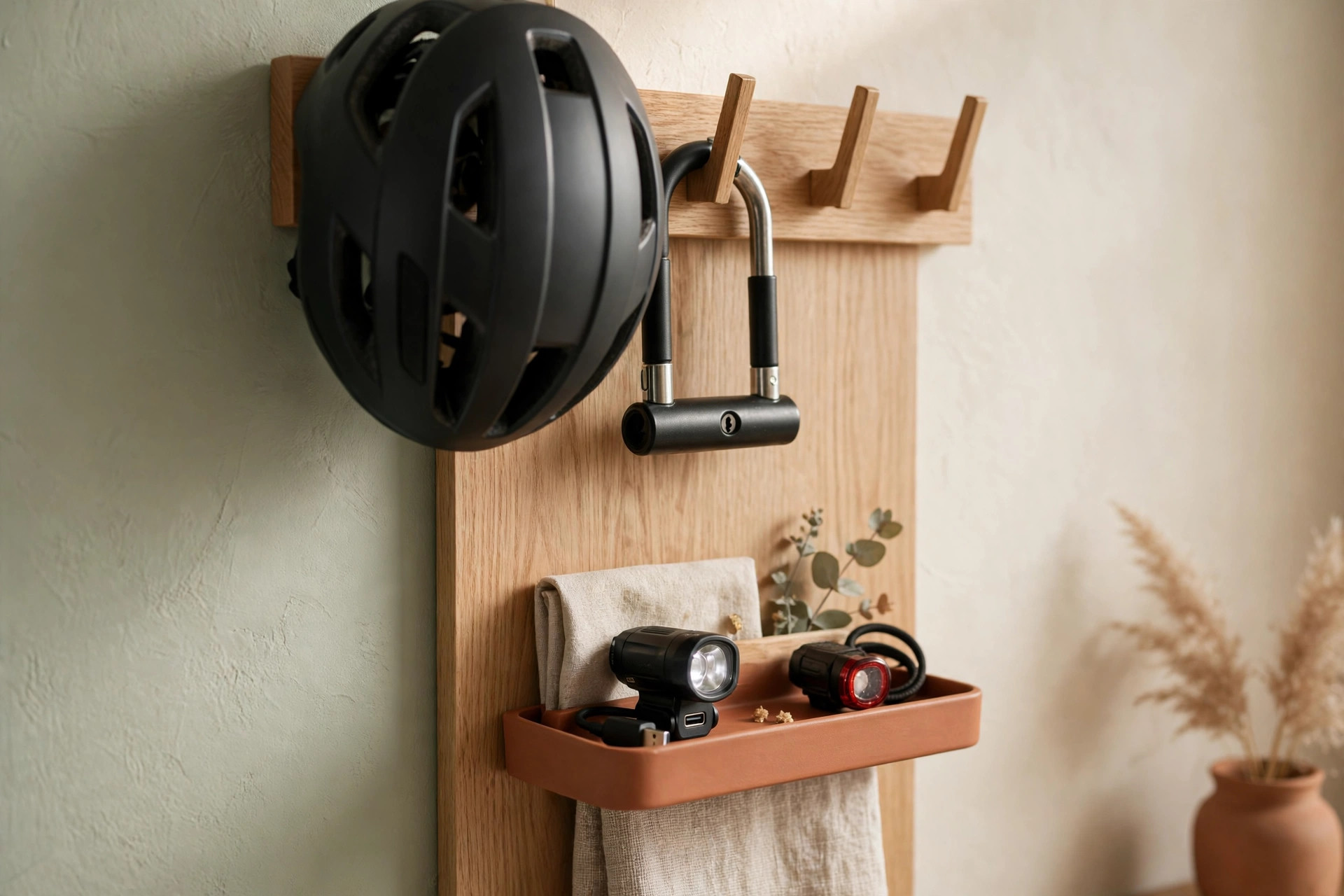
Mount a small hook rail, adhesive strip, or over-the-door hooks beside the bike’s parking spot: one hook for the helmet, one for the lock, one for a bag holding lights and gloves. Hanging the lock by its shackle keeps it from scratching the wall. This is the same catch-and-contain idea behind these small mudroom ideas for apartments, scaled down to one bike and one rider.
15. Dock rechargeable lights by the door every night
Rechargeable bike lights die at the worst moment: halfway home, in the rain. Keep a small charging tray or USB strip on the entry shelf where the lights live, and plug them in the moment you get home. Making charging part of arriving — not a separate chore — means the lights are always ready, and the routine takes five seconds.
Mistakes to avoid
The most common bike storage mistakes are not about buying the wrong product; they are about skipping the measurements and the lease check. Do not mount a heavy bike into bare drywall, hang a bike over a walkway or bed, or store a bike in a shared hallway that doubles as a fire escape. Do not buy a stand before measuring the bike’s length and ceiling height, and do not assume a balcony is weatherproof just because it has a roof — wind-driven rain reaches further than you expect.
Frequently asked questions
Can I store a bike in a small apartment without drilling holes?
Yes. Freestanding floor stands, gravity stands, and tension pole racks all hold a bike securely with no drilling and no wall damage.
How much wall space does a wall-mounted bike need?
A horizontally mounted bike needs a clear wall about as long as the bike itself, roughly 68 to 72 inches, plus room to lift it on and off. A vertically mounted bike needs only about 24 inches of wall width but roughly 6 feet of ceiling height.
Is it okay to store a bike on a balcony?
It is okay only with protection and permission. Check your lease and building rules first, then use a weather-rated mount and a fitted cover, and bring the bike inside during storms. An uncovered bike left outside will rust, fade, and wear out far faster than one stored indoors.
What is the best bike storage for renters?
For most renters, a freestanding vertical stand or tension pole rack is the best starting point: no holes, no landlord dispute, and both move to your next apartment.
How do I keep bike tires from marking my walls and floors?
Put a tray or rubber mat under the wheels, add adhesive felt pads where tires touch the wall, and wipe tires after wet rides.
Conclusion
A bike in a small apartment does not have to mean a blocked hallway or a scuffed wall. Measure first, choose one system that fits your space and your lease — a wall mount, a ceiling hoist, or a freestanding stand — and give the helmet, lock, and lights a home beside it. Save this pin for later, or browse more small-space storage ideas for the rest of your apartment.