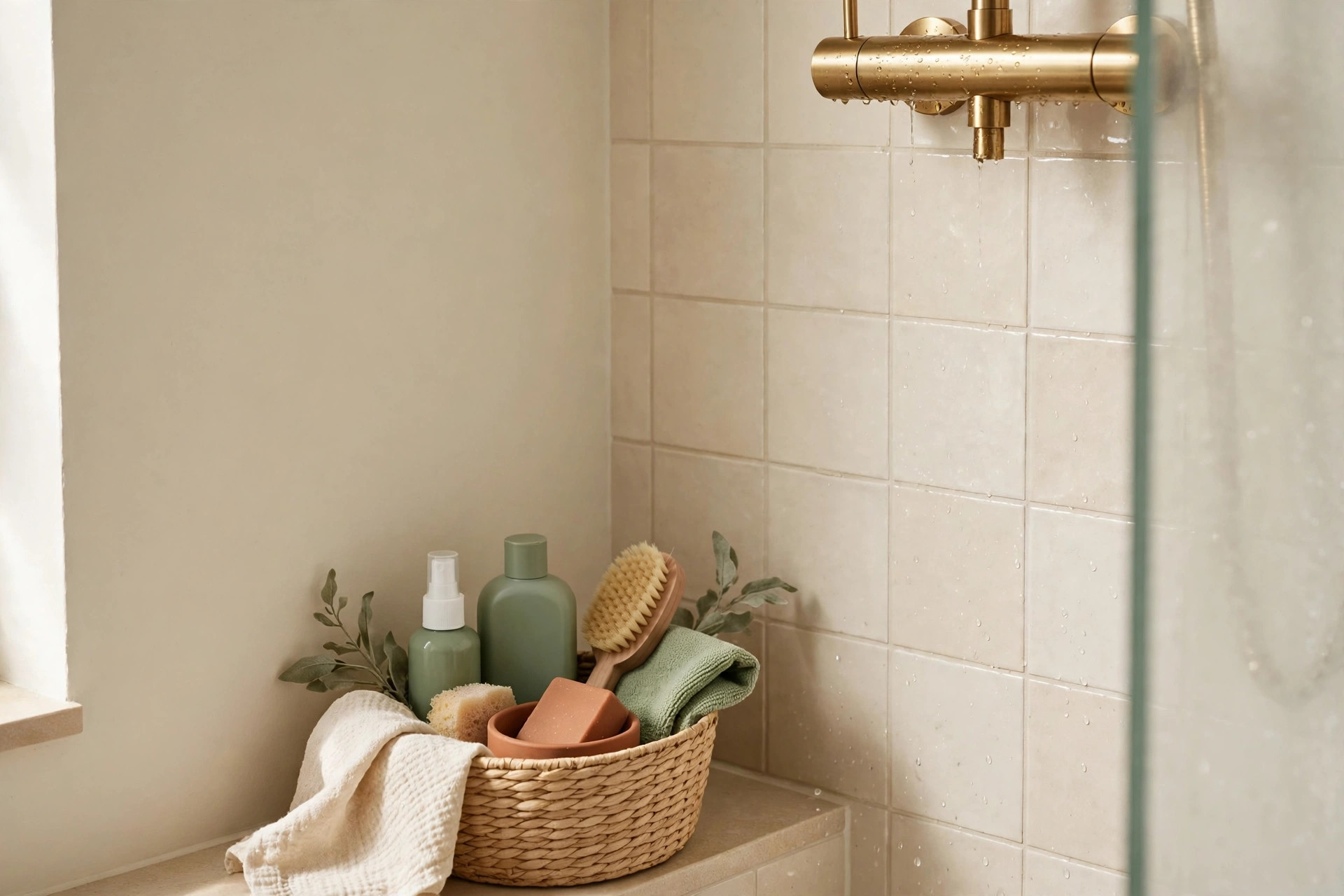
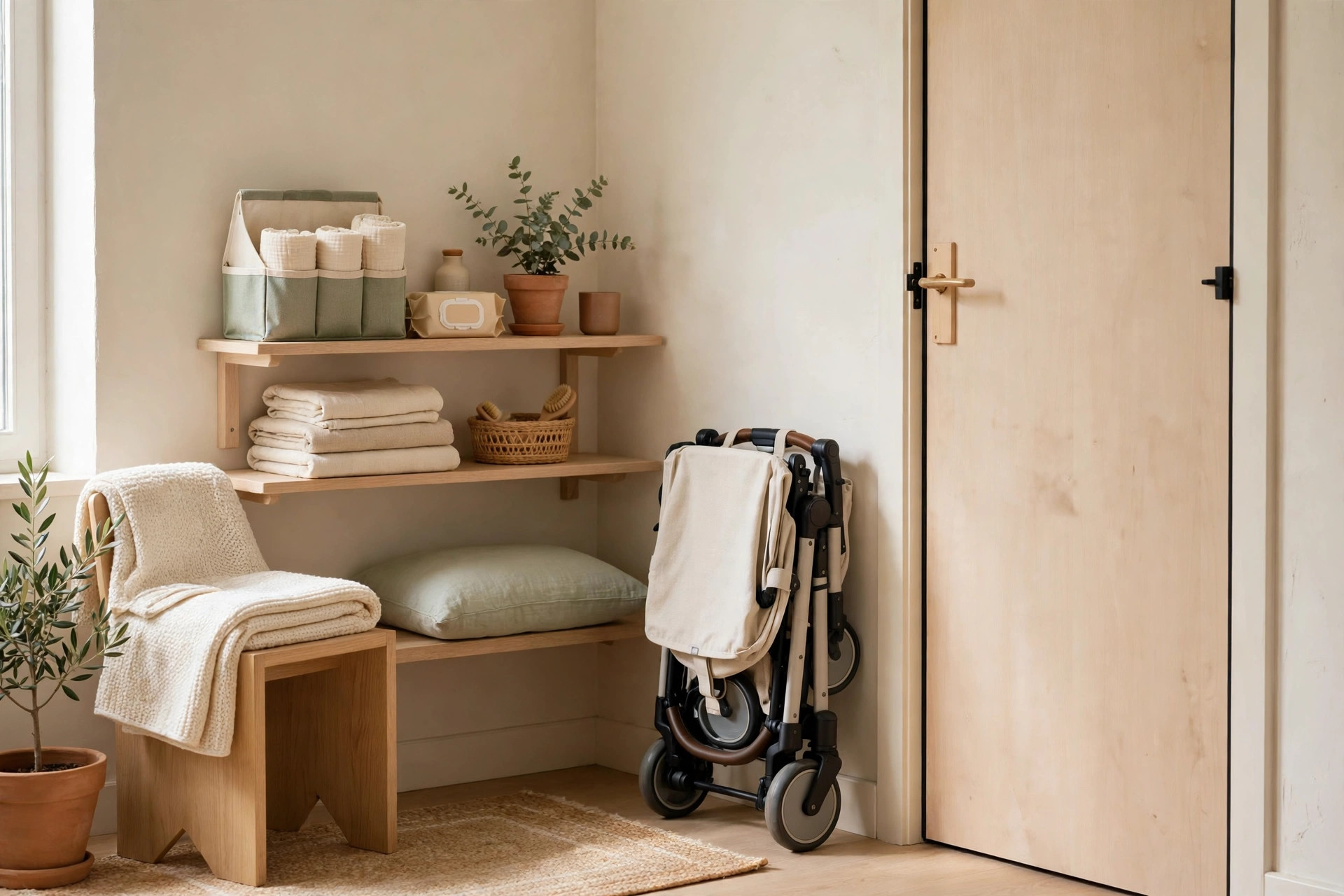
A small shower turns chaotic fast. Bottles crowd the tub ledge, the razor slides into a corner, and someone always knocks a bottle over mid-shower. With no shelf and no drilling allowed, everything ends up balanced on edges that were never meant to hold it. These are the shower storage ideas small bathroom owners actually stick with, and they need no holes in the tile: hanging caddies, tension poles, suction shelves, and one-caddy-per-person systems that keep every bottle upright, reachable, and easy to clean.

The shower audit: what actually needs to live in the shower
Most small showers hold twice as many products as anyone uses in a week: half-empty bottles, hotel samples, three conditioners, and a razor nobody remembers buying. No caddy fixes a collection that is too big for the space, so audit first.
1. Keep only the daily-use seven
Count what one person genuinely uses every shower: shampoo, conditioner, body wash, face wash, a razor, and one or two treatments such as a scrub or hair mask. That is six or seven items. Everything else — backup bottles, monthly treatments, specialty products — moves to a bin under the sink or in a linen closet. If a product has not been used in two weeks, it does not earn shower space.
2. Give every bottle a home before you buy a caddy
Measure your tallest bottle, usually a shampoo bottle at about 9 to 10 inches, and the width of your shower’s usable wall space. A caddy with 4-inch-deep baskets swallows standard bottles but not jumbo salon sizes, and a tension pole needs a flat ceiling-to-floor run of about 7 to 8 feet. Keep the numbers on your phone before shopping — the same measure-first rule behind our 18 Small Bathroom Storage Ideas That Make a Tiny Bathroom Work Harder.
Over-showerhead and hanging caddies: what holds up
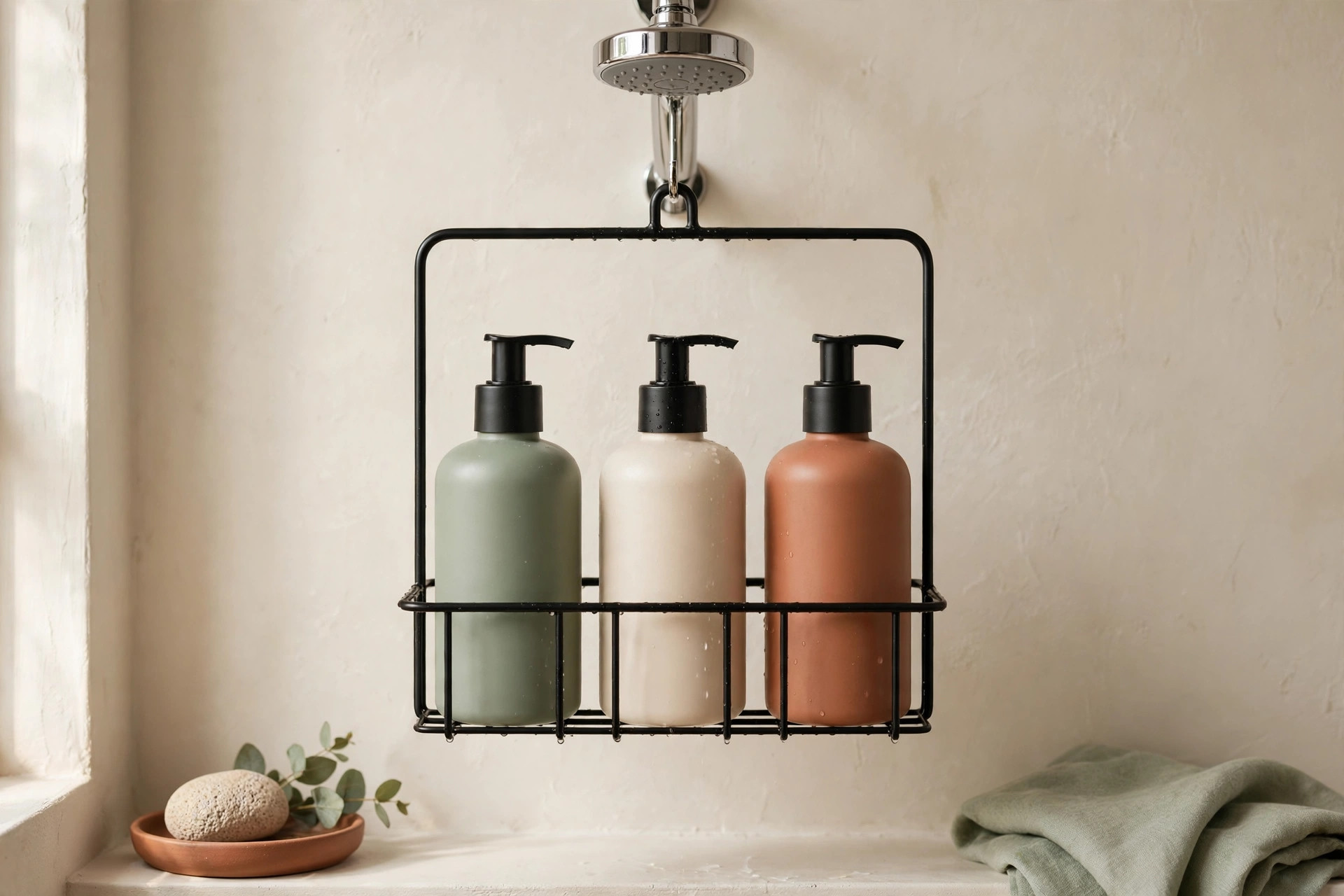
The over-showerhead caddy is the fastest fix in a small bathroom because it uses dead space: the pipe already sticks out of the wall, and the caddy hangs from it. No suction, no adhesive, no drilling, and it moves with you when you move out. The trade-off is weight and balance, so choose by construction, not by looks.
3. Choose a rust-proof over-showerhead caddy with a stable hook
Look for stainless steel or coated aluminum, not chrome-plated wire that rusts at the joints within a few months. The hook should grip the shower arm firmly rather than sliding, and the caddy should have two baskets: a deeper one of about 4 inches for tall bottles and a shallower tray for a razor and soap. Hang it so the bottom basket clears the showerhead spray by a couple of inches, or it will collect standing water.
4. Add a hanging mesh caddy for the overflow
If the over-showerhead baskets are full, a hanging mesh caddy hooked over the showerhead pipe adds a second tier without another fixture. Mesh drains fast, which matters for loofahs and washcloths that stay damp in solid baskets. Keep it light, though: one or two bottles plus a sponge is the limit. Overloaded hanging caddies swing, drip on the bather, and slide off the pipe at the worst moment.
Tension poles: floor-to-ceiling storage that renters love
A tension pole wedges between the tub edge or floor and the ceiling with a spring mechanism, creating four adjustable shelves in a corner that otherwise holds nothing. It is the highest-capacity no-drill option, and it leaves zero marks when removed.
5. Install the pole in the corner opposite the showerhead
Place the pole in the corner farthest from the spray so bottles stay reachable but not constantly blasted with water. Extend it until snug, then give it a firm tug: it should not shift at all. Put the heaviest items — full shampoo and conditioner bottles — on the lowest shelf, where the pole is most stable. A pole rated for roughly 20 pounds handles a full household’s daily products with room to spare.
6. Assign one shelf per person on a shared pole
In a shared bathroom, label shelves by person, not by product type. Each person gets one shelf of about 12 inches of vertical space for their own bottles, razor, and soap. This ends the daily reshuffle where one person’s conditioner migrates into someone else’s spot, and it makes it obvious when a shelf is overloaded. If a shelf holds more than five or six items, that person needs their own audit from idea 1.
Corner shelves and suction storage that stay put
Suction shelves and corner units use the shower’s vertical corners, the one spot where two walls meet and bottles otherwise slide around. They work beautifully on smooth, glossy tile and glass, and they fail on textured tile, grout lines, and natural stone. Knowing your wall surface before you buy is the whole trick.
7. Test your tile before trusting any suction cup
Press a suction cup to a clean, dry tile and leave it for 24 hours with a bottle hanging from it before loading it fully. If it holds on smooth glazed tile, it will hold long term. If your tile is matte, textured, or pitted, suction will slowly lose grip and drop everything at 2 a.m. For textured walls, skip suction entirely and use a tension pole or hanging caddy instead.
8. Use a two-tier corner shelf for the products you reach for most
A two-tier corner shelf puts shampoo and body wash at hand height and conditioner and treatments one tier up, so nothing hides behind anything else. Keep bar soap on the lower tier where water drains away from it, or the bar turns to mush in a solid tray. Wipe the shelf’s drainage holes weekly; clogged holes are the number one reason corner shelves start smelling musty. This kind of vertical corner thinking also shows up in our 19 Tiny Bathroom Organization Ideas to Maximize Every Inch.
Family showers: one caddy per person that works
A family shower fails differently from a single-person shower: the problem is not the caddy, it is that four people’s products compete for the same two baskets. The fix is personal containers, not bigger shared ones. When each person owns a caddy, nobody’s bottles get knocked over by someone else’s morning rush.
9. Give each person a portable shower caddy with a handle
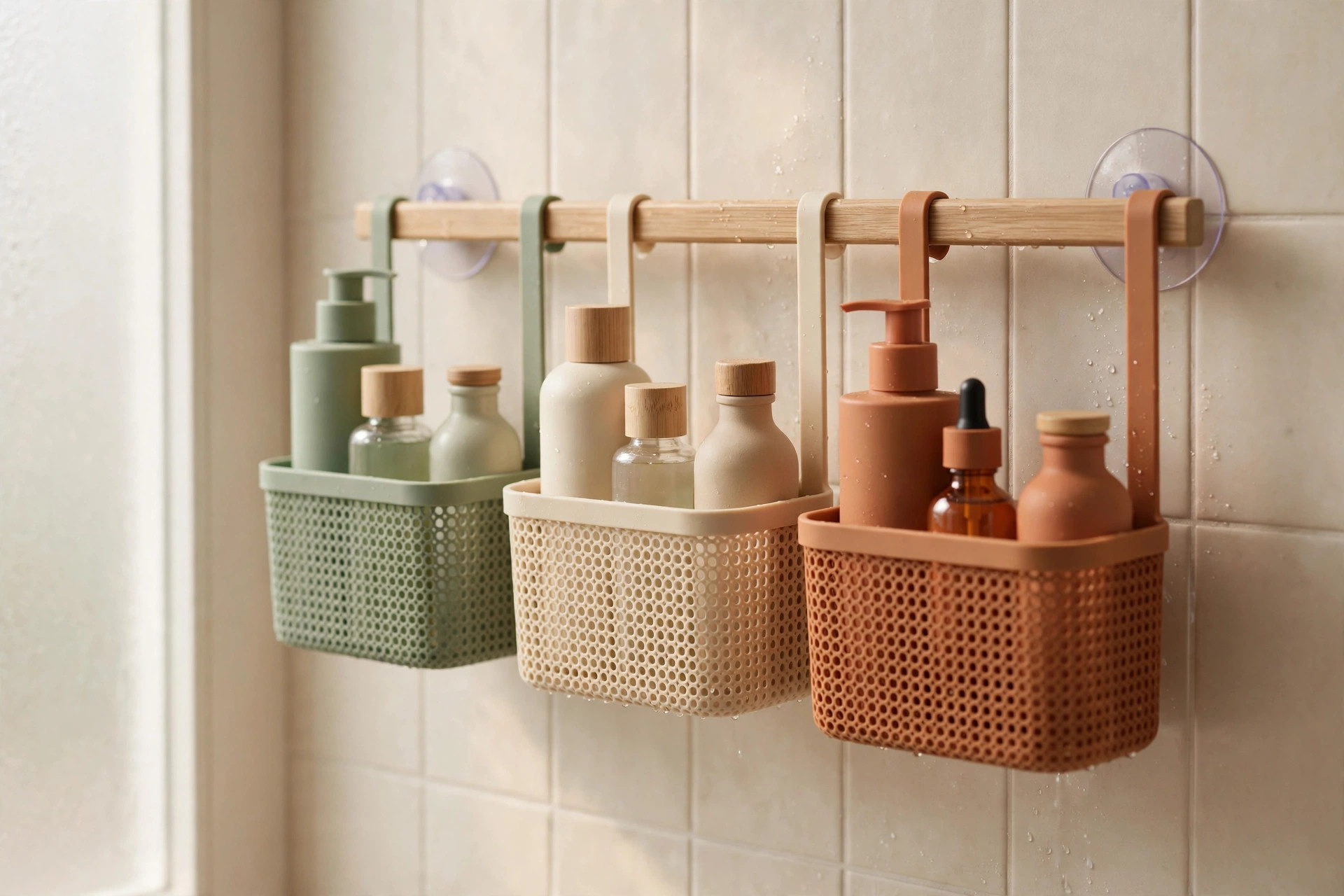
A portable caddy, about 10 inches long by 6 inches wide with a handle, lives in the shower during use and on a bathroom shelf or hook between showers. Each person carries their own set in, showers, and carries it out. This works especially well when the shower itself has almost no wall space, because the storage lives outside the shower and only visits it. Kids’ caddies should be plastic and light.
10. Color-code caddies so nobody grabs the wrong shampoo
Assign one color per person — a sage caddy for one, terracotta for another — and keep the color consistent across the caddy and the towel hook. Color-coding stops the daily “whose conditioner is this” argument and makes it instantly visible when someone’s caddy is missing from its hook. In a rental, a row of hooks on the back of the bathroom door holds the caddies without a single screw.
11. Keep one shared basket for family-only products
Not everything needs a personal caddy. Body wash the whole family shares, a single bar of soap, and the shower cleaner live in one small shared basket on the lowest tension-pole shelf or the tub ledge. One shared basket, not three, is the rule: the moment shared products multiply into two or three baskets, the personal-caddy system collapses back into clutter.
Mold and mildew: keeping shower storage clean
Shower storage gets moldy because bottles sit in standing water and nobody wipes the caddy until it smells. The caddy is not the problem; the drainage and the cleaning rhythm are. Every storage type in this article can stay clean, but only if water has somewhere to go and someone wipes it weekly.
12. Choose open, draining designs and dry the caddy weekly
Pick caddies with wire frames, mesh, or drainage holes rather than solid plastic trays that pool water. Once a week, lift every bottle out, rinse the caddy under the shower, and wipe it with a cloth. The whole job takes about two minutes and prevents the pink and black buildup that makes a caddy look dirty even when the bottles are new. Wipe flat-bottomed bottles too, since residue collects underneath them first.
13. Ventilate the shower after every use
Mold grows in still, damp air, so the cheapest mold prevention costs nothing: run the bathroom fan for about 20 minutes after showering, or crack the door if there is no fan. Leave the shower curtain or door partly open so air circulates around the caddy shelves instead of trapping humidity behind a closed curtain. The U.S. Environmental Protection Agency’s mold guidance notes that controlling moisture is the key to controlling mold indoors, and a shower caddy is no exception.

The weekly shower reset in 5 minutes
A shower stays organized only if resetting it is faster than ignoring it. The weekly reset is a five-minute routine, done on the same day each week, that returns every bottle to its home, tosses empties, and wipes the storage. It is the habit that makes all sixteen ideas stick.
14. Set a five-minute timer and work top to bottom
Start at the top shelf and work down: return stray bottles to their owner’s caddy or shelf, toss anything empty, and wipe each shelf as you pass it. Top-to-bottom matters because drips fall downward, so wiping the bottom shelf first just means wiping it again. When the timer rings, stop. A reset that regularly takes longer than five minutes means the shower holds too many products, and it is time to repeat the audit from idea 1.
15. Refill from a backup station outside the shower
Keep backup bottles in one bin under the bathroom sink or in the linen closet, not in the shower. During the reset, check each daily bottle: if it is below about a quarter full, refill it from the backup or swap in the new bottle, and put the empty in recycling immediately. This keeps the shower at its daily-use count all week and stops the classic clutter pattern of a nearly empty bottle sitting next to its full replacement. The same backup-bin logic keeps vanities tidy too, as covered in our Vanity Organization Ideas for Small Bathrooms.
16. Do a monthly swap-out of anything that has gone unused
Once a month, during the reset, pull any product nobody has touched in four weeks out of the shower and into the backup bin or the donation pile. Seasonal products, a scrub bought on impulse, a treatment that did not suit your hair — all of it leaves. This monthly swap is what keeps a sixteen-idea system at sixteen ideas instead of slowly growing into thirty bottles again. If a product comes back into the shower three months running without being used, let it go.
Mistakes to avoid: what NOT to buy
Do not buy suction cups for textured tile, adhesive hooks for a rental you will leave within a year, or a drilled corner shelf when your lease forbids holes — a lost deposit costs far more than any caddy. Do not buy a caddy sized for a single person when your household has four, and do not buy solid trays with no drainage, because standing water breeds mold faster than any other mistake on this list. Skip giant multi-tier units that block the showerhead spray or crowd the bather; in a small shower, a caddy that makes showering awkward gets ripped out within a week. Finally, do not buy a second caddy to solve an overstuffed first one. Audit first, then buy, never the other way around.
Frequently asked questions
Can you organize a small shower without drilling any holes?
Yes. Over-showerhead caddies, tension poles, suction shelves on smooth tile, and portable caddies with door hooks all work without drilling or permanent changes. The right choice depends on your wall surface and ceiling height: smooth tile suits suction, textured tile suits tension poles, and a shower with almost no wall space suits portable caddies.
How do I keep a suction shower caddy from falling down?
Clean the tile and the suction cup with warm soapy water, dry both fully, and press the cup firmly to smooth glazed tile with no grout line underneath it. Test it for 24 hours with a light load before filling it completely. If it still slips, your tile is probably textured, and a tension pole or hanging caddy will hold far better.
What is the best shower storage for renters?
A tension pole is the best all-around renter option because it holds the most, leaves no marks, and moves with you. Pair it with an over-showerhead caddy for the items you reach for most and portable caddies if the shower is shared. Avoid adhesive hooks and drilled shelves entirely in a rental, since removal damage can cost part of your deposit.
How often should I clean my shower caddy?
Wipe and rinse the caddy once a week during your regular bathroom cleaning, and do a deeper clean monthly, removing every bottle and scrubbing the frame and drainage holes. Weekly wiping takes about two minutes and prevents the mold and soap scum that make caddies look dirty and smell musty.
How many products should live in a small shower?
One person needs about six or seven daily-use products in the shower. A family of four needs roughly one small caddy per person plus one shared basket, with all backups stored outside the shower. If the count climbs past that, do a quick audit and move anything unused in two weeks back to the backup bin.
Conclusion
Sixteen ideas, zero holes, one rule: audit first, store second, reset weekly. Start with the audit, add the one storage type that fits your walls and household, and let the five-minute reset keep it working. Browse our small-spaces collection and save this pin for later.