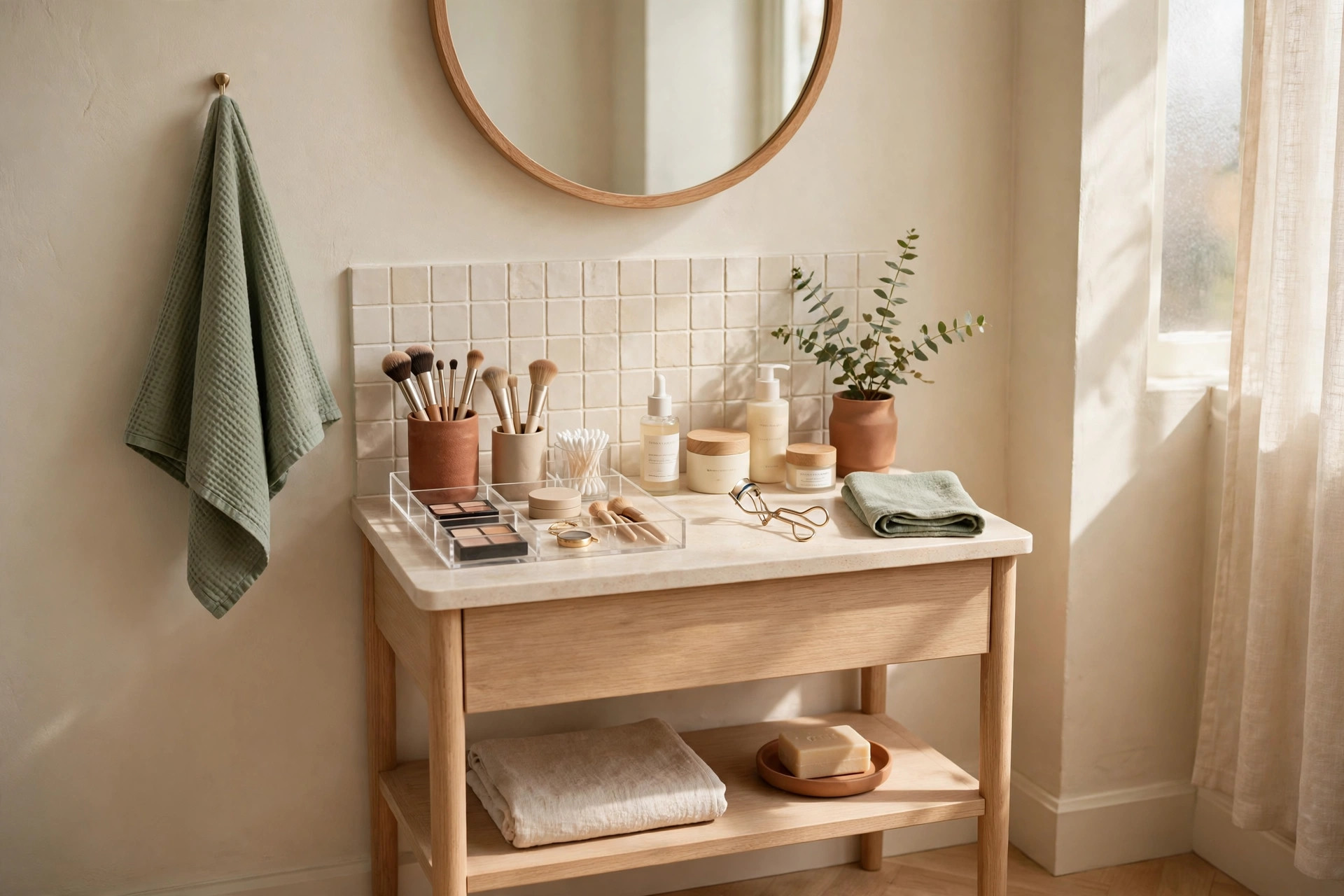
A small bathroom vanity has to do the work of a dressing table, a medicine cabinet, and a linen closet, usually on about 24 inches of counter. When every bottle lands wherever there is a gap, mornings slow down and products get lost behind each other. These vanity organization ideas small bathroom owners rely on fix that by giving every product a home sized to how often you actually use it. Below are 16 practical ideas, organized by zone.
The vanity audit: daily products vs everything else
Before you buy a single organizer, empty the vanity completely. Group everything into three piles: used daily, used weekly, and rarely or never used. Most people discover that only 8 to 12 products are true dailies, while the rest are backups, seasonal items, or things that expired quietly months ago. Dailies earn counter or top-drawer space. Everything else moves to a less convenient spot, such as a higher shelf or an under-sink bin.
1. Run the 14-day basket test. Put every product you think you use daily into a small basket for two weeks. Anything still untouched at the end of the fortnight is not a daily, no matter how much you like it. Move it to secondary storage and free the prime real estate.
2. Decant instead of duplicating. If you keep a backup bottle of the same cleanser or moisturizer, store the backup elsewhere and keep only the open bottle at the vanity. Two identical bottles side by side double the clutter without adding a single function.
Drawer inserts and small-item trays
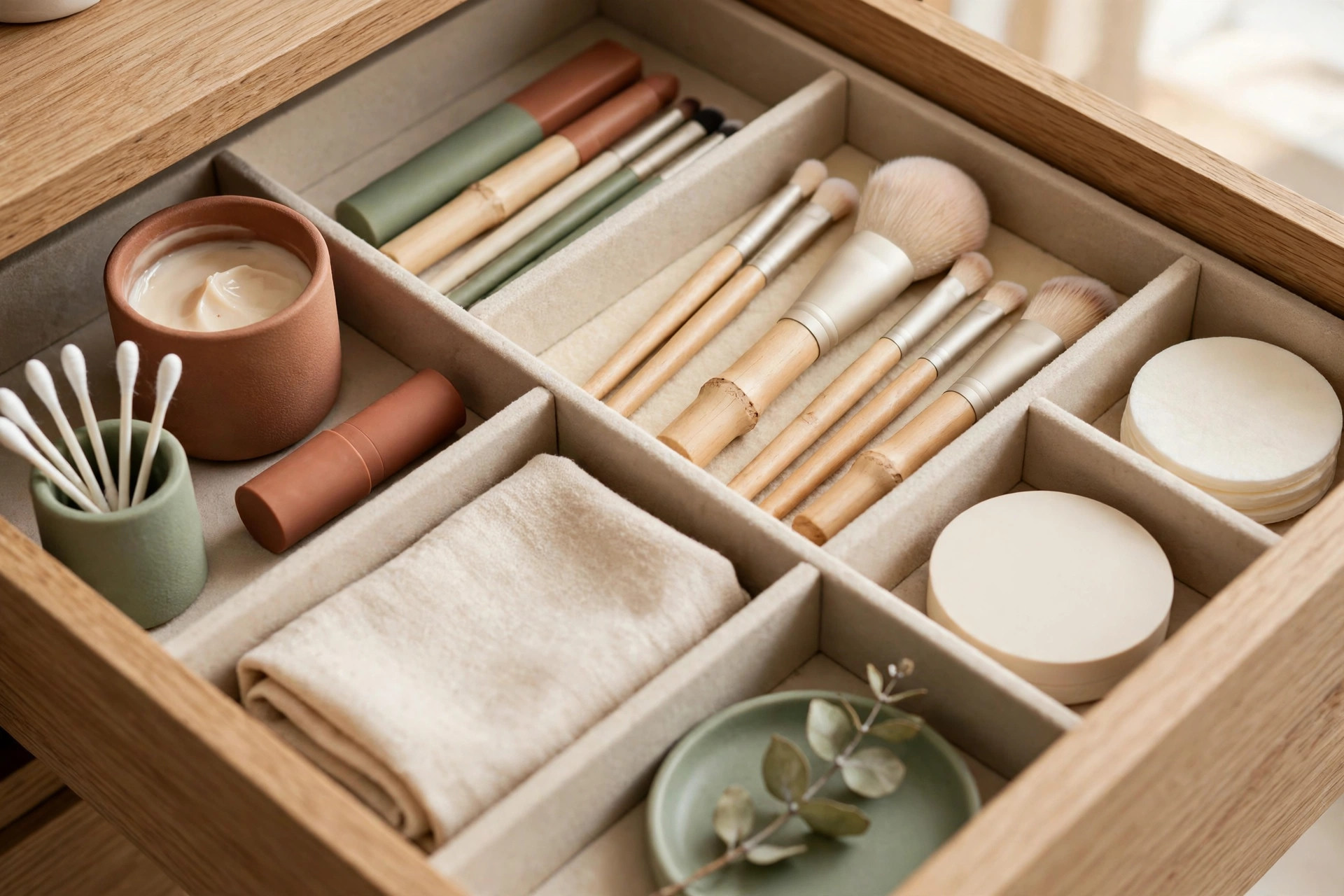
Vanity drawers fail because small items slide. A single deep drawer becomes a junk drawer within a week unless items are corralled. The fix is inserts that fit the drawer’s exact measurements, not generic bins that leave dead gaps on either side. Measure length, width, and depth before ordering anything, and remember that plumbing pipes often steal the back half of a bottom drawer.
3. Fit adjustable drawer dividers first. Spring-loaded or slide-to-fit dividers create lanes for tall bottles, tubes, and tools, and they adapt when a product changes size. Leave one lane empty on purpose so new purchases have a place to land.
4. Use small-item trays for the fiddly things. A shallow tray, roughly 6 by 4 inches, holds lipsticks upright, hair ties, bobby pins, and cotton swabs so they stop migrating to the back of the drawer. One tray per category beats one big tray for everything.
5. Stack a second level inside deep drawers. A low stacking tray sits above the drawer base and holds flat items like sheet masks, tweezers, and nail files, while taller bottles live beside it. You get two layers of storage from one drawer without digging.
If your vanity has no drawers at all, the same principle applies under the sink. Our guide to 17 Under-Sink Bathroom Storage Ideas for Tiny Vanities shows pipe-aware bins and tiered trays that work around plumbing.
Vertical storage: shelves, rails, and wall organizers
When the counter is full, the walls are your next frontier. A small bathroom usually has at least two usable vertical strips: the wall beside the mirror and the stretch above the toilet tank or beside the vanity. Wall storage works best for lightweight, frequently grabbed items, not heavy backup stock.
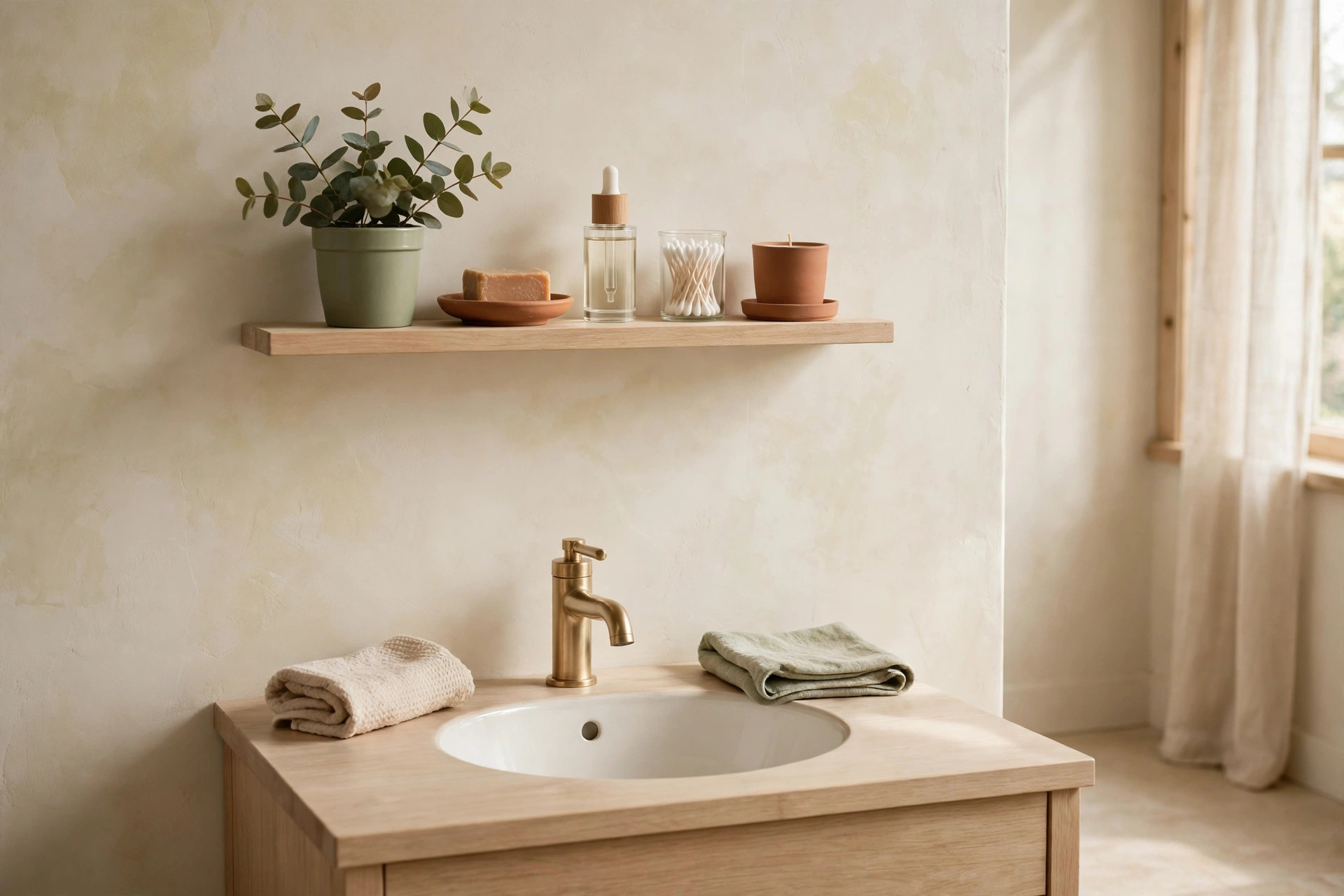
6. Add two floating shelves beside the mirror. Two shelves, each about 16 inches wide and spaced 12 inches apart, hold daily skincare at eye level and decorative jars above. Keep the bottom shelf for dailies only so you never reach past a candle to get your cleanser.
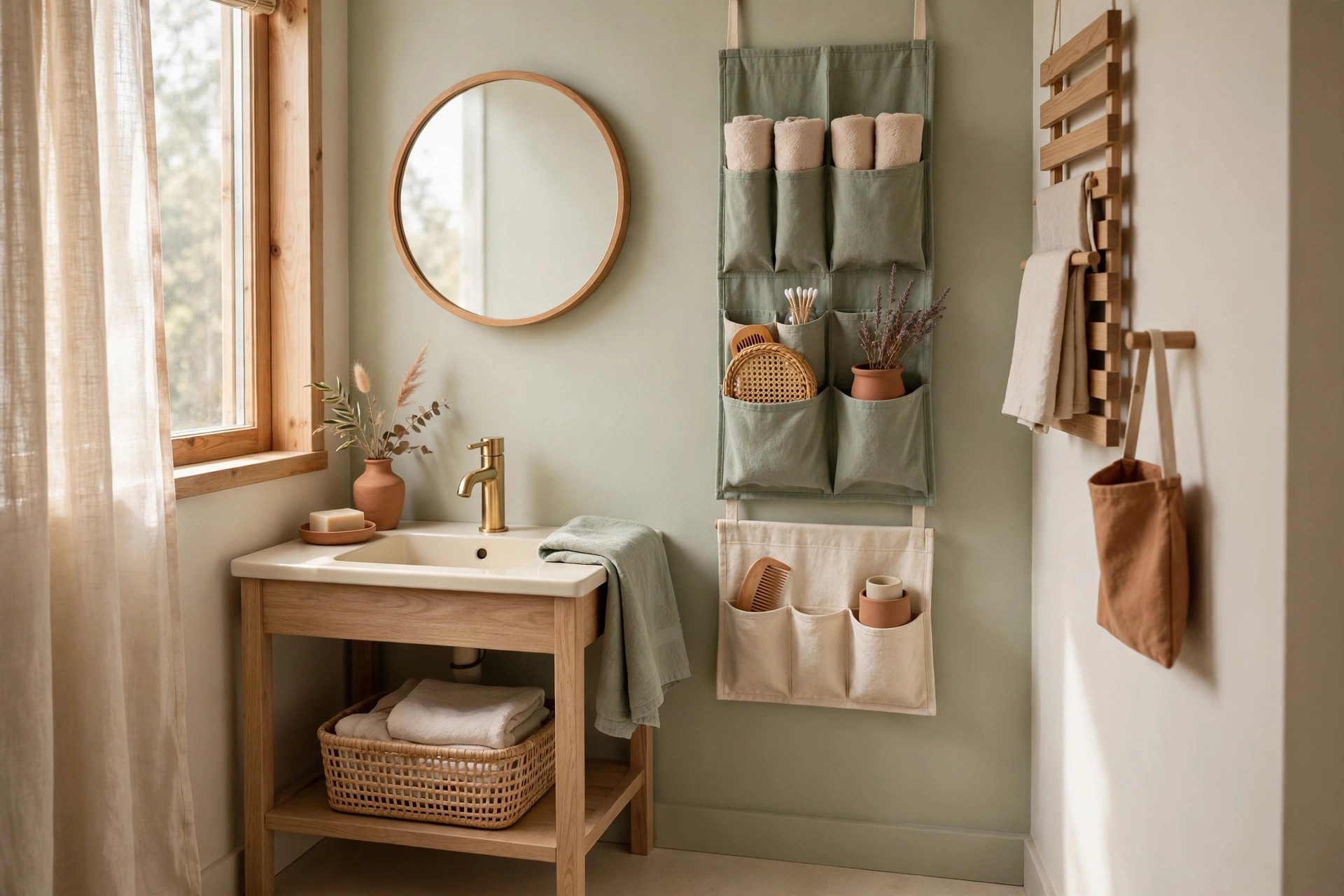
7. Hang a rail for tools and caddies. A short adhesive or screw-mounted rail on the side wall holds a hanging cup for brushes, a hook for a hair dryer holder, and a small basket for styling products. Renters should use adhesive rails rated for at least 5 pounds.
8. Mount a slim wall organizer inside the door or on a narrow wall. A fabric or clear-pocket organizer, about 12 inches wide, stores flat irons, extra cotton pads, and travel sizes without touching the counter. Keep heat tools in a heat-resistant pocket and never store a hot tool in a fabric pocket.
For the wider bathroom picture, 19 Tiny Bathroom Organization Ideas to Maximize Every Inch covers measure-first rules and vertical storage for the whole room, not just the vanity.
Counter zones: skincare, makeup, hair — in inches
The most useful small bathroom vanity storage trick is zoning the counter by task and assigning each zone a fixed width. A standard 24-inch vanity counter can realistically hold three zones if you are strict about the boundaries. When a zone creeps, the whole counter follows.
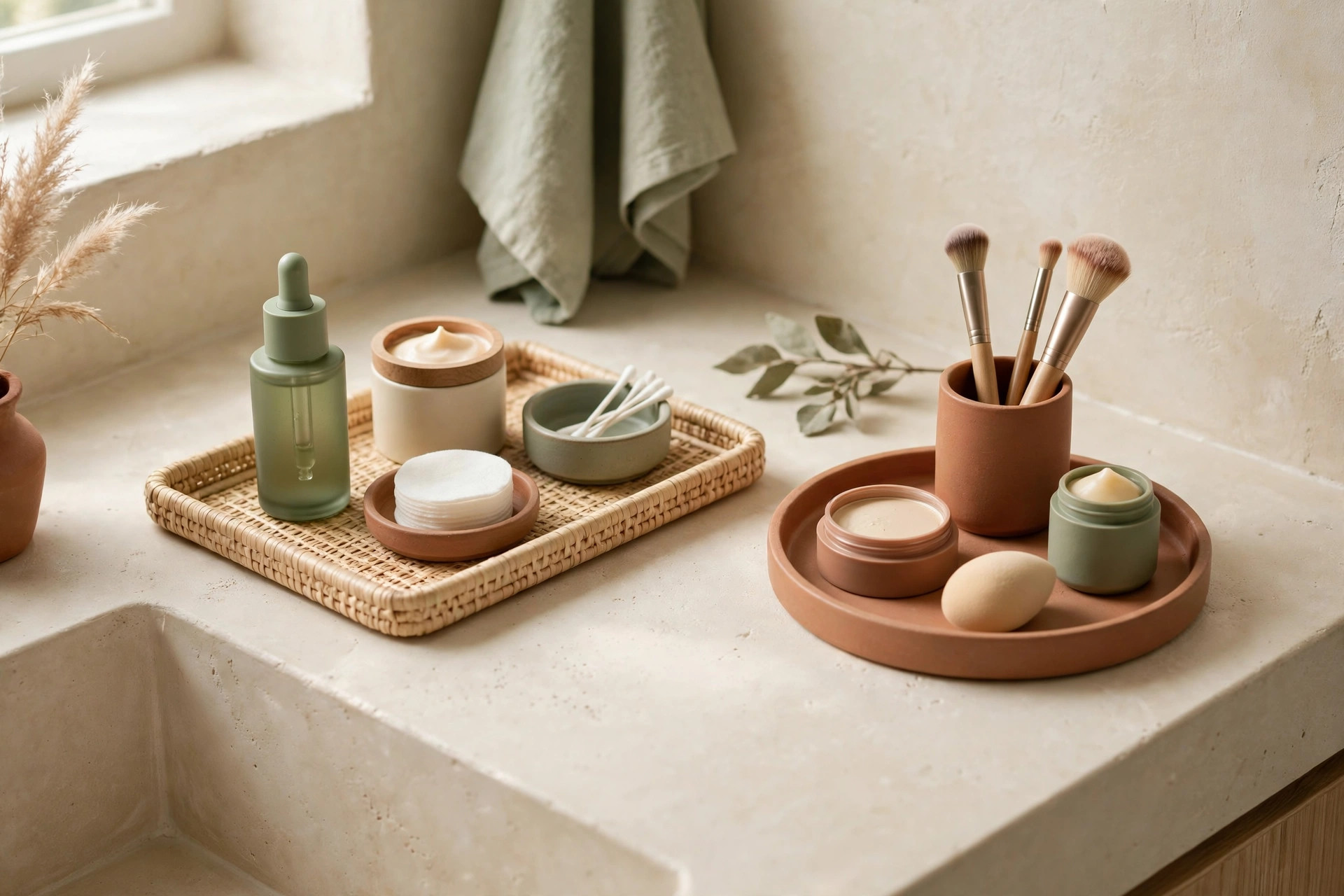
9. Give skincare a 10-inch zone by the faucet. Cleanser, moisturizer, and sunscreen live on a small tray closest to the water, because that is where you use them. A tray with a raised lip, about 10 by 6 inches, keeps drips contained and lets you lift the whole zone to wipe the counter.
10. Give makeup an 8-inch zone in the middle. A single acrylic or bamboo tray holds your daily makeup: foundation, concealer, blush, and two or three brushes in a cup. If a product does not fit the tray, it does not live on the counter. That one rule stops makeup sprawl better than any organizer.
11. Give hair a 6-inch zone at the far end. A heat-resistant mat or a tall cup holds the dryer, a brush, and one or two styling products. Storing the dryer upright in a cup saves space and keeps its cord from tangling with everything else.
Once the vanity zones are set, the same measure-first approach works for the rest of the room — see 18 Small Bathroom Storage Ideas That Make a Tiny Bathroom Work Harder for over-toilet shelving and other whole-room fixes.
Shared-bathroom vanity rules for two people
Two people sharing one small vanity doubles the products but not the counter, so the system has to be explicit. The fairest setup is equal, clearly divided space rather than a vague agreement to “keep it tidy.” Agree on the split once, label it if needed, and revisit it only when something changes.
12. Split the drawers, not just the counter. Give each person one drawer or one clearly divided half of a shared drawer, plus one shared zone for communal items like hand soap and cleaning wipes. Personal products never migrate into the other person’s drawer, even temporarily.
13. Use personal caddies for the overflow. Each person gets one portable caddy, roughly shoebox-sized, for products that do not fit their drawer. Caddies live on a shelf or under the sink and come out only during a routine, which keeps the shared counter clear between uses.
Keeping products clean in a humid bathroom
Bathrooms stay damp, and dampness shortens product life and grows grime on organizers. The goal is not a sterile bathroom, which is impossible, but a setup where moisture cannot pool around your products. Ventilation matters more than any container: run the exhaust fan during and for about 20 minutes after a shower, and leave the door ajar when the fan is off.
14. Switch to lidded, wipeable containers. Open baskets look pretty but collect dust and moisture. Lidded acrylic or ceramic jars for cotton pads, swabs, and bath salts keep contents dry, and a quick weekly wipe of the lids stops buildup. Avoid cardboard or untreated wood containers, which absorb moisture and warp.
15. Keep brushes and tools dry between uses. Stand makeup brushes upright in a ventilated cup, bristles up, so they air-dry instead of sitting damp in a drawer. Wash brushes about once a week with gentle soap, rinse well, and reshape the bristles before drying. Damp, dirty brushes irritate skin and shed faster.
For authoritative guidance on controlling indoor moisture, the U.S. Environmental Protection Agency’s guide to mold and moisture is a genuinely useful reference: A Brief Guide to Mold, Moisture, and Your Home.
The weekly vanity reset
Even a well-organized vanity drifts. Products get left out, new purchases arrive without a home, and the counter slowly fills again. A short weekly reset prevents the slow slide back to chaos and takes far less time than a full reorganization every few months.
16. Run a 10-minute Sunday reset. Set a timer and do four things: return stray products to their zones, wipe the counter and tray bottoms, toss empties and anything expired, and check whether any zone has outgrown its boundary. If a zone has overflowed two weeks in a row, it is time to remove a product, not buy a bigger organizer.
Mistakes to avoid
The most common vanity mistake is buying organizers before auditing. Pretty bins full of products you never use are still clutter, just better-looking clutter. Measure first, audit second, and buy last. Another frequent error is storing everything on the counter for visibility: visibility feels convenient, but a crowded counter collects dust, water spots, and knocked-over bottles. Keep dailies out and everything else behind a drawer front or a lid. Finally, avoid oversized organizers in small drawers. An insert that fits loosely wastes the very inches you are trying to save, and a tray that is too tall stops the drawer from closing. Measure twice, buy once.
Frequently asked questions
How many products should live on a small bathroom vanity counter?
Aim for 8 to 12 daily products on the counter, grouped into zones. Everything beyond that belongs in a drawer, on a shelf, or under the sink.
Can you organize a vanity with no drawers?
Yes. Use wall shelves, a rail with hanging caddies, a door organizer, and a portable caddy that lives on a shelf when not in use. The zoning principle still applies: assign each task a fixed spot, even if that spot is vertical rather than horizontal.
How do I keep makeup organized in a small bathroom?
Keep only daily makeup on the counter in one tray, store the rest in a drawer tray or caddy, and store brushes upright in a ventilated cup. A one-tray rule for daily makeup prevents the slow spread that turns a tidy vanity into a cluttered one.
How often should I clean out my bathroom vanity?
Do a quick 10-minute reset weekly and a full audit every three months. The weekly reset handles drift, while the quarterly audit catches expired products, duplicates, and items you stopped using.
Conclusion
A small vanity works when every product has a zone sized to how often you use it, not when you own the most organizers. Start with the audit, zone the counter, and let the weekly reset do the long-term work. For more small-space ideas, browse our small-spaces collection and save this pin for later.