If you live in a small apartment, your shoes probably live there too — piled by the door in a tangled heap that swallows your entryway. The problem is rarely too many shoes; it is that every pair you own is competing for the same six square feet of floor. These are the shoe storage ideas small apartment living demands, and they work because they attack that problem directly: move most pairs out of the entryway entirely, use vertical space for what stays, and set up a rotation so the pile never rebuilds. Below are 18 ideas in seven moves — audit, vertical towers, under-bed storage, door organizers, furniture-style cabinets, seasonal rotation, and the one-pair rule that holds it all together.
Count your shoes first: the audit that decides everything
Before buying anything, gather every pair you own into one spot. Most people discover 4–6 pairs they forgot existed. The audit takes ten minutes and it decides what you actually need to buy.
1. Do the 10-minute shoe audit
Pull every pair out of closets, under beds, and behind furniture. Sort them into three groups: worn weekly, worn monthly, and not worn in six months. The weekly group — usually 5 to 8 pairs — is all that earns entryway space. Everything else gets stored elsewhere in this article’s systems. If you cannot fit the monthly group into your planned storage, that is your signal to rehome a pair or two before buying organizers.
2. Measure your entryway before you shop
Measure the width of the wall beside your door and the floor depth you can spare. In most small apartments that is roughly 24 inches of wall width and no more than 8–10 inches of floor depth before you block the door swing. Write them down — they rule out bulky racks and keep you from ordering a 14-inch-deep organizer for a 10-inch space.
Vertical shoe towers: the footprint math
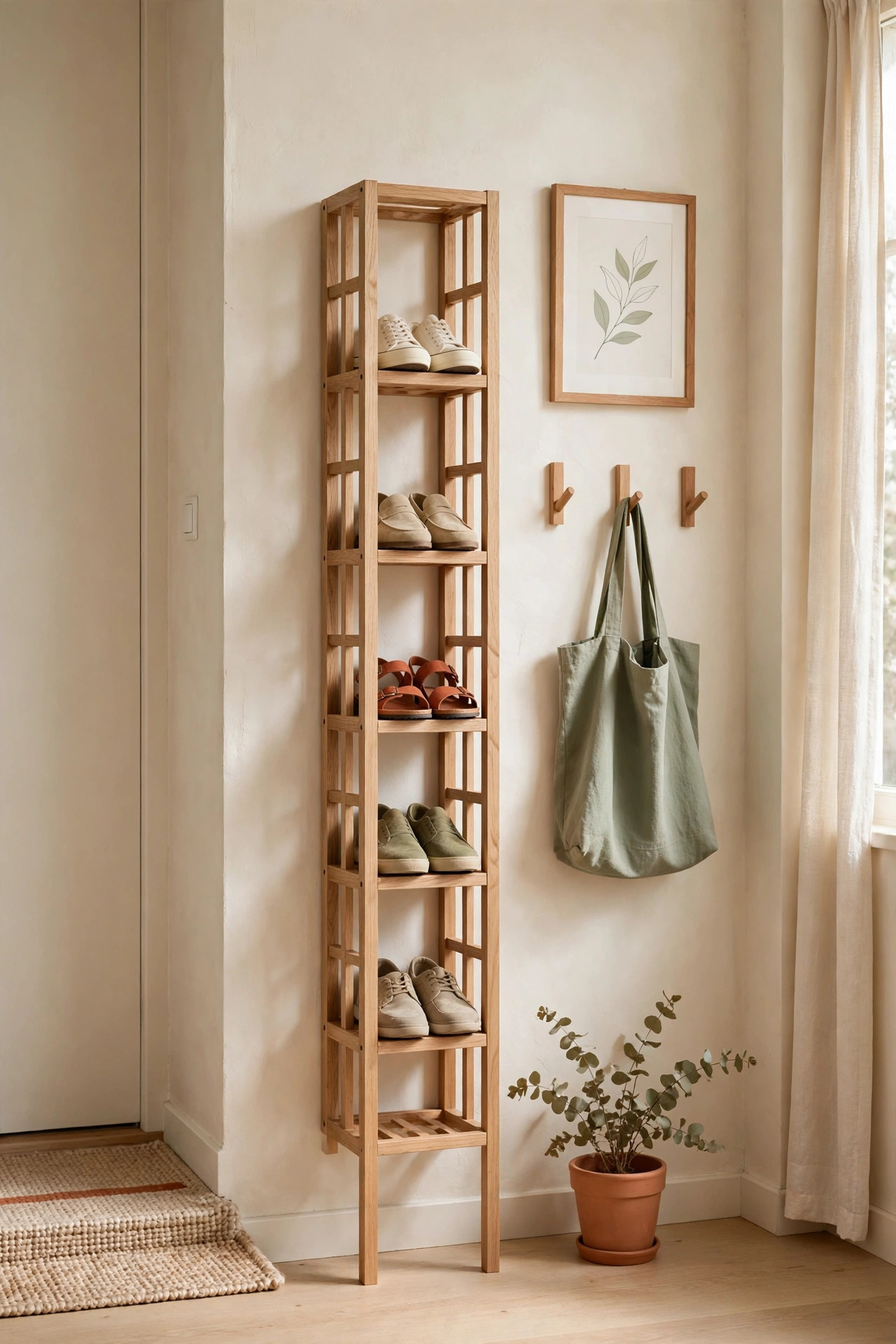
A 24-inch-wide vertical tower holds roughly 15–20 pairs in about 2 square feet of floor. That is five to six times the storage of a flat rack with the same footprint. Tall and narrow wins because you trade wall space you have for floor space you do not.
3. Stack a 10-tier fabric shoe tower in dead wall space
Fabric towers roughly 10 inches deep and 24 inches wide slide into the gap beside most apartment doors. Each tier holds 2 pairs of flats or 1 pair of boots, so a 10-tier tower stores about 15–18 pairs. Anchor it to the wall with a removable adhesive hook loop if you cannot drill — a fully loaded tower is top-heavy and will lean.
4. Mount a wall-mounted fold-down shoe rack by the door
Fold-down racks hang flat against the wall like a shelf (about 4 inches deep) and flip open to hold 2–3 pairs. Ideal for your daily pair — open, grab, fold back. Mount renter-safe with removable adhesive strips; skip these on textured or brick walls, where they fail.
5. Turn a narrow bookcase into a shoe library
A 24-inch-wide, 5-shelf bookcase (about $25–$35 at most big-box stores) fits most apartments’ unused corners. Each shelf holds 3–4 pairs. This doubles as a console top for keys and mail — one piece of furniture doing two jobs.
Under-bed and under-furniture shoe storage
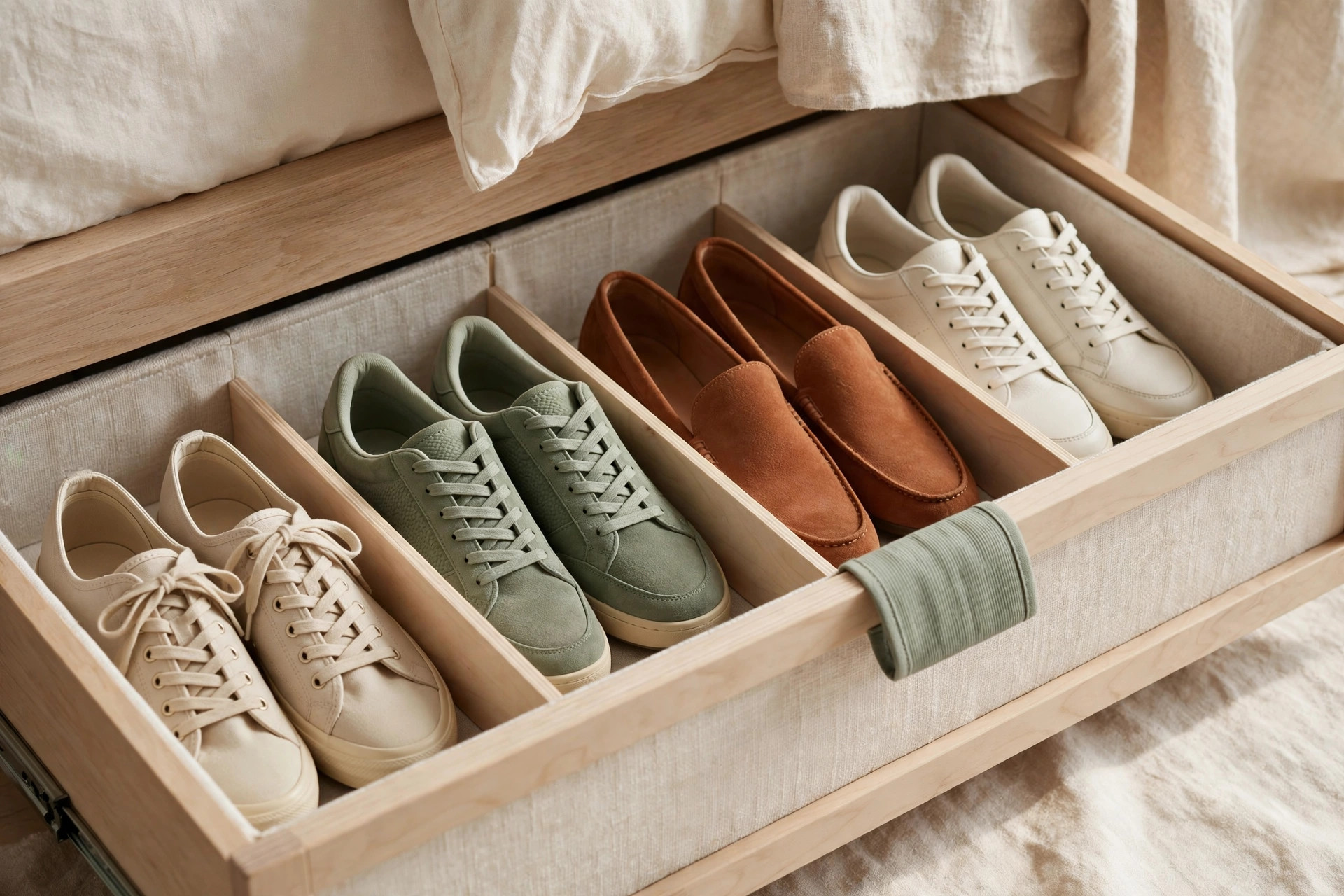
The space under your bed holds 10–14 pairs you will never trip over. This is where the monthly-wear group goes — out of the entryway but one step away.
6. Use low flat bins under the bed with lids
First measure your clearance — most apartment frames give 6 to 10 inches. Buy bins 5–6 inches tall so they slide without catching. Clear bins mean you can see the contents; lidded bins keep dust out. One bin roughly 24 × 16 inches holds 4–5 pairs. If you need a primer on measuring and bin types, see 17 Under Bed Storage Ideas for Small Bedrooms.
7. Slide shoes under the sofa and dressers too
Furniture with a 4–6 inch gap — sofas, dressers, TV stands — fits 1–2 pairs per opening. Use shallow boot trays or single-pair dust bags to keep pairs together and protect floors from scuffs. Dress shoes worn twice a month do not need prime entryway real estate.
Over-door and behind-door shoe organizers
Interior doors are free real estate — roughly 20 square feet of surface you are not using. Over-door organizers work best on closet, bedroom, and laundry-room doors; avoid the front door, where they look cluttered and block the peephole.
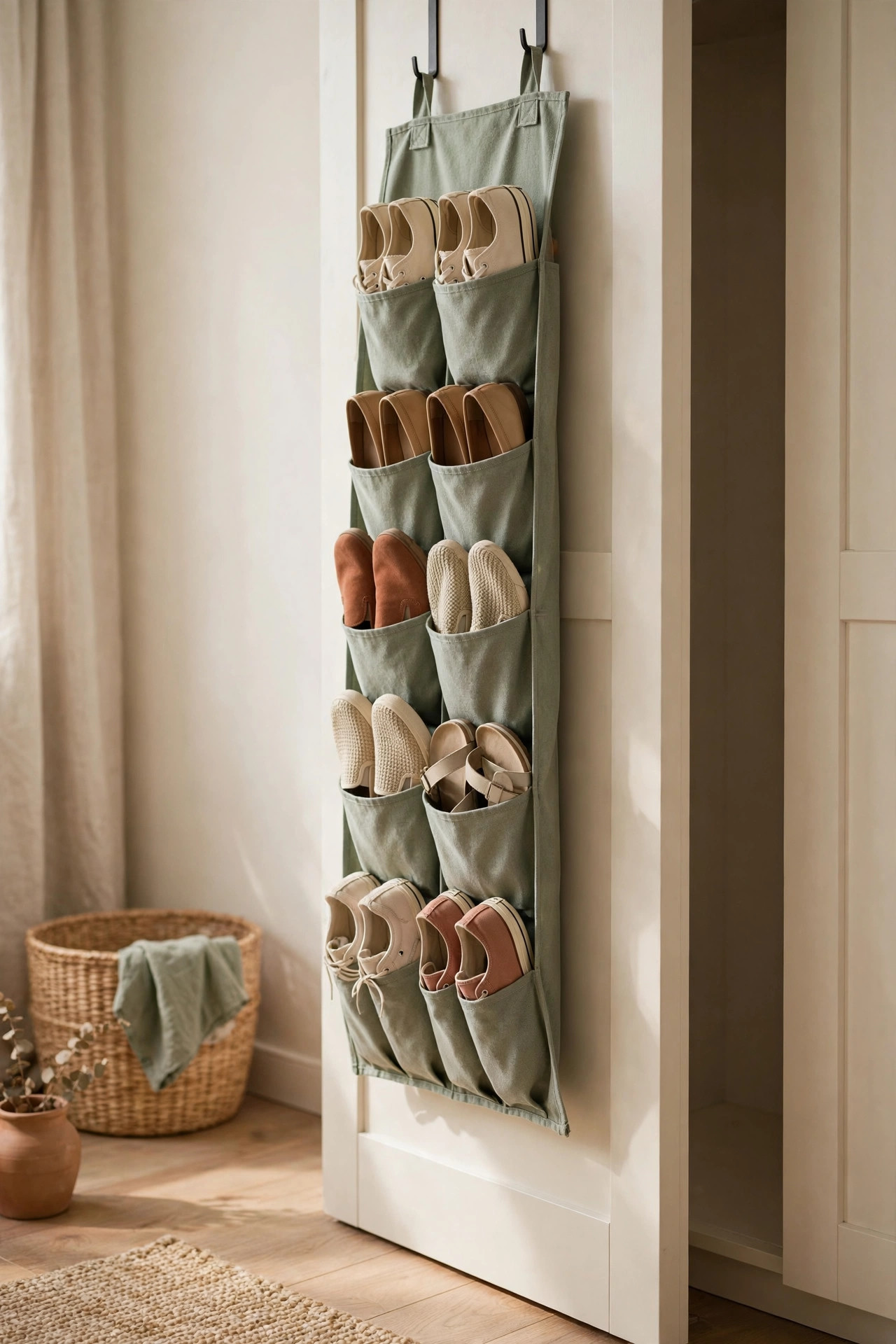
8. Hang a clear-pocket organizer on a closet door
Standard over-door pocket organizers hold up to 36 pairs, but half that is realistic for adult shoes — bulky sneakers and heels eat two pockets. The clear pockets matter: shoes you cannot see are shoes you forget, and forgotten shoes migrate back to the door pile. For renter-safe hanging rules that work on hollow apartment doors, see Over-the-Door Organization Ideas for Every Room.
9. Add a single over-door rail for tall boots
Boots collapse and lose their shape when stuffed in bins. A rail that hooks over a door — tall boots draped over it upside down — keeps 3–4 pairs crease-free and visible. If boots are your main collection, this one addition saves more pairs than any other single move.
Slim cabinets that look like furniture
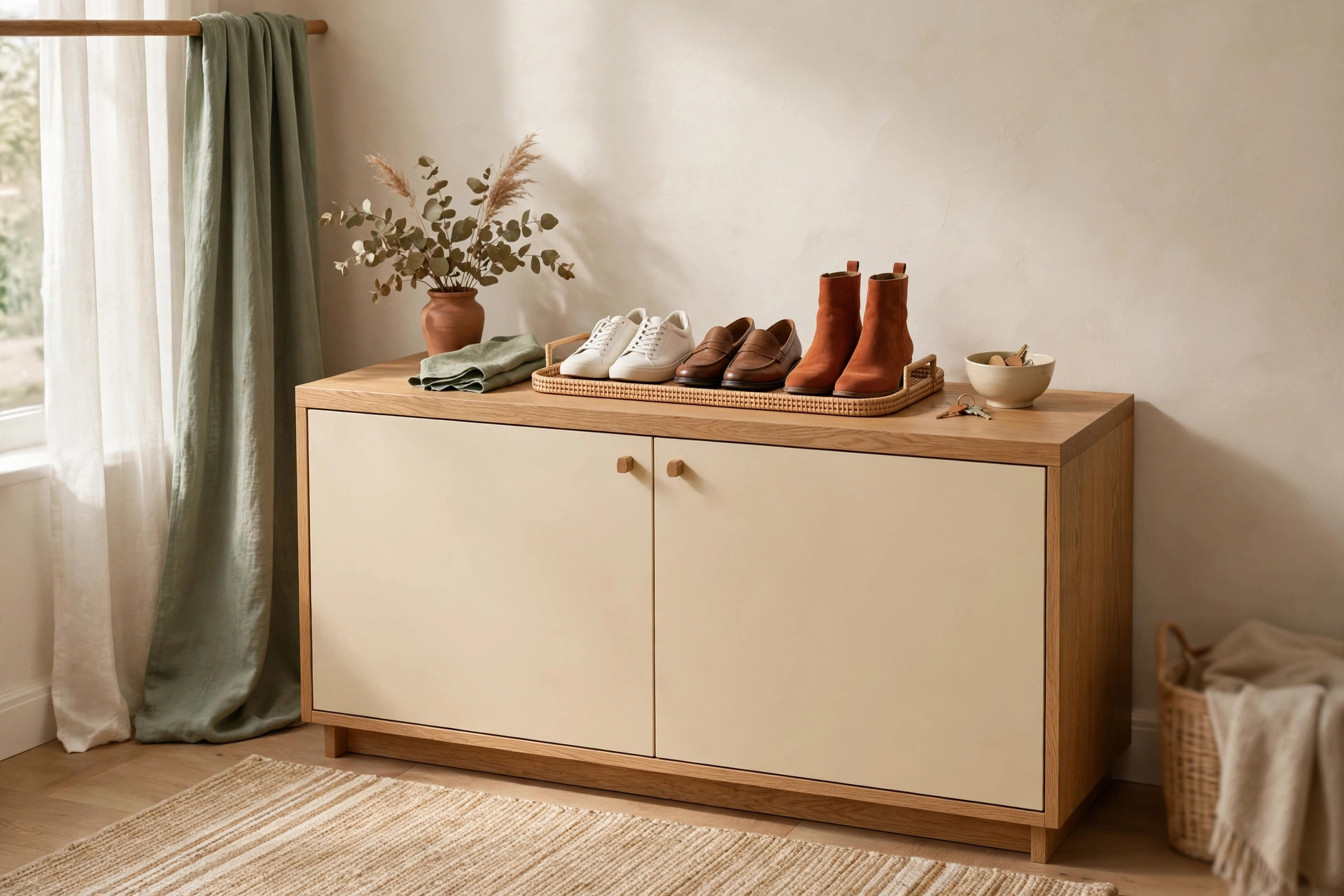
When storage sits in the entryway, it should look like it belongs there. Tilt-out and flip-drawer cabinets read as furniture, not organizers — important in apartments where the door opens straight into the living room.
10. Use a 2-tier tilt-out shoe cabinet by the door
Tilt-out cabinets are typically 8–10 inches deep, so they hug the wall like a console table. Two tiers hold 6–9 pairs, and the top becomes your keys-and-wallet drop zone. This replaces the door pile with one calm piece — the single biggest visual upgrade in this article.
11. Repurpose a flip-drawer storage bench
A bench with hidden flip-drawer compartments (roughly 12 inches deep, 40–47 inches wide) gives you a seat for putting shoes on plus 8–12 pairs of hidden storage. In studios, where the entryway is also the living room, a bench earns its floor space twice. Check that the drawers tilt from the bottom — some cheaper models only open halfway, trapping boots.
Seasonal rotation: off-season shoes don’t live by the door
The average person wears a fraction of their shoes year-round. If winter boots crowd your July entryway, the system is broken. Rotation is the habit that makes every other idea in this article permanent.
12. Pack off-season shoes into labeled bins now
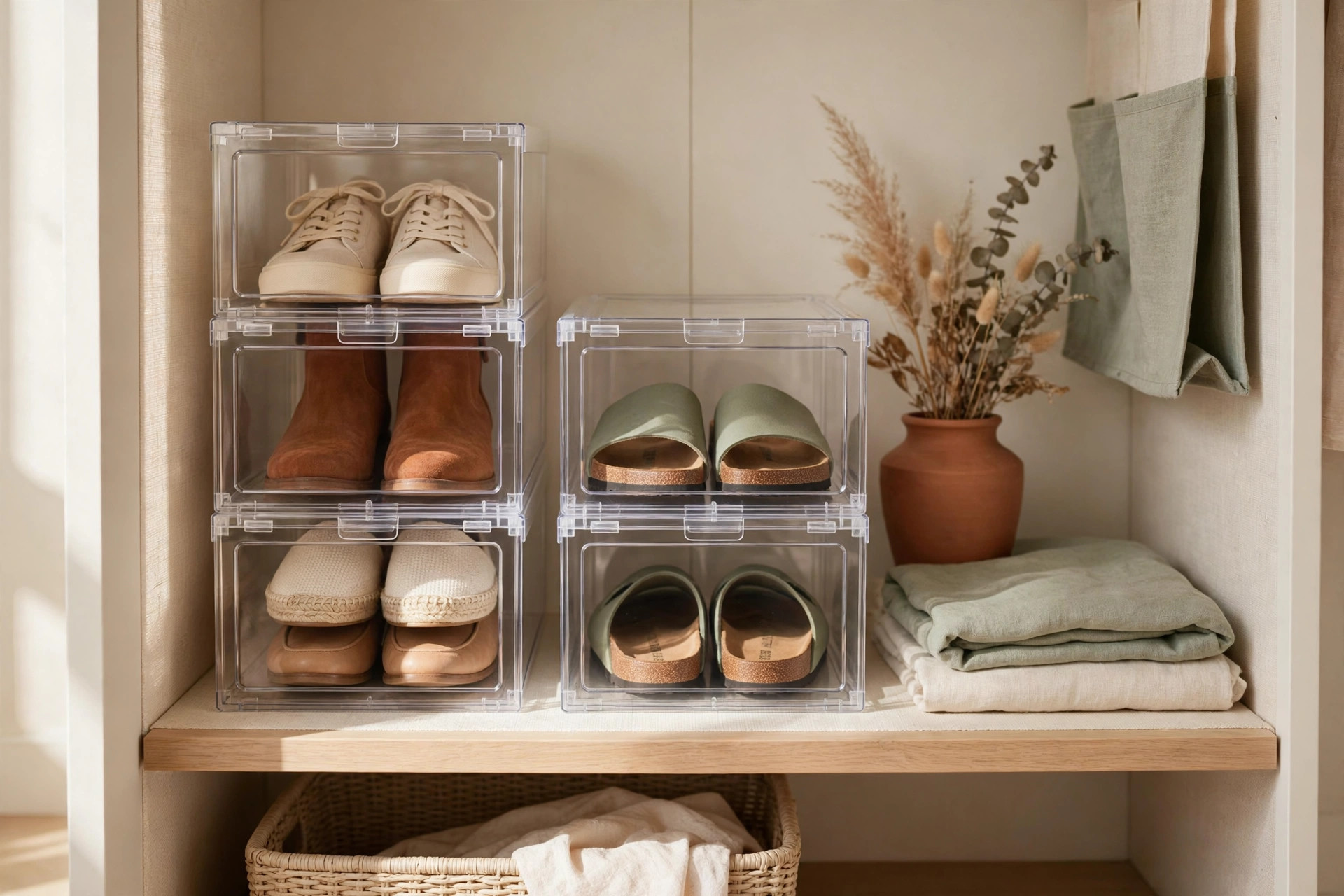
At each season change, pack the 4–8 pairs you will not wear for months into one labeled bin (about 16 × 11 × 8 inches for a typical collection). Store it at the back of a closet or under the bed. Label by season (“Summer 2027”) so the bin tells you when to reopen it.
13. Keep a one-bin “swap shelf” in the closet
Shoulder seasons are the rotation trap — October sneakers next to February boots. Keep one small bin in the closet for in-between pairs and swap from it weekly. Ten minutes of swapping beats a permanent 15-pair pile.
14. Wash and dry shoes before packing them away
Brush off dirt, wipe soles, and let every pair air-dry fully before storage — damp shoes in a sealed bin grow mildew within days. Stuff paper into toes to hold shape. This 20-minute chore keeps stored pairs wearable, not smelly.
The one-pair rule for the entryway
Everything above creates the system. This is the habit that keeps it alive. The door pile rebuilds one pair at a time, so the rule stops it one pair at a time.
15. Allow one active pair per person at the door
One pair per person — the pair currently on your feet most days. When you come home, the shoes you wore go back to their home (tower, cabinet, or bench), and tomorrow’s pair comes out. It takes thirty seconds and it is the entire difference between a system and a pile.
16. Add a small boot tray for wet and muddy days
A 30-inch plastic boot tray catches water and salt on bad-weather days so wet shoes never touch your floors. Keep the tray small — overflow forces shoes back into the system instead of spreading.
17. Do a 60-second nightly shoe reset
Before bed, walk the entryway: each pair goes to its home. Sixty seconds. This is the same daily-reset logic that keeps small entryways working overall — for the full no-foyer setup, see 15 Small Entryway Organization Ideas (Even With No Foyer).
18. Re-audit every six months
Shoes accumulate silently. Twice a year, repeat the 10-minute audit from idea #1 and rehome anything unworn. Eighteen ideas of storage cannot fix a collection that grows forever — the audit keeps the system sized to your life.
Mistakes to avoid (and what NOT to buy)
Do not buy the 50-pair door rack. Those giant revolving racks are made for closets, not entryways — they are 16+ inches deep and turn your doorway into an obstacle. Do not buy stackable cube organizers without measuring — most are 12 inches deep and eat your walking path. Do not skip lids on under-bed bins — dust will ruin shoes faster than any space savings justify. And do not keep shoeboxes for daily shoes: one box is a display, ten boxes are a cardboard fire hazard. Recycle the boxes, keep the bins.
Frequently asked questions
How can I store shoes in a tiny entryway with no closet?
Go vertical and slim: a 10-tier fabric tower or a tilt-out cabinet no deeper than 10 inches, one active pair per person at the door, and everything else stored under the bed or on a closet door.
How many pairs of shoes should a small apartment entryway hold?
Roughly 5 to 8 pairs for one person — your weekly-wear group. Extras belong in under-bed bins or on the rotation shelf.
Can I store shoes under the bed without them getting dusty?
Yes, with lidded low bins (5–6 inches tall for typical clearance) or zippered under-bed bags. Vacuum briefly before packing, and keep pairs in dust bags if your building is especially dusty.
How do I keep boots from collapsing in storage?
Drape tall boots upside down over an over-door rail, or stand them in tall bins with a rolled towel or boot shaper inside each shaft. Never lay heavy boots sideways under other pairs.
Your shoes are not the problem — every pair piled by the door is. Pick three ideas from this list, do the audit tonight, and the pile is gone by the weekend. For more systems that make small spaces feel twice as big, save this pin for later or browse the storage ideas collection.