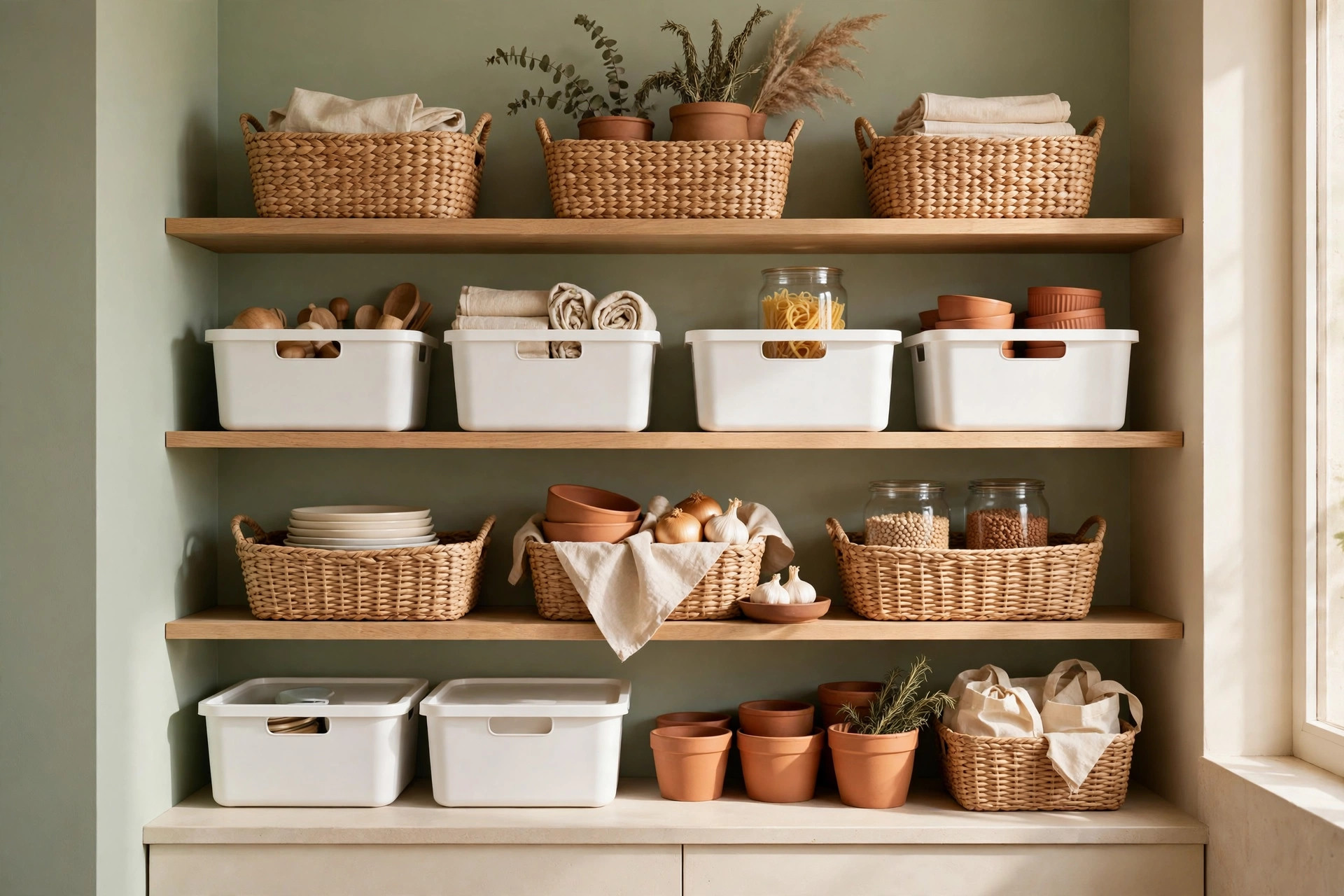
Small apartments run on inches, and store-bought organizers are built for average spaces — which is exactly why so many of them almost fit your drawers, almost grip your cabinets, and almost work in that weird corner. 3d printed organization ideas solve that mismatch at the source: instead of hunting for a container that happens to match your space, you get a piece designed for your exact measurements — storage that uses every millimeter instead of fighting it.
You do not need to own a 3D printer or learn modeling software. Free designs exist for thousands of organizers, and libraries, makerspaces, and print services can produce them for a few dollars each. This guide covers the pieces that make the biggest difference in small apartments, room by room, plus how to get them printed and when printing beats buying.
Why 3D printing fits small spaces: custom-fit everything
The biggest advantage of 3D printing for organization is customization at a price that used to be impossible: a factory-made custom organizer costs hundreds in tooling alone, while a printed one costs a few dollars of plastic filament and some machine time.
Think about the gaps standard products leave behind: the 3-inch dead strip beside your fridge, the drawer that is 17 inches deep instead of 18, the shelf with a pipe through it. A printed organizer can be sized to the tenth of an inch and shaped around obstacles. In a 400-square-foot studio, a half-inch of wasted width across four drawers is real, lost storage.
Hooks and holders for exact gaps
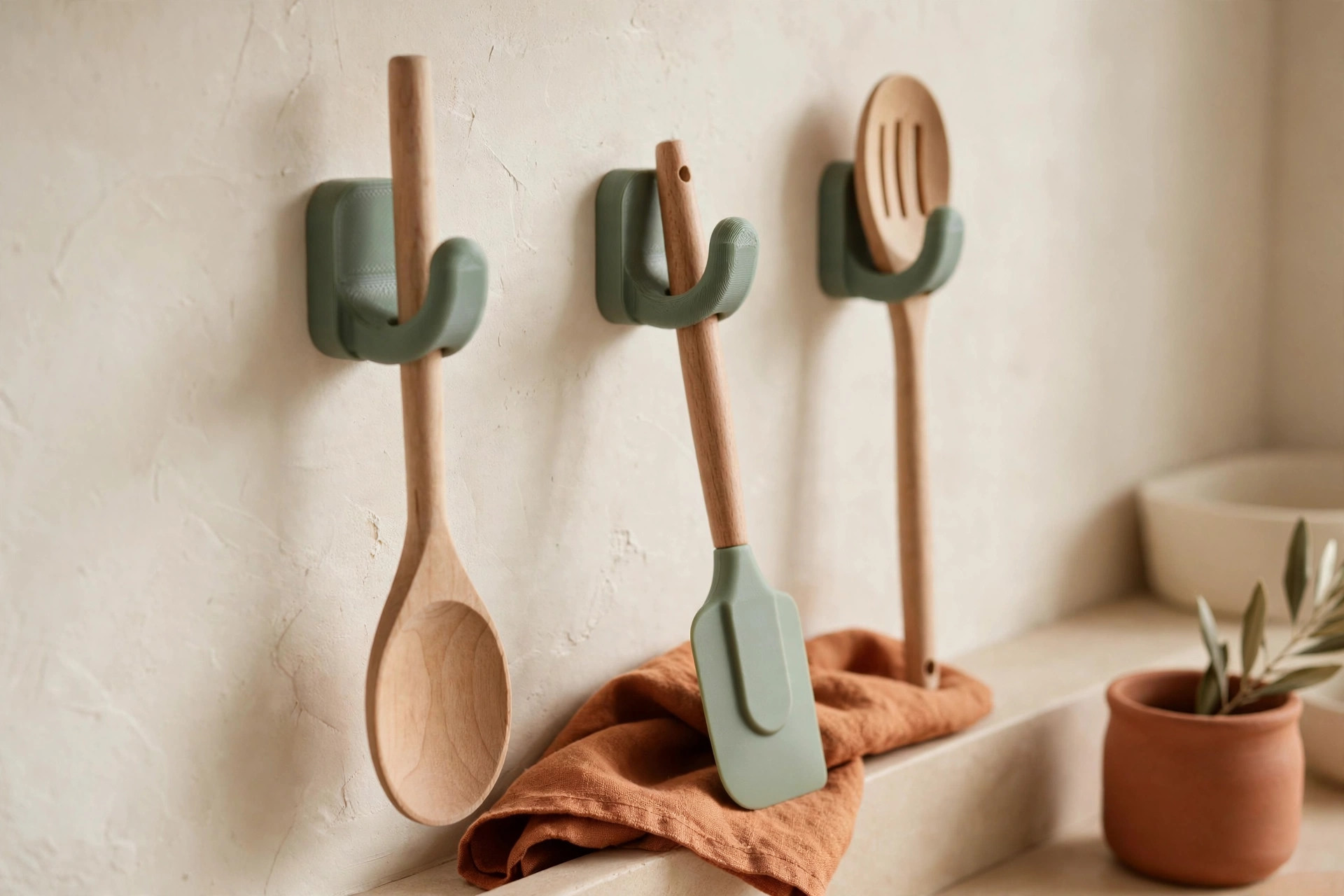
Hooks are where 3D printing quietly shines: a hook must match the surface it mounts to and the object it holds at once. Printed hooks can be designed for your exact door thickness, broom handle diameter, or shelf lip — standard hooks pick one of each and hope.
Look for designs sized to your situation: door hooks shaped to your door’s exact top thickness (most interior doors are 1⅜ inches), shelf hooks that clamp a specific board depth, and holders with the internal diameter of the items you own. Common small-apartment wins include broom and mop holders sized for your handles and under-cabinet hooks matched to your mug rims.
Renter-friendly mounting is straightforward: most small pieces take removable adhesive strips or command-style tabs on a flat back. For heavier items, choose a wide adhesive footprint or two anchor points. The damage-free strategies in 17 Renter-Friendly Closet Organization Ideas (No Drilling Required) pair well across the whole apartment.
Cable and charger organizers
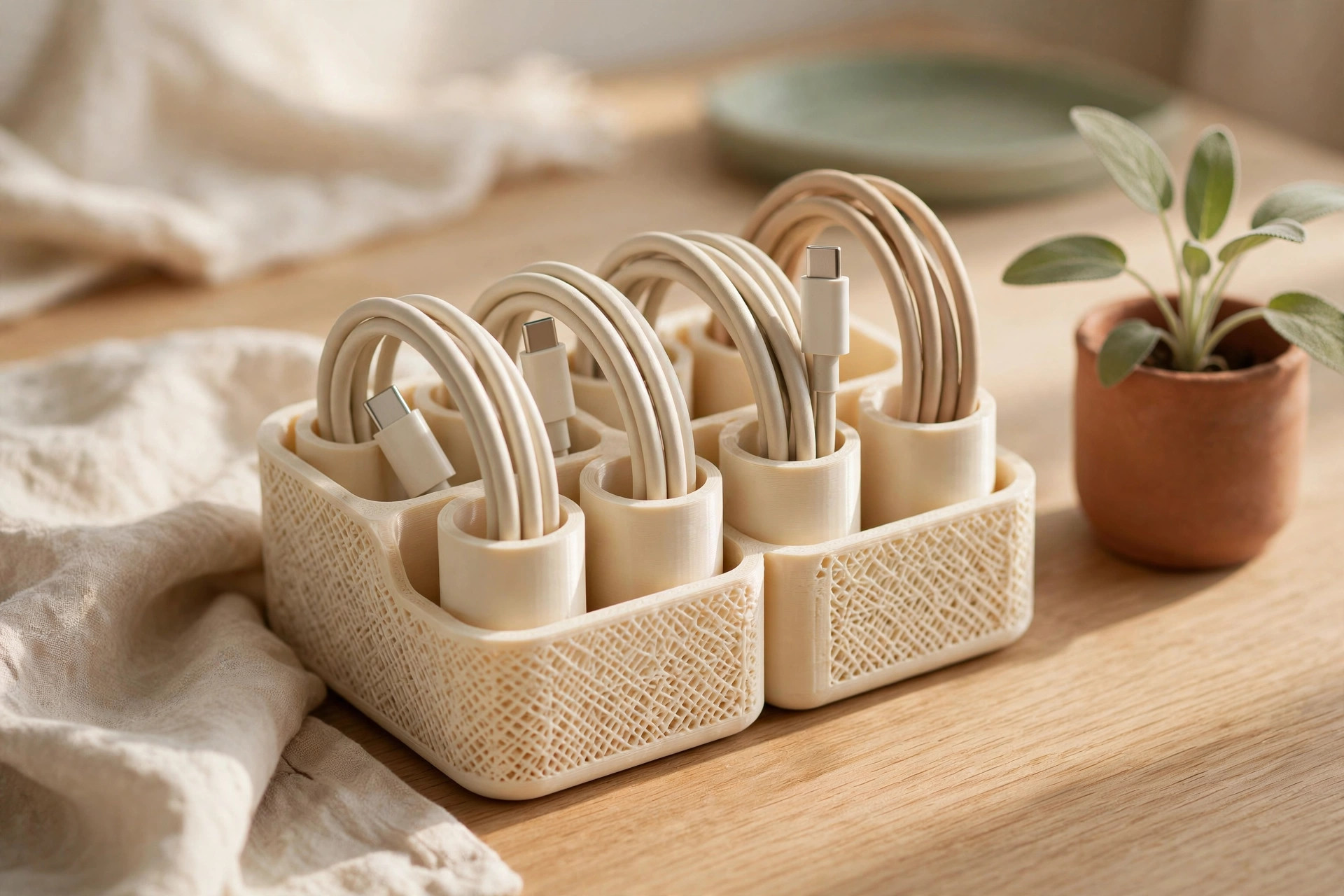
Printed cable organizers are one of the most mature design categories — years of iteration have made the available designs genuinely refined:
Cable clips sized to your actual cables. Generic clips come in “small, medium, large” and still fit nothing perfectly. Printed clips can match your exact cable diameter.
Charging docks and stands. Multi-device docks hold a phone, earbuds, and a watch in one footprint, with cutouts routing cables underneath. Measure your devices, then pick the dock built around them.
Cord spools for stored cables. Printed spools keep spare cables coiled at a safe diameter, and many stack neatly in a drawer.
Under-desk cable trays. These mount under your desk and hide a power strip plus its cable bundle. Pick a tray width that matches your power strip.
Kitchen and drawer inserts
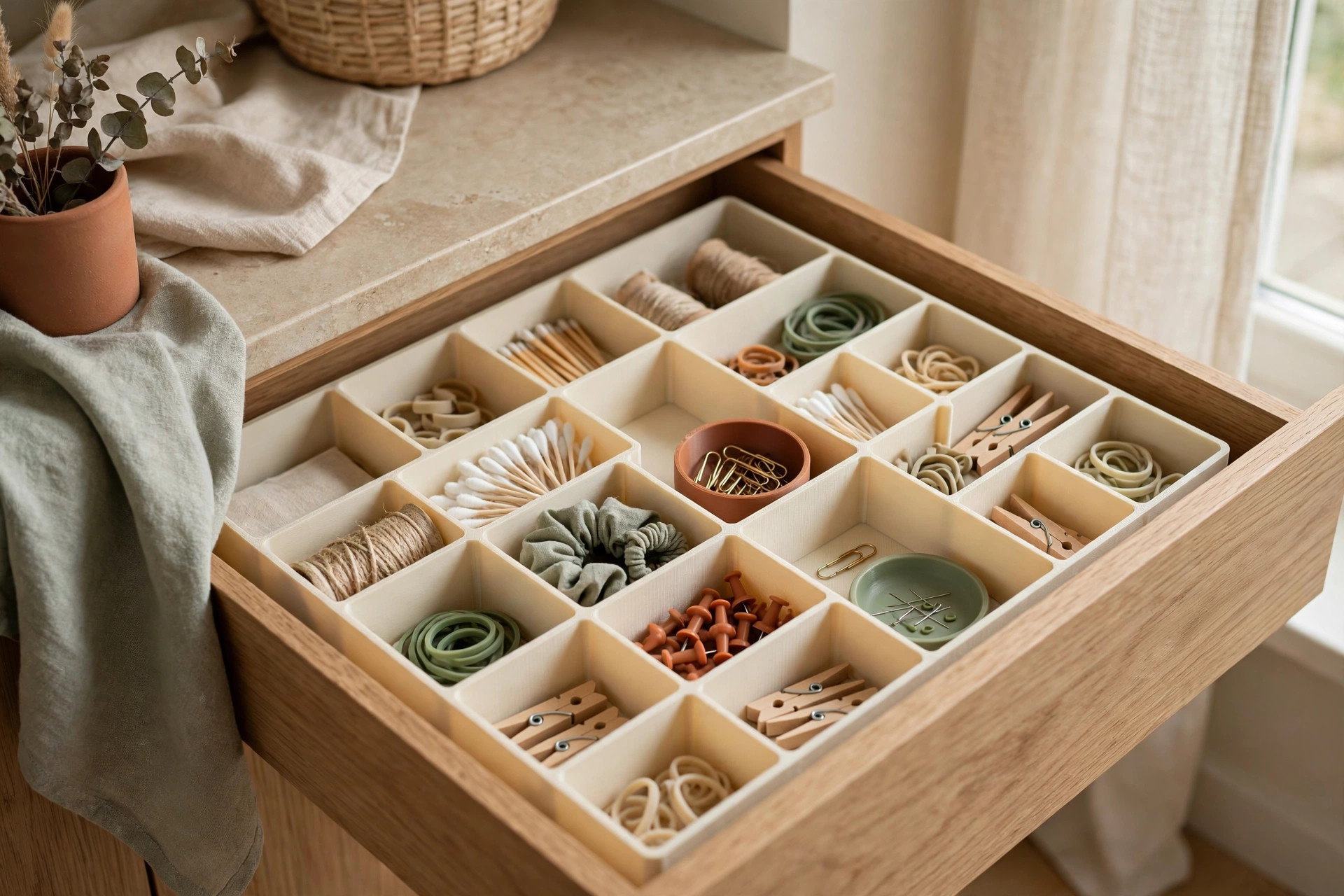
Apartment kitchen drawers are rarely standard sizes, and generic organizers either leave dead space around the edges or get trimmed down and look terrible. Printed inserts can be sized to the drawer interior exactly, with compartments built around what you actually store.
Start with the utensil drawer: a tray designed around your specific tools — long slots for spatula and tongs, square wells for measuring cups, a narrow channel for chopsticks. Nothing slides when the drawer opens.
Next, tackle the problem drawers: junk, spice, odds-and-ends. A grid of small stackable bins sized to fill the drawer completely — no gaps, no sliding, and every bin lifts out for cleaning.
For drawer zoning and the one-drawer-per-task system, see Kitchen Drawer Organization Ideas for Tiny Drawers.

Beyond drawers, printed kitchen pieces fill the awkward spots: spice risers matched to your shelf height, lid holders sized to your pot lids, bag dispensers that mount inside a cabinet door.
Bathroom and shower custom pieces
Apartment bathrooms are the hardest room to organize because every fixture is slightly different — printed organizers can be matched to each.
Practical pieces to consider:
Shower caddies sized to your shelf. A printed organizer shaped to your built-in corner shelf sits without wobbling or wasted space. Look for drainage slots so water runs through instead of pooling.
Toothbrush and razor holders. A wall- or mirror-mounted holder that grips your specific toothbrush and razor clears the counter entirely.
Under-sink organizers. Printed shelf risers and bins can be designed around your specific pipe layout, turning the area under the trap into usable storage.
Towel and accessory holders. Small printed hooks and rings mount inside cabinet doors or on the wall for hair tools, spare toilet paper, or hand towels.
One caution: moisture and heat. Standard PLA softens in hot showers. For shower pieces, ask for PETG or ASA filament — both handle heat and humidity far better.
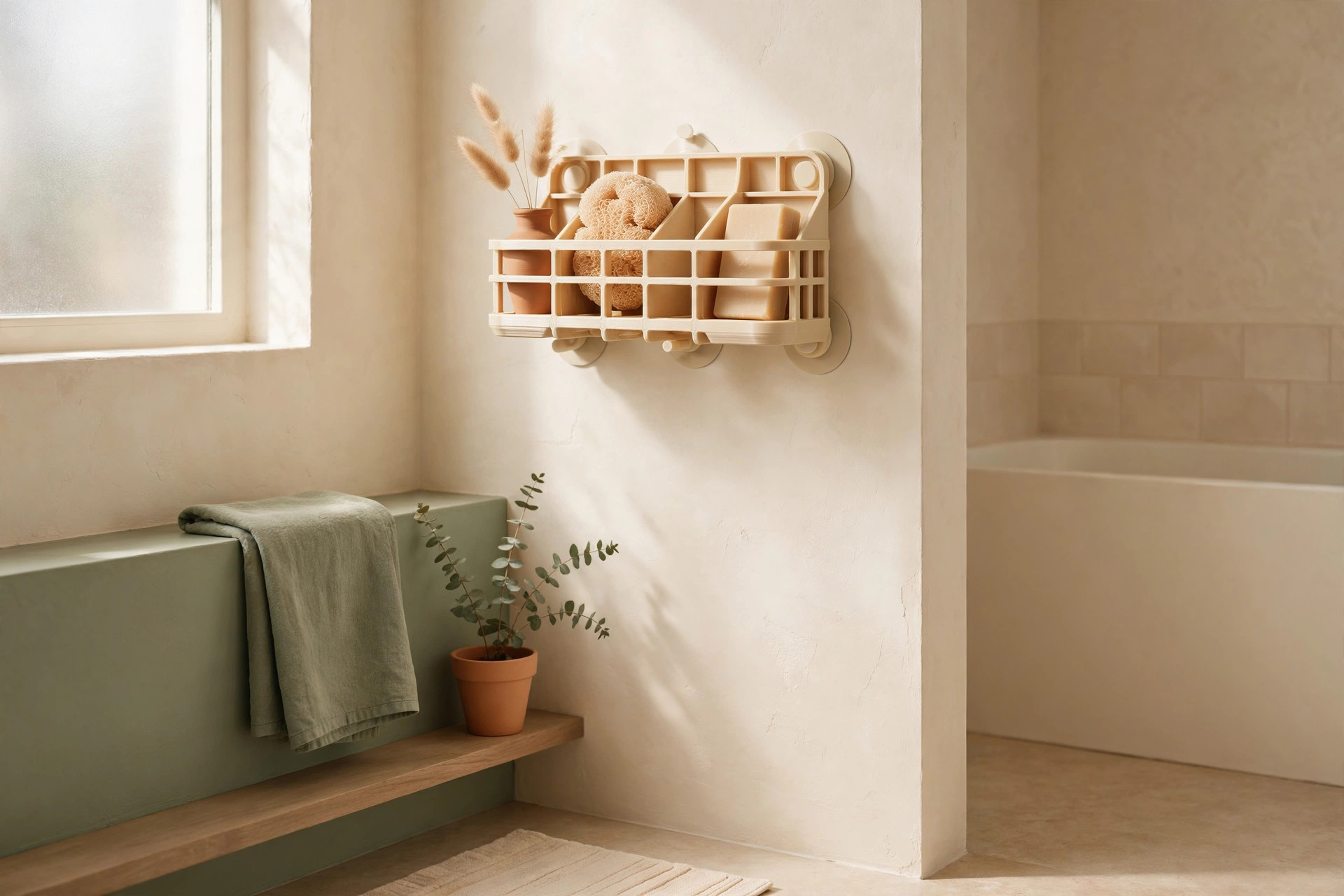
19 Tiny Bathroom Organization Ideas to Maximize Every Inch covers the measure-first rules and vertical storage systems that printed pieces slot right into.
Where to get prints without owning a printer
Most people who use printed organizers never touch a printer. The realistic options, cheapest to most convenient:
Your public library. Many library systems now offer free or near-free 3D printing — send a file, staff print it, you pick it up.
Local makerspaces. Community workshops usually print by the hour or by the gram, often with someone who can help you size and tweak a design.
Online print services. Design libraries like Printables.com — run by 3D-printer maker Prusa — host a huge library of free, community-tested organizer designs, and online services can produce and ship them to you.
When you order, send the provider the design file (usually a .stl or .3mf file), your exact measurements if you customized it, and the material you want. Standard PLA — the cheapest option — works for most organizers.
Cost vs buying: when printing wins
Printing is not always cheaper than buying off the shelf — here is where the math favors you.
Printing wins when you need a specific size or shape that does not exist off the shelf. A drawer insert that fits a 17-inch drawer exactly has no mass-market equivalent — the comparison is print cost versus not solving the problem at all.
Printing wins on small batches of matching pieces. Ten identical cable clips, a set of six drawer bins — per-piece cost drops as you reuse the same design, and everything matches. Buying them individually usually costs more and still would not fit as well.
Printing wins on replacement and repair. A broken clip on a store-bought organizer usually means buying a whole new organizer. A printed part can be reprinted for pennies, and tweaked if the first version was not quite right.
Buying off the shelf wins when a standard product fits well enough. A $3 plastic bin that fits your shelf fine does not need a printed replacement — save the printing budget for pieces that genuinely need customization. Printing also loses on very large items, where material cost and print time climb fast.
Rule of thumb: if the piece is smaller than a shoebox, unique to your space, and you need more than one, printing is usually the smart move. For systems that pair with custom pieces, browse the storage ideas collection.
Mistakes to avoid
Printing before measuring. The number-one failure: a beautifully designed organizer that is 5 millimeters too wide is scrap. Measure twice, write the numbers down, and double-check before you print or order.
Choosing the wrong material. Standard PLA is great for drawers and closets but softens in hot cars, sunny windowsills, and steamy bathrooms. Use PETG or ASA near heat or moisture, and flexible TPU for parts that get handled repeatedly.
Ignoring weight and strength. Printed plastic is strong along its layers but weaker between them. A hook holding a heavy winter coat needs a thick print or a load-bearing design with a wide mounting base. Do not trust a thin decorative hook with anything heavy.
Printing everything. Start with the three most annoying spots in your apartment and solve those first. A printed organizer should eliminate a daily friction, not decorate a drawer you never open.
Forgetting the design’s license. Most designs are shared under licenses that allow personal use but restrict commercial use. That is fine for your own home — just do not sell printed copies of someone else’s design without checking.
Frequently asked questions
How much does it cost to 3D print an organizer?
For a small piece like a cable clip or drawer bin, a few dollars or less at a library or makerspace, and roughly $5–$20 through an online print service. Standard PLA is cheapest; PETG and flexible materials cost a bit more. The design files are usually free.
Do I need to learn 3D modeling to use printed organizers?
No. Thousands of ready-made designs are free to download, and many can be resized to your measurements with simple scaling tools. Modeling software is only needed to design something from scratch.
Are 3D-printed organizers strong enough for daily use?
Yes, for normal tasks like drawer bins, hooks, cable organizers, and shelf dividers. For heavy loads — full toolboxes, heavy coats — print thicker designs in stronger materials like PETG, or use a wide adhesive base.
Can printed organizers damage my apartment?
The printed parts themselves do not damage anything — the risk is only in how you mount them. Use removable adhesive strips or command-style tabs instead of screws, and check the adhesive rating against the weight of the piece plus its contents. This keeps everything renter-friendly.
Where can I find free 3D-printed organizer designs?
Design libraries like Printables.com and Thingiverse host huge free collections with user ratings and photos. Search for your need plus your measurements — “17-inch drawer divider” or “1.375-inch door hook” — and sort by most-downloaded.
Conclusion
3D-printed organizers earn their place in small apartments by doing the one thing mass-market products cannot: fitting your exact space. Start with your three most annoying spots — the drawer that never closes right, the cables that tangle daily, the shelf that wastes inches — and solve those with printed pieces sized to your measurements. You do not need a printer of your own; a library or print service can produce your first pieces for a few dollars. Save this pin for later.