Every home has a room-shaped secret: the flat, unused surface on the back of nearly every door. While countertops overflow and closet shelves buckle, the 14 square feet behind a standard door sits completely empty — holding nothing but the door itself. These over the door organization ideas turn that dead space into working storage: shoes in the bedroom, towels in the bathroom, spices in the pantry, toys in the kids’ room. Nothing here requires drilling, nothing touches your floor plan, and most organizers cost $10–$25 and hang in under five minutes. The only real work is measuring your door first so the bracket fits and the door still closes.
Why doors are the most underused storage in the house
A standard interior door is about 24 by 80 inches of completely flat, completely empty real estate. A slim over-the-door rack sits in the 3–4 inch gap between door and wall when open, adding storage volume without touching your floor plan. Most organizers cost $10–$25 and install in under five minutes with zero tools — one of the highest-value storage upgrades per dollar.
The catch is fit. Measure three things before buying anything: door thickness (standard interior doors run 1⅜ inches), clearance above the door when it closes (standard frames leave about ¼ inch — plenty for flat hook brackets), and the swing. A rack on a door that opens against a wall must be shallow enough not to hit.
Bedroom: shoes, accessories, bags
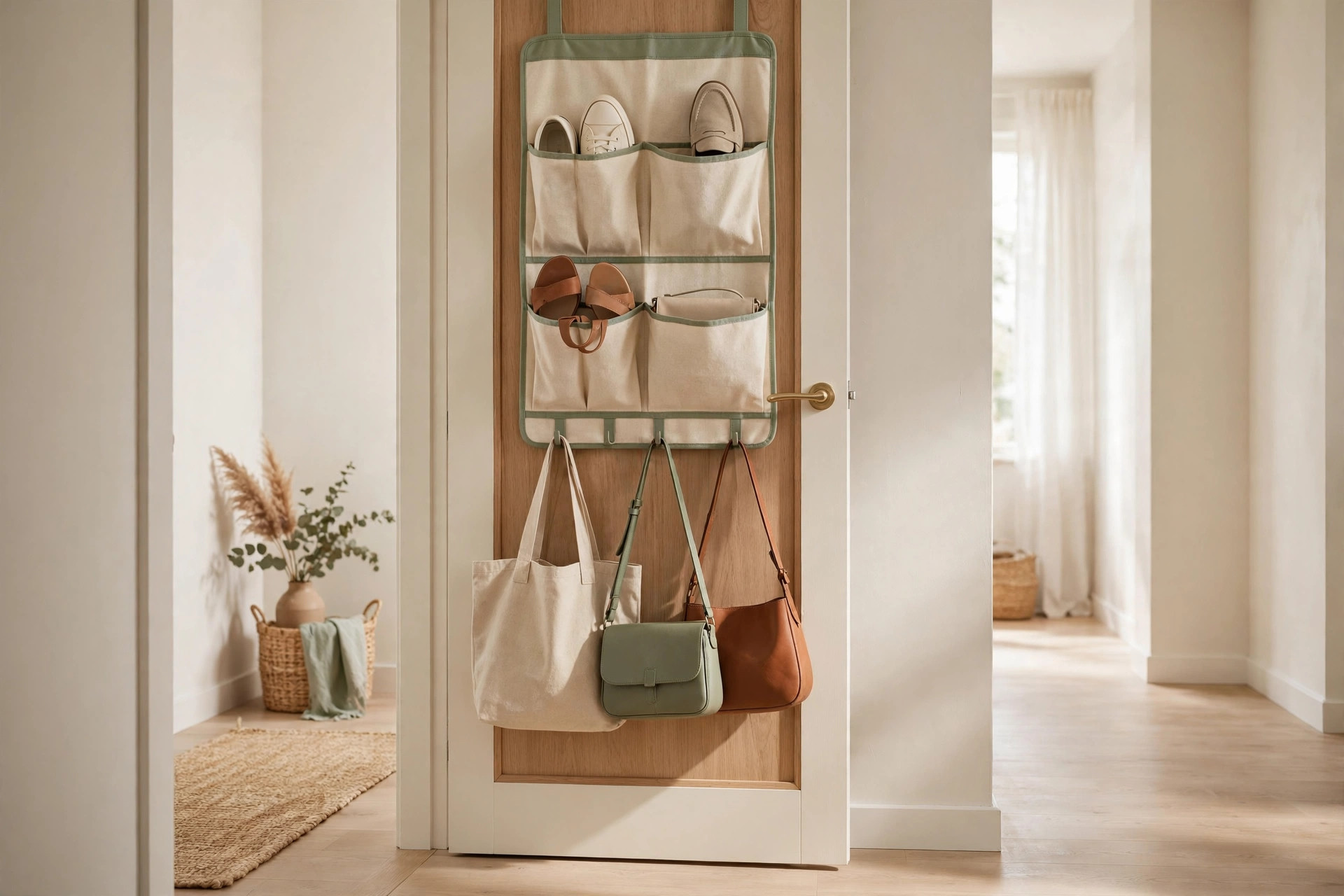
Bedroom doors and closet doors are the easiest wins in the house — small stuff with no home: shoes, the bag you grabbed twice this week, belts and scarves that never make it back to a drawer.
Hang shoes where you can actually see them
A 24-pocket fabric organizer holds roughly a dozen pairs of flats, sneakers, or sandals (bulky shoes take two pockets each). Sort by how often you wear them: daily pairs in the top two rows at eye level, occasional shoes low. If your door swings into a tight hallway, use a flat-panel canvas organizer instead of wire — under 2 inches deep when open, versus 5–6 for wire.
Give bags and belts a real home
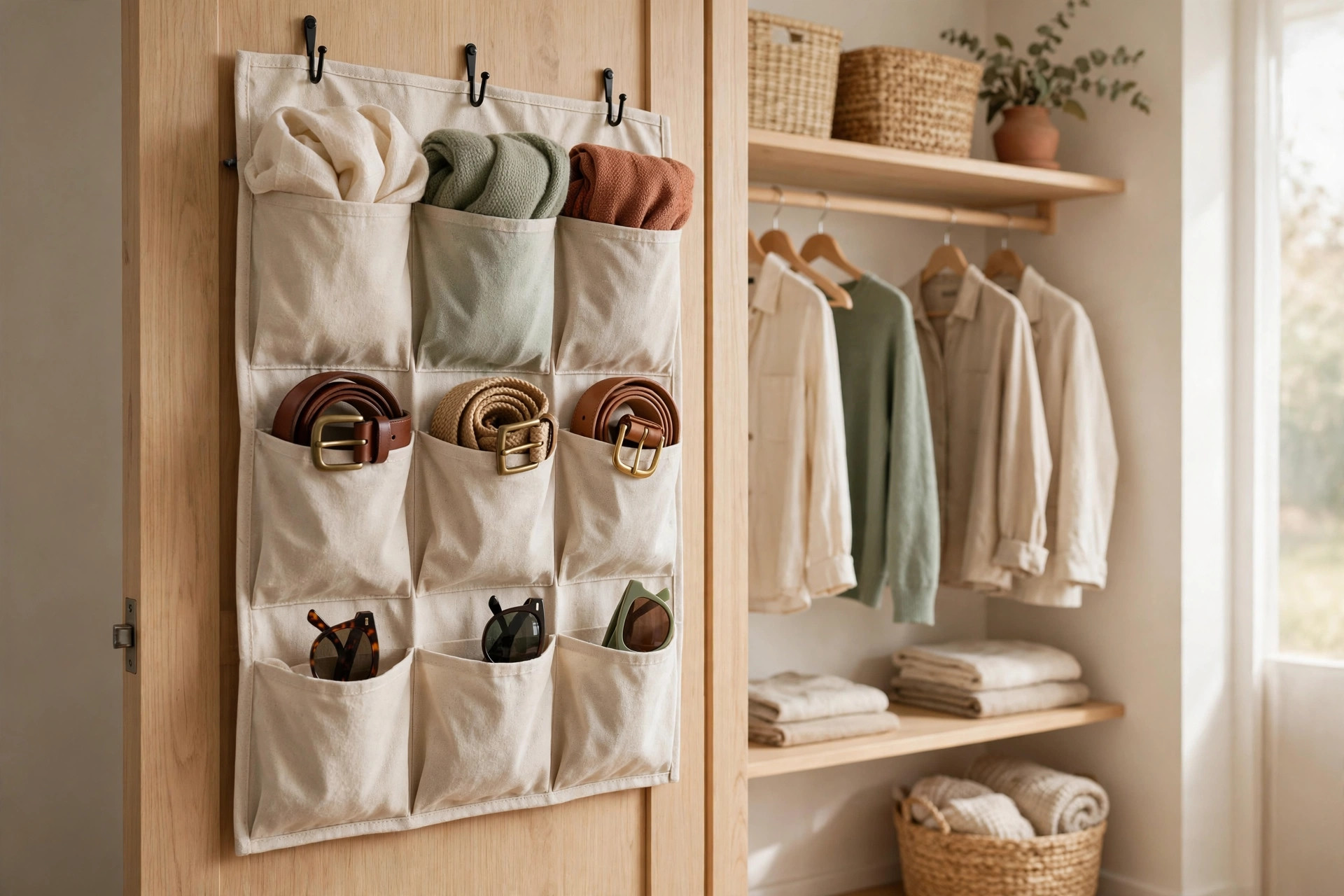
Metal over-door hooks with 4–6 staggered arms handle handbags, backpacks, and weekender bags. One heavy bag per hook avoids stretched straps; the heaviest goes closest to the hinge side so the door doesn’t drift open. A 20-hook belt rack on an over-door hook gives belts and scarves a visible slot — the reason they live tangled in drawers is that people can’t see them.
Bathroom: towels, toiletries, hair tools
Bathrooms are where over-door storage earns its keep fastest: small, humid, and full of things that multiply. Behind the bathroom door you can reclaim counter space without spending a fortune. For the counter and under-sink zones these racks don’t reach, see 19 Tiny Bathroom Organization Ideas to Maximize Every Inch.
Create a towel and washcloth station
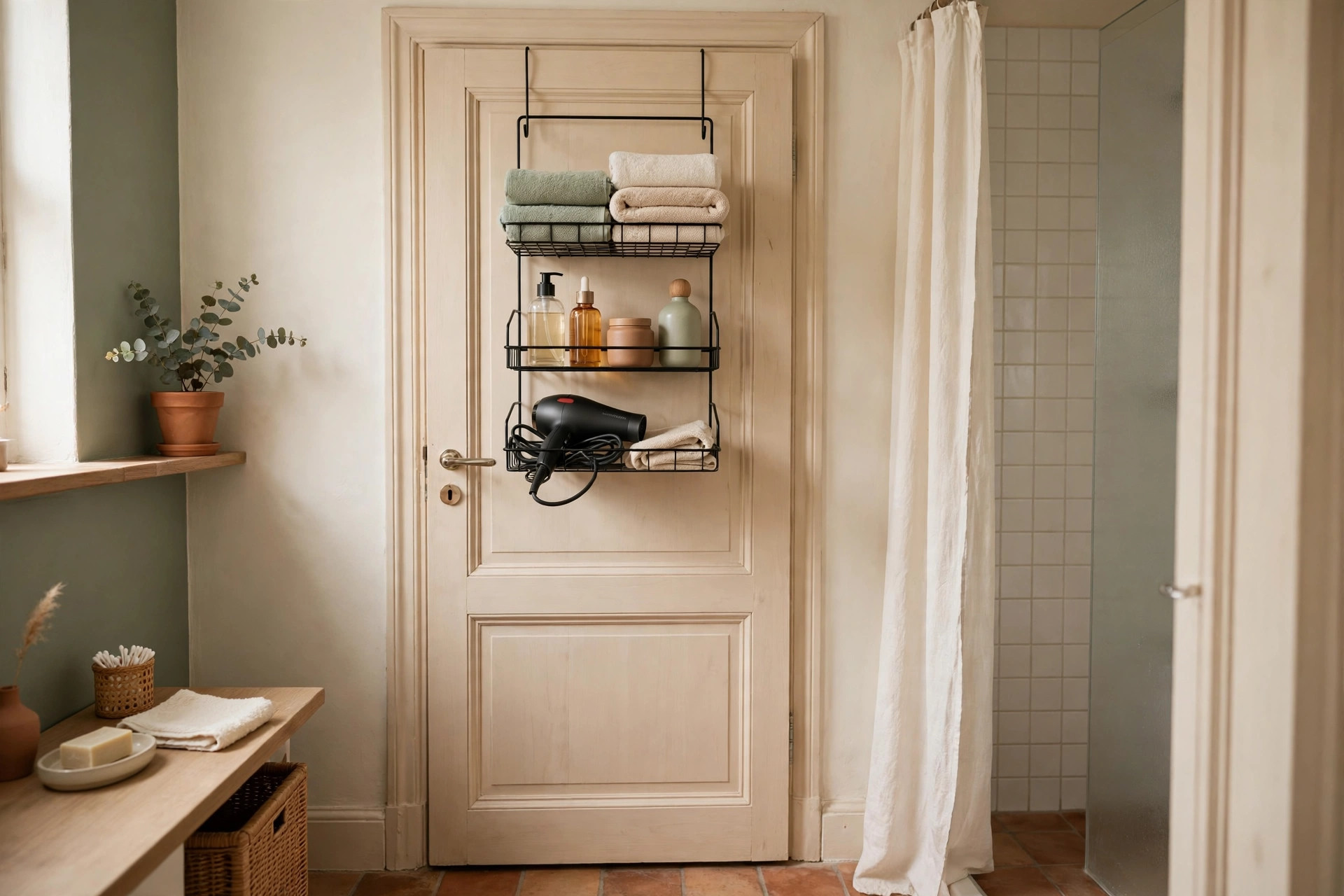
Two over-door hooks hold your in-use bath towel and hand towel; a hanging wire basket with a hook that clears the door top holds folded washcloths and spares. Towels on the door get airflow from both sides and dry faster in humid bathrooms — a small mold-prevention bonus.
Store toiletries without cluttering the counter
A clear-pocket organizer with 15–24 pockets lets you see every tube and bottle at a glance, which stops the “buy a duplicate” problem. Group by routine: morning in one column, evening in the next, first-aid and nail care in a third. Clear vinyl wipes clean; mesh breathes better but hides contents.
Keep hair tools safe and untangled
A heat-resistant silicone-lined holder hangs inside the door and holds a dryer, flat iron, and curling wand in separate sleeves while they’re still warm — no more hot irons balanced on counters. Let tools cool in their sleeves for 15 minutes, then they live there permanently.
Kitchen and pantry: spices, wraps, cleaning
Kitchen and pantry doors take the highest-traffic chaos — the wrap drawer that jams, the spice cabinet where jars hide behind each other — and flatten it onto one visible surface. For a fuller pantry overhaul, see 21 Small Apartment Pantry Organization Ideas That Actually Work.
Build a visible spice rack
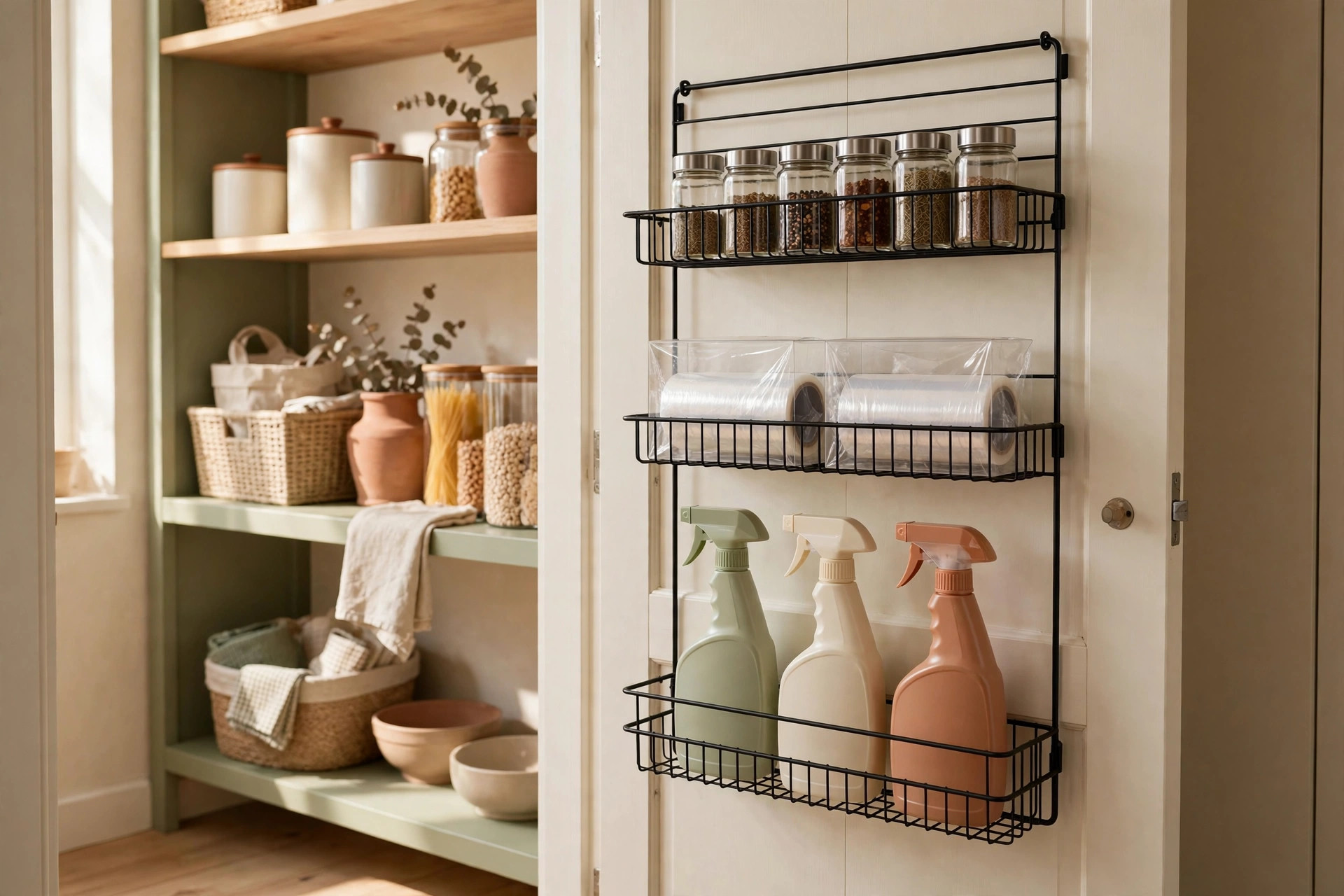
Two rows of slim wire baskets on the pantry door hold 20–30 standard spice jars with labels facing out, mounted no higher than 60 inches so everything is reachable without a step stool. Group by cooking zone — everyday in the center, baking in one row, occasional in the other. Alphabetical order breaks the moment you buy one new jar; grouping by use survives real life.
Tame wraps, bags, and lids
An over-door wrap station with slots for plastic wrap, foil, and parchment ends the kitchen-drawer wrestling match; a lower pocket holds zip bags. The same rack style works for pot lids: slide lids vertically into wide pockets sorted by diameter, ending the lid avalanche for good.
Stow cleaning supplies out of sight but in reach
A narrow over-door caddy on the pantry door holds spray bottles upright with nozzles accessible, plus a basket for sponges and gloves. Keep one stocked caddy per floor: an upstairs caddy means you stop carrying spray bottles up the stairs.
Closet doors: double your storage
The inside of a closet door is the most valuable underused surface in most bedrooms. Anything stored there stays hidden when the door is closed, so it’s ideal for the overflow that doesn’t need to look pretty — out-of-season accessories, backup toiletries, the gift wrap you use twice a year.
Hang the accessory overflow
A jewelry organizer with 32–72 small clear pockets turns the inside of a closet door into a flat jewelry box — no more tangled necklaces, everything visible at once. Because the door closes, none of this needs to be beautiful; it just needs to keep you from digging.
Store backup toiletries and cleaning supplies
A wire over-door rack inside the closet door holds the duplicates — backup shampoo, travel-size bottles, extra razors — that currently colonize your bathroom counter. If you’re renting and can’t drill into closet walls, this approach is also the backbone of 17 Renter-Friendly Closet Organization Ideas (No Drilling Required), which covers the rest of a no-drill closet system.
Kids’ rooms: toys and art supplies
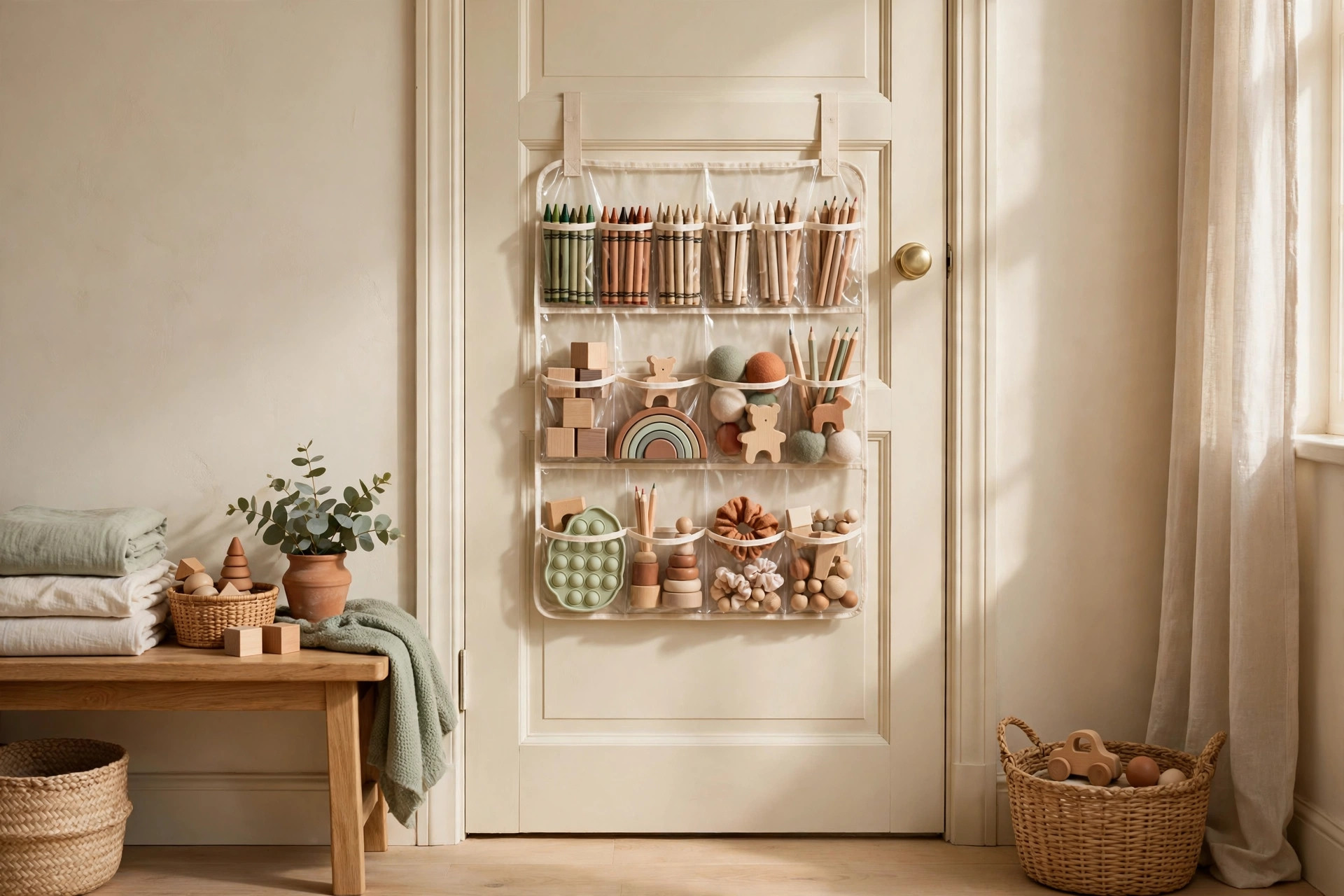
Kids’ rooms fail on storage because kids don’t put things back where adults would look. The fix is storage they can see and reach without opening anything: an over-door organizer puts every pocket at their height, and because it’s a vertical strip rather than a toy chest, small pieces don’t disappear.
Sort toys by pocket, not by bin
Label pockets with a picture label (a crayon drawing of the toy type works as well as anything) so even pre-readers can sort correctly. Keep the organizer’s bottom edge no more than 36 inches off the floor so a 5-year-old can reach the top row.
Make art supplies self-serve
A narrow wire rack holds coloring books upright, a pencil pouch, stickers, and a sketchbook — a complete art station on 18 inches of door. The rule that makes it work: art supplies live ONLY on the door. When everything has one visible home, cleanup becomes “put it back on the door,” a single instruction a child can follow.
Renter rules: no-damage hanging that holds
Everything above only matters if your landlord approves. The good news: over-the-door organizers use no screws, no adhesive, and no holes — among the most renter-friendly upgrades available. But “no damage” has fine print, and getting it wrong is what costs deposits.
Choose the right hook for your door type
Flat hook brackets — thin metal hooks that slide over the top of the door — are the standard, needing about ¼ inch of clearance. Metal-frame apartment doors and fire-rated entry doors often have tighter clearances; if the bracket scrapes the frame or stops the door closing, switch to padded adhesive hooks. For textured or frosted glass, adhesive won’t hold — use a padded bracket that grips by tension.
Protect the door’s finish
The deposit killer isn’t the hook, it’s the hook rubbing paint off. Stick felt furniture pads on the back of every bracket where metal touches the door — top edge and face. Check monthly for the first three months: if you see a mark forming, reposition the pads or swap to a silicone-coated bracket.
Respect the weight limit
Most racks are rated for 15–25 pounds, but the door itself is the real limit. Hollow-core doors flex under loads over about 20 pounds, which makes the door harder to latch. Keep heavy items low and on the hinge side, and never hang a rack on a door whose hinges already squeak or sag — that door needs a hinge repair first, not more weight.
Mistakes to avoid with over-the-door organizers
Most over-door storage fails for reasons that have nothing to do with the organizer and everything to do with the door. Buying before measuring door thickness and top clearance produces a rack that rattles, scrapes, or stops the door closing. Overloading is the slow killer: 30 pounds on a hollow-core door pulls it off true until it won’t latch — move half the contents to a second door. Measure the swing radius before choosing a deep rack, or it will smack into walls and furniture. Keep bare metal out of steamy bathrooms, and stick to one organizer, one job — a shoe rack that also holds snacks becomes a junk drawer on a door.
Frequently asked questions
Can over-the-door organizers damage doors?
Damage usually comes from unprotected metal brackets rubbing paint off the door’s top edge or face — felt furniture pads on every contact point prevent nearly all of it. The other risk is weight: keep the load under 20 pounds on hollow-core doors, and skip doors with sagging hinges.
How much weight can an over-the-door hook hold?
Most racks are rated 15–25 pounds by the manufacturer — a fair ceiling for solid doors. For hollow-core interior doors, the lightweight doors in most apartments, treat 15–20 pounds as the practical limit, with heavier items low and on the hinge side.
Do over-the-door organizers work on all doors?
Nearly all standard interior doors, yes, as long as the hook bracket fits the door thickness (usually 1⅜ inches) and there’s about ¼ inch of clearance above it. They struggle on metal-frame doors with tight clearances, fire-rated doors, and textured-glass doors where adhesive also fails. In those cases, a tension-mounted pole organizer is the safer choice.
Can I use over-the-door storage in a rental without losing my deposit?
Yes — over-door organizers are one of the safest storage upgrades for renters, needing no screws, nails, or adhesive. Put felt pads on all bracket contact points and respect the weight limit so the door doesn’t warp. Everything comes off with zero repair when you move.
Start with one door
Pick the door that’s closest to your biggest daily frustration — bedroom door if mornings are chaos, bathroom door if the counter is always covered, pantry door if you can’t find the cumin. Measure it, hang one organizer, and live with it a week before adding more. For more storage ideas, browse the storage ideas category — and save this pin for later so you have the renter-safe rules handy when you move.