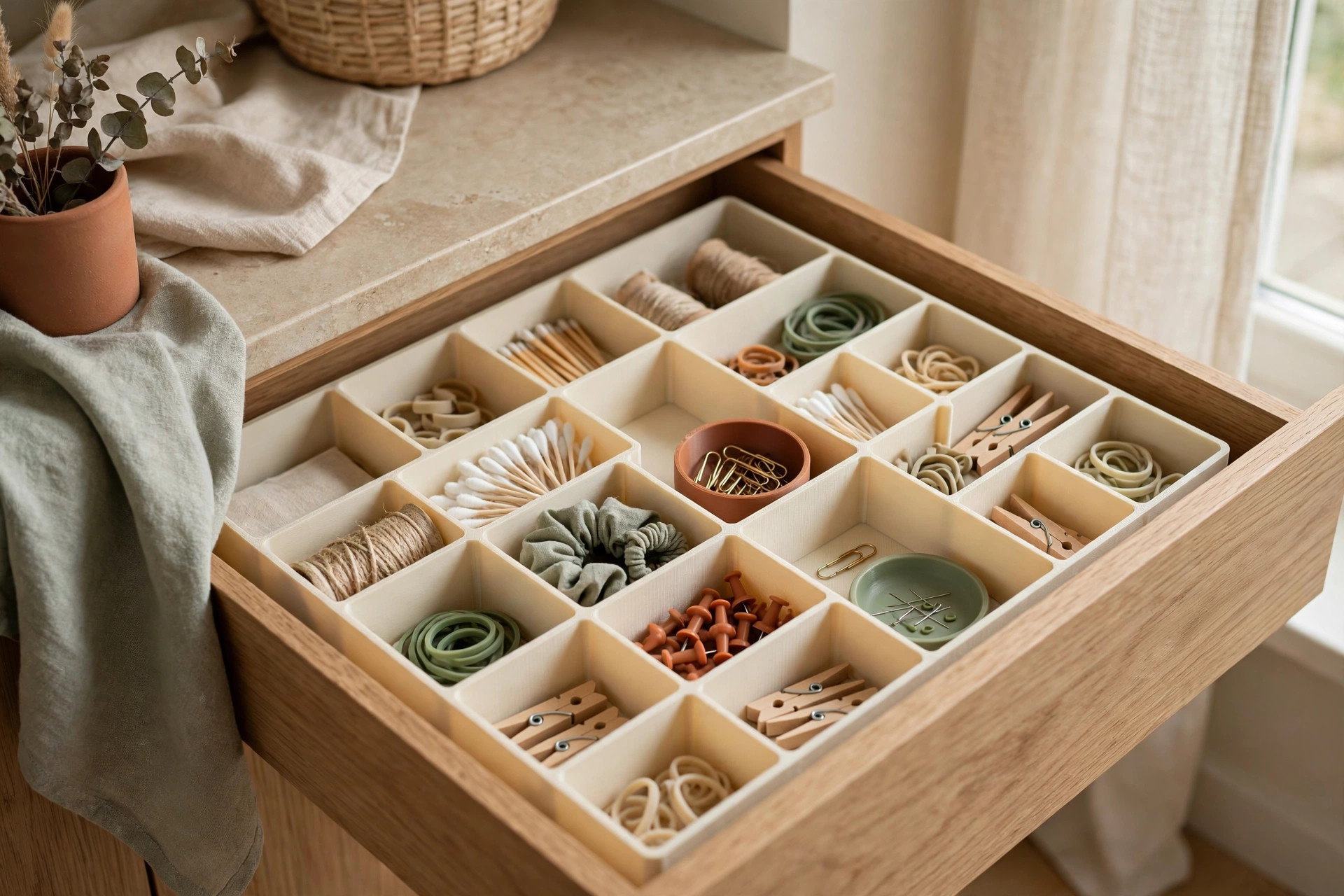
You’re standing in the middle of a room that feels like it’s closing in on you, and someone says “just declutter” — as if the problem is that you never thought of that. If you’ve searched for minimalist decluttering where to start and landed here, you’re probably not lazy, disorganized, or a lost cause. You’re overwhelmed by clutter, and overwhelm shuts down exactly the part of your brain that makes decisions. This guide is the answer to where to start when you’re overwhelmed: one zone, one simple method, one week — no marathon purge, no perfection required. By the end, you’ll have a finished starting point, a repeatable system, and a plan for your first week.
Why overwhelm happens (and it’s not laziness)
Overwhelm happens when your brain faces too many micro-decisions at once. A single cluttered room can hold hundreds of unmade decisions — keep or toss, where does this go, when did I last use it — and each one costs mental energy. Psychologists call this decision fatigue, and it’s why you can organize a spice rack fine but freeze in front of a packed closet. The freezer isn’t a bigger job than the spice rack; it just asks for far more decisions per square foot.
Two other forces stack the deck. First, sunk-cost thinking: “I paid good money for that,” your brain says, even about a $12 gadget untouched in two years. The money is gone either way — the question is only whether you keep paying rent in space and attention to store the evidence. Second, imagined futures: you keep the bread maker because of the person you might become, not the person you are. Minimalist decluttering asks one honest question: does this serve the life you’re living now?
None of this is laziness. It’s your brain doing its job — avoiding pain — in a situation with too many inputs. The fix isn’t motivation. It’s shrinking the decision set until each choice is easy.

The one-zone rule
Here’s the entire philosophy in one sentence: work in exactly one zone at a time, and finish it before you start another.
A zone is not a room. A zone is one drawer, one shelf, one 3-foot section of closet rod, one corner of the counter. When you feel overwhelmed by clutter, your instinct is to tackle the whole house, because the whole house is what’s bothering you. Resist it. A whole room is 30 decisions at once; one drawer is five. You can make five decisions. You’ve made five decisions before breakfast.
Pick your first zone with a timer in mind: choose something you can finish in 20 minutes or less. The junk drawer, the top shelf of the bathroom cabinet, the “landing strip” where bags and mail pile up by the door. Finishing small creates momentum — your brain logs a completed task and hands you energy for the next one.
Start with the easiest win: trash sweep
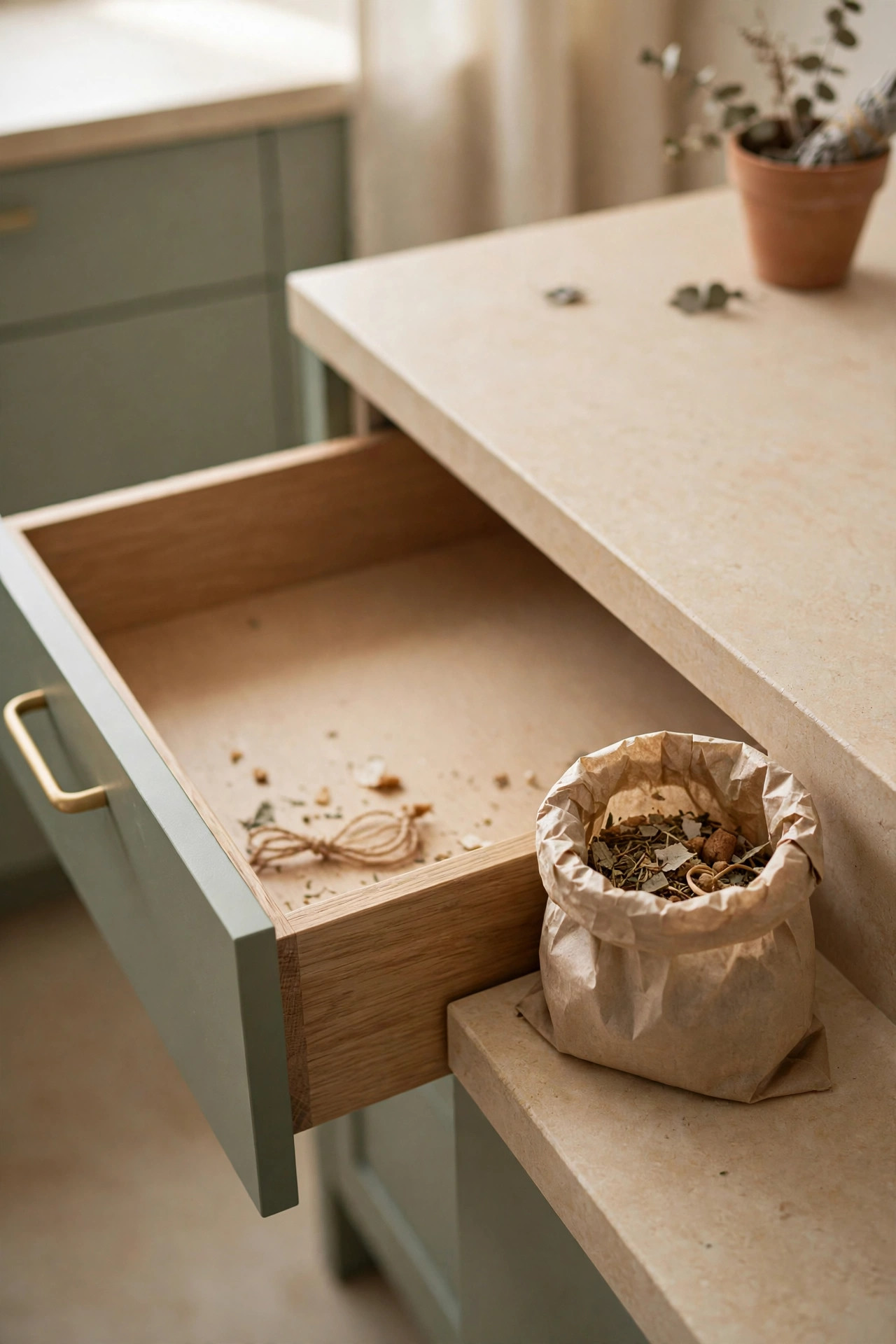
Before you make a single keep-or-toss decision, do a trash sweep. Walk your chosen zone with a trash bag and remove everything that is obviously garbage: expired coupons, dead batteries, dried-out pens, packaging, receipts from 2023. No decisions required — trash is trash.
This sounds trivial, but it matters for two reasons. First, roughly 15–20% of a typical cluttered zone turns out to be outright trash, so your first win is nearly free. Second, it warms up your decision muscles on zero-stakes choices. By the time the trash is gone, your brain is already in sorting mode, and the real decisions feel easier.
Do the trash sweep first, every time, in every zone. It’s the cheapest momentum in all of decluttering, and overwhelmed beginners need every bit of it.
The 4-box method simplified
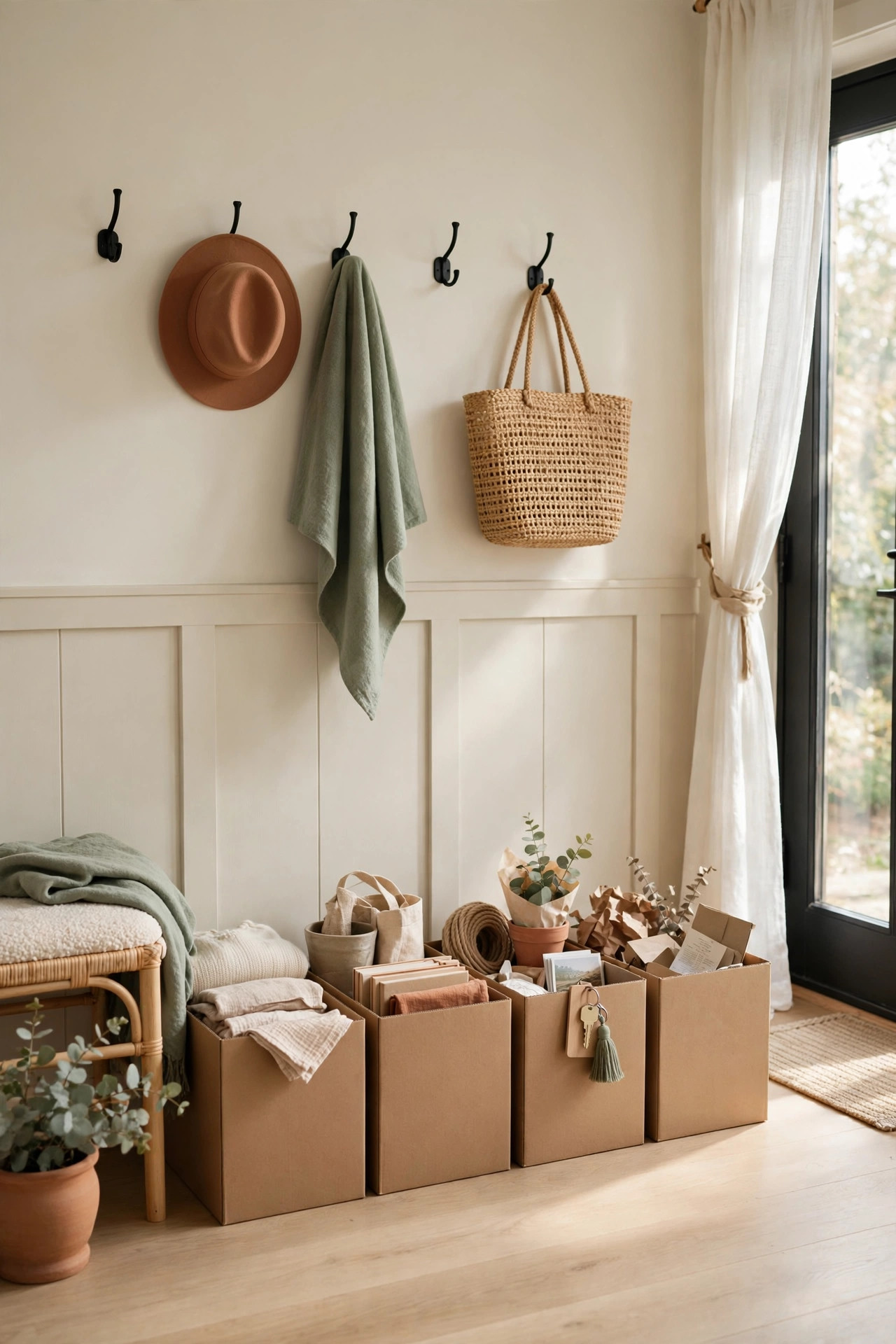
Once the trash is gone, pull out four bags or boxes and label them:
- Keep — stays in this zone because you use it here.
- Relocate — useful, but belongs in a different zone.
- Donate/sell — useful to someone, not to you.
- Trash — the stragglers the first sweep missed.
Touch every remaining item once and put it in a box. Don’t set anything “back for now” — that’s a postponed decision, and postponed decisions are exactly what built the clutter. If you hesitate for more than about ten seconds, ask two questions: Have I used this in the last six months? and Would I buy this again today at full price? Two noes means it goes in donate/sell.
Handle the relocate box immediately when the zone is done — walk those items to their homes right away. The donate/sell box gets sealed and put by the front door today, not “next weekend.” Donations that sit in bags become invisible furniture. Schedule the drop-off within 48 hours, or you’ll be re-sorting the same box next month.

Sentimental items: last, not first
Every decluttering guide puts sentimental items last, and beginners ignore it — then spend forty minutes crying over birthday cards and accomplish nothing. Sentimental items are the hardest decisions you’ll make, and hard decisions belong at the end, after your muscles are strong.
Here’s the practical version: when you’re sorting a zone and hit something with emotional weight — photos, letters, kids’ artwork, a relative’s belongings — don’t decide. Put it in the keep box for now, without guilt. You’re not keeping it forever; you’re scheduling the decision for later, when you have momentum behind you. A dedicated sentimental session, weeks in, with a finished house around you, is a completely different experience than deciding surrounded by chaos.
When that session comes, use the display test: instead of keeping all 40 birthday cards in a drawer, keep your three favorites and photograph the rest. You keep the memory (that’s the actual point) and release the bulk. Minimalism was never about throwing away your history — it’s about not paying storage rent on guilt.
What minimalism actually means for real homes
Forget the aesthetic of empty white rooms with one chair. Real-home minimalism is a ratio, not a look: every object you keep should either be used regularly or genuinely loved. That’s it. A well-stocked kitchen isn’t clutter — it’s a kitchen. Clutter is the duplicate, the broken, the “just in case” that never gets its case.
Think in terms of duplicates first, because duplicates are objective. Nobody needs three spatulas or four phone chargers for two phones. Removing duplicates alone can clear 10–15% of a cluttered space, and it needs almost no emotional energy — you keep the best one and release the rest.
Then think in terms of friction. Every object costs you a small amount of maintenance: dusting, moving, cleaning around, repairing. When you’re overwhelmed by clutter, you’re feeling that maintenance debt as physical weight. Minimalism pays down the debt. You don’t end up with nothing — you end up with a home where everything earns its place, and you can finally find your keys.
Your first week plan
Don’t try to finish your home in a week. The goal of week one is proof: proof that the system works and proof that you can follow it. Here’s the day-by-day plan:
Day 1 — Trash sweep, one zone. The junk drawer or the entryway landing strip. Trash bag only, 20 minutes. Done is done.
Day 2 — 4-box method, same zone. Sort what remains. Seal the donate box and put it by the door.
Day 3 — Drop off donations. Take the box to the donation point today. This counts as a decluttering task.
Day 4 — Trash sweep + sort, second zone. A bathroom shelf, a kitchen drawer, one closet shelf. Same process, faster this time.
Day 5 — Relocate review. Walk the house and put away every relocate item from zones one and two. Then pick zone three.
Day 6 — Trash sweep, zone three. You’re noticing a pattern. That’s the point — the method is the same every time.
Day 7 — Rest and observe. Walk through your three finished zones and notice how they feel. This is the feeling you’re building toward, one zone at a time.
If you want a longer runway after week one, The 30-Day Declutter Challenge for Beginners picks up right where this plan leaves off — one small task a day, no marathon purges. And if you want to map your whole house before continuing, the Room-by-Room Declutter Checklist for the New Year gives you every room in order at a pace you can actually finish.

Mistakes to avoid
Buying organizers before decluttering. You cannot organize clutter — you can only hide it in prettier containers. Declutter first, live with the space for a week, then measure what actually needs a home. The dollar store organization guide is for the buying phase, not the decluttering phase.
Starting with the hardest zone. The garage, the storage room, the craft corner — these are boss-level zones. They demand hundreds of decisions, including sentimental ones. Do them fourth or fifth, not first.
Decluttering someone else’s stuff. Sorting your partner’s desk or your kids’ toys without their buy-in creates conflict and gets undone in a week. Declutter your own zones. Your finished spaces become the best argument.
The “maybe” pile. There is no maybe pile. Everything goes in one of the four boxes. “Maybe” is a decision wearing a costume, and costumes pile up.
Doing it all in one day. Marathon purges produce marathon messes — and a mid-day crash that teaches your brain decluttering feels awful. Twenty minutes a day beats six hours once.
Frequently asked questions
How do I start decluttering when I’m completely overwhelmed?
Shrink the task until it’s laughably small: one drawer, one shelf, one 20-minute session. Overwhelm comes from facing hundreds of decisions at once, so the fix is making the decision set tiny. A trash sweep with zero real decisions is the ideal first move.
Can minimalism work if I have kids or a busy household?
Yes — busy households benefit most, because clutter’s maintenance cost is highest when your time is scarcest. Adjust the definition: your home needs more stuff than a solo minimalist’s, and that’s fine. The ratio still applies — used regularly or genuinely loved, everything else negotiates for its space. The 15-minute decluttering tasks fit around kids and work schedules.
What if I regret throwing something away?
It happens, and it’s survivable. Most people regret fewer than 1 in 100 decluttered items, and the regret fades within days while the calm lasts for months. Hedge your bets: photograph items before donating and keep a small “quarantine box” for borderline items with a 30-day expiry. Almost everything is replaceable.
How long does it take to declutter a whole house?
With 20-minute daily sessions, most people finish a typical home in 4–8 weeks. The number doesn’t matter — the only deadline is “keep going.” Speed comes from consistency, not intensity. One finished zone beats five half-sorted rooms every time.
Do I need to buy anything to start decluttering?
No. You need four bags or boxes (reuse grocery bags and shipping boxes) and a trash bag. That’s the complete supply list. Buy organizers only after you’ve decluttered and measured what needs storing — browse more storage ideas when you’re ready for that phase.
Conclusion
Overwhelm isn’t a character flaw — it’s your brain telling you the job is too big in its current form. Shrink it to one zone, warm up with a trash sweep, sort with four boxes, save the sentimental decisions for last, and repeat for twenty minutes a day. A week from now you’ll have three finished zones and a system that works anywhere in your home. Save this pin for later.