Pet gear spreads fast in a small apartment. One week you have a food bag, a leash, and two toys; a few months later the kibble bag lives on the kitchen floor, toys migrate under the sofa, and the leash ends up draped over a dining chair. If you are looking for pet supply storage ideas that actually fit a small space, the fix is not a bigger apartment or a pet room. It is a system: one feeding station, one toy bin, and door gear that never leaves the entryway. These 15 ideas give every category of pet supplies a home, so the gear stops colonizing your floors and your apartment still looks like yours.
The pet audit: food, toys, gear, and vet supplies
Before you buy a single bin, empty every pet item you own onto one surface and sort it into four piles: food, toys, walk gear, and vet and grooming supplies. Most small-apartment pet clutter is not too much stuff. It is stuff with no assigned spot, so each category drifts to a different corner. The audit takes about 20 minutes and tells you exactly how much storage each category needs, which stops you from buying a bin that is too big for the toys and too small for the food.
1. Audit every pet item into four piles before buying anything. Count bags, toys, leashes, medications, and grooming tools separately. If a pile fits in one shoebox, it needs a shoebox-sized home, not a whole shelf.
2. Set one home per category and label it. Food goes in the kitchen, walk gear by the door, toys in the living room, and vet supplies in one bathroom drawer or box. When a category has one home, stray items are obvious and easy to return.
Feeding station that doesn’t take over the kitchen
A feeding station earns its floor space only if it contains the mess instead of spreading it. The goal is a station roughly 24 inches wide that holds bowls, a mat, and the current bag or bin, with nothing spilling onto the surrounding floor.
3. Build a contained feeding station on a washable mat. Use a silicone or rubber mat about 24 by 18 inches under the bowls, with a raised lip of at least half an inch to catch spilled water and kibble. Place it against a wall, not in a walkway, so the bowls are never kicked across the kitchen.
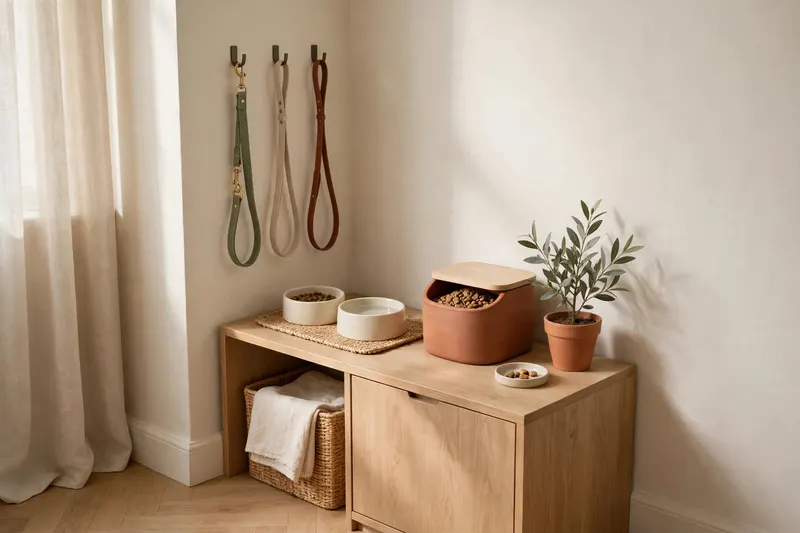
4. Use a raised feeder with storage underneath. A feeder stand 4 to 8 inches high (sized to your pet) with a drawer or open shelf below holds a small food bin and a measuring scoop in the same footprint as the bowls. One piece of furniture replaces a bowl set, a food bag, and a loose scoop.
Toy rotation: one bin out, the rest stored
Pets do not need access to every toy at once. In fact, a smaller selection kept in rotation stays interesting longer, and your living room stays walkable. This is the same rotation principle that works for children’s toys, and the approach in our guide to kids toy storage ideas for small living rooms — one bin out, the rest stored — translates directly to pet toys.
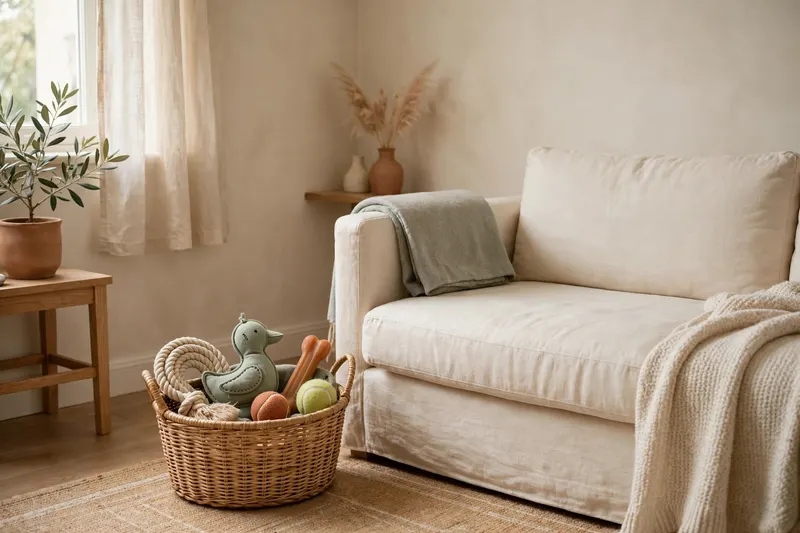
5. Keep one toy bin out and store the rest in a closet bin. Choose a lidded bin about 12 by 10 by 8 inches for the daily toys, and a second bin on a closet shelf for the rotation stock. Swap 3 to 4 toys every Sunday so the selection feels new without buying more.
6. Sort toys by type so cleanup takes two minutes. Put chew toys, fetch toys, and puzzle toys in separate small pouches or compartments inside the bin. At the end of the evening, everything goes back in one sweep instead of a hunt under furniture.
Leash, harness, and walk gear by the door
Walk gear is the category most likely to end up on a chair, because it is used several times a day and never quite makes it back to a drawer. It needs a station at the door, not in a closet.
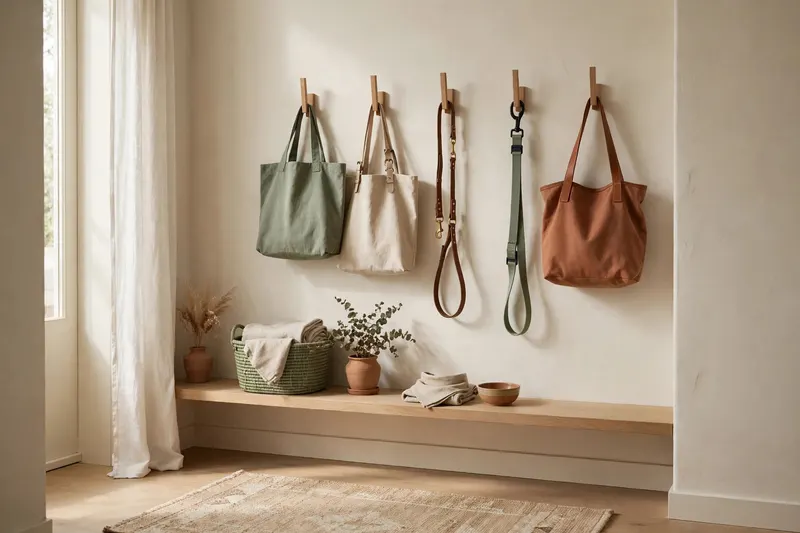
7. Hang a dedicated walk station beside the front door. Mount 3 to 4 adhesive or screw-in hooks at shoulder height for the leash, harness, and poop-bag holder, plus a small tray or wall pocket below for treats and keys. Everything for a walk is grabbed in one motion, and nothing lands on the dining chairs.
8. Add a muddy-paw kit at the door. Keep a small basket with a towel, paw wipes, and a boot tray about 14 by 10 inches by the threshold. Wet paws get handled at the door instead of tracked across the apartment, and the basket doubles as the spot for the harness on rainy days. If your entryway needs a fuller setup, the ideas in our guide to small mudroom ideas for apartments show how to build a complete catch-and-contain zone in just a few square feet.
Food storage: airtight bins and portion systems
Open kibble bags go stale, attract pests, and take up awkward floor space. Sealed, portioned storage solves all three problems and makes feeding faster.
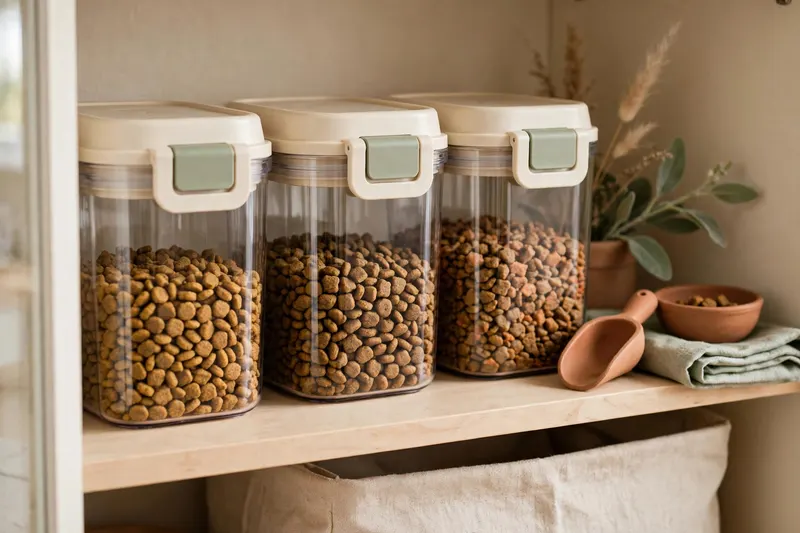
9. Decant food into an airtight bin sized to one bag. A bin of roughly 10 to 15 quarts holds a standard small bag of kibble; buy the bin after the audit, not before, so it matches the bag you actually buy. Keep the bin in the kitchen or on a pantry shelf, never on the floor by the feeding station. The same decanting logic works for people food too, as shown in our guide to small apartment pantry organization ideas.
10. Pre-portion meals for the week in labeled containers. Fill seven small lidded containers or zip bags with one day’s food each on Sunday. Weekday feeding becomes grab-and-pour, the scoop never goes missing, and you can see at a glance whether the week’s food is running low.
Vet records and grooming supplies in one spot
Vet paperwork and grooming tools are small, easy to lose, and urgently needed exactly when you cannot find them. One box solves the problem.
11. Keep one vet file with records, prescriptions, and vaccination dates. Use a single folder or slim binder with sections for vaccination records, prescription details, and the vet’s phone number written on the front. Store it with the grooming kit, not in a general filing pile, so a vet visit never starts with a search.
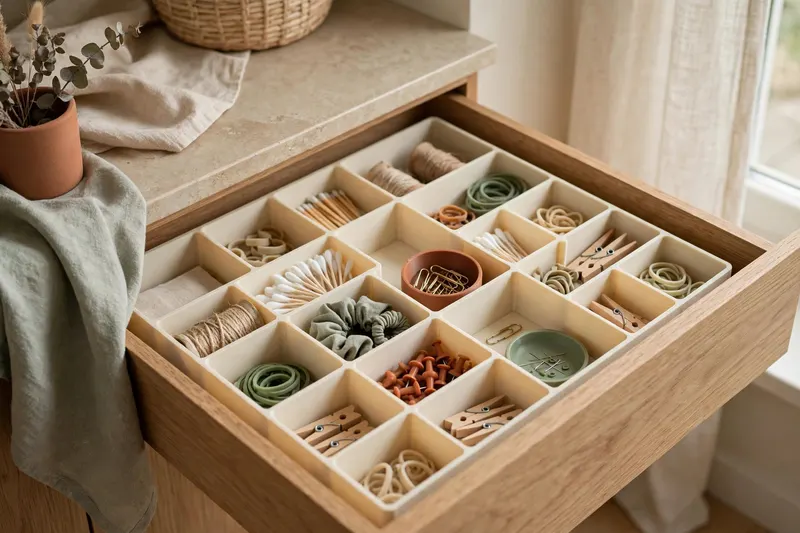
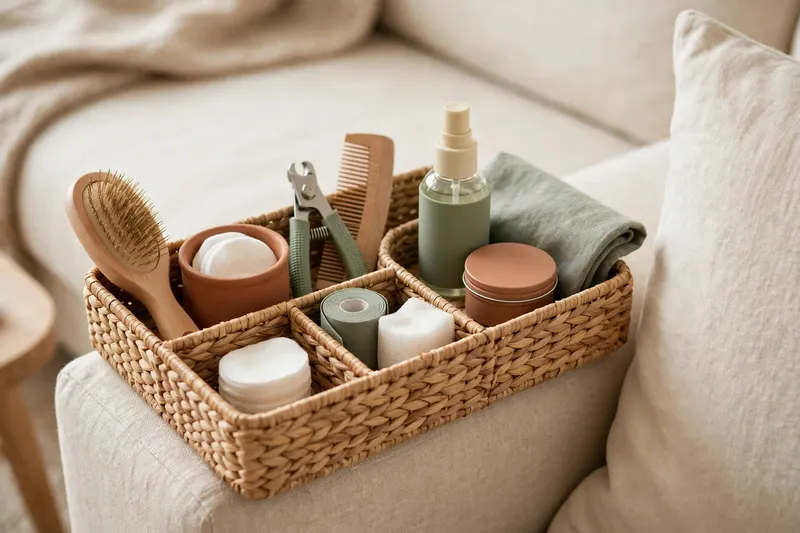
12. Pack grooming supplies into a single portable caddy. A caddy about 10 by 6 by 6 inches holds a brush, nail clippers, shampoo, and ear cleaner, and it moves to the bathroom or balcony for grooming sessions and back to its shelf afterward. If a tool does not fit the caddy, it does not belong in the daily kit.
Pet storage that looks like home decor, not a kennel
Pet storage only works long-term if you do not mind looking at it. In a small apartment, every bin is visible, so the storage has to blend with the room.
13. Choose woven baskets and wood-toned bins over wire crates for display. A seagrass basket or a lidded wooden crate holds toys or food just as well as a plastic tub, and it reads as furniture. Match the material to the room: baskets in the living room, ceramic or stainless in the kitchen.
14. Use furniture with hidden pet storage. An ottoman with a lift-off lid, a bench with a hollow seat, or a side table with a lower shelf hides a toy bin or food container inside furniture you already need. The pet gear disappears when guests arrive, with no extra footprint.
15. Hide the litter box or crate behind a furniture-style enclosure. A side-table enclosure or a cabinet-style crate cover turns the least attractive pet item into a piece that matches your decor. Leave the ventilation openings clear and the door accessible, and choose an enclosure sized to the litter box plus at least 2 inches of clearance on each side.
Mistakes to avoid
Buying storage before the audit is the most common mistake: you end up with bins that fit nothing you own. Other traps include storing food in the original open bag on the floor, which invites staleness and pests; keeping every toy out at once, which defeats rotation and clutters the living room; and hanging walk gear on a bedroom door, where it is out of sight at the exact moment you need it. Avoid novelty pet furniture that holds less than a plain bin of the same size. And never store medications in a spot a pet can reach, such as an open low shelf — a closed, high box is the minimum.
Frequently asked questions
How do I store pet supplies in a really small apartment?
Give each category one small, specific home: a contained feeding station in the kitchen, a single toy bin in the living room, hooks by the door for walk gear, and one box for vet and grooming supplies. Small, assigned homes beat one large storage unit, because the gear stays where it is used.
Can I keep pet food in the kitchen without it smelling?
Yes, if the food is sealed. Decant kibble into an airtight bin, keep the bin closed between meals, and store it away from heat sources like the stove. An open bag is what smells; a sealed bin does not.
How many toys should a dog or cat have out at once?
About 5 to 8 toys in the daily bin is plenty for most pets. Store the rest and rotate 3 to 4 toys each week. Fewer toys out means faster cleanup and a more interesting selection for your pet.
Where should I put a litter box in a small apartment?
Choose a low-traffic corner with ventilation, such as a bathroom corner or a laundry nook, and use a furniture-style enclosure to make it blend in. Avoid the kitchen and the entryway, where odors and tracking cause the most friction.
Conclusion
Small apartment pet organization comes down to one feeding station, one toy bin, and door gear that never wanders. Audit first, assign every category a home, and choose storage that looks like it belongs in your rooms. For more ideas in this vein, browse our storage ideas collection, and save this pin for later so the system is there when the pet gear starts spreading again.