A half-finished puzzle is the worst kind of clutter in a small apartment. It is too fragile to move, too big to ignore, and it claims your only dining table for days at a time. You end up eating over the sink and tiptoeing past a thousand loose pieces. These puzzle storage ideas fix that without asking you to give up puzzling. With a roll-up mat, a few sorting trays, and a proper vertical home for your boxes, you can keep a work in progress safe and clear the table in under a minute — and get your evenings back.
The work-in-progress problem: puzzles need a home mid-build
A 1,000-piece puzzle needs roughly 27 by 20 inches of flat surface for a week or more. In a small apartment, that surface is usually the dining table. One bumped corner and hours of sorting scatter. The fix is a portable home base.
1. Give every puzzle a dedicated home base
Build on one base — a board, a mat, or a tray system — never directly on the table. A dedicated base lets you lift the whole puzzle in one motion. Size it to your usual puzzle: 24 by 18 inches for 500 pieces, 30 by 22 for 1,000.
Roll-up mats and puzzle boards that slide under furniture
The roll-up mat is the classic small-space puzzle tool: it turns a table-sized project into a tube you can lean behind the sofa. Puzzle boards do the same job with a hard surface. The trick is choosing a system that fits your puzzle size and your hiding spot.
2. Roll up the puzzle in a felt mat when dinner calls
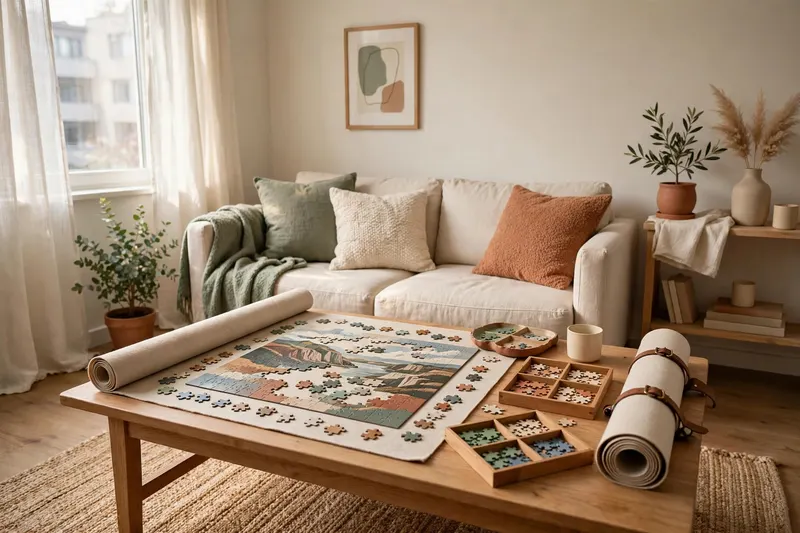
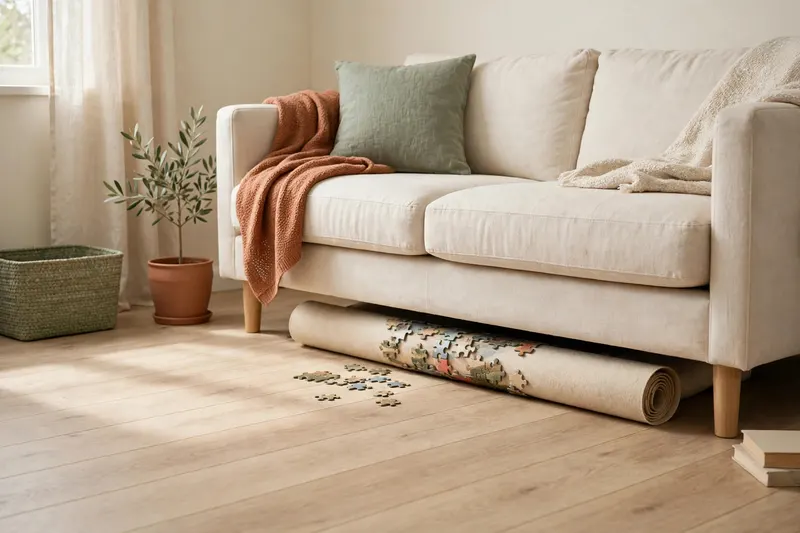
A felt roll-up mat rolls a half-finished puzzle into a tube in thirty seconds. Build on the mat, then roll it snugly around the tube and secure the straps — the felt grips the pieces so they stay put. Standard mats fit 1,000-piece puzzles; choose one 30 inches wide for 1,500-piece builds.
3. Build on a puzzle board with raised edges
A puzzle board is a flat, rigid surface with a raised lip, usually wood or thick foam core. The lip stops pieces sliding off, and the board slides under a bed or shelf. Look for a smooth surface and a lip under half an inch, so pieces glide and your hands clear it.
4. Slide the board under the bed or sofa between sessions
Under your bed is the best hiding spot a puzzle board will ever have: a standard frame leaves 6 to 8 inches of clearance — plenty for board, puzzle, and a thin cardboard dust cover. If your bed sits low, bed risers add about 3 inches.
Portfolio cases and folders for finished puzzles
Finished puzzles need a different kind of home. They are flat, fragile, and oddly shaped for a shelf, and stacking them crushes the bottom ones. Portfolio cases — the zippered folders artists use for large drawings — hold finished puzzles flat and dust-free, and stand upright like books.
5. Store finished puzzles flat in a zippered portfolio case
A standard A2 portfolio case (about 24 by 17 inches) holds two or three finished 1,000-piece puzzles, separated by wax paper. The zipper keeps dust out, the rigid covers stop bending, and the case slides onto a bookshelf like a thick book. Label the spine with the puzzle’s name.
6. Keep a puzzle folder for the ones you rotate through
If you rebuild favourites, keep them in one accordion folder or document wallet rather than a full case. Slide each finished puzzle, mounted on foam core, into its own pocket.
Sorting trays: keeping pieces grouped without a table takeover
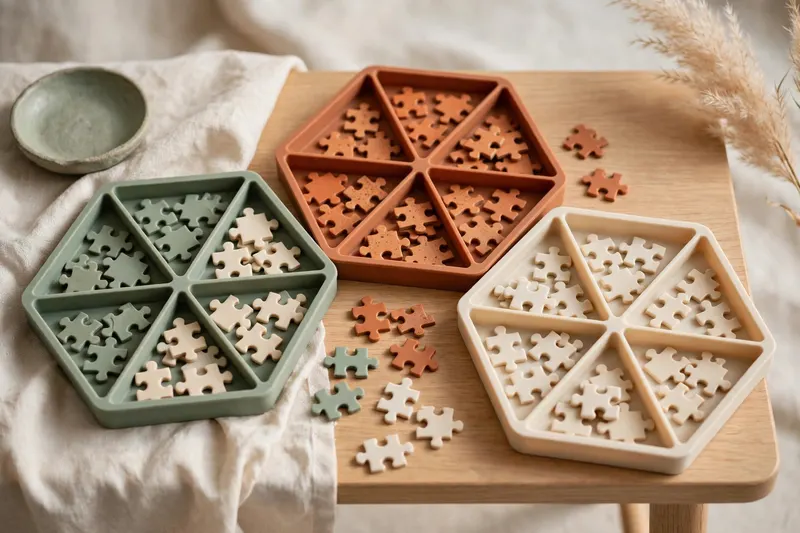
Sorting is where most puzzles sprawl: border pieces in one pile, sky pieces in another, and soon the whole table is covered. Sorting trays contain that sprawl into a stackable footprint.
7. Sort pieces into stackable puzzle trays
Stackable sorting trays, sold in sets of six or eight, are shallow trays that nest into a pile. Sort by colour, edge versus interior, or by picture section — one tray per group. When you need the table, stack the trays and set the pile on a shelf. Six 9-by-7-inch trays stack about 4 inches tall.
8. Use small dishes and a muffin tin for micro-sorting
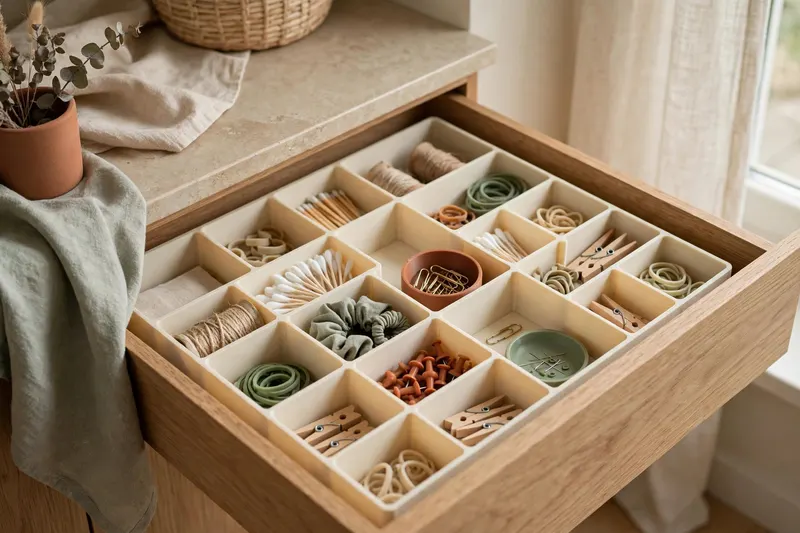
For the final stage — sorting a few dozen similar pieces by shade — you do not need a full tray. Small ceramic dishes, a muffin tin, or a craft box work just as well and cost nothing. A 12-cup muffin tin is surprisingly good: each cup holds one shade group, and it sits on a table corner without wobbling. The same small-part sorting works for craft supply organization in small spaces.
Box storage: vertical, labeled, and out of the way
Puzzle boxes are wide and shallow and do not stack neatly, so most people end up with a leaning tower on top of a wardrobe. Vertical storage — boxes on their sides like books — fixes the tower and makes every box visible.
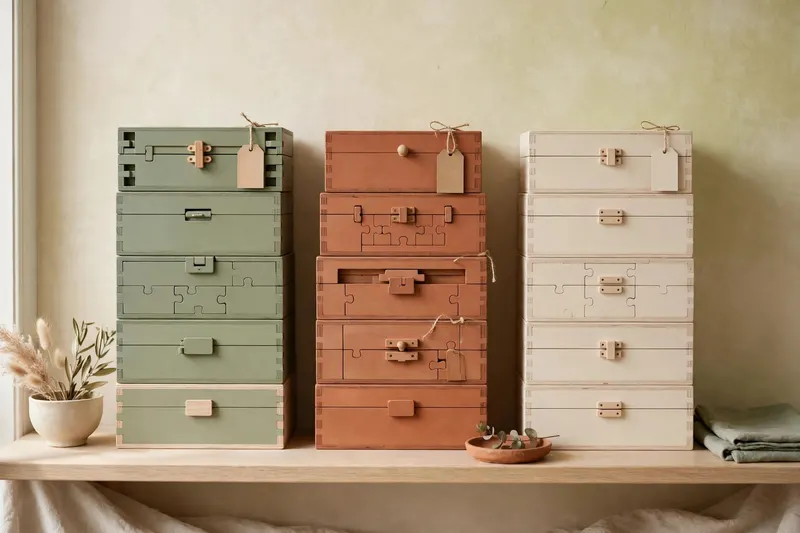
9. Store puzzle boxes vertically like books on a shelf
Turn each puzzle box on its side, picture facing out, and line the boxes up on a shelf like books. You can see every puzzle at a glance and pull one out undisturbed. Most boxes are about 8 inches deep, so a standard 10-inch shelf works. Keep the heaviest boxes at the bottom so light ones are not crushed.
10. Label the box spine with piece count and status
A row of vertical boxes looks tidy, but the spines all look alike. Wrap masking tape around each spine and write three things: piece count, puzzle name, and status — “unstarted”, “in progress”, or “finished”. That label saves you from pulling out five boxes to find the one you want. The same spine-labelling trick works for board games in a small apartment too.
11. Corral the box collection in one under-bed bin
If your collection has outgrown your shelf, give it one hard boundary: a single under-bed bin, about 32 by 16 by 6 inches. When the bin is full, the collection is full. The bin keeps dust off the boxes and stops puzzles spreading beyond the wardrobe top.
Displaying finished puzzles without a frame shop bill
A finished puzzle deserves to be seen, but a professional frame can cost more than the puzzle itself — these two ideas get one onto the wall for a few dollars.
12. Hang finished puzzles in cheap poster frames
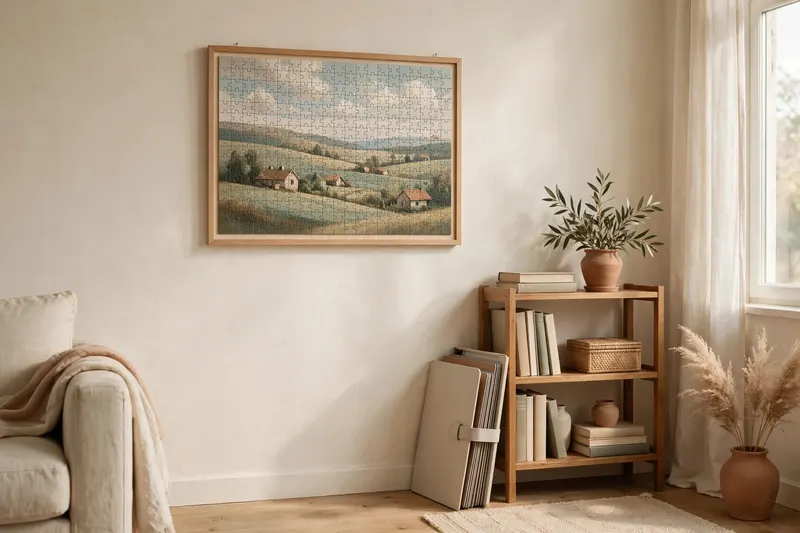
A poster frame in the right size — 20 by 28 inches fits most 1,000-piece puzzles — costs a fraction of custom framing. Glue the puzzle first, let it dry flat overnight, then slide it into the frame. Hang it with a Command strip or a single nail.
13. Mount a finished puzzle on foam board for a no-frame display
If frames feel too formal, mount the finished puzzle onto foam core cut to size. Glue the puzzle to the board, trim the edges flush, and hang it with two small Command strips. The result looks like a floating art print and weighs almost nothing. Foam board costs a dollar or two per sheet. Collectors use the same thinking in our guide to small apartment storage ideas for collectors.
The one-puzzle rule: finishing before starting the next
All the storage in the world will not help if three half-finished puzzles compete for one table. The final two ideas are not about containers — they are about the habit that keeps them from overflowing.
14. Finish one puzzle before opening the next
The one-puzzle rule is simple: no new box opens until the current puzzle is finished, glued, framed, or packed away. It is the most effective puzzle organization rule for a small apartment: every unfinished puzzle is a second table, a second set of trays, and a second box. If you lose interest halfway through, pack it away, label it “unfinished”, and move on.
15. Keep a puzzle log to stop repeat buys and duplicates
A notebook or phone note listing every puzzle you own stops you buying one you already have. When you finish a puzzle, note how long it took and whether you would do it again. Puzzles marked “would not rebuild” are the first to pass on. The same thinking applies to our LEGO storage ideas for small spaces: knowing what you own is half the storage battle.
Mistakes to avoid
The most common mistake is building directly on the table — one bumped elbow and the whole build is on the floor. Second, do not buy a mat too small for your puzzle; pieces hanging off the edge scatter every time you roll it. Third, never store finished puzzles somewhere damp — cardboard absorbs moisture, warps, and can grow mould. Fourth, do not glue a puzzle you still want to rebuild; once glued, it can never be taken apart. Finally, do not buy a dedicated puzzle table unless you have measured where it will live when not in use — most are just large boards with legs.
Frequently asked questions
Can you store a jigsaw puzzle halfway through?
Yes — build on a roll-up mat or puzzle board, then roll or slide the build out of the way. A felt mat keeps pieces in place while rolled, and a board protects the build under a bed.
How do you store puzzle boxes in a small apartment?
Store the boxes vertically on a shelf, like books, with a label on the spine showing piece count and status. If the collection outgrows the shelf, move it into one under-bed bin as the hard limit.
What is the best way to sort puzzle pieces in a small space?
Stackable sorting trays are best because they nest into a small pile. Sort by colour or picture section, one tray per group. For the final stage, small dishes or a muffin tin work well for separating similar pieces.
How can I display a finished puzzle without framing it professionally?
Glue the finished puzzle, mount it on foam core board, and hang it with two Command strips. It looks like a floating print, weighs almost nothing, and costs a few dollars. A cheap poster frame is the other low-cost option.
Do roll-up puzzle mats damage the puzzle?
No — as long as the mat is the right size and you roll it snugly, not tightly. Pieces stay put because the felt grips them. Let the puzzle lie flat for a few minutes after unrolling so any curl in the edge pieces settles.
The takeaway
A small apartment does not mean giving up jigsaw puzzles — it means a portable home for each puzzle, stackable trays, and boxes stored vertically where you can see them. Start with a roll-up mat and sorting trays, add the one-puzzle rule, and your table will be yours again. Save this pin for later, and browse our storage ideas collection when your next project needs a home.