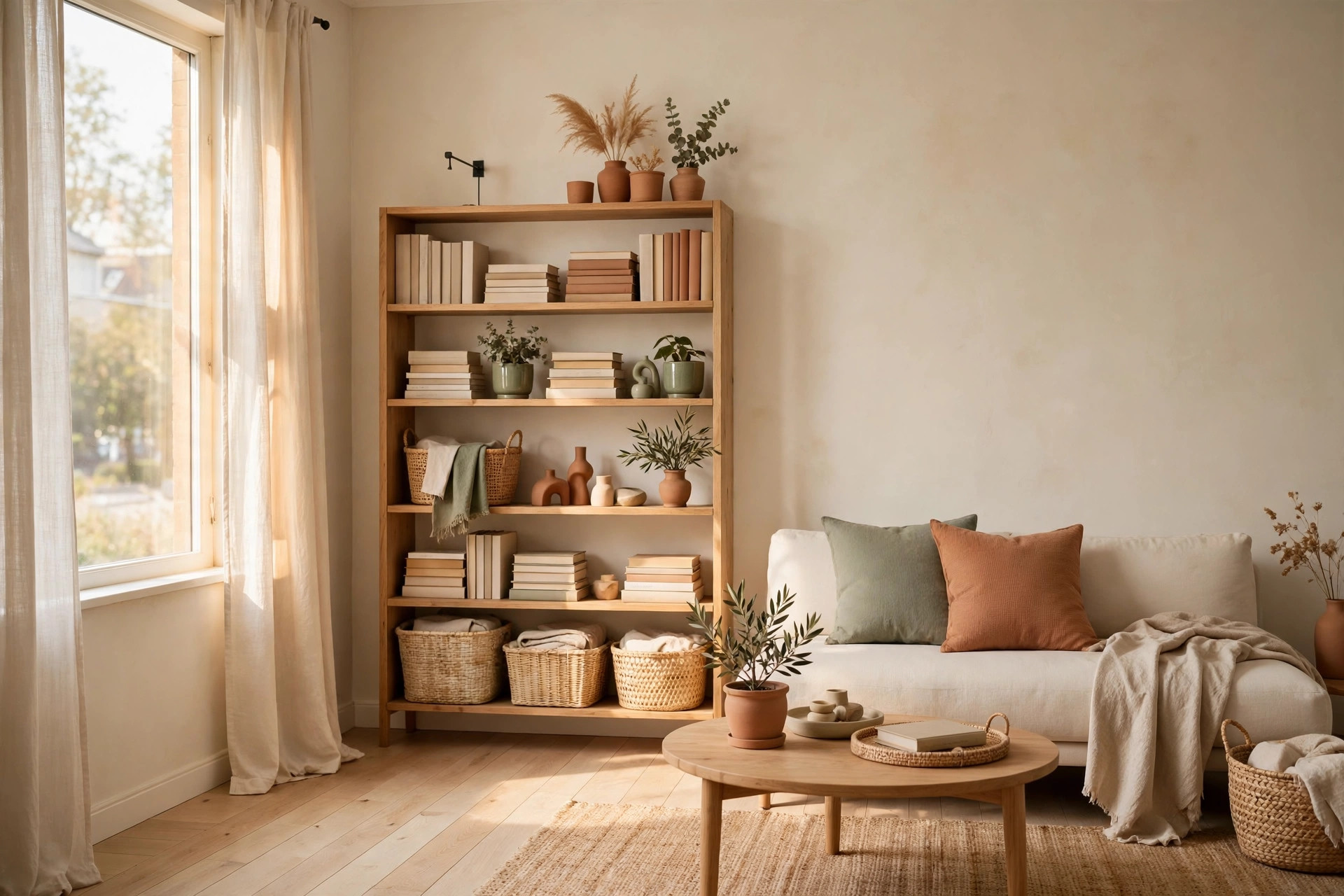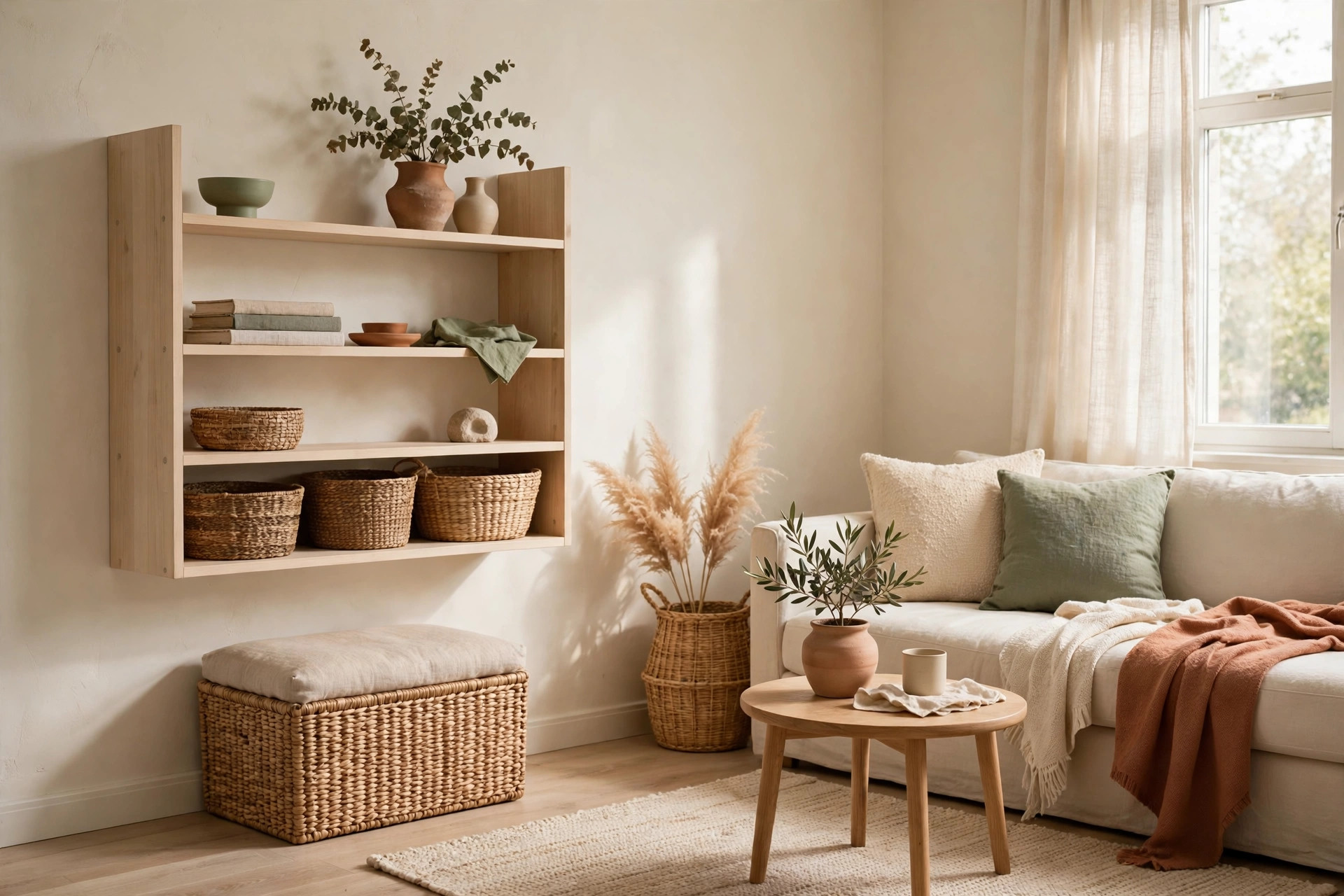
Small apartments ask every object to do two jobs. The basket on the shelf should look good and hold the blankets. The bench by the door should finish the entryway and swallow the shoes. When decorating and storage fight for the same square footage, one of them always loses — usually your sanity. The good news is that small apartment decorating storage ideas work best when the two jobs merge into one: pieces that are visibly beautiful and quietly useful.
Below are 16 ideas that do exactly that. Each stores something real — blankets, books, shoes, mail, chargers — while making the room look more intentional. No renovation, no built-ins, nothing a renter cannot undo in an afternoon.
Pretty and practical: the decorating-storage overlap
The trick is choosing pieces where the storage IS the decoration. A lidded basket is a texture, a shape, and a container at once. A stack of books is a color story and a shelf-filler. When the storage item is attractive on its own, you never have to hide it.
1. Let a big beautiful basket be the room’s anchor
Choose one oversized basket — roughly 18 to 20 inches wide and 14 inches tall — in seagrass, cotton rope, or woven water hyacinth, and give it a visible home: beside the sofa, at the foot of the bed, or next to the front door. Fill it with daily-use items — throw blankets, dog toys, spare shoes — and let folded textiles show at the rim. Keep it to one large basket per room so it stays a feature, not a pile.
2. Turn a stack of books into a styled display
Books are the easiest decorative storage because you already own them. Stack three to five hardcovers horizontally on a console, coffee table, or nightstand, largest at the bottom, and set a small plant or candle on top. Put the books you actually read at the bottom and the prettiest spines on top. A stack takes up about 12 inches of surface and hides a remote or reading glasses underneath the top book — clutter, disguised as styling.
Baskets and boxes that look intentional, not hidden
Baskets fail as decor when they are random: five materials, three sizes, no plan. They succeed when they look like a set. Pick one material family and one or two colors, then repeat them across the apartment so the eye reads “collection” instead of “clutter.”
3. Use matching lidded baskets on open shelves
Open shelves look messy when every object is visible. Lidded baskets fix that in one move: the shelf stays styled, the contents stay hidden. Choose baskets about 2 inches shorter than the shelf opening so lids clear easily, and label the inside of the lid so only you know what is inside. Two matching baskets per shelf, with one open display item between them, looks curated rather than packed.
4. Corral the small stuff in a lidded box that earns its place on the table
Remotes, chargers, hair ties, and keys migrate to every flat surface. Give them one home: a lidded box roughly 12 by 8 inches in wood, leather, or linen, kept on the coffee table or entry console. The rule is simple — if it fits in the box, it lives in the box; if it doesn’t, it doesn’t belong on that surface. Because the box is attractive, guests see a styled object, not a junk drawer with a lid.
Display shelves that store and style at once
Shelves are the highest-return surface in a small apartment: they use wall space you were not using, and they put your storage on display. The difference between a styled shelf and a storage unit is editing — roughly two-thirds display, one-third storage, nothing that doesn’t earn its spot.
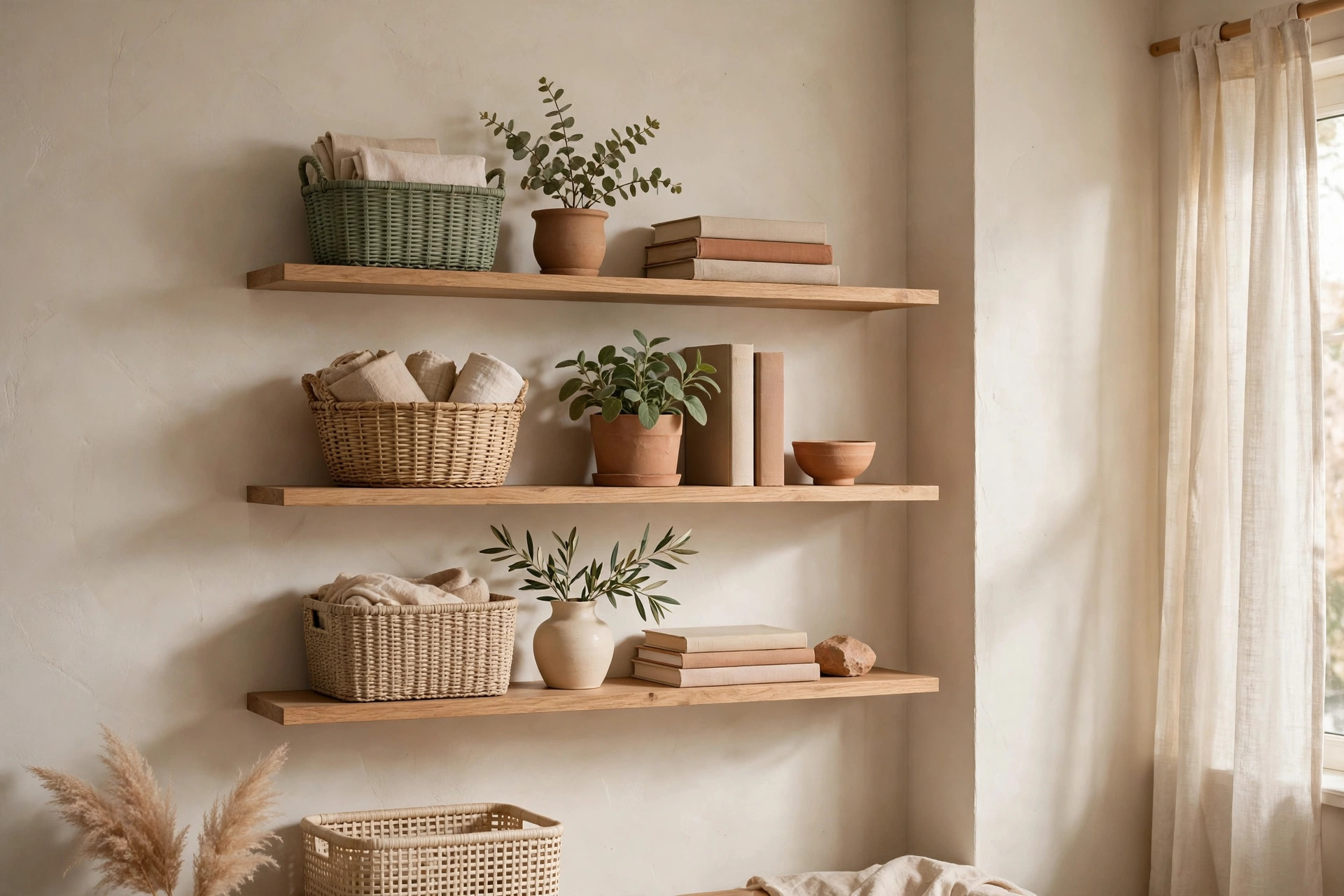
5. Style a picture ledge with books and a basket behind
A narrow picture ledge — 4 to 6 inches deep — holds framed prints, small plants, and upright books, and the books store themselves while decorating the wall. Lean two or three frames at the back, stand five or six books in front, and tuck a small woven basket at one end for the bits that don’t fit elsewhere. Ledges work in hallways, above desks, and over sofas, where a deep shelf would crowd the room.
6. Dedicate one shelf to “display storage” and keep it honest
Pick the shelf at eye level and treat it as your display-storage shelf: pretty containers only. Glass jars for cotton balls and bath salts, a ceramic canister for coffee, a wooden box for tea. Everything here must be both used weekly and pleasant to look at. If an item is useful but ugly, it moves to a closed cabinet; if it is pretty but unused, it moves out. For more shelf ideas that hold real weight, see these 16 Bookshelf Organization Ideas for Small Apartments.
Furniture with hidden storage: ottomans, benches, beds
Hidden-storage furniture is the backbone of decorative storage. It costs more than a basket, so choose pieces that replace something you already own — an ottoman instead of a coffee table, a bench instead of a console — rather than adding furniture to an already full room.
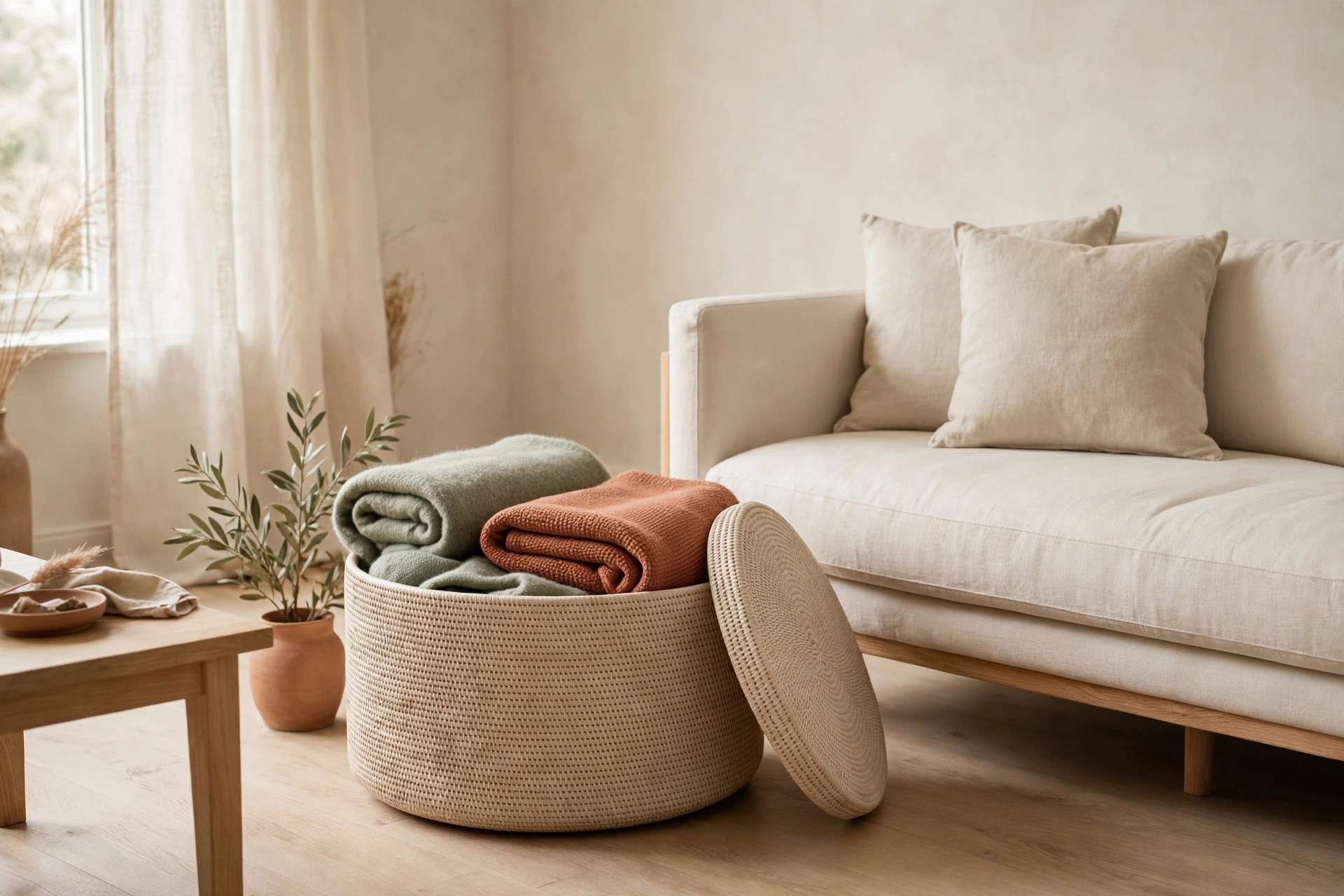
7. Swap the coffee table for a storage ottoman
A rectangular storage ottoman — about 36 by 18 inches, 16 to 18 inches high — holds board games, extra blankets, and art supplies inside, and gives you a soft surface for feet, a tray, or a laptop. Choose a firm, flat top (not tufted) so a tray sits level, and pick a performance fabric or wipeable faux leather if you eat on the sofa. You lose nothing: the ottoman takes the same footprint as the table it replaces.
8. Put a storage bench at the end of the bed or by the door
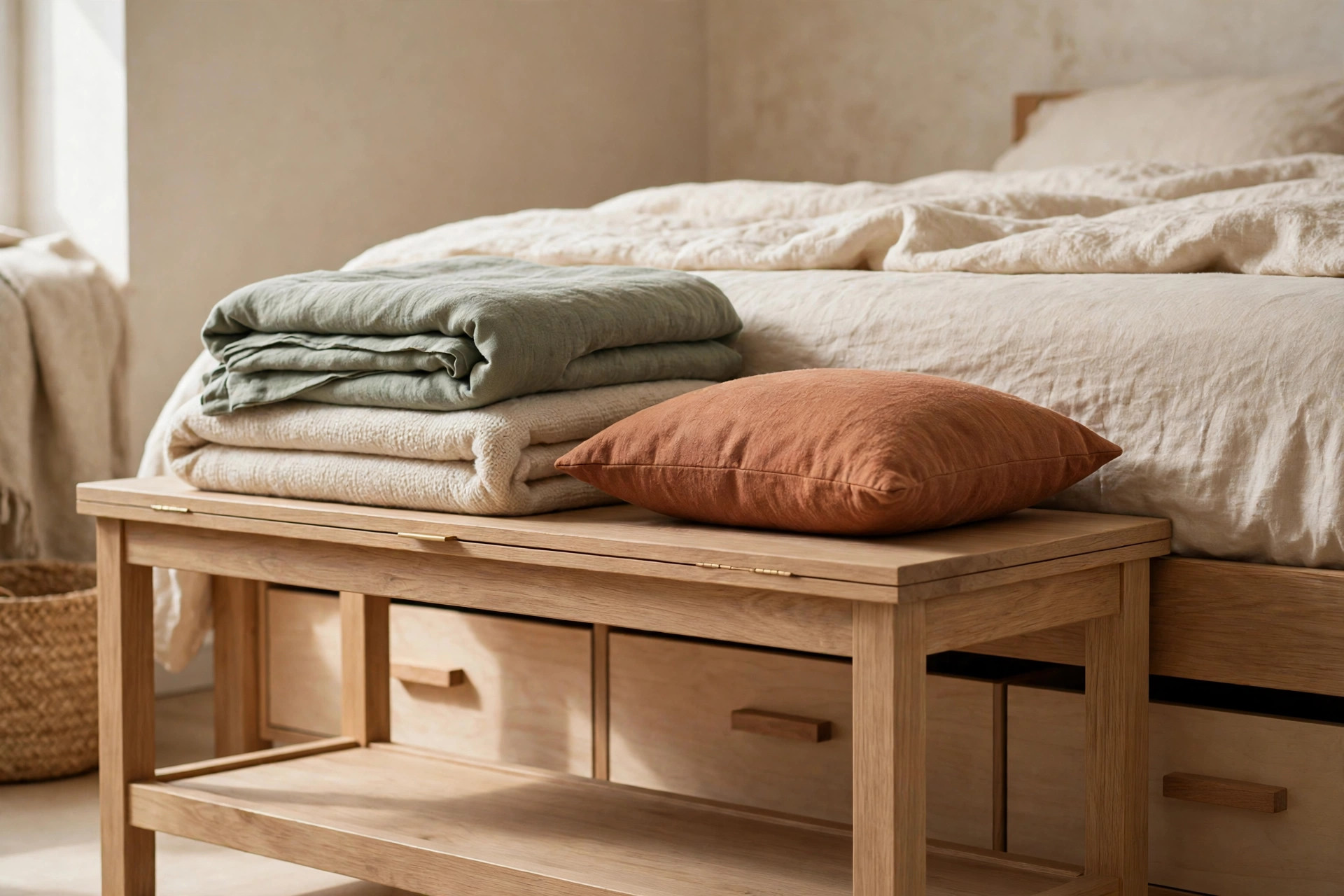
A bench with a lift-up lid or two deep drawers stores off-season clothes, spare linens, or the shoes that never make it into the closet. At the foot of the bed it holds the extra blanket and the book you are reading; by the door it is a seat for putting shoes on. Leave at least 24 inches of clear walking space in front of it, or it becomes an obstacle. If your bedroom has no closet, pair the bench with the ideas in Bedroom Storage Ideas for Small Rooms With No Closet.
9. Choose a bed frame with drawers or a lift-up base
The space under a bed is the largest hidden storage zone in a small apartment — roughly 30 to 35 cubic feet under a queen. A frame with two or four drawers, or a lift-up base, turns that dead space into seasonal storage without adding a single visible box to the room. Store bulky bedding, out-of-season clothes, and suitcases there. Keep a short list taped inside the top drawer so you remember what is underneath; under-bed storage only works if you can find things again.
Wall decor that holds things: peg rails and ledges
Walls are free real estate, and peg rails turn them into storage that looks like design. A rail with hooks and pegs is both a display and a coat rack — the trick is hanging things you actually like looking at.
10. Hang a peg rail and treat it as wall art
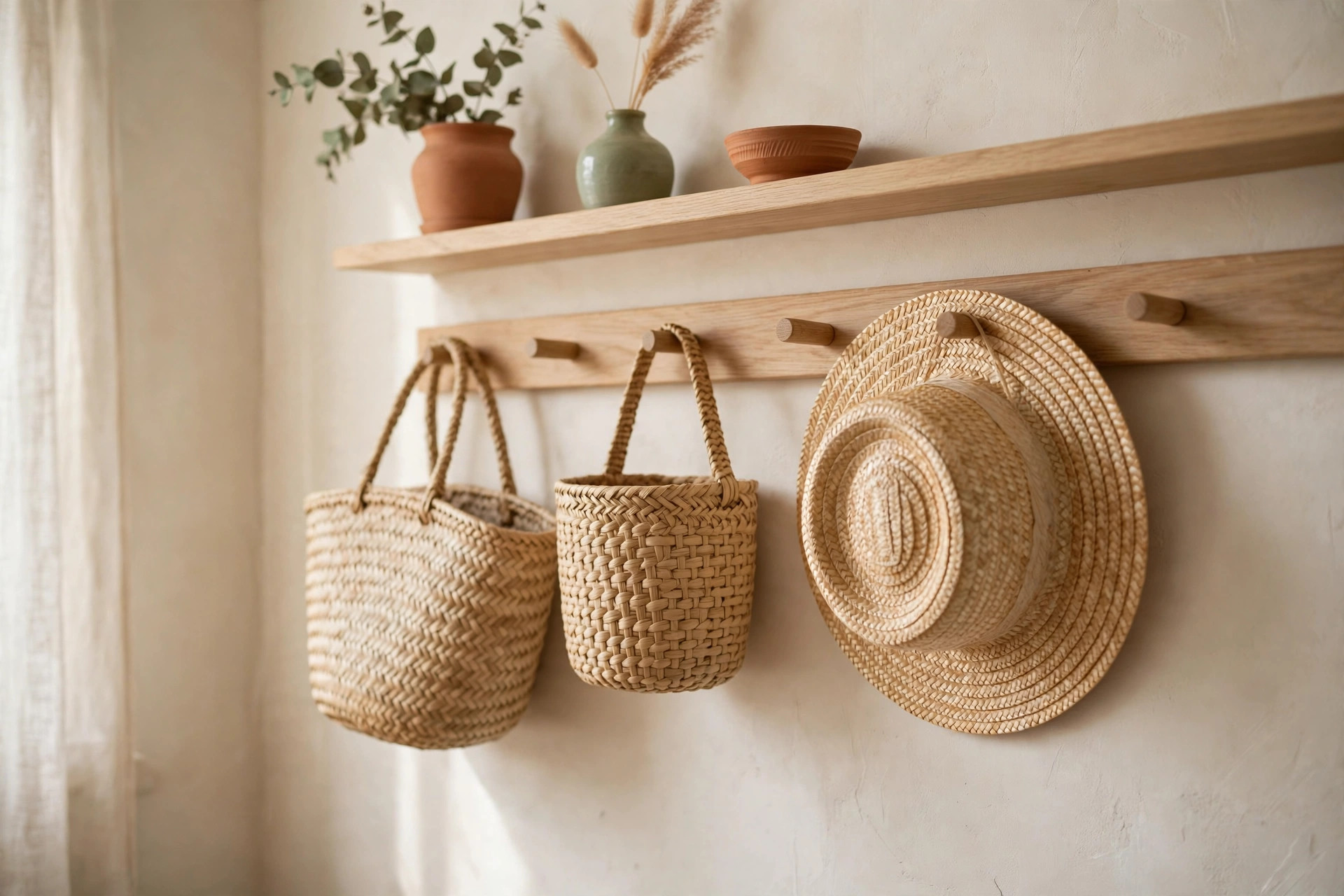
Mount a wooden peg rail — 36 to 48 inches long, pegs every 6 to 8 inches — in the entryway, bedroom, or kitchen. Hang a hat, a tote bag, a woven basket, and a small plant. The rail stores coats, bags, and dog leashes, but because the objects are spaced and the wood is visible, it reads as a styled wall feature. Hang only what you use weekly; anything untouched for a month comes down.
11. Use a wall-mounted ledge as a mini bar or vanity shelf
A 24-inch floating ledge with a small lip holds perfume bottles, a jewelry stand, or three or four pretty glasses and a bottle — a vanity or bar that takes zero floor space. Add a small mirror above it and the ledge becomes a focal point. Keep the count low (five to seven objects) and leave breathing room between them; a crowded ledge looks like a shelf that fell over. For plant lovers, a similar ledge displays greenery without losing a surface — see 15 Indoor Plant Display Ideas for Small Apartments.
Entry and living room styling with storage built in
The entry and the living room are the two places guests see first, and the two places clutter lands fastest. Both need storage that is part of the furniture, not added to it.
12. Style the entry console with a basket underneath and a tray on top
A slim console table — 10 to 12 inches deep — fits even a narrow entry. Put a lidded basket or two under it for shoes and dog gear, a small tray on top for keys and mail, and one framed print or mirror above. The tray is the discipline: keys and mail live on the tray, never scattered across the table. If your entry has no foyer, the same setup works against any blank wall — see Small Entryway Organization Ideas With No Foyer.
13. Float a shelf above the sofa as a living room display
One floating shelf, 36 to 48 inches long, mounted 12 to 18 inches above the sofa back, holds framed photos, a small plant, and a row of books — storage and decor in a single line. It frees the coffee table and side tables, which is the point: every surface you clear stops collecting clutter. Keep the load light (under 15 pounds total) and use proper wall anchors so it stays renter-safe.
14. Hide the media clutter in a lidded media console
Routers, remotes, game controllers, and cables are the ugliest residents of a small living room. A low media console with solid doors — not open cubbies — hides all of it behind one clean front. Drill one discreet cable hole in the back panel if needed, and keep a small lidded box inside for the controllers. The TV wall then shows one piece of furniture, not a tangle of electronics.
Keeping it calm: the uniformity and edit rule
Decorative storage only works if the room stays calm. Six basket styles, four wood tones, and a rainbow of boxes look chaotic no matter how organized the contents are. Uniformity is what makes storage look like decorating.
15. Repeat one material and one color story everywhere
Pick one basket material (seagrass, cotton rope, or wood) and one neutral palette (ivory, beige, sage, or terracotta) and use them in every room. Same baskets in the living room, bedroom, and entry; same box style on the shelves and console. Repetition turns scattered containers into a design scheme. A new container must match the family or it doesn’t come home.
16. Edit one item out every time you style a surface
The final idea is a habit, not a purchase. Every time you restyle a shelf, table, or ledge, remove one item before you add anything. A styled surface holds five to seven objects at most; the eighth tips it into clutter. If you can’t decide what to remove, remove the thing you haven’t touched in a month. Decorating a small apartment is mostly editing.
Mistakes to avoid
- Buying storage before decluttering. A basket full of things you don’t need is still clutter — just prettier clutter. Edit first, then buy the container that fits what remains.
- Mixing too many materials. Five basket styles in one room look like a garage sale. One material family, repeated, looks like a plan.
- Choosing open storage for ugly necessities. Cleaning supplies, chargers, and paperwork belong behind a lid or a door. Open shelves are for things you enjoy seeing.
- Overfilling every shelf. A shelf packed edge to edge reads as a storage unit. Leave 20 to 30 percent of every shelf empty — the empty space is what makes the rest look styled.
- Ignoring weight limits. Floating shelves and peg rails have real limits (usually 15 to 25 pounds per shelf with proper anchors). Overloading them is a safety problem, not a styling choice.
- Hiding things so well you forget them. If you can’t find it in under a minute, the storage has failed. Label the inside of lids.
Frequently asked questions
How do I make storage look decorative in a small apartment?
Match the container to the room: one material family, one neutral color story, and containers that are attractive on their own. Keep open shelves two-thirds display and one-third storage, and hide ugly necessities behind lids or doors.
Can I do decorative storage in a rental without drilling?
Yes. Freestanding pieces — baskets, storage ottomans, benches, leaning shelves, and console tables — need no holes at all. For walls, use removable adhesive hooks rated for the weight (usually up to 7 pounds each) or a tension-rod shelf inside a closet.
What is the best hidden storage furniture for a small apartment?
A storage ottoman is the best first buy because it replaces the coffee table without adding footprint, followed by a storage bench at the foot of the bed or by the door. A bed frame with drawers or a lift-up base is the biggest single win, adding roughly 30 cubic feet of hidden storage under a queen bed.
How many baskets is too many in a small apartment?
One large basket per room as a feature, plus matching lidded baskets on shelves, is the practical limit — usually four to six baskets total in a one-bedroom apartment. If you need more containers than that, the problem is volume, not storage: edit first, then buy.
Conclusion
Decor that stores is the simplest way to make a small apartment feel bigger: every beautiful object earns its place by holding something, and every storage piece earns its place by looking good. Start with one storage ottoman and one set of matching baskets, then repeat the material and color story room by room. Browse more ideas in the decorating category and save this pin for later — your next tidy, styled room is one basket away.