Suitcases are the hardest thing to store in a small apartment. Big, rigid, awkwardly shaped, used a few times a year — yet they eat a closet shelf or a bedroom corner every day in between. Good small apartment luggage storage is not about buying more bins. It is about giving every bag a real home in space you already have: under the bed, on the closet top, inside furniture. These 17 ideas hide your luggage in plain sight and let you grab it in minutes when a trip comes up. You do not need a bigger apartment — you need a better system for the bags you already own.
The luggage audit: how many bags, how often do you travel
Before you buy a hook or bin, count what you own. Most people find six pieces — and half do not earn their keep.
1. Count every bag, then cut the collection in half
Pull every bag out and count them. Keep one large checked bag, one carry-on, one duffel, one backpack. Anything extra — a second large case, a bag unused for two years, a free tote — donate it. Four bags are far easier to store than eight.
2. Match the storage spot to how often you travel
If you fly monthly, your carry-on belongs near the door, not on the closet top. If you travel twice a year, the big bag can live in the least convenient spot — under the bed or above the closet. Keep your most-used bag within a minute’s reach.
Under-bed: the suitcase garage hiding in plain sight
Under a queen bed: roughly 30 to 40 cubic feet — and a standard 28-inch suitcase is only about 4 inches thick lying flat.
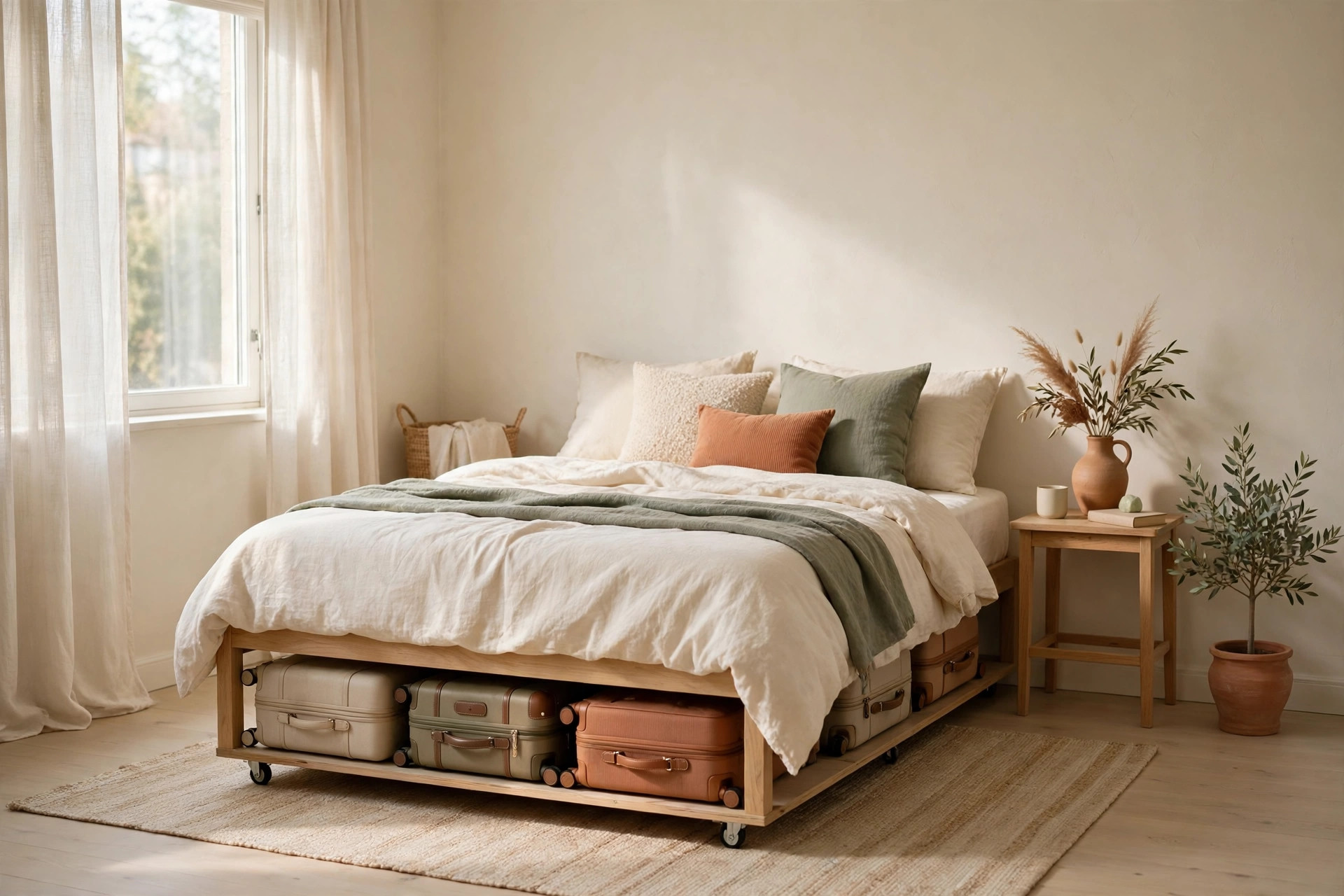
3. Slide the big suitcase flat under the bed
Lay your largest suitcase flat under the bed, wheels down, handle facing out. The suitcase itself is the container. Measure clearance first — most bed frames offer 6 to 8 inches. If your bed sits too low, 3-inch bed risers cost little. More ideas in our 18 Under-Bed Storage Ideas That Turn Dead Space Into a Dresser.
4. Store off-season clothes inside the empty suitcase
An empty suitcase is a sealed, dust-proof box doing nothing for ten months a year. Fill it: off-season clothes, a spare blanket, or beach towels inside, zipped shut, slid under the bed. Two categories, one footprint. Add a silica gel packet.
5. Park soft bags in a flat rolling bin
A flat rolling bin — roughly 35 x 18 x 6 inches — holds a folded duffel, a backpack, and packing cubes. Pick one with wheels and a clear lid. Dragging a loaded bin across carpet without wheels is why storage gets abandoned.
Top of the closet: using the highest shelf properly
The top closet shelf is usually a dumping ground for one random box and a hat nobody wears — but it is the perfect luggage shelf: wide, deep, and out of the way.
6. Put the hard case up high, wheels facing out
Place your hard-shell checked bag on the closet’s top shelf, wheels facing you, handle forward. A standard shelf is 12 to 14 inches deep, and most large suitcases are 11 to 13 inches deep on their side — measure before you lift. If the shelf feels flimsy, add a bracket.
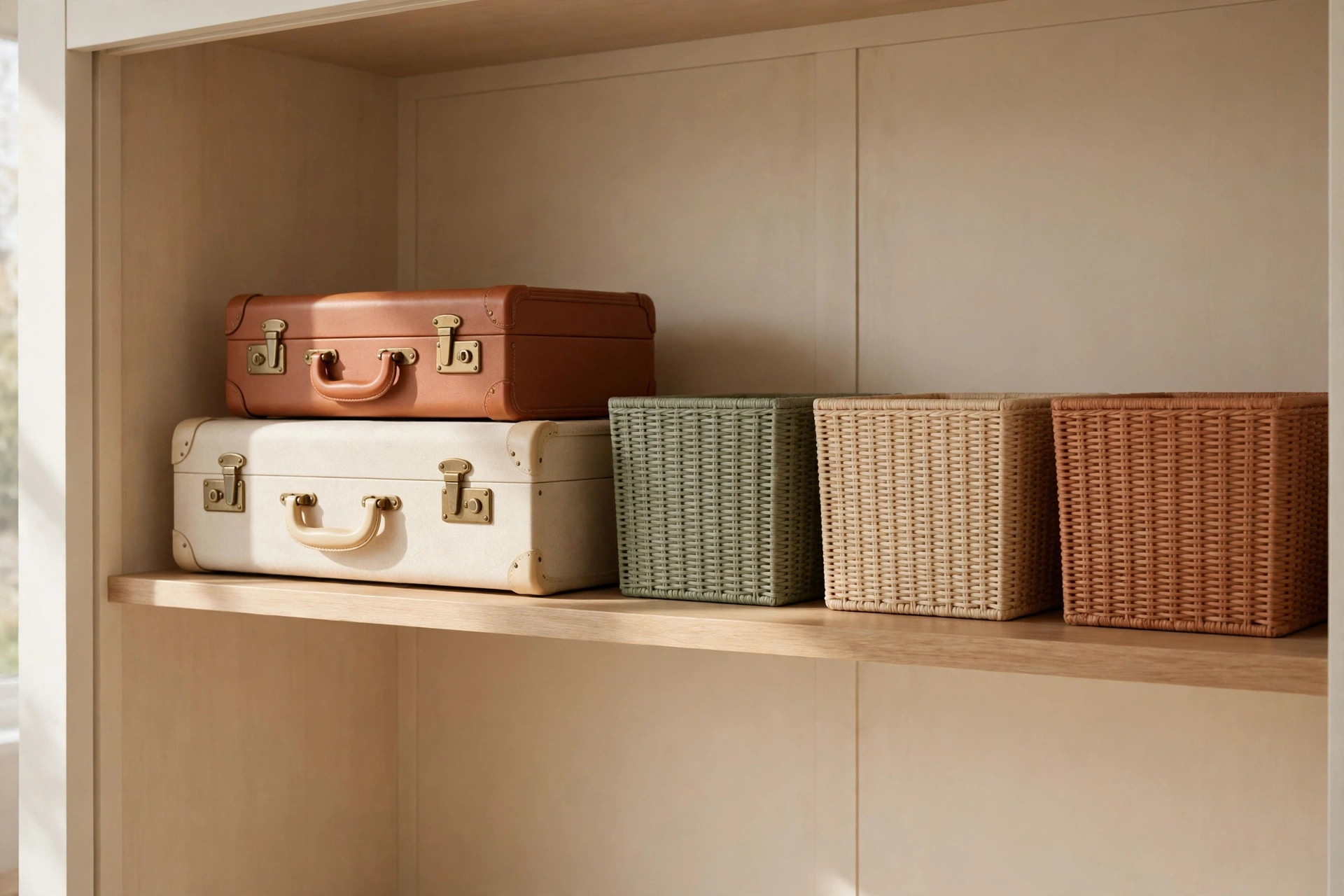
7. Keep a labeled “between trips” bin on the same shelf
Next to the suitcase, keep one small labeled bin — about 12 x 10 x 8 inches — for the things that travel with you every time: toiletries, an adapter, a scale, a spare tag. When a trip comes up, grab the suitcase and the bin together.
8. Stop the slide with a shelf lip or a strap
Suitcases on high shelves creep forward and slide off when the closet door slams. Fix it with a 1-inch adhesive shelf lip on the front edge, or a luggage strap looped around the case and hooked to the back wall. Either fix costs under five dollars. Same idea as our 18 Small Apartment Seasonal Storage Rotation Ideas: the top shelf holds what you need rarely, and a twice-a-year swap keeps it from turning into a junk pile.
Behind and inside furniture: ottomans, benches, and wardrobes
Furniture that hides storage is the small-apartment superpower — a suitcase needs no closet if a piece you own can swallow it.
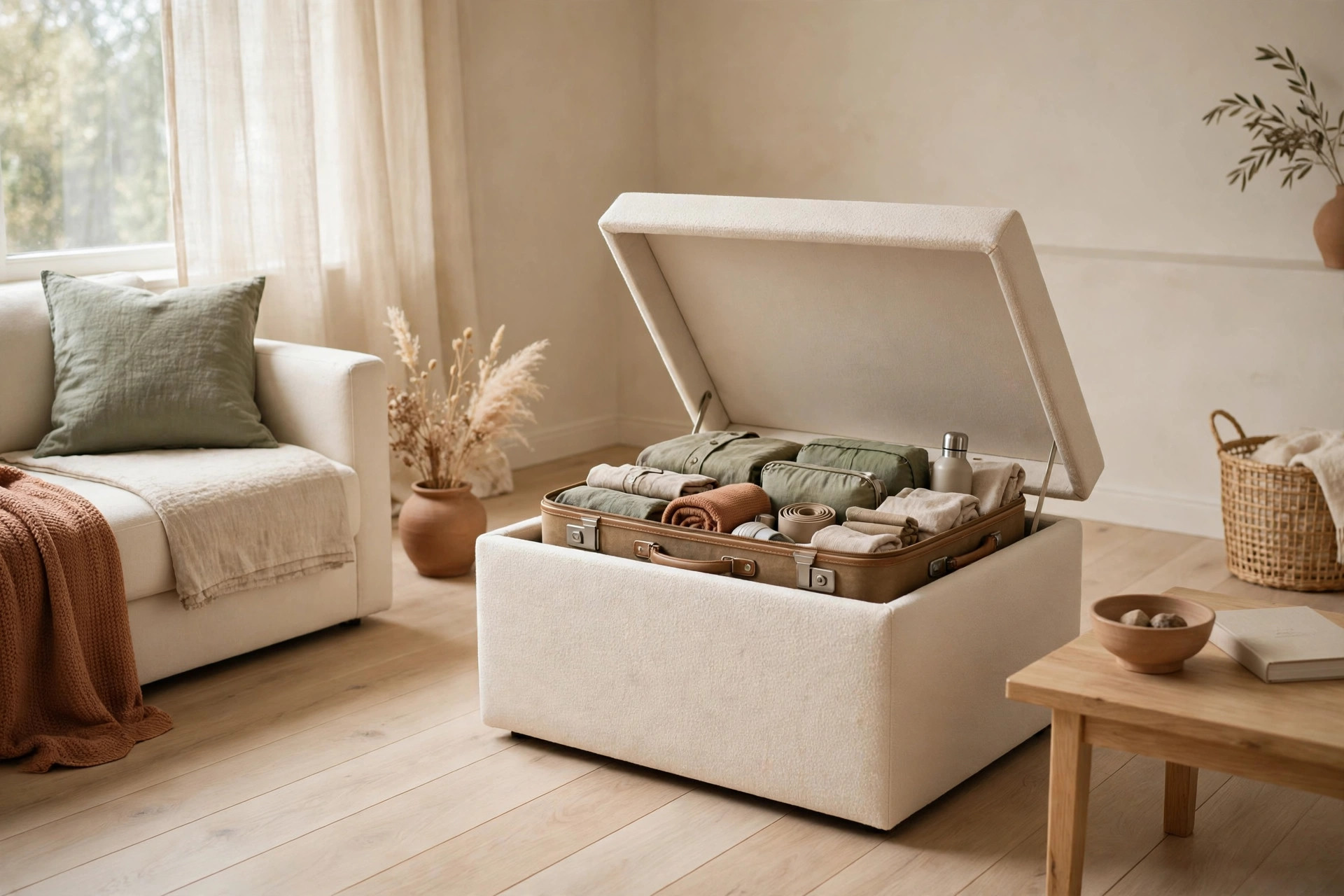
9. Turn a storage ottoman into a suitcase garage
A storage ottoman with an interior of at least 30 x 15 x 14 inches fits a folded duffel, a carry-on, or a weekender bag — and doubles as a footrest or seat. Keep it at the foot of the bed or in the living room: the bag you use most stays within reach but never visible.
10. Use an entryway bench with a lift-up lid
If your entryway fits a bench — even a narrow one, about 36 inches wide — pick one with a lift-up seat. A carry-on or duffel fits inside, and you can sit on it to put on shoes. Add two hooks above for a backpack and tote, and your travel kit lives in about four square feet by the front door.
11. Claim the bottom of the wardrobe for the carry-on
In a freestanding wardrobe, the floor below the hanging clothes is wasted space about 12 to 18 inches tall. Stand your carry-on there on its wheels, handle up — out of sight, ready to roll out. No built-in closet? Our Bedroom Storage Ideas for Small Rooms With No Closet shows how wardrobes replace one.
Nesting and packing cubes: shrinking the footprint
You cannot shrink a hard-shell suitcase, but you can shrink the space your collection takes up.
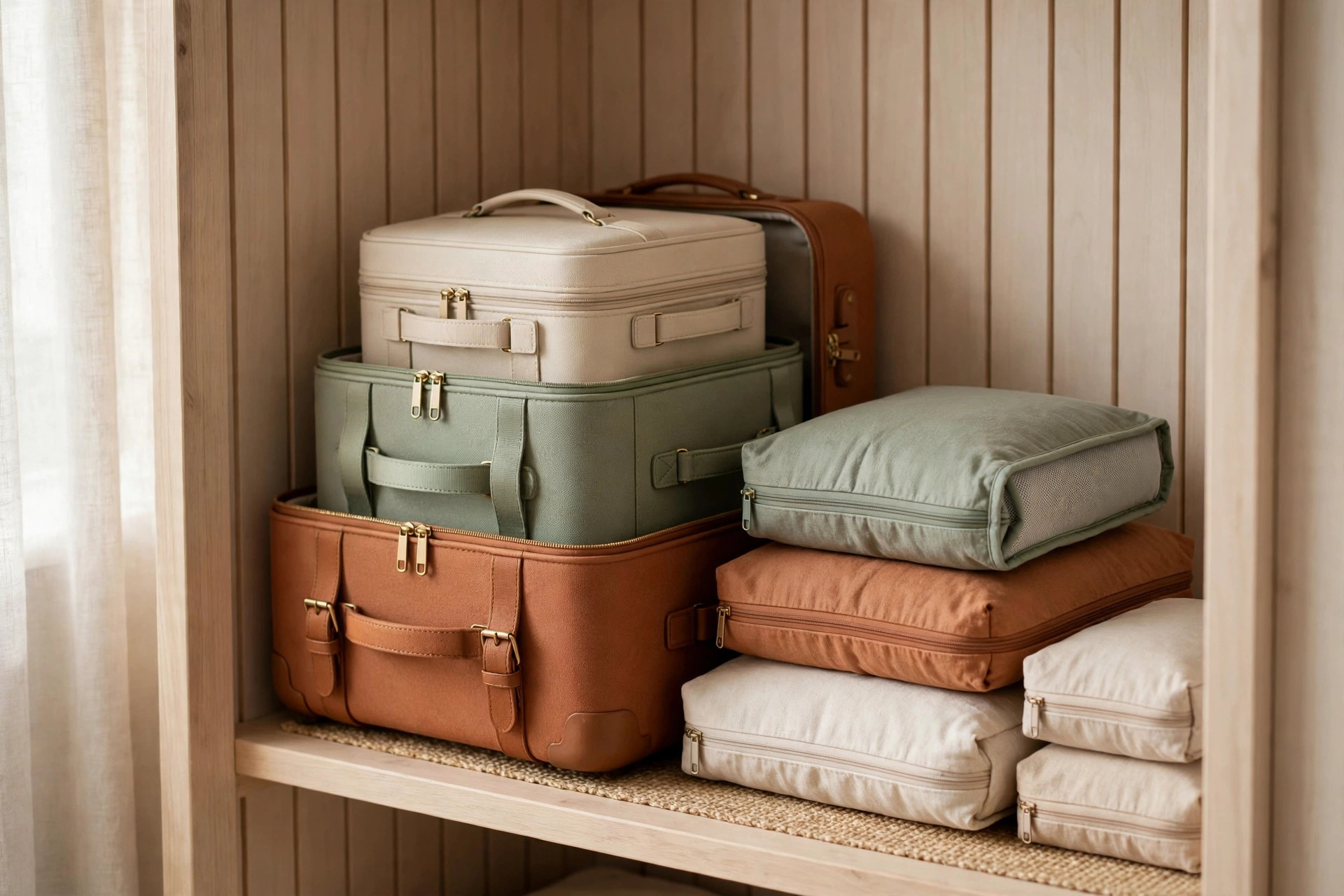
12. Nest smaller cases inside larger ones
A 20-inch carry-on fits inside a 24-inch case, which fits inside a 28-inch bag. Stack them like Russian dolls: your collection now occupies the footprint of one large suitcase. Slip a cloth between shells so they do not scuff. Same trick for duffels.
13. Compress soft bags with packing cubes
Packing cubes organize clothes on the trip and compress soft bags at home. Fold a duffel flat, strap two compression cubes around it, and it shrinks to about half its thickness. Store it under the bed or on a shelf — no more room than a folded sweater.
Travel gear beyond suitcases: backpacks, duffels, and carry-ons
Backpacks and duffels are the bags that actually clutter a small apartment — draped over chairs, piled by the door, stuffed behind the couch.
14. Fold duffels flat and file them like books
A soft duffel folds to about the size of a hardcover book. Stand it upright in a closet cubby or between two bookends. More than two? Keep the two you use and donate the rest.
15. Hang backpacks on hooks, never on chairs
A backpack on a chair is clutter; on a hook it is storage. Stick two or three adhesive hooks (rated 5 to 7 pounds) inside a closet door or on an entryway wall, and hang each backpack by its top loop. They stay ventilated — a bag in a closed bin turns musty — and grab-and-go for a weekend trip.
The grab-and-go travel station for frequent flyers
If you travel more than once a month, stop storing your luggage and start staging it: one small zone — a shelf, a hook rail, a bin — where everything you need lives packed and ready.
16. Build a one-shelf station near the door
Dedicate one shelf or a narrow console table near your front door to travel: your carry-on upright, a tray for keys and wallet, a hook rail above for a backpack and tote. Trip coming up? Walk to the station, grab the bag, and go. Keep it to about 24 inches wide; any bigger and it becomes a junk shelf.
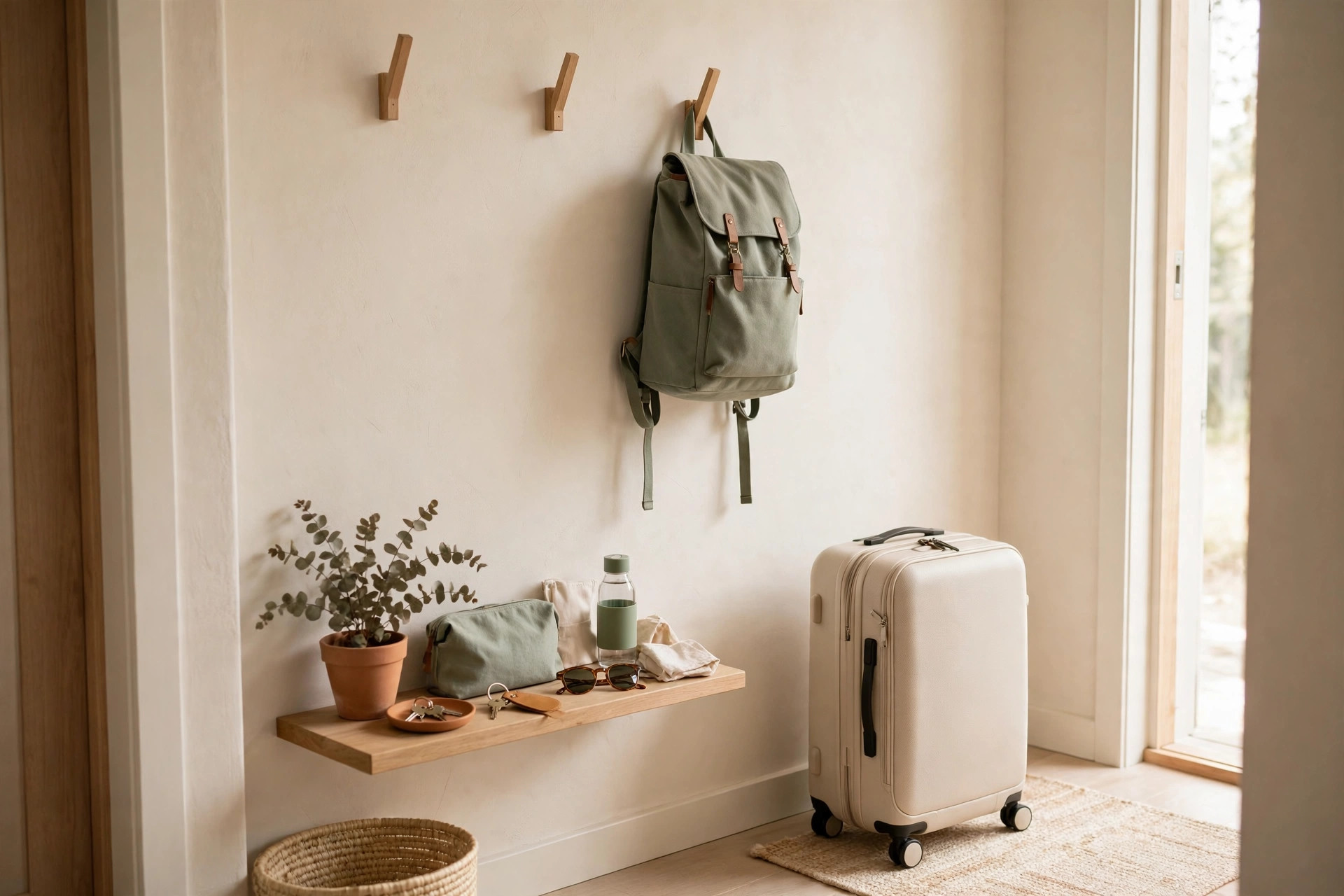
17. Keep a pre-packed kit that never gets unpacked
The fastest packers do not pack from scratch — they maintain a kit. Keep a toiletry bag stocked with travel-size shampoo, toothpaste, a razor, and medication, plus a tech pouch with a charger, cable, and adapter. Store both in your carry-on, so a trip means adding clothes and going. Refill the kit the day you return home. Check the TSA’s What Can I Bring? list before packing.
Mistakes to avoid
Storing luggage on top of the wardrobe without a barrier. A suitcase balanced on a wardrobe slides off eventually, usually at 2 a.m. Add a lip.
Keeping every free bag you have ever received. Conference totes and promo backpacks multiply silently. Unused for a year and not chosen by you? It is clutter, not luggage.
Storing a damp suitcase. A bag put away wet grows mildew within days. Open it, wipe it dry, and air it out for 24 hours before it goes back under the bed.
Buying a storage trunk before measuring. A trunk two inches too wide for your closet is an expensive mistake. Measure first, then shop.
Hiding the bag you use most in the hardest spot. The carry-on you use monthly does not belong on the top shelf behind winter coats. Match convenience to frequency, or you will stop putting it away.
Frequently asked questions
Where should I store luggage in a small apartment?
Under the bed, on the closet’s top shelf, or inside storage furniture like an ottoman or entryway bench. Under the bed suits the large bag you use twice a year; an ottoman near the door suits the carry-on.
Can I store a suitcase under the bed without it getting dusty?
Yes, if you protect it. Slide it into a cotton storage bag or zippered dust cover, or wipe it down before each trip. A hard-shell case resists dust far better than a fabric one.
How do I store luggage in an apartment with no closet?
Use furniture: a storage ottoman for the carry-on, a freestanding wardrobe for the checked bag, hooks on the bedroom door for backpacks. A bed with 6 inches of clearance also works.
Is it okay to store clothes inside my suitcase between trips?
Yes — one of the best space-saving moves in a small apartment. Off-season clothes or beach towels inside a zipped suitcase stay clean and dust-free. Add a silica gel packet and label the outside.
Conclusion
Luggage does not need a closet of its own — it needs one assigned spot per bag, matched to how often you travel. Start with the audit, give the big suitcase the under-bed or closet-top spot, nest the rest, and keep your kit ready by the door. Save this pin for later, and browse our small-spaces collection.