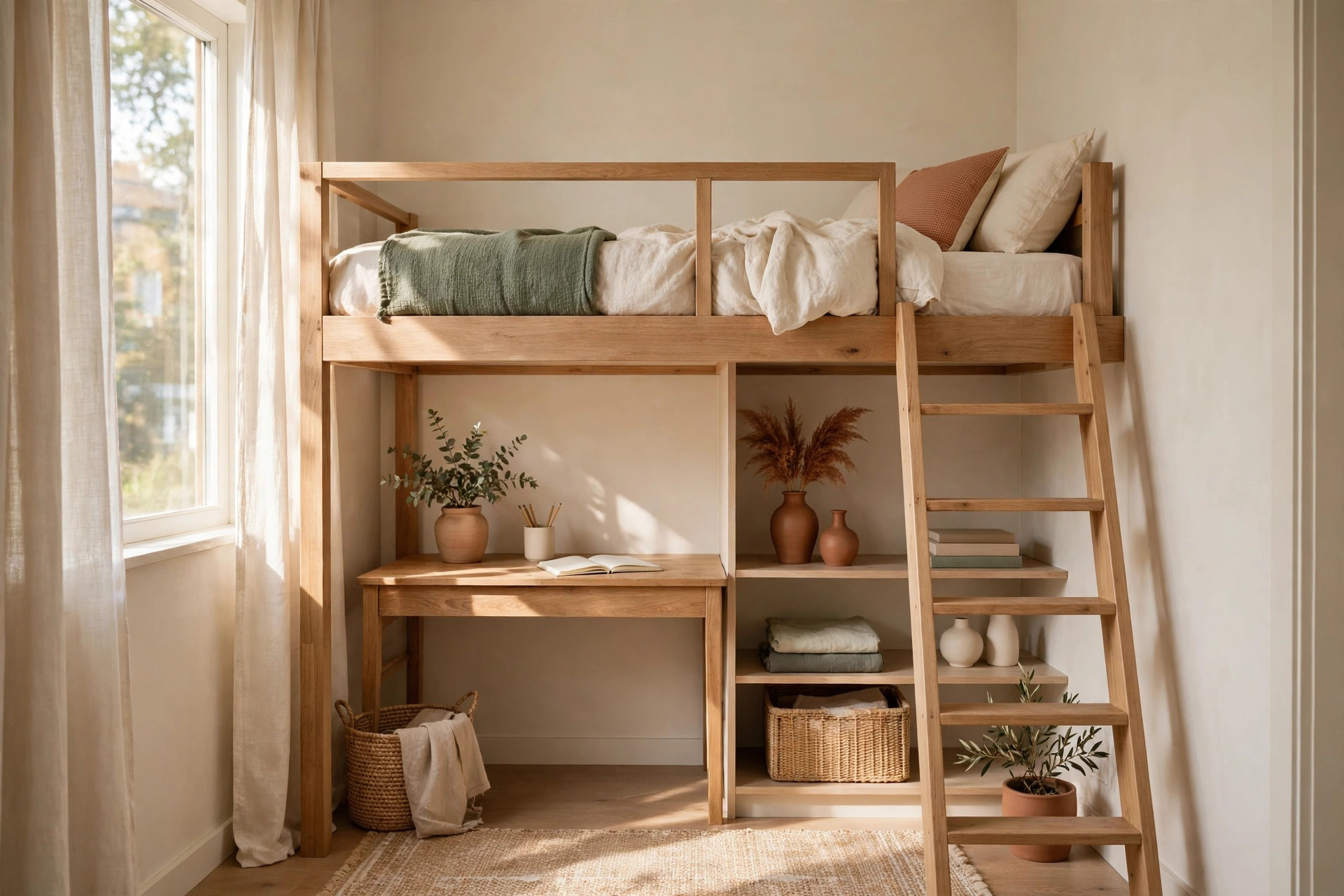
A loft bed gives you a whole second room inside a small bedroom — or it gives you a dark, dusty cave where things go to disappear. The difference is planning. These small bedroom loft bed storage ideas turn the space underneath into a desk, a closet, or a reading nook, so the freed-up floor actually works for you. Measure first, then build the zone that fits your life.
Measure first: clearance, ceiling height, and weight limits before you plan anything
1. Map the clearance under the bed before choosing a single piece of furniture
Measure the height from the floor to the underside of the bed frame, the width between the legs, and the depth from the wall to the front edge. Most twin lofts leave 55 to 60 inches of clearance underneath; high lofts can offer 65 inches or more, while low lofts may give you only 40 to 45 inches. A standard desk is about 29 to 30 inches tall, so it fits under almost any loft, but a hanging rail with clothes needs roughly 60 inches from rail to floor so shirts do not drag. If your clearance is under 48 inches, skip the desk and closet ideas and plan a low zone instead: rolling bins, a floor cushion nook, or short drawers.
2. Check the ceiling, the weight limit, and the safety rules in one pass
Sit on the mattress and measure from the top of the mattress to the ceiling — you want at least 30 inches of sitting clearance up there, ideally 36 inches. Then find the manufacturer’s weight limit for the sleeping platform and treat it as a hard ceiling: most twin lofts are rated for 200 to 250 pounds total, including the mattress, the sleeper, and anything stored on the bed itself. Children under six should never sleep on the upper bunk, and the U.S. Consumer Product Safety Commission requires upper-bunk guardrails to extend at least 5 inches above the mattress, with gaps no wider than 3.5 inches.
Under-loft desk zone: a full workspace in the dead space
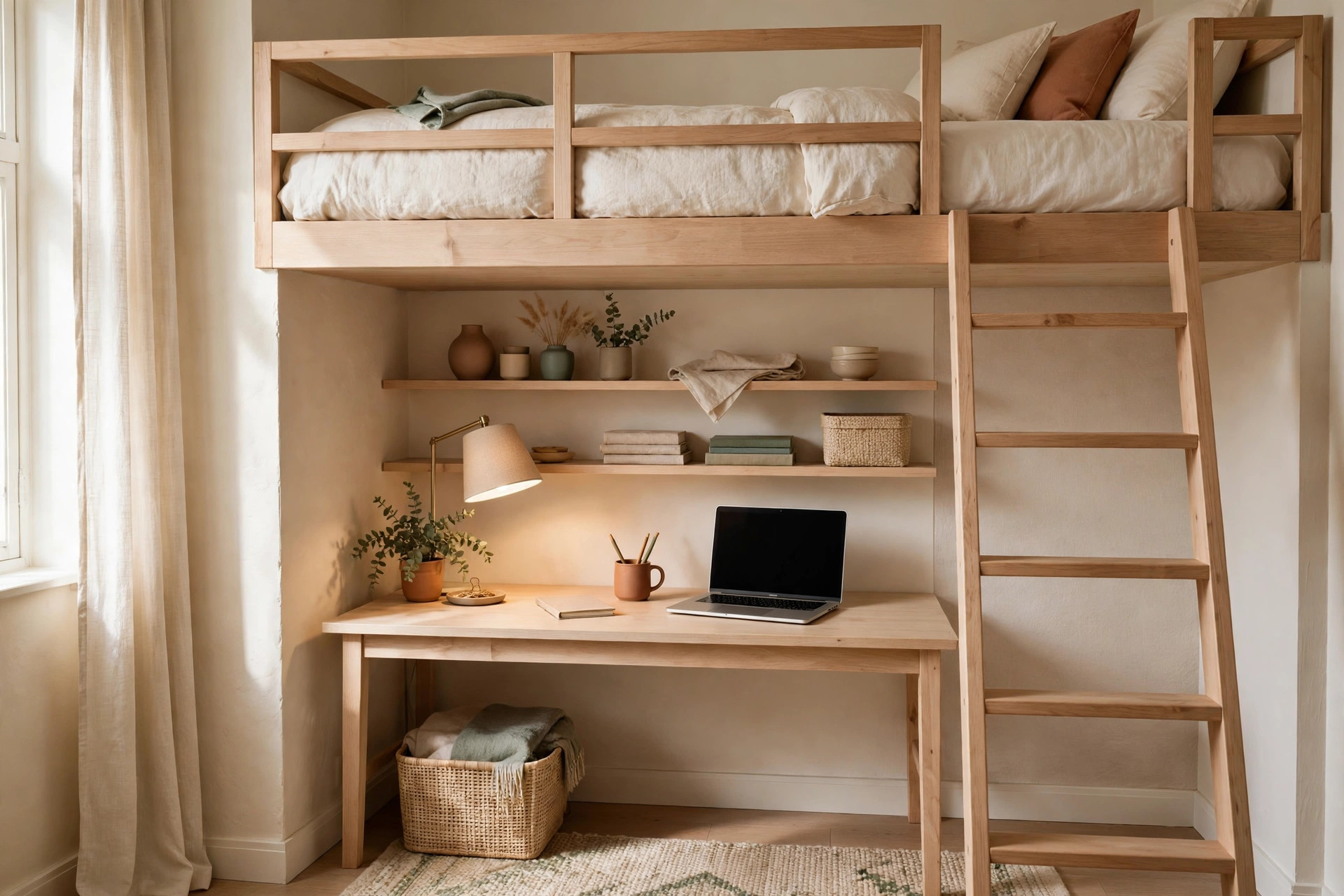
3. Fit a narrow desk along the back wall, not across the opening
A desk 40 to 48 inches wide and 20 inches deep fits neatly along the back wall of most twin lofts, leaving the front open for your chair and the ladder. Push it flush against the wall so the bed frame shades the back of the desk, not your screen. Skip drawers on the desk itself — they eat knee room where every inch counts — and keep a small rolling file cart or a desktop organizer on the surface for daily supplies.
4. Light the desk like a real office, or you will never use it
Under a loft, the bed blocks the ceiling light, so the desk zone goes dark by default. Mount a slim LED bar or a clamp-on desk lamp under the bed frame, aimed down at the work surface, and add a second small light at the back of the desk to kill shadows on your keyboard. A battery-powered puck light under the frame costs a few dollars and makes the difference between a desk you use and one that collects laundry.
Under-loft closet: hanging rail, drawers, and shoe storage
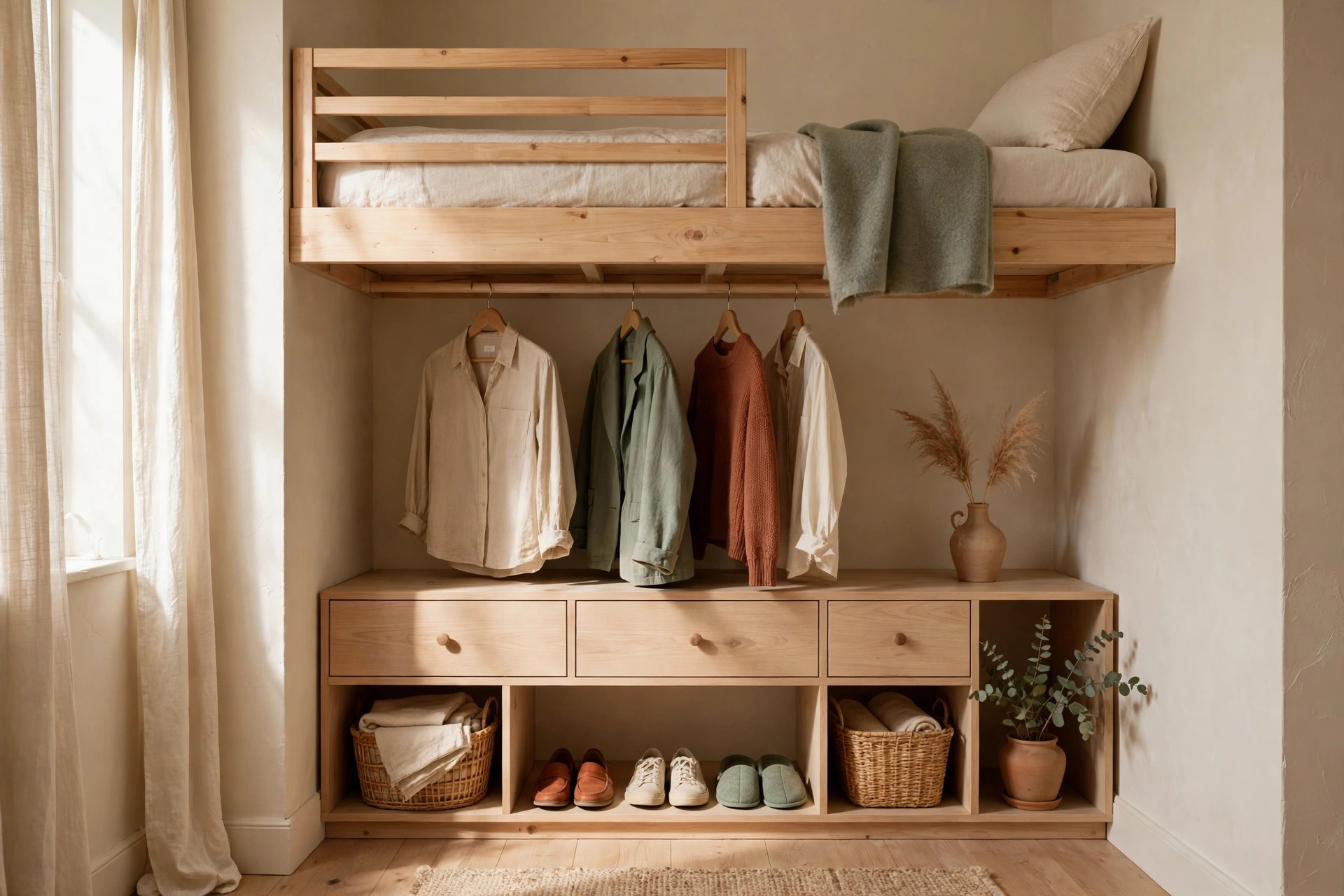
5. Hang a rail at the tall end and curtain it off
Mount a closet rod between the two bed legs at the tallest end of the loft, about 60 inches off the floor, and hang your most-worn clothes there: work outfits, school clothes, the jacket you grab every morning. A tension rod works if the legs are sturdy and close together, but a rod screwed into the frame (where the manufacturer allows it) or a freestanding garment rack slid underneath is sturdier for a full load. Hang a cotton or linen curtain across the front to hide the clothes and keep dust off them.
6. Stack drawers and shoe storage at the low end
The low end of the loft — where the clearance drops or the ladder sits — is where drawers belong. A three-drawer unit 24 to 30 inches tall fits under most lofts and holds folded clothes, underwear, and accessories in the exact spot where a hanging rail would be too short. Put a two-tier shoe rack or a row of clear shoe boxes beside the drawers, one pair deep, so shoes stay visible and off the floor. If your room has no closet at all, this pairs well with the freestanding wardrobe ideas in our guide to bedroom storage ideas for small rooms with no closet.
Reading nook or lounge corner under the loft
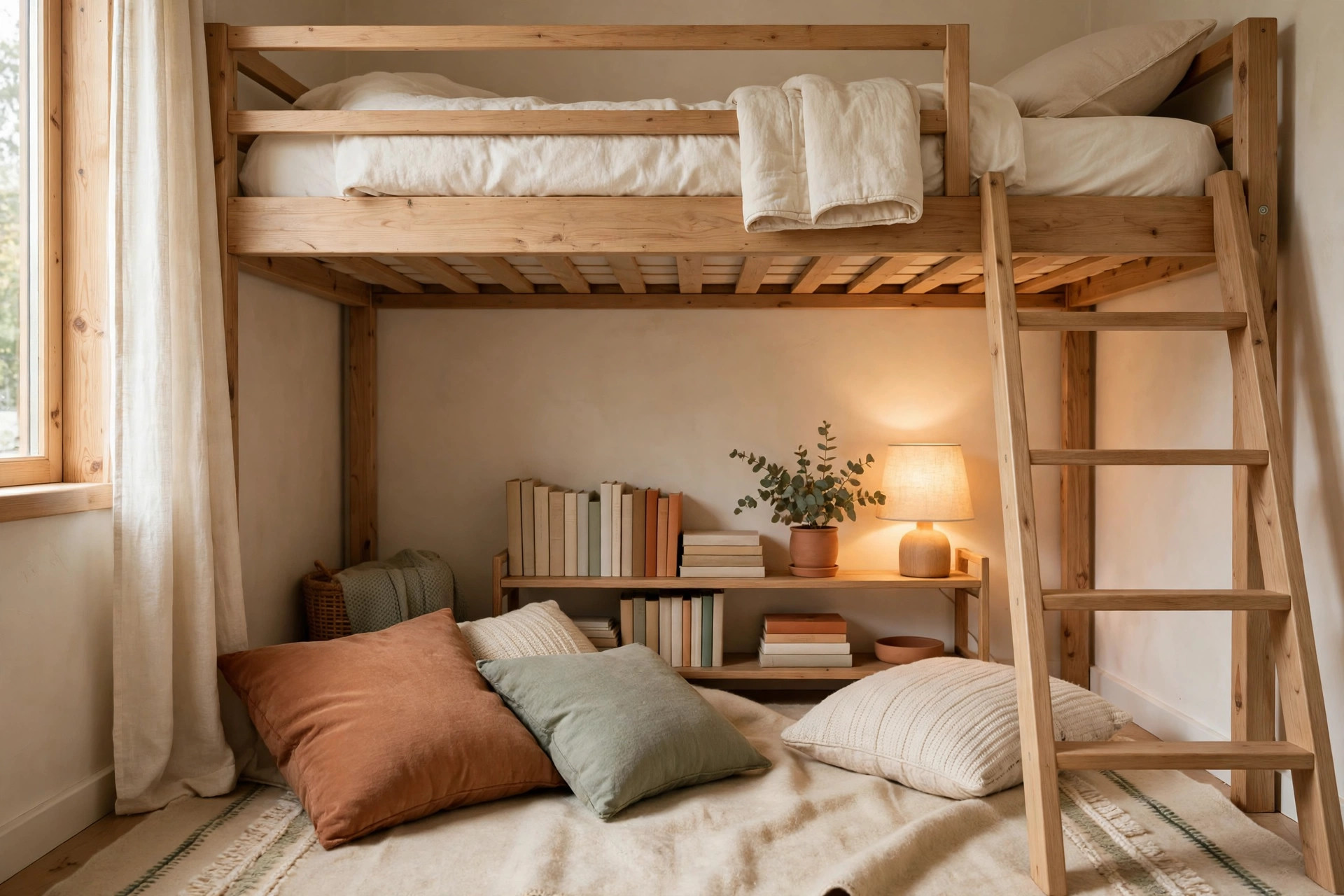
7. Build a floor-cushion nook with a cushion, a throw, and a book basket
Lay a thick floor cushion or a folded futon mattress (about 4 inches thick, twin width or smaller) against the back wall, add two throw pillows and a soft blanket, and place a small basket of books or magazines within arm’s reach. This works even in low lofts with only 40 inches of clearance, because you are sitting on the floor, not in a chair. A battery-powered fairy light string or a clip-on reading light along the frame makes the nook usable at night without wiring.
8. Add a low shelf and a charging spot so the nook stays tidy
A nook without a home for its stuff becomes a pile within a week. Mount a single low shelf on the bed frame at sitting height — about 18 inches off the floor — for the book you are reading, a water bottle, and your phone. Run a short extension cord or a power strip along the base of the frame, secured with clips and never loose on the floor, so a charger lives in the nook permanently.
Storage stairs: steps that double as drawers
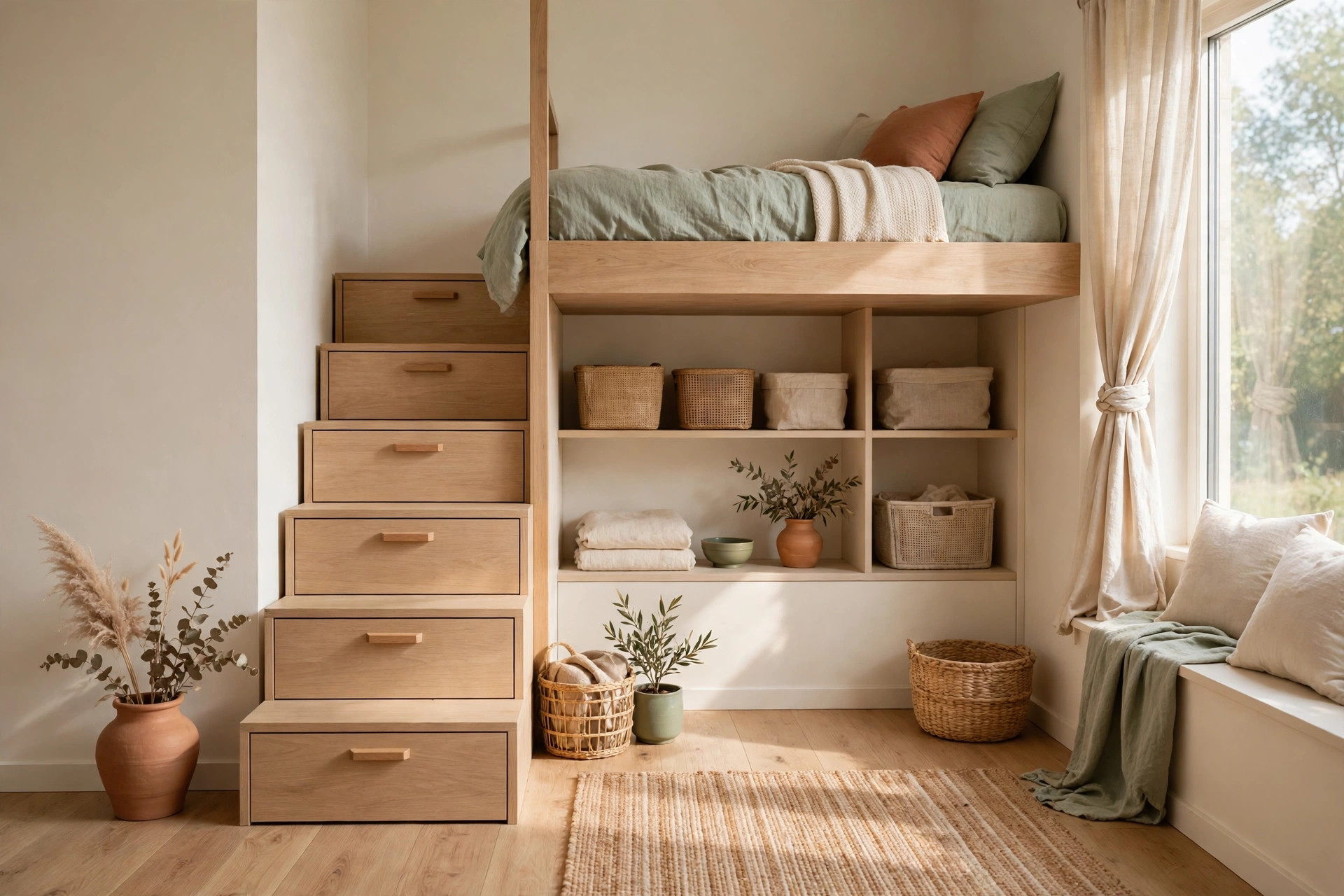
9. Choose a staircase unit with at least three drawers
A typical storage staircase has three to five steps, and each step is a drawer roughly 30 inches wide, 12 inches deep, and 7 inches tall. Three drawers hold a full rotation of folded clothes, pajamas, and linens; five drawers can swallow an entire seasonal wardrobe. Buy the staircase made for your specific bed model when one exists — the step height, the attachment points, and the weight rating are designed to match. A staircase that does not bolt to the frame is a tipping hazard.
10. Assign every step a category and label it
Drawers only stay organized when each one has a job. Label the bottom step “pajamas and loungewear,” the middle step “folded tops,” and the top step “linens and out-of-season clothes,” using a label maker or removable stickers. The bottom drawer is the easiest to reach, so it gets the things you grab daily; the top drawer is the hardest, so it gets the things you touch once a season.
11. Use the stair landing as a nightstand
The top step of a storage staircase sits at mattress height, which makes it a natural nightstand. Put a small tray on it for your phone, glasses, and a glass of water, and add a clip-on light to the bed frame above it. Just keep the landing clear of clutter: it is a step first and a shelf second, and anything left on it becomes a tripping hazard in the dark.
Shelving on the loft frame: books and bedtime essentials within reach
12. Mount a narrow ledge shelf along the guardrail
A picture-ledge shelf 3 to 4 inches deep, mounted on the outside of the guardrail or on the frame just below the mattress, holds a phone, a book, a water bottle, and a small lamp. Choose a ledge with a raised lip so nothing slides off when the bed shifts, and never mount anything on the guardrail itself if the manufacturer forbids it — clamp-on bedside caddies that hook over the rail are the renter-friendly alternative.
13. Run a vertical shelf strip up the frame at the ladder end
The frame at the ladder end is usually dead space, and it is the first thing you see when you climb up. Mount a slim vertical shelf — three or four cubbies, each about 10 inches square — on the frame at that end, and use it for the current book, a notebook, headphones, and a charging cable. This is also the right place for the vertical storage ideas mindset: the wall and frame are the only surfaces that do not cost floor space.
Rolling bins and crates that slide under the low end
14. Use low rolling bins for out-of-season and bulky items
Flat rolling bins 6 to 8 inches tall slide under the low end of the loft and hold out-of-season clothes, extra bedding, or bulky items like spare blankets and winter coats. Choose bins with lids and wheels, and label each one on the end that faces out so you can read it without pulling the bin all the way out. One bin per category — “winter clothes,” “extra bedding,” “craft supplies” — and a rule that nothing goes into a bin unlabeled. For more on choosing the right bin height, see our guide to under-bed storage ideas that turn dead space into a dresser.
15. Corral small stuff in stackable crates with handles
Loose items — chargers, cables, board games, gift wrap, hobby supplies — vanish in deep bins. Stack two or three open crates with handles in the low zone instead, one category per crate, so you can pull a single crate out like a drawer. Handles matter: a crate without a handle in a 12-inch-high gap is a crate you will never pull out. Keep the stack to two crates high so the top one stays reachable.
Keeping it dust-free and easy to clean underneath
16. Leave a cleaning gap and choose washable, wipeable surfaces
Leave at least 3 inches of clearance between the bottom of your lowest furniture and the wall, and keep a clear 12-inch path at the front of the zone so a vacuum nozzle or a flat mop can reach the back wall without moving furniture. Choose furniture with smooth, wipeable surfaces — laminate, sealed wood, or metal — over raw fabric or unfinished particle board, which holds dust. Wash curtains and cushion covers every month or two.
17. Set a monthly five-minute reset for the whole zone
Pick one day a month — the first Saturday works for most people — and spend five minutes on the zone: pull out the bins, wipe the shelf, shake the cushion, and return anything that has drifted in from the rest of the room. The reset is what separates a storage system from a storage pile: the system gets maintained, the pile just grows.
Mistakes to avoid
The most common mistake is buying furniture before measuring: a desk that is two inches too tall or a wardrobe that blocks the ladder wastes money and a weekend. Second is overloading the sleeping platform — the weight limit includes the mattress, the sleeper, and everything stored up top. Third is blocking the ladder or the stairs with bins and crates; the way up and down must stay clear at all times, even at 3 a.m. in the dark. Fourth is skipping ventilation: leave a gap at the top of the curtain and air the room out daily.
Frequently asked questions
How much weight can a loft bed hold?
It depends on the model — most twin lofts are rated for 200 to 250 pounds total on the sleeping platform, including the mattress and the sleeper. The number is on the manufacturer’s label or product page. Never exceed it, and never store heavy items on the bed itself.
Can you put a desk under a loft bed?
Yes, and it is one of the best uses of the space. You need at least 50 inches of clearance under the frame for a desk and a chair to feel comfortable, plus a light mounted under the frame since the bed blocks the ceiling light.
How do you keep the space under a loft bed from getting dusty?
Use lidded bins, washable curtains and cushion covers, and wipeable furniture surfaces. Leave a clear path at the front so a vacuum or flat mop can reach the back wall, keep a handheld vacuum in the zone, and do a five-minute wipe-down and reset once a month.
Is a loft bed safe for kids?
Loft beds are safe when they meet safety standards and are used correctly: guardrails on both sides of the upper bunk extending at least 5 inches above the mattress, gaps under 3.5 inches, a firmly attached ladder, and no child under six sleeping on top. Always follow the manufacturer’s age and weight guidance, and re-tighten the bolts every few months.
Can a loft bed work in a rental?
Yes, with renter-friendly choices: freestanding desks and garment racks, tension rods and curtains instead of built-in panels, clamp-on bedside caddies instead of mounted shelves, and storage stairs that bolt to the bed rather than the wall.
Conclusion
A loft bed only saves space if the space underneath has a plan. Measure first, give the zone one clear job — desk, closet, or nook — and keep everything in labeled, reachable homes you can clean in five minutes a month. Start with the measurement card and one zone this weekend, and save this pin for later so the rest of the ideas are there when you are ready. For more ways to make a small bedroom work harder, browse our small-spaces ideas.