When a bedroom is tight, the nightstand is the first piece of furniture that has to go — but the lamp, phone, glasses, and book don’t disappear with it. These small bedroom nightstand alternatives keep every bedtime essential within arm’s reach while giving back the two or three square feet a traditional nightstand eats up. That sounds like nothing until you realize it’s the difference between a closet door that opens fully and one that doesn’t.
This guide gives you exactly 15 tiny nightstand ideas, sorted from wall-mounted to headboard-integrated, plus a five-minute bedside audit so you buy nothing you don’t need, a charging setup with no cable nest, and a nightly reset that keeps the whole zone calm. Do the audit first — five minutes that saves you every wrong purchase after. The renter-safe options are flagged throughout.
The bedside audit: what you actually need at arm’s reach
Before you shop, pull everything off your current nightstand (or the pile on the floor where one would go) and sort it into three groups. Must-reach items are what you touch every night: light source, phone, glasses, medication, water — most people land at four to six. Sometimes items are the book you’re reading, lip balm, a journal — weekly, not nightly. Doesn’t belong here is everything else: spare chargers, old receipts, the mug from three days ago.
The rule is simple: your bedside solution only needs to hold the must-reach group. Everything else gets a real home elsewhere — a bookshelf for the reading stack, a dresser drawer for spare cables. Most people discover their “need” for a big nightstand was really just storage for things that belonged in another room. If your bedroom has no closet, the same audit thinking applies room-wide — our guide to bedroom storage ideas with no closet walks through it.
Wall-mounted shelves and floating nightstands
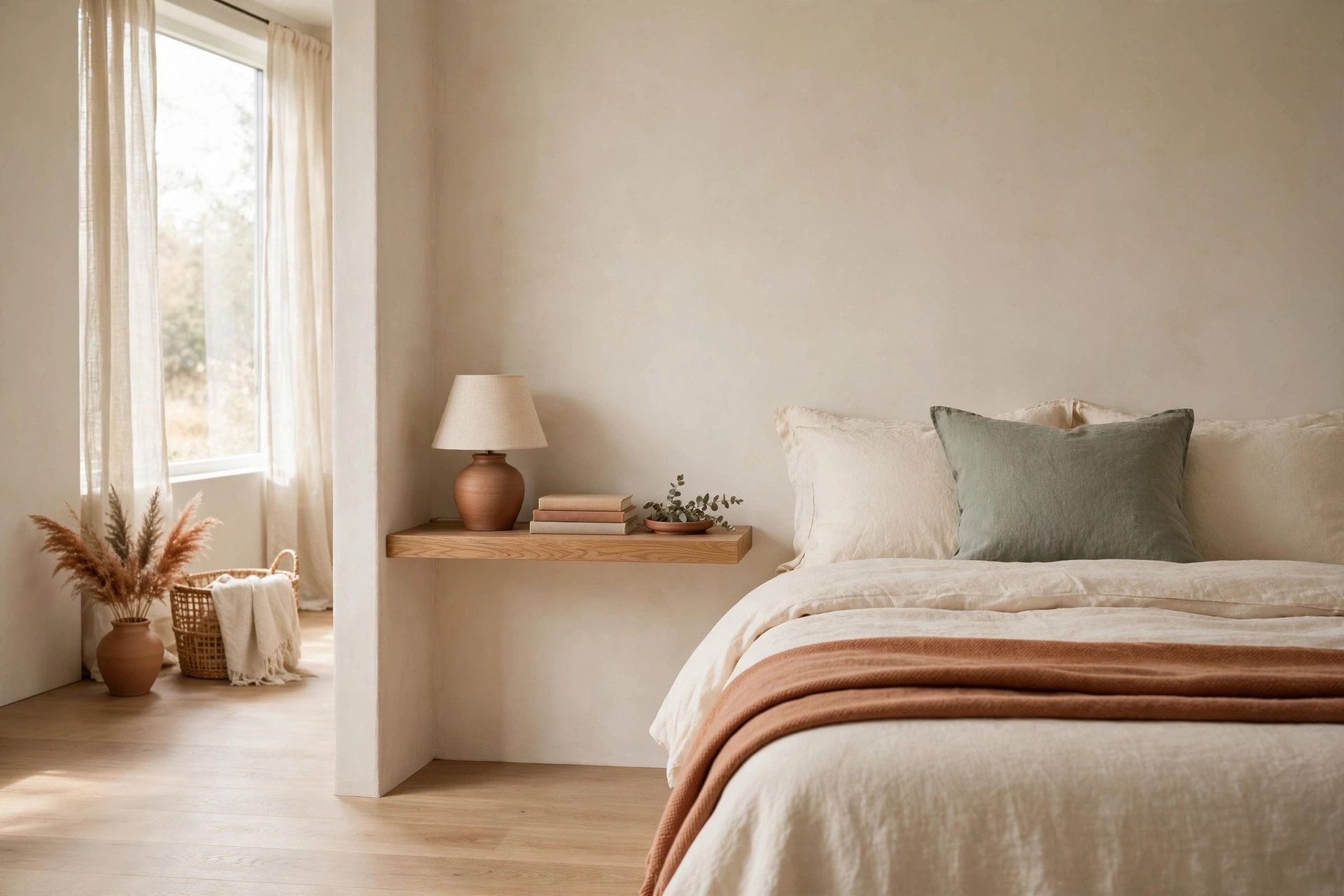
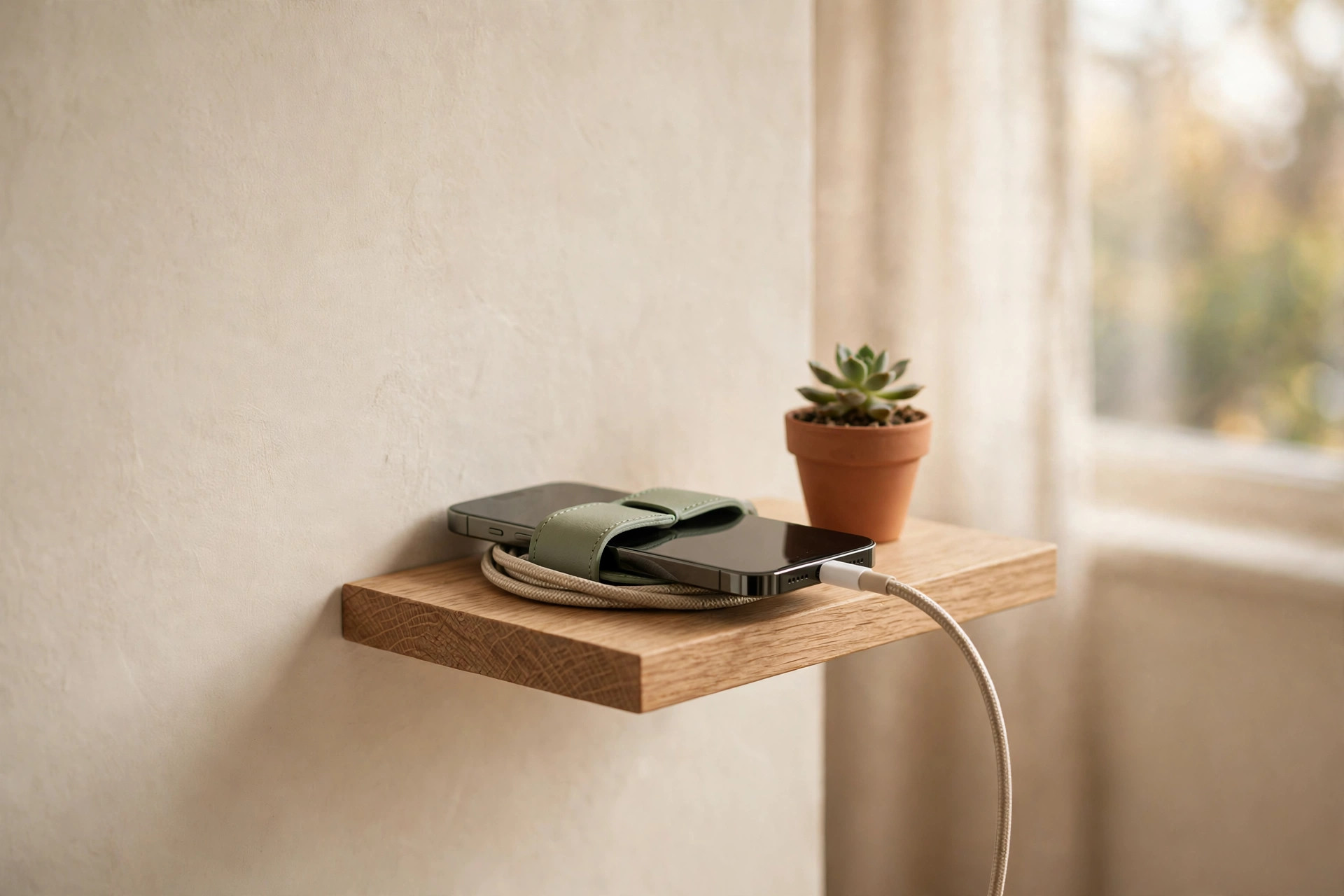
Walls are free real estate in a small bedroom. Mount your shelf so the top sits 2 to 4 inches above your mattress top — roughly 24 to 28 inches off the floor for most beds — so you can grab your phone without sitting up.
1. Floating shelf nightstand
A 12-by-8-inch floating shelf with a concealed bracket holds a lamp, phone, and water glass for under $25. Rate the bracket for at least 15 pounds and anchor into a stud or use toggle bolts — a sagging shelf is worse than no shelf at all.
2. Wall-mounted cube nightstand
A 10-inch open-front cube gives you a surface plus one hidden compartment. It reads like a nightstand but steals zero floor space, and the enclosed cube hides the charging mess an open shelf shows off.
3. Fold-down wall shelf
A 14-inch fold-down bracket shelf works like a Murphy table: up for nighttime use, folded flat against the wall during the day. Best for rooms under 100 square feet, where even an 8-inch projection feels crowded when you’re making the bed.
4. Corner-mounted triangular shelf
Two adjacent walls meet at your bed’s corner — and that triangle is dead space anyway. A corner shelf turns it into a two-tier perch for the lamp up top and books below. Measure first; most stock corner shelves need at least 10 inches of clear width per side.
Wall solutions are the heart of vertical thinking — our vertical storage ideas for small apartments carries the logic floor-to-ceiling for every room.
Clip-on and slide-under bedside trays
No drilling allowed? These options attach to the bed itself, which makes them the most renter-friendly of all tiny nightstand ideas — zero wall holes, and they move with you.

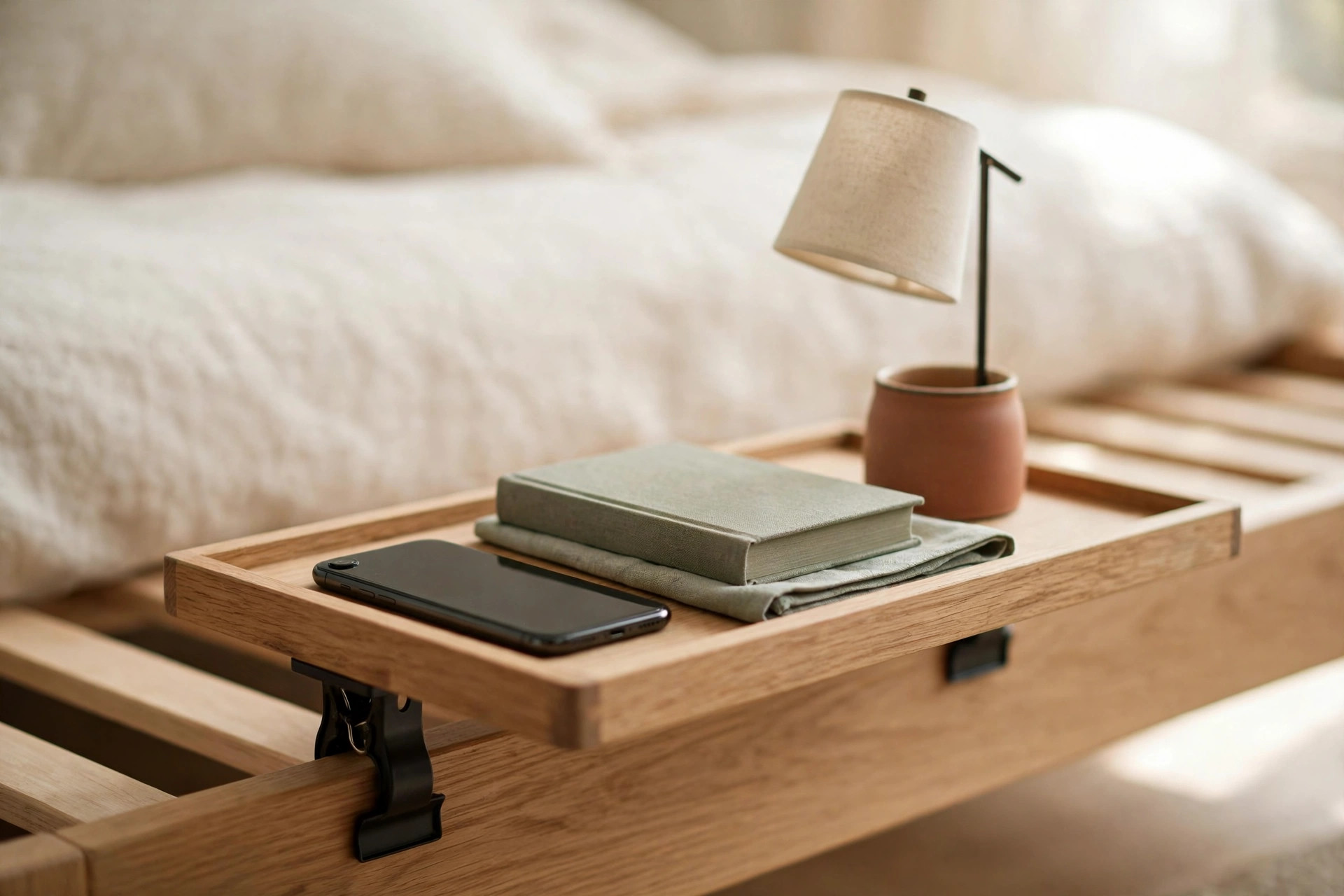
5. Clip-on bedside shelf
A tray with a C-shaped clamp grips your bed frame or headboard, creating a roughly 12-by-9-inch surface at mattress height. Check the clamp range before buying — most fit frames 1 to 3 inches thick.
6. Slide-under bedside tray
A flat tray with a long arm slides between mattress and box spring, cantilevering a small platform beside the bed. It holds about 5 pounds — phone, glasses, paperback — and needs at least an 8-inch mattress to grip.
7. Bedside caddy organizer
A fabric caddy that hooks over the mattress edge gives you four to six pockets for the remote, phone, book, and glasses. Choose one with a stiffened back panel so it doesn’t collapse when you pull something out.
Headboard storage: pockets, shelves, and organizers
Your headboard is roughly 60 inches of unused vertical surface in a queen bed. Storage on it keeps everything at arm’s reach with zero added footprint.
8. Headboard with built-in shelves
Replace a flat headboard with a shelving headboard — typically a 60-by-36-inch panel with two open shelves holding everything a nightstand would, plus the books on your floor. Keep total depth under 10 inches.
9. Fabric headboard organizer pockets
A pocket organizer drapes over your headboard with no tools: six to eight canvas pockets for phone, glasses, book, and remote. Around $10 to $15 — the cheapest option here, unpack-to-installed in under five minutes.
10. Slim ledge behind the headboard
If your headboard sits 2 to 4 inches from the wall, slide a 4-inch-deep wooden ledge into that gap for the alarm clock and charging station — invisible from the doorway, reachable from the pillow. Secure it with L-brackets so a bumped headboard doesn’t send it sliding.
11. Pegboard headboard panel
Mount a 24-by-24-inch pegboard on the wall just behind one side of the headboard, with hooks, a small shelf insert, and a hanging cup for lamp, phone, and headphones. Move the hooks when your routine changes instead of buying new furniture.
The one-drawer rule for nightstand clutter
A nightstand fails when it becomes a junk drawer with a lamp on top. The fix is the one-drawer rule: your bedside gets exactly one small drawer or one lidded container. New item in, old item out — one container forces decisions that three drawers never will.
12. Slim rolling cart with one drawer
A 7-to-9-inch-wide rolling cart slides into the gap between bed and wall where a nightstand won’t fit. Top holds the lamp; the single drawer holds the must-reach group. Need the floor back? Roll it under the bed — it pairs naturally with a full under-bed storage system.
13. Lidded tray as the single container
No drawers? A lidded 10-by-7-inch tray on your shelf or cube is the container. Lid closed, the bedside looks clean; lid open, everything you need is there. The lid is the discipline — an open bin invites tossing, a closed lid invites intention.
Charging without the cable nest
Three devices plus a lamp means four cables, and four cables become a dust-collecting nest within a week. The fix is a charging dock with cable management: a wall-mounted strip with short 1-foot cables, plus adhesive clips routing each cord along the shelf’s back edge.
14. Wall-mounted charging shelf with cable clips
Mount a slim 6-inch charging shelf at outlet height behind your floating shelf and run one power strip to it. Swap the 6-foot cables that came in the box for 1-foot ones — oversized cable is the single biggest source of cable nests. Our small home office corner organization guide uses the same clip-and-short-cable method for desk zones.
Keeping the bedside calm: the 2-minute nightly reset
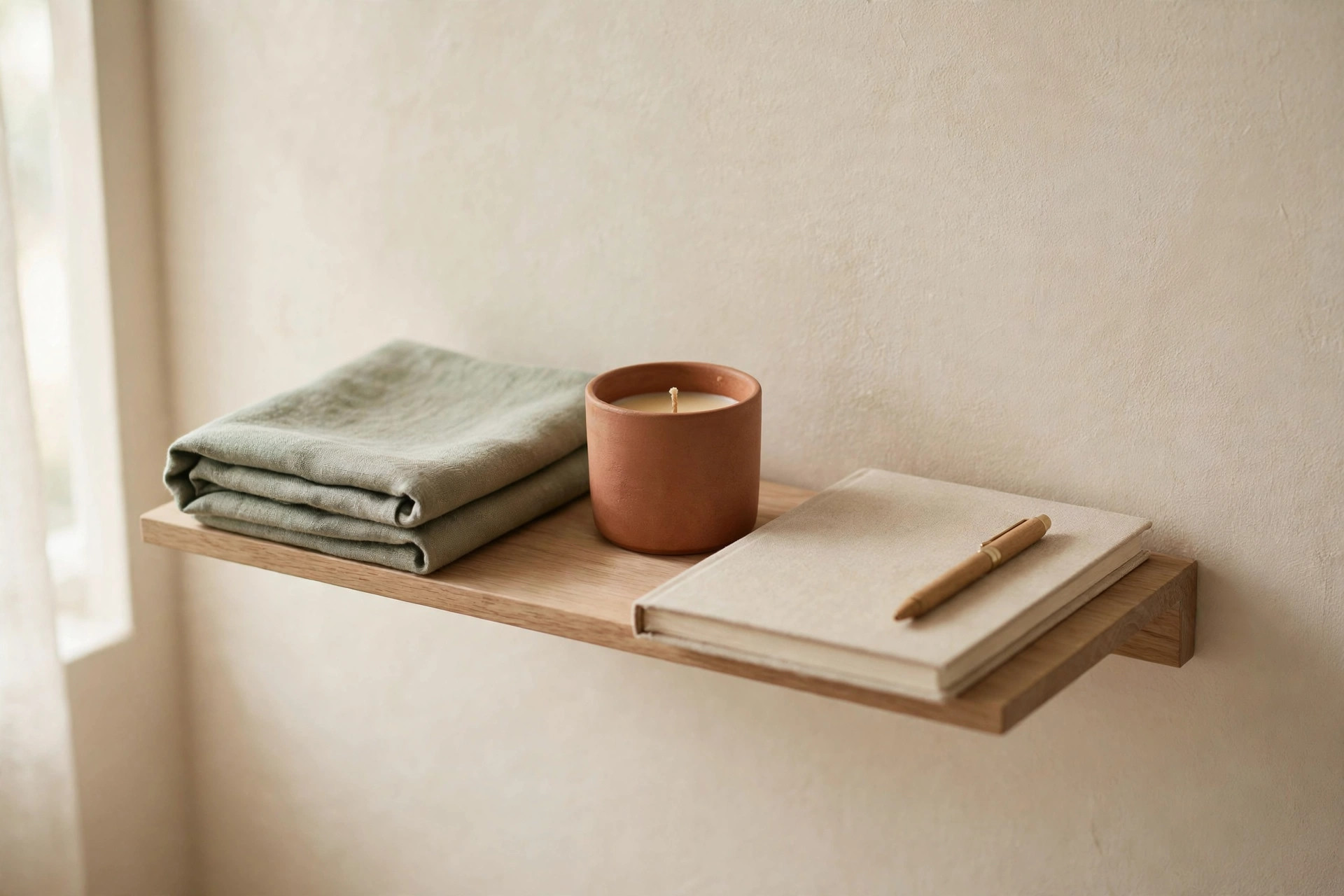
The best bedside solution still fails if the surface slowly accretes clutter. The nightly reset takes two minutes: book back to the shelf, glass to the kitchen, phone on the charger, drawer or tray lid closed. Tie it to an existing habit — do it while you brush your teeth.
15. The nightly reset tray
Give the reset a physical anchor: a small tray that is the only place evening items may land. When its contents go home each night, the surface stays permanently clear. A tray that’s empty every morning is the sign the system works.
Mistakes to avoid: what NOT to buy
Don’t buy a “small” nightstand that’s still 16 inches deep. Many products marketed as compact are only narrower, not shallower. Measure depth, not just width.
Don’t buy a tall narrow tower. A 30-inch-tall, 8-inch-wide tower looks space-saving but tips easily, and reaching below the top shelf means sitting up — it fails the arm’s-reach test for everything but the top.
Don’t buy floating shelves rated under 10 pounds. A lamp plus a full water glass approaches 8 pounds, and cheap shelves sag — a sagging shelf slowly walks its contents off the edge.
Don’t buy a bedside caddy with fewer than four pockets. Two-pocket caddies force you to stack items, which defeats the purpose — you’ll end up with the phone-on-book pile you were trying to escape.
Don’t buy matching sets for both sides when only one side has space. In a truly tight bedroom, one good solution on your dominant side beats two cramped ones. Asymmetry is fine — function first.
Frequently asked questions
How can I make a nightstand alternative without drilling?
Choose bed-attached options: a clip-on shelf (idea 5), a slide-under tray (idea 6), a fabric headboard organizer (idea 9), or a slim rolling cart (idea 12). All four need zero wall holes and move with you when your lease ends.
Can a floating shelf really replace a nightstand?
Yes, for the must-reach group. A 12-by-8-inch shelf holds a lamp, phone, glasses, and water — everything you touch nightly. It only fails if you were using the nightstand as general storage, in which case the overflow needs a real home elsewhere, not a bigger bedside.
How do I keep charging cables tidy in a small bedroom?
Mount a slim charging shelf at outlet height, switch to 1-foot cables, and route each cord through adhesive clips along the shelf’s underside. One power strip feeds everything, and nothing dangles.
What’s the cheapest nightstand alternative?
A fabric headboard organizer at around $10 to $15 (idea 9). Five minutes from box to installed, six to eight pockets, no tools or anchors — the best value on this list by a wide margin.
Conclusion
The nightstand was never the point — arm’s-reach access was. Do the bedside audit, pick the wall, clip-on, or headboard option that fits your space and lease, and let the one-drawer rule keep it calm. If this helped, save this pin for later and browse our small spaces collection.