Sharing a tiny bedroom with your partner sounds romantic until the second person’s shoes, chargers, books, and laundry start competing for the same square footage. One closet, one dresser, one small patch of floor — and two sets of everything. The good news is that small bedroom storage ideas for couples are less about buying more furniture and more about giving every item a fair, agreed-upon home. When both people know exactly where their things live, the room stops feeling crowded and starts working. These 15 ideas cover the audit, the closet split, the nightstand problem, under-bed storage, vertical space, shared surfaces, and a weekly reset.
The two-person audit: counting what two people actually own
Most couples skip this step and jump straight to buying bins. That is backwards. Two people own roughly twice the clothes, shoes, and bedside clutter of one person — in a room that is not twice as big. Count what you have first, together, in one sitting.
1. Empty the closet and dresser together, then count by category
Take everything out of the closet and dresser at the same time, sort it into piles by category — tops, bottoms, shoes, accessories — and count each pile. You will find duplicates you forgot about, like three black hoodies, and at least one bag of things neither of you has worn in a year. This count is the only honest basis for deciding how much space each person needs. If one partner owns 60 percent of the hanging clothes, a 50/50 closet split was never going to work.
2. Agree on a one-in, one-out rule before you reorganize
A shared tiny bedroom has no spare capacity for new purchases, so the rule has to come first. Every new item that enters the room means one similar item leaves it — a new sweater replaces an old one, a new pair of shoes replaces a worn pair. Keep a small donation bag in the closet so the “out” half is easy. Skip this rule and the volume keeps growing while the space stays fixed.
Splitting the closet fairly: zones, rods, and the 50/50 rule
The closet is where most tiny-bedroom arguments start, because both people use it every single day. Fairness here is not about equal inches — it is about equal access and a split both people agreed to.
3. Divide the closet by person, not by item type
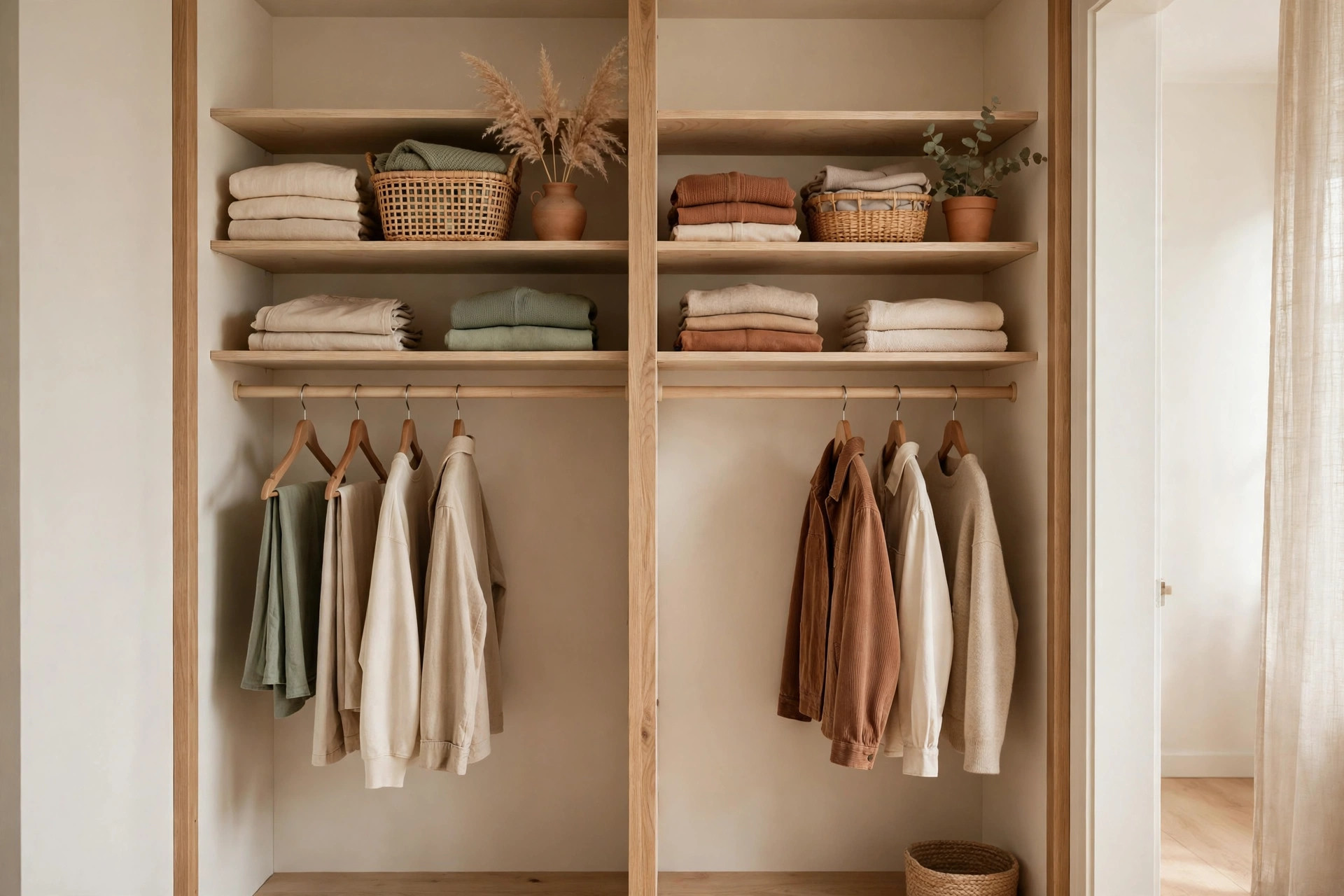
Give each person a clearly marked zone — left and right, or top rod and bottom rod — instead of mixing both people’s clothes across the whole closet. Use a different hanger color for each person so the boundary is visible at a glance. When clothes are mixed, one person’s overflow quietly eats the other person’s space, and nobody notices until someone cannot find a clean shirt.
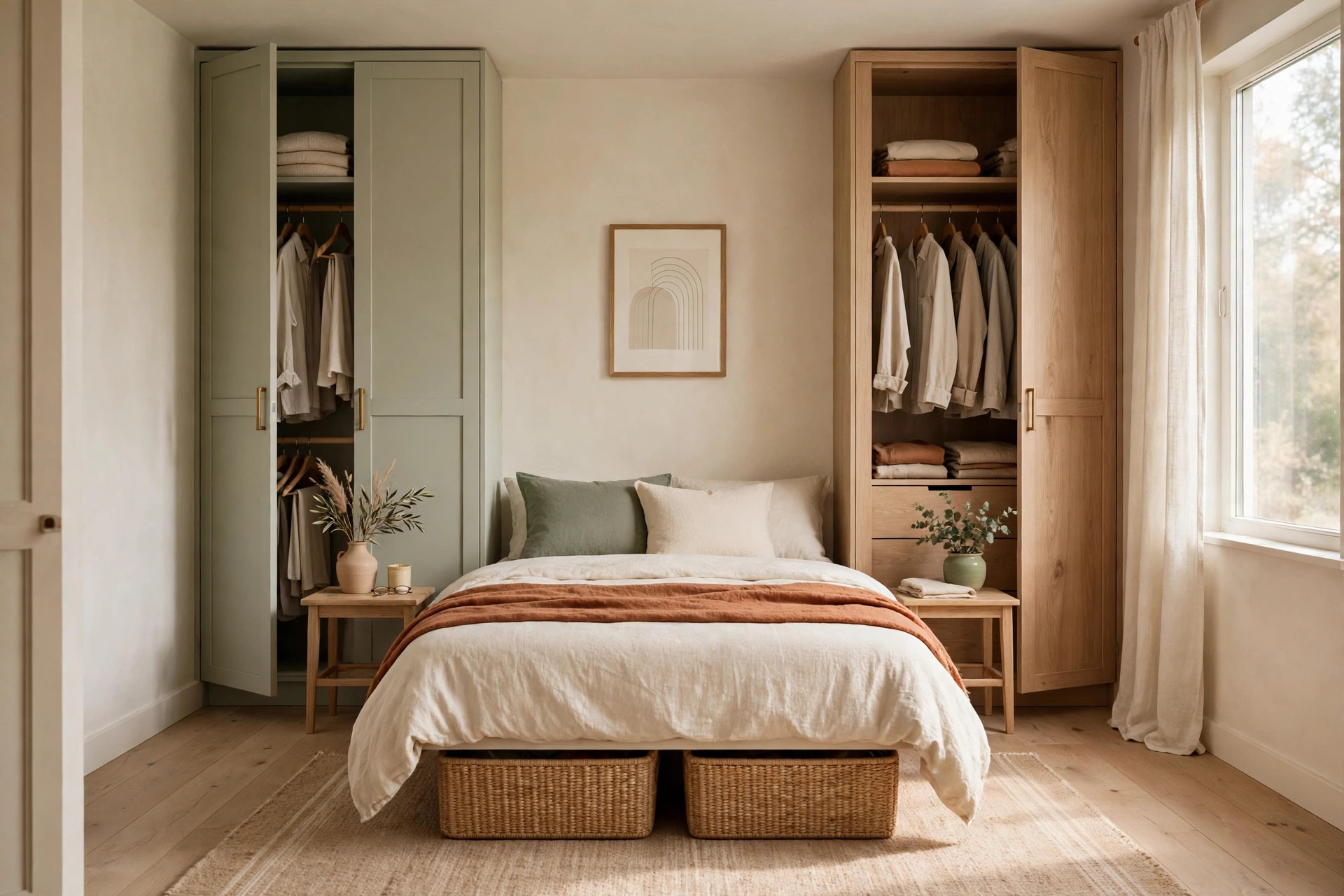
4. Add a second rod to double the hanging space
A standard closet has one rod and a lot of wasted air underneath it. Install a second rod about 40 inches below the first, and you instantly double hanging capacity for shirts, blouses, and folded trousers. Keep longer items — dresses, coats, long skirts — on the single-rod side or the outer end. In a rental, a tension rod or freestanding double-hang unit works without drilling. For the full breakdown of fair splits, double-hang math, and boundary rules, see 15 Closet Organization Ideas for Couples Sharing One Closet.
His-and-hers nightstand alternatives when there’s no room for two
Two full nightstands rarely fit beside a bed in a tiny room, and one shared nightstand becomes a dumping ground within a week. Give each person a small, personal bedside zone that needs no floor space.
5. Mount a floating shelf on each side of the bed
A wall-mounted shelf about 10 by 12 inches, installed at mattress height, holds a phone, a glass of water, and a book — which is all a nightstand really needs to do. Because it floats, it takes zero floor space. Choose a shelf with a small raised lip so a phone cannot slide off in the dark. If you cannot drill, a heavy-duty adhesive shelf rated for at least 5 pounds works for light items, though it will not hold a heavy lamp.
6. Use clip-on trays and a shared headboard shelf
If even two floating shelves feel crowded, clip a bedside tray onto each side of the bed frame. These fold flat, hold a phone and a glass, and cost less than a takeaway dinner. Above the bed, a single headboard shelf holds the shared items: the alarm clock, a small lamp, and the book you are both reading. Personal items go on your side’s tray, shared items go on the headboard shelf. For more zero-floor-space options, see 15 Small Bedroom Nightstand Alternatives That Save Floor Space.
Under-bed as shared storage: bins, drawers, and the retrieval deal
The space under the bed is the largest unused storage area in most tiny bedrooms — roughly 30 cubic feet under a queen bed — and the easiest place for one person’s stuff to swallow the other’s. Shared under-bed storage only works with a clear division and a retrieval agreement.
7. Split the under-bed space down the middle
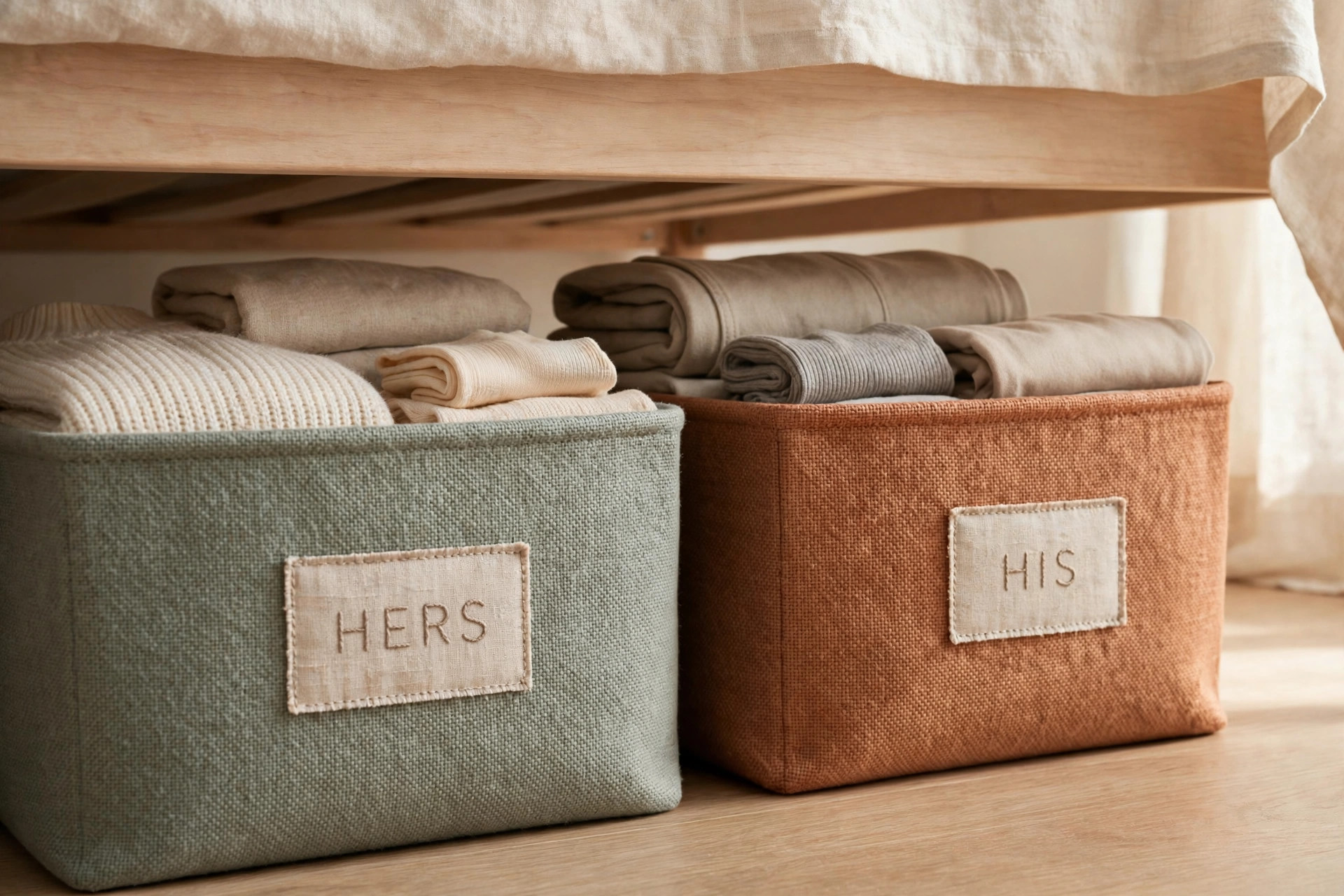
Assign each side of the bed to one person, matching the side each of you sleeps on. Use flat, clear bins about 6 inches high so you can see what is inside without pulling everything out, and label each bin with its owner and contents. Rolling drawers on casters work even better, because they slide out fully instead of needing to be dragged. Store off-season clothes, spare bedding, and shoes here — not daily items, which you will resent digging out every morning.
8. Make a retrieval deal: nothing buried deeper than one layer
The most common under-bed failure is stacking bins two deep and never opening the back ones. Agree on a simple rule: one layer only, nothing stacked on top of anything else, and every bin must slide out without moving furniture. If something cannot be reached in under 30 seconds, it does not belong under the bed. For the full guide to bins, drawers, and dust-proofing, see 18 Under-Bed Storage Ideas That Turn Dead Space Into a Dresser.
Vertical space: shelves and hooks that double capacity
When floor space is gone, the only direction left is up. Walls in a tiny bedroom are usually bare above shoulder height, and that empty band can hold as much as a whole extra dresser — if you use it deliberately.
9. Run one high shelf around the room’s dead wall
Install a single shelf about 12 inches below the ceiling on the wall with no door or window. It holds off-season items, memory boxes, and things you need a few times a year, in matching boxes so it looks intentional rather than cluttered. Keep a small folding step stool behind the door, because a shelf you cannot reach safely is a shelf you will never use. Never store daily items up high — the shelf is for the slow rotation, not the everyday.
10. Give each person a hook rail at the door
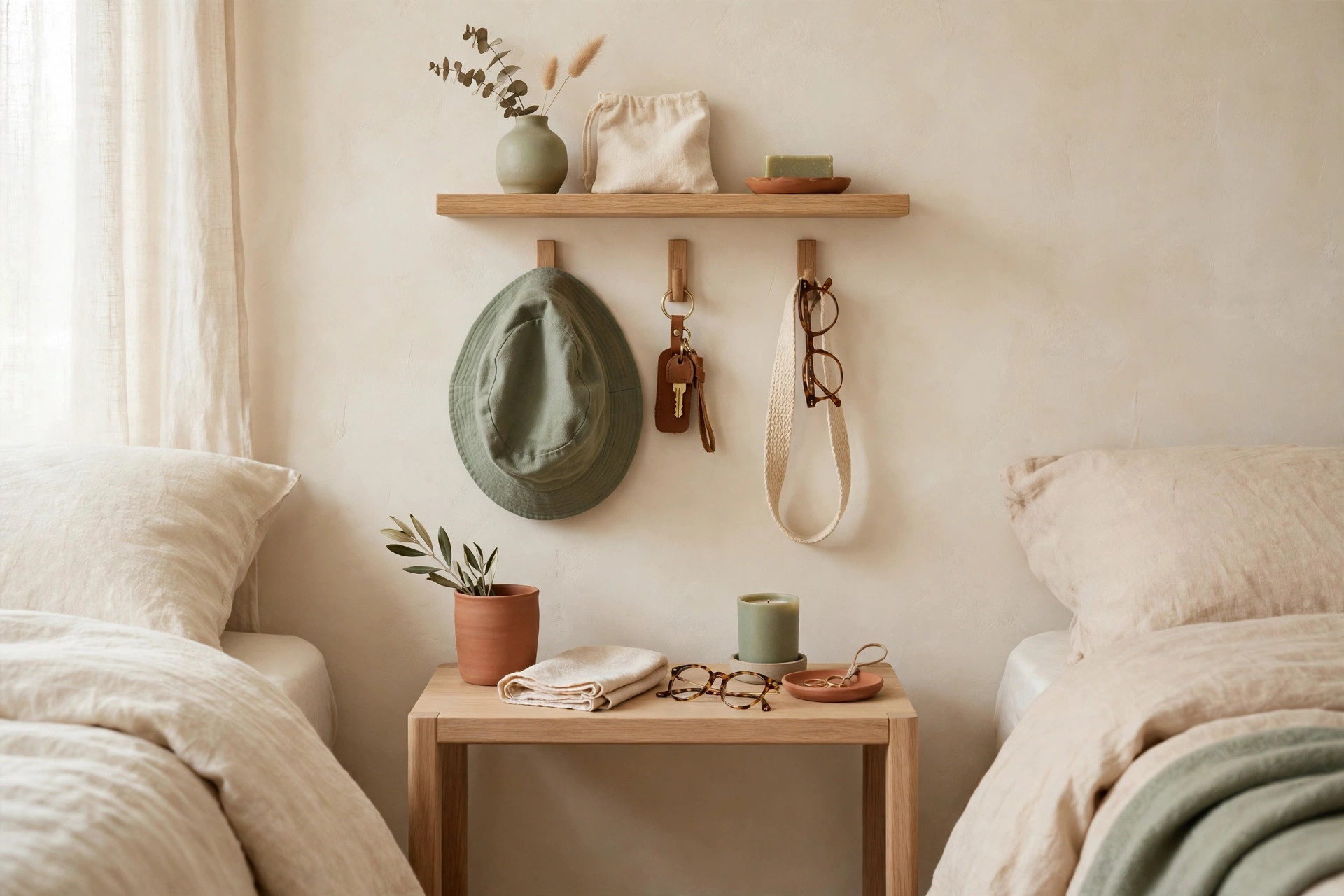
Mount two short hook rails — one per person — on the wall beside the bedroom door or on the back of it. Each rail holds tomorrow’s outfit, a bag, and a jacket, which keeps the “chair pile” off the furniture and off the floor. Four hooks per person is enough; more hooks just invite more clutter. This clears the most visible mess in a shared bedroom, because the chair pile is usually the first thing you see when you walk in.
The shared-surface rules: dresser tops, laundry, and daily clutter
Shared surfaces are where two people’s habits collide. The dresser top, the laundry chair, and the floor by the bed are neutral territory, which means nobody owns them and everybody uses them. Without rules, they become the room’s junk drawer.
11. Cap the dresser top at three items per person
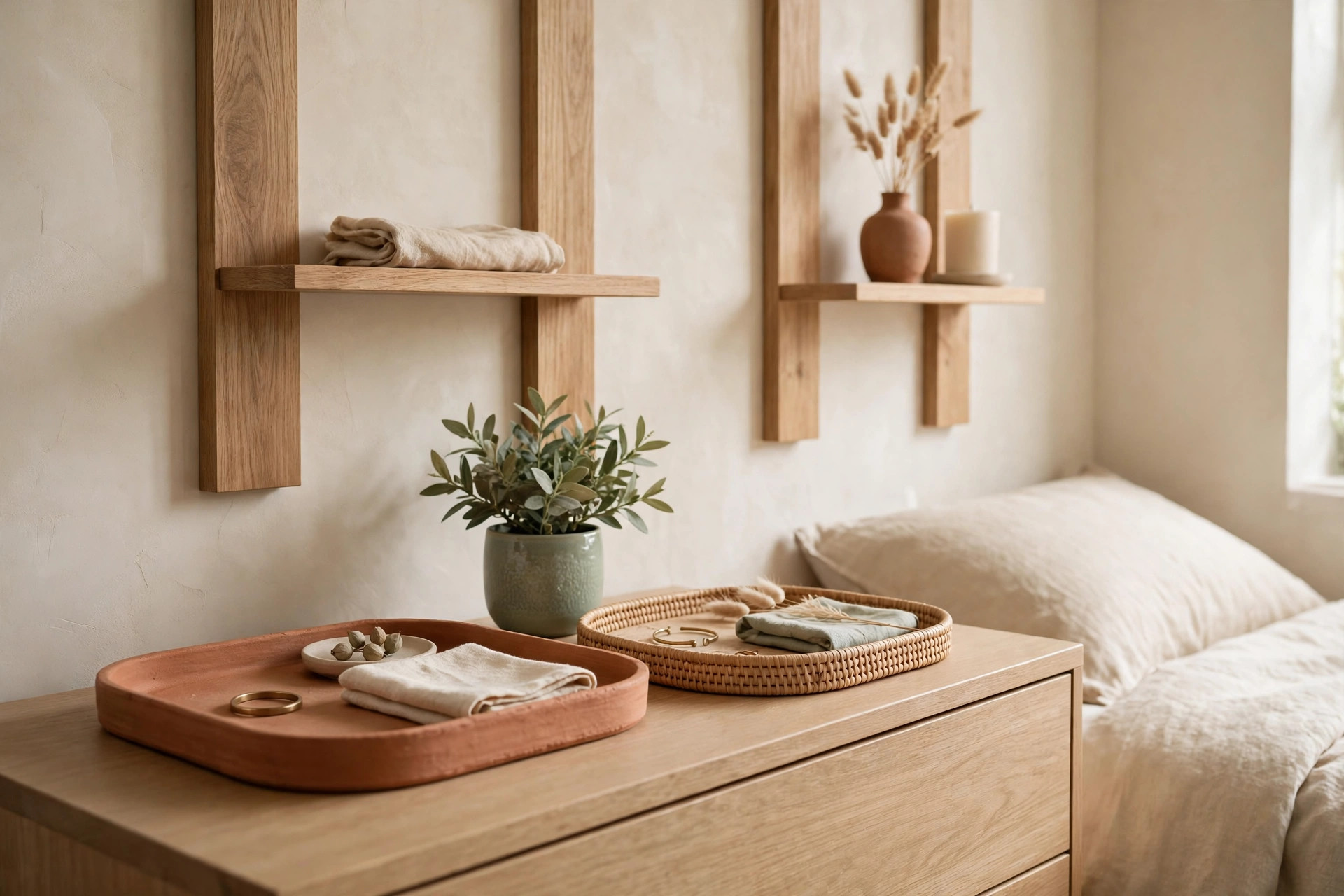
Pick a number and stick to it: each person gets three items on the dresser top — a lamp, a tray, a framed photo, whatever matters to them. Everything else lives in a drawer. A small tray per person acts as a boundary: your keys, watch, and wallet stay inside your tray, and anything outside the tray gets put away at night. This is the cheapest peace treaty in a shared bedroom, because the limit is visible and equal.
12. Run one shared laundry system, not two piles
Two people produce roughly a full laundry basket every two to three days, and two separate piles on the floor double the mess. Use one tall, divided hamper with two compartments — one per person — or one hamper plus a small mesh bag for delicates. Dirty clothes go in the hamper the moment they come off, not on the chair, the bed, or the floor. When the hamper is full, whoever notices it runs the load, or you alternate weeks — but the rule itself is not negotiable.
13. Give every daily item a landing spot within arm’s reach of the door
Keys, wallets, sunglasses, and the bag you carry every day need a home by the bedroom door, not scattered across the room. A small wall-mounted organizer with two pockets — one per person — or a narrow tray on the dresser nearest the door does the job. The test is simple: can you leave the room in the morning without crossing it twice to find something? If not, the landing spot is in the wrong place.
The weekly 10-minute couple’s reset
No storage system survives two busy people without maintenance. The weekly reset is the maintenance — short, shared, and scheduled, so it happens before the room falls apart instead of after.
14. Set a fixed 10-minute reset every Sunday evening
Pick one evening, set a timer for 10 minutes, and both of you tidy at the same time. Each person handles their own zone: their closet side, their nightstand shelf, their under-bed bins, their dresser tray. Shared areas — the floor, the laundry, the dresser top — get split down the middle. Ten minutes is short enough that nobody dreads it, and weekly is frequent enough that the mess never becomes a project.
15. End the reset with a one-minute “what’s not working” check
When the timer ends, spend one minute asking each other one question: is anything in this room annoying you this week? A drawer that sticks, a bin that is too deep, a hook that keeps dropping your jacket — small frictions are why systems get abandoned. Fix one friction per week, even if the fix is just moving a bin six inches to the left. Couples who adjust their system weekly keep it for years; couples who wait until it breaks start over from scratch.
Mistakes to avoid (and what not to buy)
The fastest way to waste money on a tiny shared bedroom is buying storage before you have a system. Do not buy matching decorative boxes until you know what goes inside them — empty boxes are just clutter with a lid. Do not buy a second dresser before auditing the closet; most couples discover they need hanging space, not drawers. Do not buy open shelving for clothes you do not fold neatly, because open shelves display mess instead of hiding it. And do not buy one person’s solution for a two-person problem: a single organizer or nightstand ends up belonging to whoever claims it first. Buy for two, in pairs, or do not buy it at all.
Frequently Asked Questions
How do couples split a small closet fairly?
Measure, don’t guess. Count and measure each person’s hanging clothes, then divide the closet to match those numbers instead of defaulting to 50/50. Give each person a marked zone with their own hanger color, add a second rod, and revisit the split every season.
Can two people share a bedroom with only one nightstand?
Yes, but not by sharing the nightstand — by replacing it. Mount a small floating shelf on each side of the bed, or use clip-on bedside trays, so each person has a personal spot for a phone, water, and a book. Keep shared items like the alarm clock on a headboard shelf instead.
What is the best under-bed storage for couples?
Flat, clear bins about 6 inches high or rolling drawers on casters, split down the middle so each person owns the side they sleep on. Label every bin with its owner and contents, store off-season clothes and spare bedding there, and follow the one-layer rule so nothing is ever buried.
How do you stop clutter wars in a shared tiny bedroom?
Agree on the rules before you buy anything: a one-in, one-out rule, a cap on shared surfaces, a single laundry system, and a weekly 10-minute reset you both do together. Most clutter wars are not about stuff — they are about unclear boundaries, and clear boundaries end them.
Conclusion
A tiny bedroom shared by two people works when the space is divided fairly, every item has a named home, and the rules are simple enough to keep. Audit what you own, split the closet and the under-bed space, give each person a bedside zone, use the walls, cap the shared surfaces, and reset together for 10 minutes a week. Save this pin for later, and explore more ideas in our small-spaces collection.