A sloped ceiling turns a perfectly good bedroom into a puzzle: the floor is there, but half of it sits under a ceiling you cannot stand beneath, and every dresser you own is too tall for the low side. The fix for small bedroom storage sloped ceiling rooms is not fighting the angle — it is building low where the ceiling is low and going tall only where the ceiling allows. These 15 attic bedroom storage ideas cover knee-wall drawers, under-eaves bins, and the tall wall, so the awkward triangle stops wasting space and starts holding your clothes, shoes, and off-season gear.
Measure the slope: where you can stand, sit, and store
1. Mark your stand, sit, and store zones with painter’s tape
Walk toward the tall wall until your head clears the ceiling by at least 2 inches, then mark the floor with painter’s tape. Do the same sitting down — the point where you can sit upright, roughly 36 to 40 inches of ceiling height, gets a second line, and everything below it is store-only space.
2. Make a clearance card before you shop
Cut a piece of cardboard to the exact height of the spot where furniture will go — say 22 inches at the knee wall — and carry it when you shop. Write the maximum height, depth, and width for each zone on the card, and measure the doorway and stairwell too, since attic furniture often fits the room but not the stairs.
Low-profile furniture that fits under the eaves
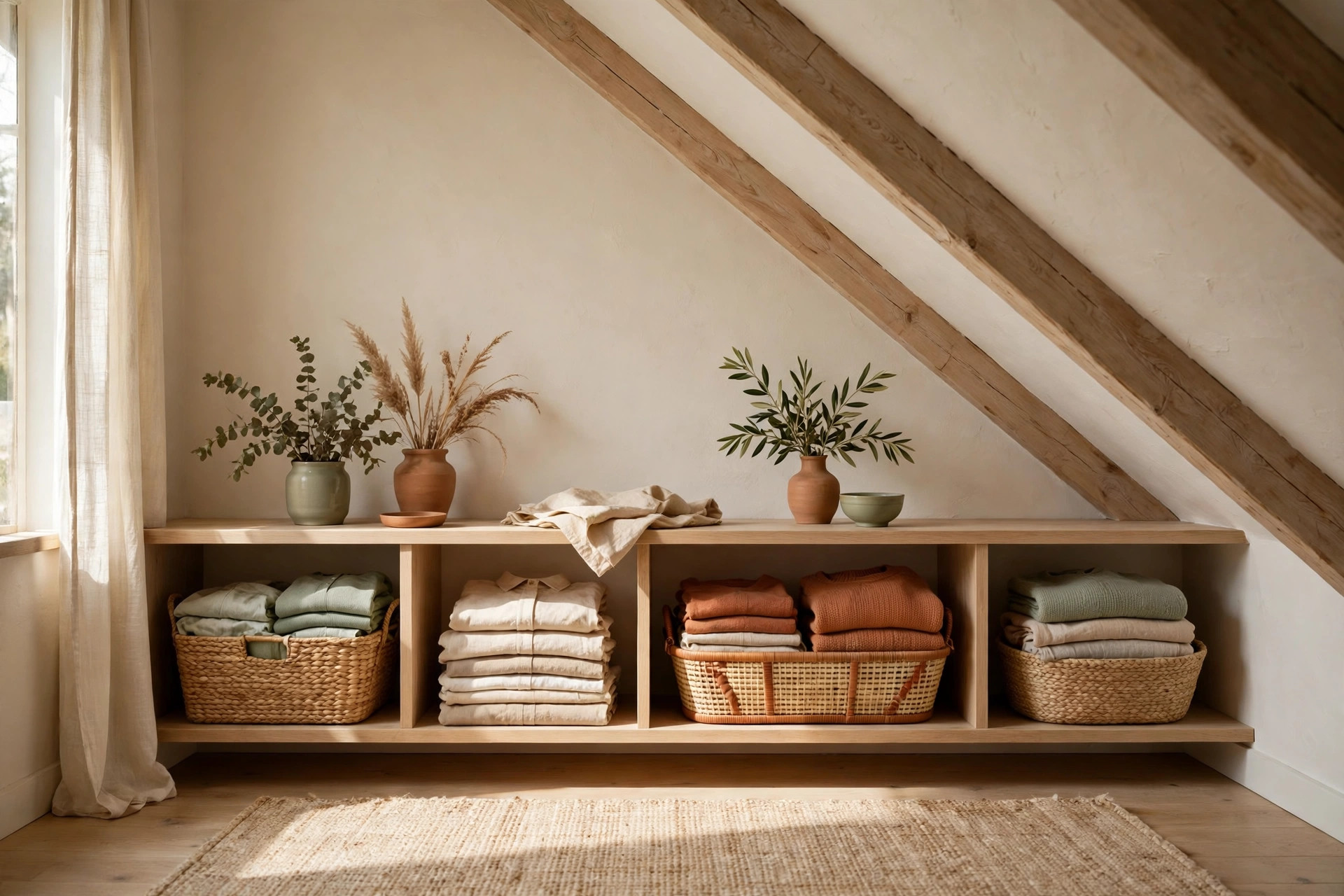
3. Use a low, wide dresser as your main clothes storage
A dresser 28 to 32 inches tall and 48 to 60 inches wide holds roughly as much as a standard tall chest, but it slides under a slope a tall dresser never could. Pick six shallow drawers over three deep ones so folded clothes stay visible in a single layer, and keep the top for a lamp and a small tray — not piles.
4. Roll drawers under the eaves on casters
Flat rolling drawers, 6 to 10 inches tall on 2-inch casters, use the lowest strip of floor — the 12 to 18 inches right against the knee wall. Fill them with out-of-season shoes or spare bedding, label each drawer front, and pull them out by the handle. If your room has no closet at all, pair these with the freestanding wardrobe approach in our guide to bedroom storage ideas for small rooms with no closet.
Knee-wall storage: drawers and doors in the dead triangle
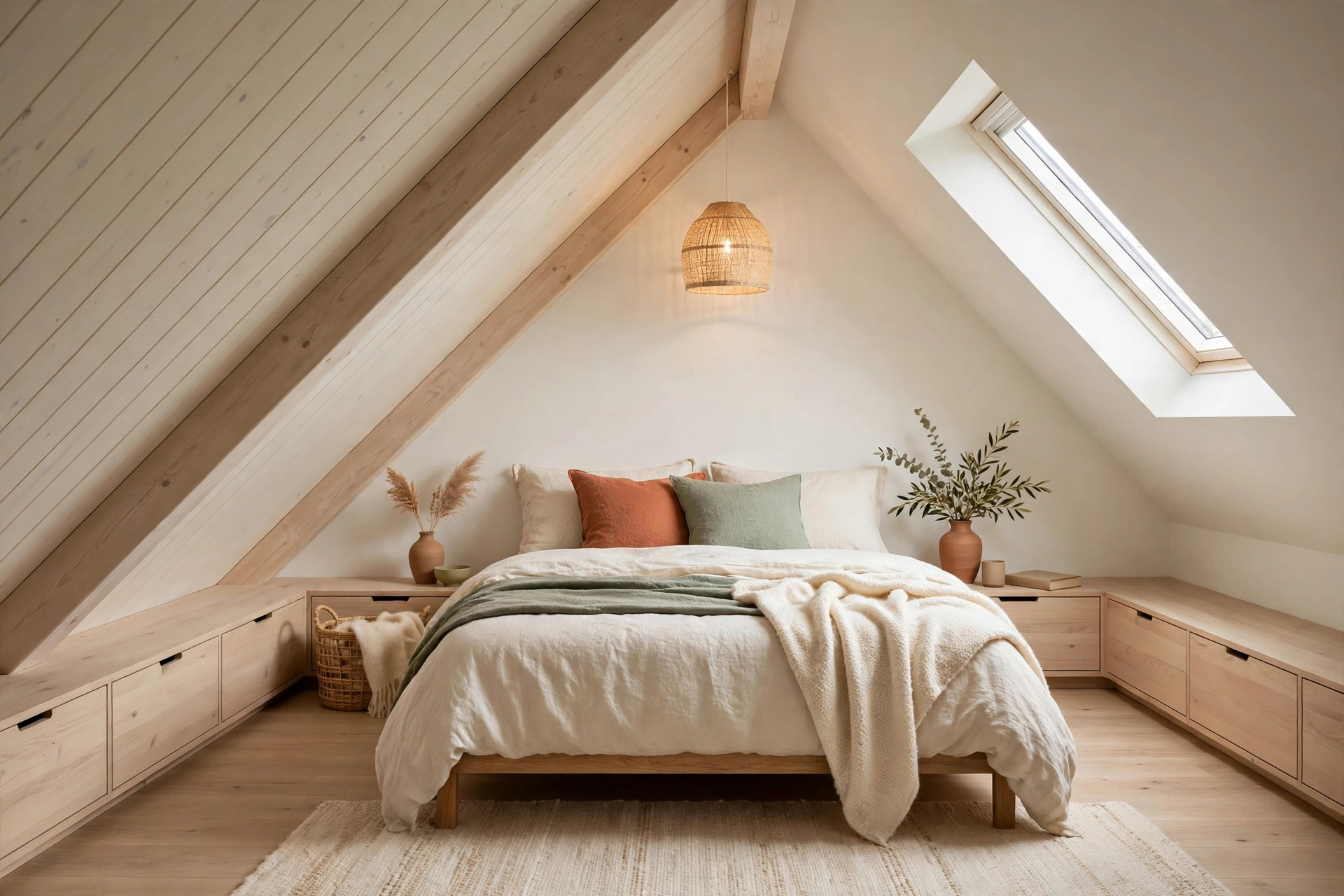
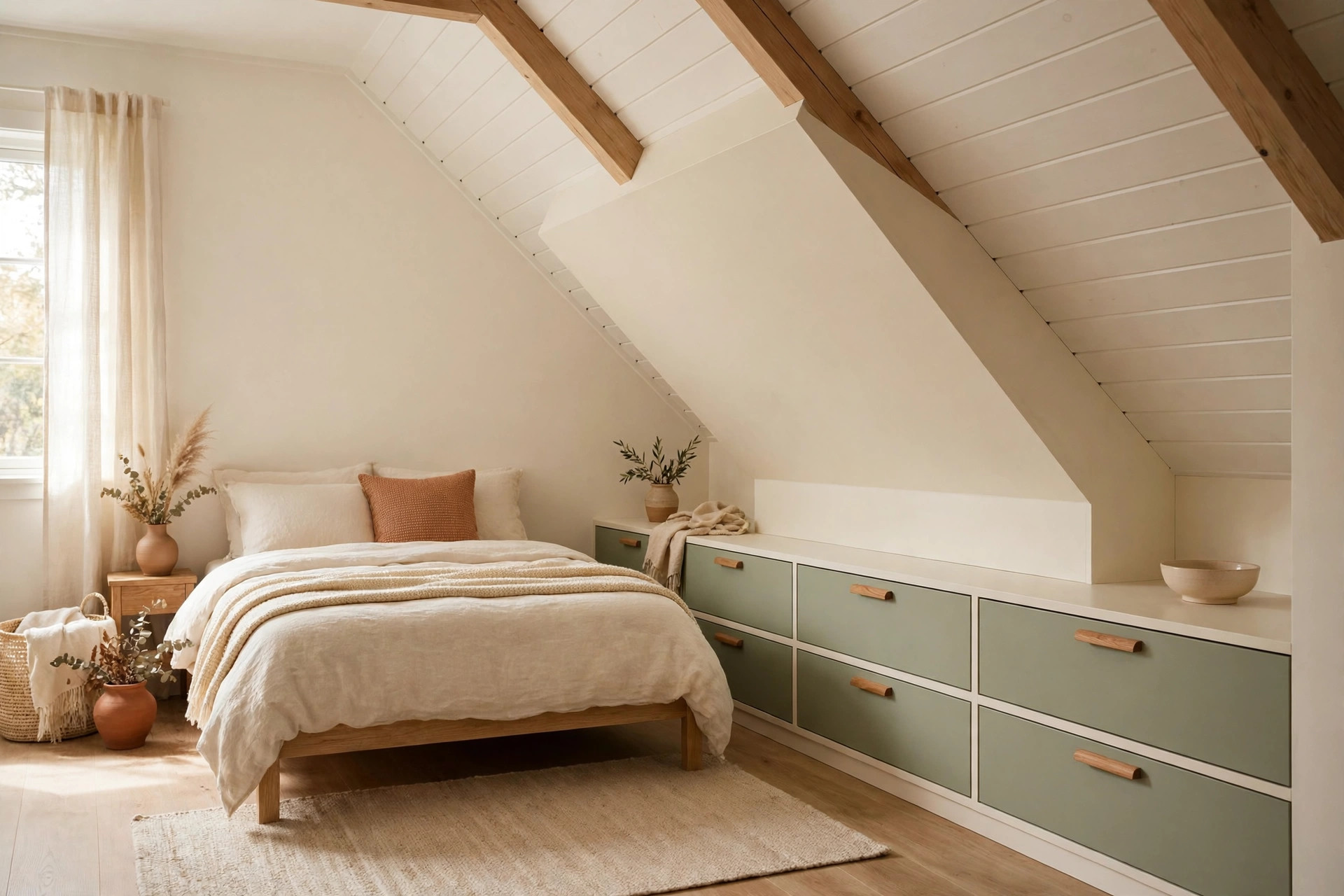
5. Build or buy drawers that fit the knee-wall triangle
If your knee wall is at least 24 inches tall, shallow drawers built into it can hold folded clothes, linens, or shoes without taking a single inch of floor space. Ready-made stackable units 20 to 24 inches tall work in front of the knee wall, while custom built-ins cut drawer fronts to follow the slope; measure the cavity depth first — most are 12 to 24 inches deep — and check for dampness after rain.
6. Add hinged doors with pull-out trays behind them
Where the ceiling drops below 24 inches, drawers stop making sense and doors take over. A hinged or lift-up door in the knee wall, with a pull-out tray or low bin on a slider behind it, turns the deepest part of the triangle into reachable storage — add a battery puck light inside, since the back corners are dark even in daylight.
Under-eaves bins: flat storage for off-season clothes
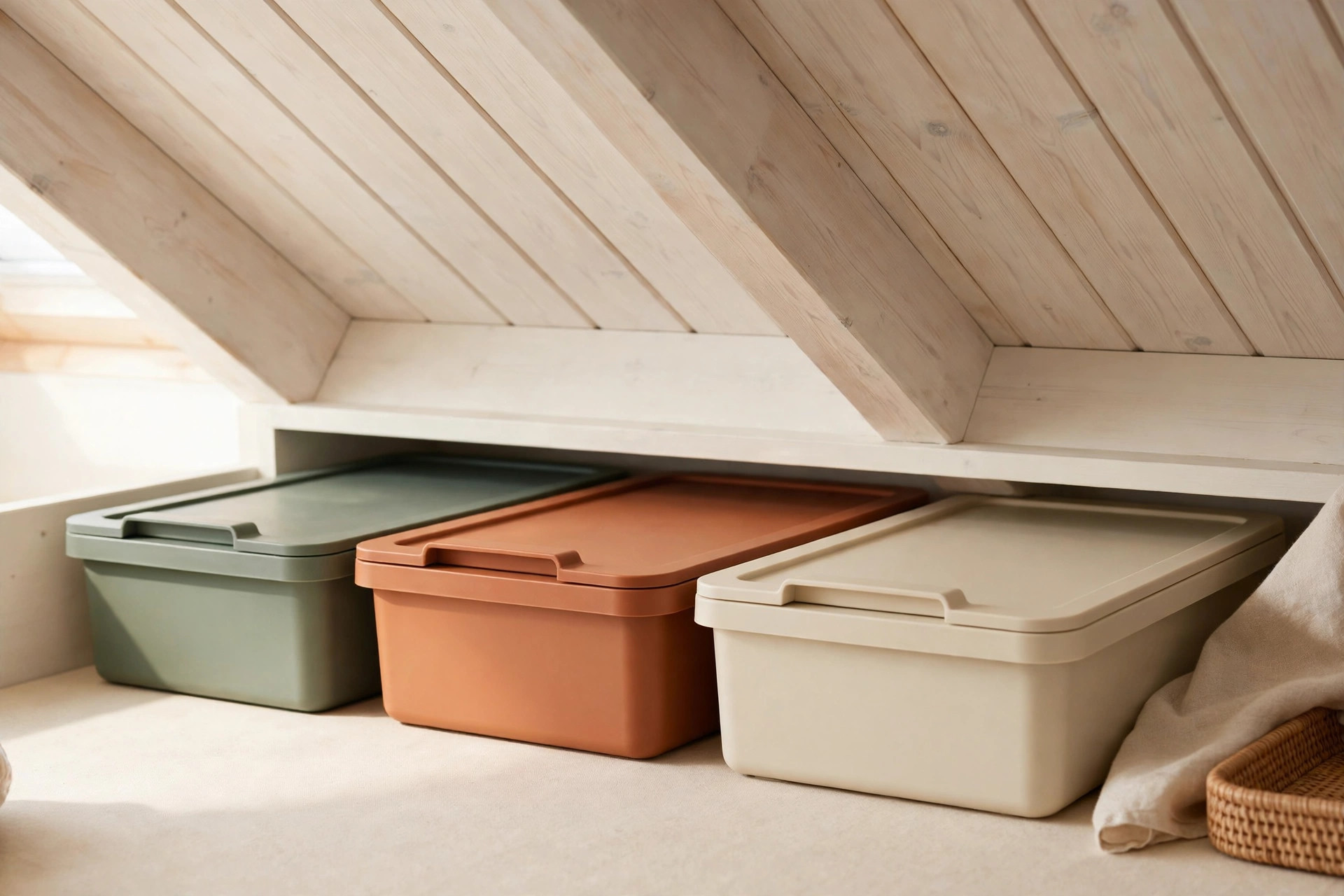
7. Use flat, lidded bins sized to your lowest zone
Buy bins 6 to 8 inches tall, with a lid that clips shut and a handle on the short end, and measure your lowest strip first — if the ceiling is 10 inches high at the back, a 12-inch bin will not slide in. Use one bin per category (winter sweaters, summer clothes, spare sheets), stack no more than two high, and label the end that faces the room, not the top.
8. Vacuum-seal off-season clothes before they go under the eaves
Vacuum storage bags cut bulky winter coats and duvets to roughly a third of their volume, which matters when storage is measured in inches of height. Slide the sealed flat packet into a hard-sided bin rather than leaving the bag loose, since a bare bag tears on rough floorboards — and pair it with a twice-a-year swap using our seasonal storage rotation ideas.
The tall wall: vertical storage where the ceiling allows
9. Put your wardrobe on the tall wall, not the slope
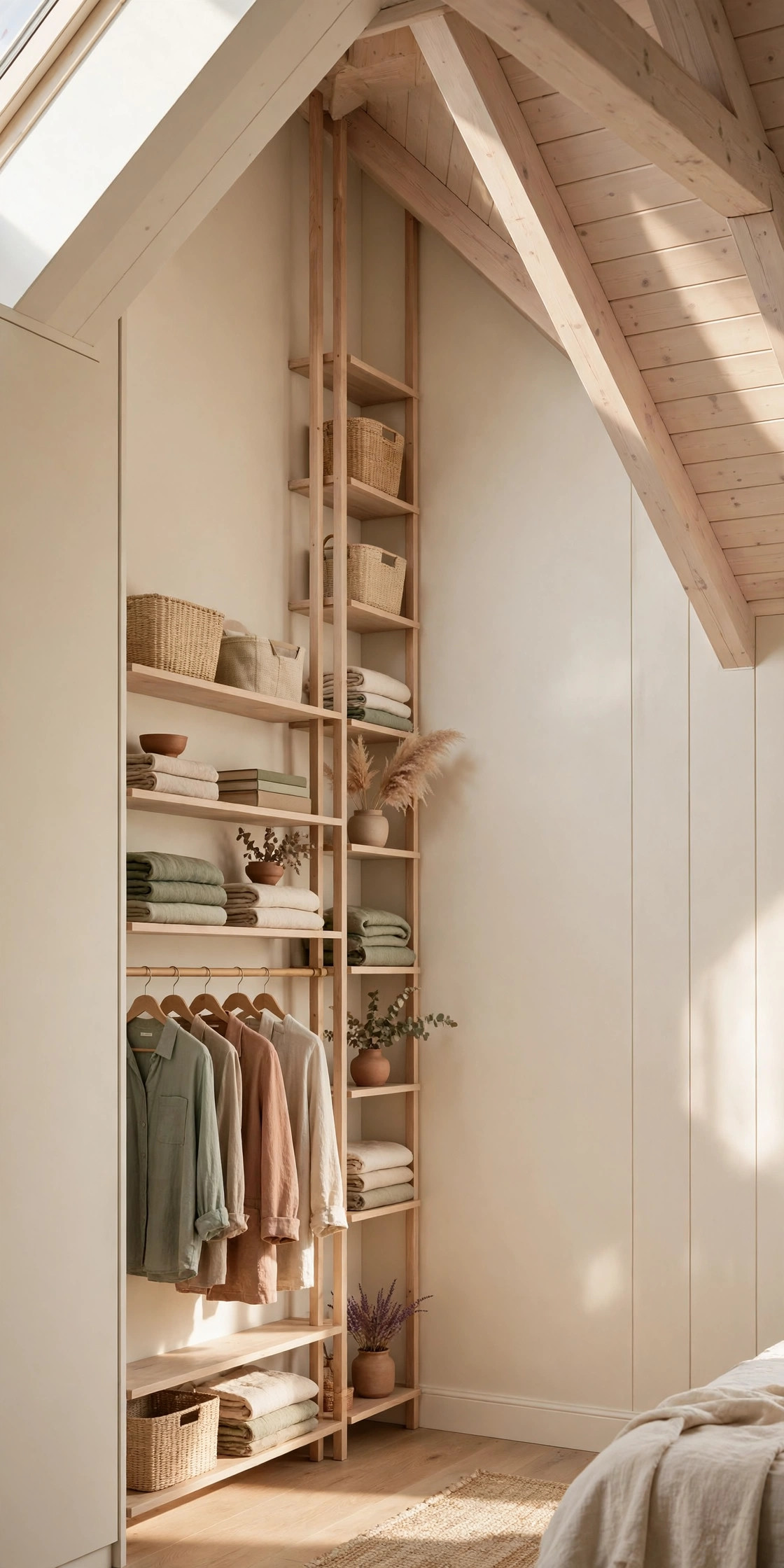
A wardrobe, armoire, or tall shelving unit belongs on the full-height wall, where it can use every inch up to the ceiling. A 72-inch-tall wardrobe with a hanging rod at 60 inches holds a full wardrobe plus out-of-season items on its top shelf — anchor it with an anti-tip strap, since attic floors are often uneven.
10. Run open shelving up the tall wall to the ceiling
Open shelves on the tall wall, spaced 12 to 14 inches apart, hold books, folded clothes, and baskets without the bulk of a wardrobe. Put daily items between waist and eye level and reserve the top shelves for things you touch a few times a year; for more on going up instead of out, see our vertical storage ideas for small apartments.
Hooks and rails on the slope itself
11. Mount a peg rail along the slope for daily items
A wooden peg rail screwed into the studs along the slope, at about 60 inches from the floor on the tall side, holds tomorrow’s outfit, a robe, a tote bag, or a hat. Use screws, not adhesive hooks, because adhesive fails faster in attic summer heat, and space the pegs 6 to 8 inches apart so hanging items do not overlap and wrinkle.
12. Hang slim hooks under the lowest slope for bags and accessories
Small screw-in hooks or a short rail under the slope, where the ceiling is 40 to 48 inches high, are perfect for handbags, scarves, belts, and caps — flat, light items you can lift off while sitting or kneeling. Keep the total weight under 10 pounds per hook, and renters should use removable hooks rated for the item’s weight; for more no-drilling approaches, see our small apartment storage ideas for renters.
Lighting the low corners so storage stays usable
13. Stick battery LED strips inside knee-wall doors and under low shelves
A battery-powered LED strip about 12 inches long, stuck to the inside top of a knee-wall door or under a low shelf, lights the exact spot your hand reaches into. Choose motion-sensor strips so they switch off by themselves, and keep the strip toward the front of the cavity so it lights the opening.
14. Add a small mirror on the tall wall to bounce window light into the low side
A mirror 18 by 24 inches, hung on the tall wall opposite the window, bounces daylight across the room and into the low corners under the eaves. Hang it at eye level from the bed, not at standing eye level, and never lean a large mirror against the slope itself — the angle makes it slide, and a falling mirror in a small room is a hazard.
What NOT to store in a hot, dusty attic room
15. Keep a “never up here” list and move those items to the tall-wall closet
Tape a short list inside the knee-wall door: no photographs or film negatives, no vinyl records, no leather goods, no electronics with batteries, no important paper documents, no candles, and no medicines. Heat warps and fades all of them — attic temperatures can climb well above 90°F (32°C) on a summer afternoon — so move those items to the tall-wall wardrobe or a cooler room.
Mistakes to avoid with sloped-ceiling storage
- Buying tall furniture for the low side. A 48-inch dresser against a 36-inch slope wastes the top foot and blocks the walkway — measure the ceiling at the exact spot, not the middle of the room.
- Storing daily clothes in the deepest corner. If you have to kneel to reach a shirt, you will stop putting it back.
- Leaving the knee-wall cavity unsealed. Dust and insects drift in through gaps around the doors — foam weatherstripping around the frame costs a few dollars and keeps stored clothes cleaner.
- Overloading the slope with heavy hooks. The slope is ceiling, not a load-bearing wall — heavy items belong on the tall wall; the slope is for light, flat things only.
- Skipping labels. Under-eaves bins all look identical in the dark, and unlabeled bins mean opening three wrong bins to find one sweater.
Frequently asked questions
Can you put a wardrobe in a room with a sloped ceiling?
Yes — put it on the full-height wall, where the ceiling is tallest. Measure the ceiling height at the exact spot, choose a wardrobe at least 2 inches shorter, and anchor it with an anti-tip strap, since attic floors are often uneven.
How do you store clothes in an attic bedroom with no closet?
Combine three zones: a low, wide dresser under the slope for folded clothes, a freestanding wardrobe or rail on the tall wall for hanging items, and flat lidded bins under the eaves for off-season clothes.
What is the best storage for under-eaves space?
Flat lidded bins 6 to 8 inches tall, sized to your lowest ceiling height, with a handle on the short end and a label on the end facing the room.
How do you stop attic bedroom storage from getting dusty?
Use lidded bins and closed drawers instead of open baskets, add foam weatherstripping around knee-wall doors, and wipe the top shelves of open storage once a month — attic rooms collect more dust than ground-floor rooms.
Is it safe to store things behind a knee wall?
Yes, as long as the cavity is dry and ventilated. Check for dampness after rain before storing anything, keep a small gap for air circulation, and keep heat-sensitive items like photographs and medicines out during summer.
Conclusion
A sloped ceiling does not mean a small bedroom has to stay messy — it just means the storage has to match the shape of the room. Build low under the eaves, use the knee-wall triangle, and save the tall wall for the wardrobe and shelves that need real height. Save this pin for later, and browse more ideas in our small spaces collection.