A tiny desk can hold a surprising amount of work, but it cannot hold a surprising amount of stuff. When pens, chargers, notebooks, and loose paper all compete for the same 36 inches of surface, the work itself gets squeezed out, and every task starts with five minutes of clearing space. Good small desk supply organization is not about buying prettier containers. It is about deciding what earns a place on or near the desk, giving each of those things a fixed home, and moving everything else somewhere it cannot interrupt you. This guide walks you through 17 practical ideas for a tiny home office.
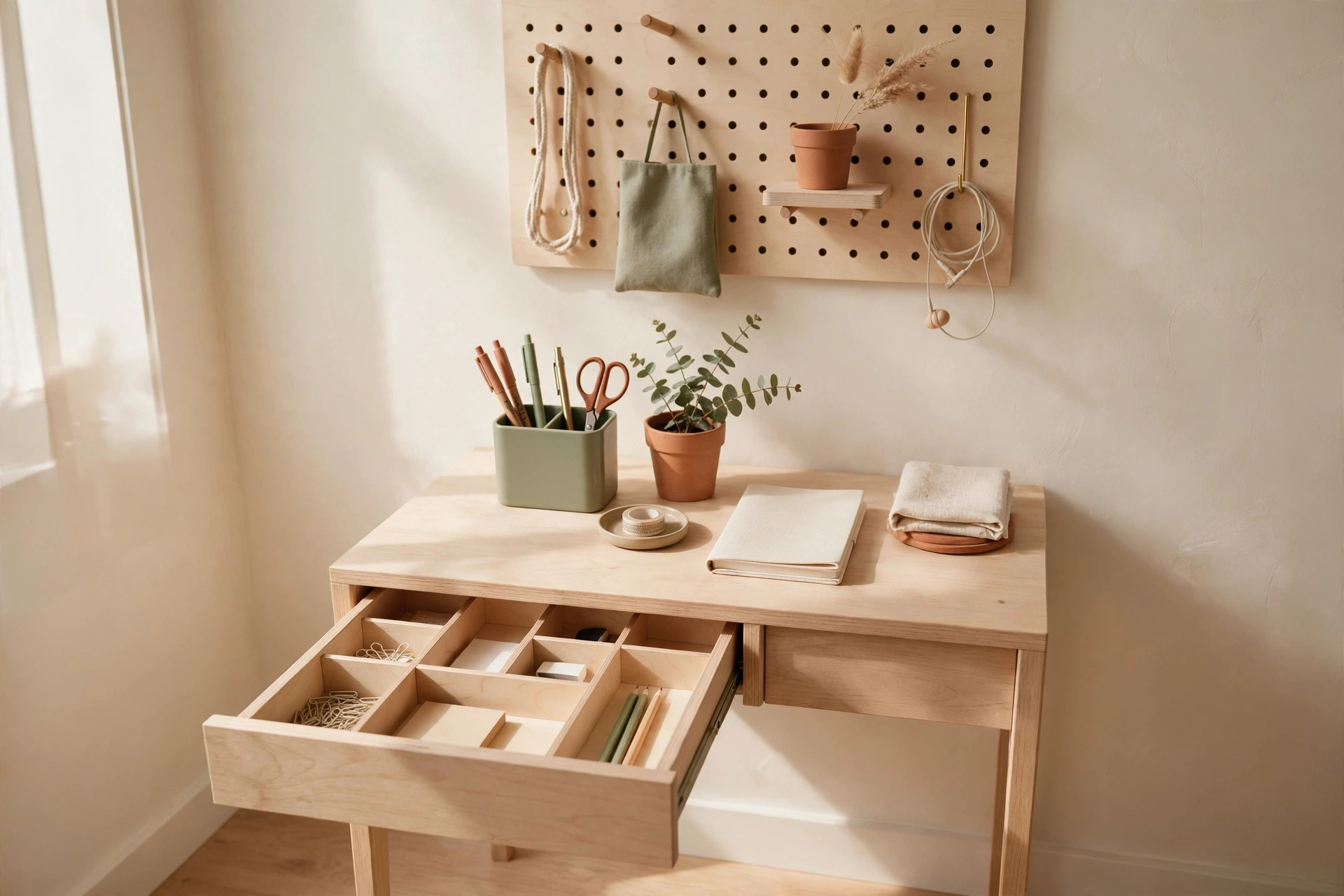
The desk audit: what you touch daily vs weekly
Before you buy a single organizer, empty the desk completely and sort everything into three groups: used every workday, used weekly, and used rarely or never. The daily group is usually much smaller than people expect — a laptop or monitor, a pen or two, a notebook, a phone charger, and perhaps a mug.
1. Keep only daily tools on the surface
Limit the desktop to the five or six items you genuinely reach for every day. Everything else moves to a drawer, a wall rail, or a nearby shelf. This single rule does more for a tiny desk than any organizer, because a clear surface is what makes the rest of the system feel effortless.
2. Give weekly supplies a “second ring” home
Weekly items should live within arm’s reach but not on the desk — the top drawer, a wall pocket, or a small shelf just above eye level. If you have to stand up to fetch scissors, they are too far away; if they sit beside your keyboard, they are too close. The second ring is the sweet spot in between.
Drawer dividers and the one-drawer supply kit
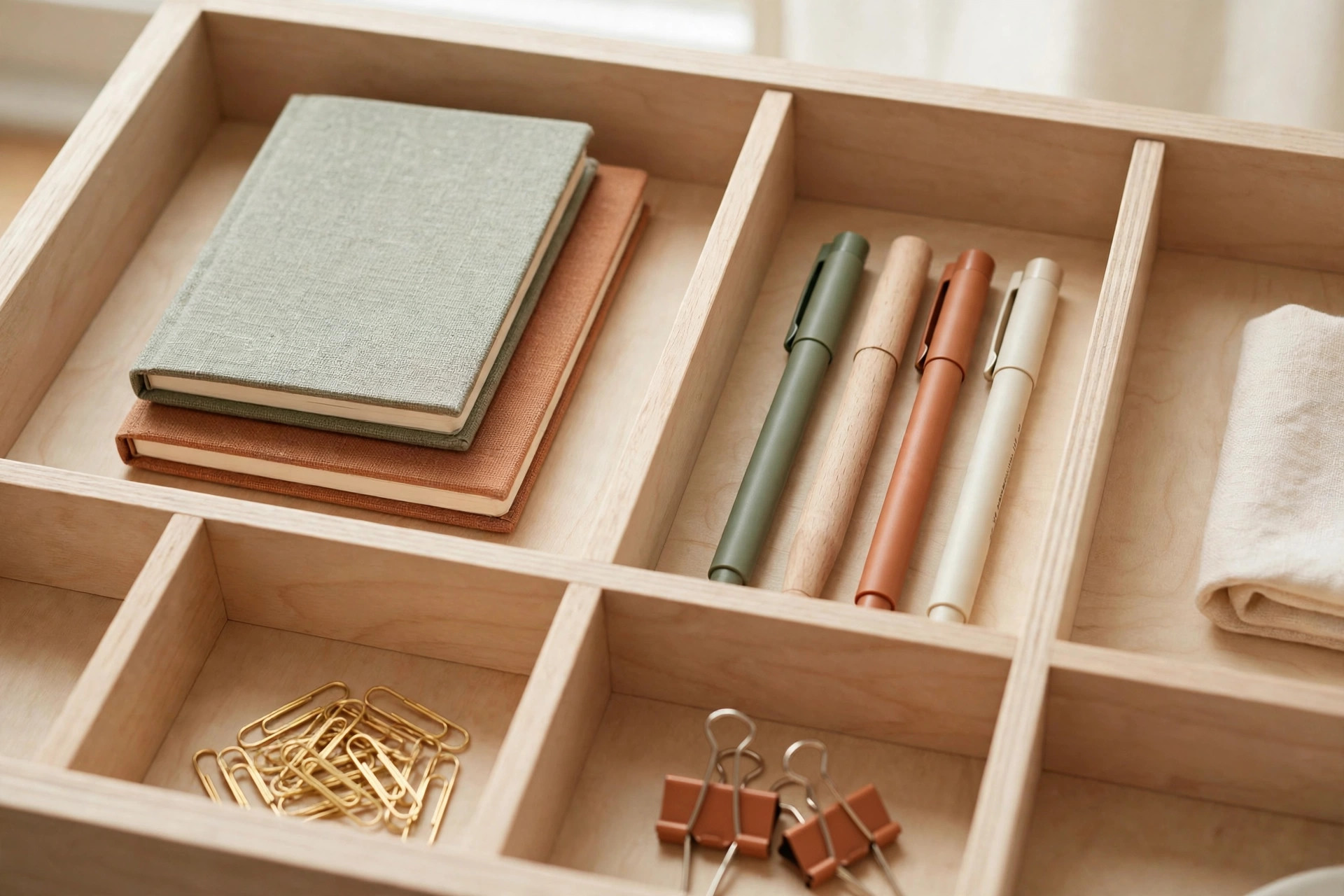
A single desk drawer, properly divided, can hold nearly every supply a tiny home office needs. The trick is dividers that fit the drawer rather than loose cups that slide around every time you open it. Measure the drawer first — length, width, and depth — and look for adjustable dividers or a tray sized within half an inch of those measurements. A tray that shifts defeats its own purpose.
3. Use a fitted tray, not loose cups
A fitted bamboo or plastic tray with five to seven compartments turns one drawer into a proper supply kit: pens in one slot, clips and pins in another, sticky notes and tabs in a third.
4. Build a one-drawer supply kit
Stock that single drawer as your complete kit and stop there: two pens, one pencil, a highlighter, scissors, tape, a stapler, paper clips, sticky notes, and a small notepad. If a new supply cannot fit in the tray, something else has to leave — that constraint is the system working, not a flaw.
5. Reserve one shallow slot for “in transit” items
Leave one small compartment empty on purpose, for things passing through: a form to sign, a letter to post, a receipt to file. Empty it every Friday, and nothing accumulates. The same measure-first discipline keeps a junk drawer elsewhere in the house under control too.
Desktop caddies that don’t eat the workspace
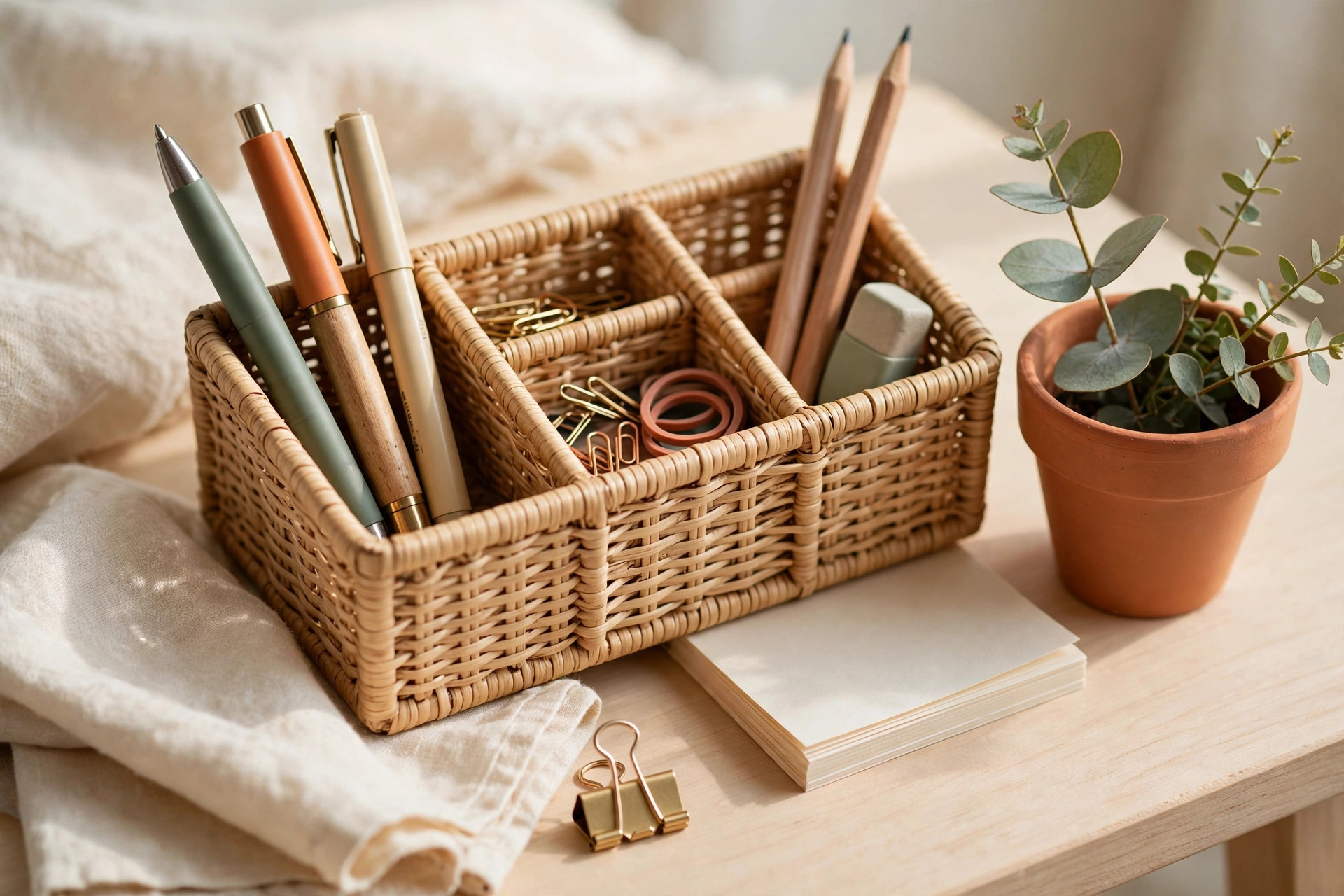
A caddy earns its place only if it holds things upright in a footprint smaller than a paperback book. Tall, narrow containers work best on a tiny desk because they use vertical space instead of surface area.
6. Choose one tall, narrow pen cup
One pen cup, roughly 3 to 4 inches across, holding no more than eight writing tools, is enough for daily work. Empty it, test every pen, and keep only the ones that write well.
7. Use a small tray as a landing zone
A tray about the size of a paperback — roughly 8 by 6 inches — parked at the back corner of the desk gives small daily items a boundary: your phone, keys, or a USB drive. Without a boundary, small items spread.
8. Clip a monitor-side holder for the tools you grab mid-task
A small holder that clips to a monitor edge or sits on a monitor riser keeps a highlighter and a pen exactly where your hand already goes. This works especially well in a corner setup — our guide to small home office organization in a corner covers desk zones and vertical storage for exactly that shape of room.
Wall and pegboard storage above the desk
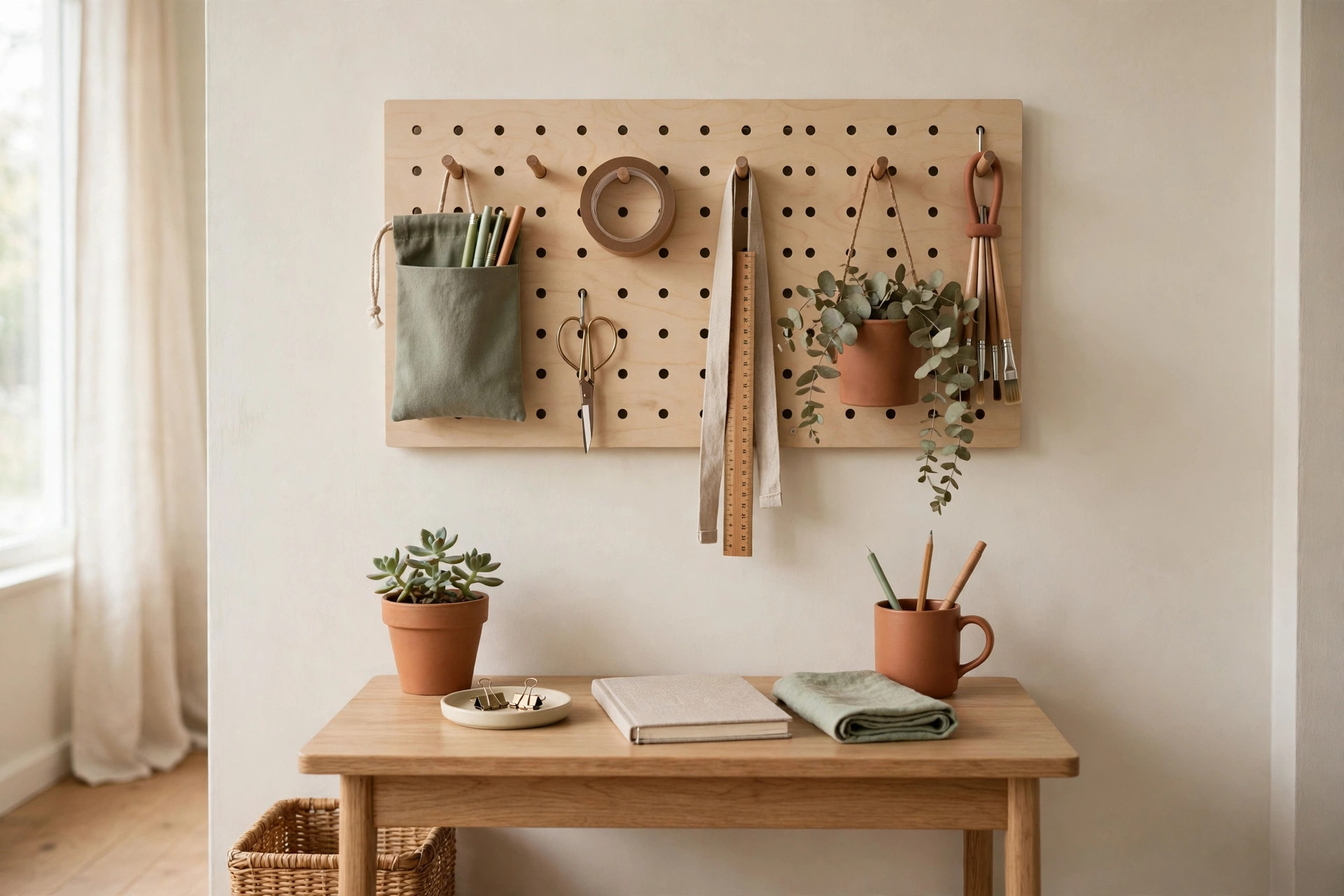
The wall above a desk is the most underused storage in a tiny home office. A rail, a pegboard, or a couple of small shelves can hold a dozen supplies without touching the desktop at all. Renters can use adhesive hooks rated for the weight, or a freestanding pegboard that leans against the wall — no holes required.
9. Mount a rail for hanging cups and clips
A 16- to 24-inch rail mounted 12 to 18 inches above the desk, with two or three hanging cups, holds scissors, markers, and a phone charger off the surface entirely. Keep the rail within easy reach while seated.
10. Use a small pegboard for the supplies you see, not store
A pegboard roughly 16 by 20 inches is plenty for a tiny desk. Hang only the five or six items you reach for often — scissors, a ruler, washi tape, a small pair of headphones — and leave the rest of the board empty. A pegboard crammed edge to edge becomes a junk wall; a half-empty board stays useful and calm.
Paper, notebooks, and reference storage
Paper is the supply that most often defeats a tiny desk, because it arrives daily and has no natural limit. The fix is a strict in-out rule: every sheet that comes in either gets filed, scanned, or recycled within a week.
11. Keep one active notebook and one inbox tray
One notebook, open or closed, on the desk; one slim inbox tray, about 12 by 9 inches, for incoming paper. When the tray fills, process it: file it, photograph it, or recycle it.
12. Store reference binders vertically on a shelf, never stacked on the desk
Binders stored upright in a bookend or magazine holder are easy to pull out and put back. Stacked flat on a desk, they become a pile that nobody wants to disturb. If you use a narrow shelf for this, measure the shelf height before buying holders, as explained in our guide to kitchen drawer organization for tiny drawers, where shallow spaces punish guesswork the same way.
13. Digitize the paper you keep “just in case”
Tax forms, warranties, and reference sheets you rarely touch are better as phone scans in a single folder than as paper on or near the desk. Scan in batches once a month, name files by topic and date, and recycle the originals you no longer legally need.
Cables and chargers: the tidy-desk finish
Cables are the last thing people organize and the first thing visitors notice. A tidy cable setup is mostly about keeping chargers in one place and preventing cables from sliding off the back of the desk.
14. Anchor cables with clips at the back edge
Adhesive cable clips along the back edge of the desk, spaced about 6 inches apart, hold each cable end where your hand can find it. The goal is simple: no cable should ever fall behind the desk.
15. Keep one charging station off the desk
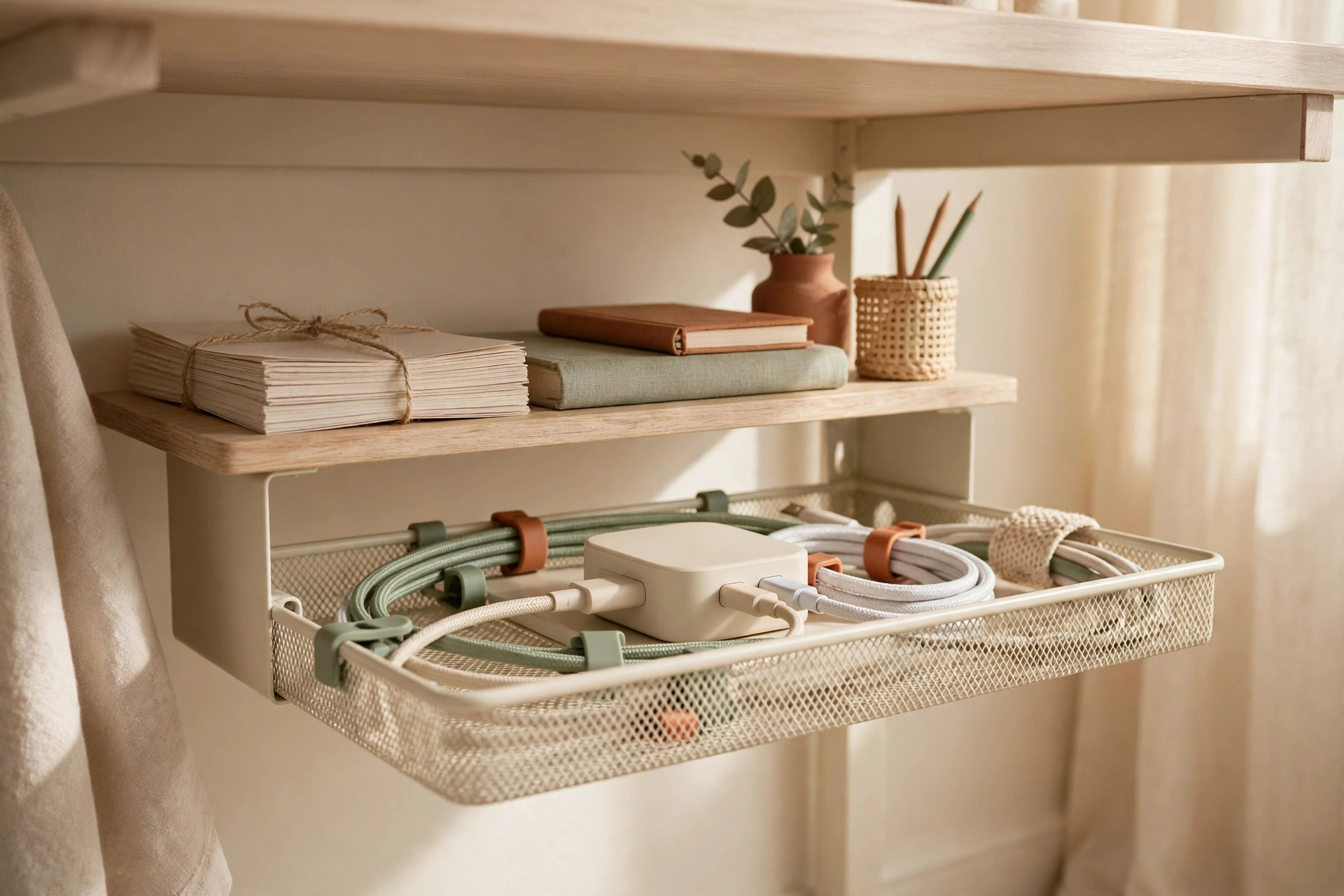
A small power strip and a short cable tray mounted under the desk or on a nearby shelf turns charging into a background task. Your phone, earbuds, and laptop charger live there, not scattered across the work surface.
The end-of-day desk reset
A desk system only survives if returning it to order takes less time than ignoring the mess. A two-minute reset at the end of each workday is the habit that protects all sixteen ideas above it.
16. Run the two-minute reset every evening
Clear the surface, return pens to the cup, drop in-transit items in the drawer slot, and file or recycle the day’s paper. Two minutes is long enough to restore order and short enough that you will actually do it when you are tired.
17. Leave tomorrow’s first task visible
End the reset by placing one thing on the desk for tomorrow morning: the notebook open to the right page, or a single sticky note with the first task. A desk that greets you with a clear next step makes the next workday start faster.
Mistakes to avoid
The most common mistake is buying organizers before doing the audit. Containers bought for supplies you later remove are wasted money and wasted space, so audit first, buy second, and buy one piece at a time. Another mistake is over-filling every organizer: a pen cup stuffed to the brim, a pegboard with no empty hooks, or a drawer tray with no spare slot all look organized for a week and then overflow. Leave roughly a fifth of every container empty, on purpose.
Frequently asked questions
How do I organize desk supplies with no drawers at all?
Use the wall and the desk edge instead: a rail with hanging cups, a small leaning pegboard, and a monitor-side holder can replace a drawer entirely. Keep the daily kit tiny — five or six items — and store the rest in a box on a nearby shelf.
What is the best first purchase for small desk supply organization?
A fitted drawer tray or, if you have no drawer, a wall rail with two hanging cups. Both cost little, both move supplies off the surface, and both work before you buy anything else.
How often should I redo the desk audit?
Once a season is plenty. Supplies creep back gradually — a free pen here, a new notebook there — so a quarterly ten-minute audit keeps the system honest without turning organization into a hobby.
Conclusion
Small desk supply organization comes down to three moves: audit what you actually use, give each kept item a fitted home on, in, or above the desk, and reset the surface for two minutes each evening. With those habits in place, even the tiniest home office can stay clear enough for real work. Browse more ideas in our small-spaces collection, and save this pin for later so the 17 ideas are ready when your desk needs its next reset.