Sharing one closet with a partner sounds romantic until your shirts get shoved aside to make room for theirs. If closet organization ideas for couples is the search that brought you here, you are facing the same math every two-wardrobe household faces: two closets’ worth of clothing, one rod, one shelf, one small patch of floor. Without a system, the bigger wardrobe quietly absorbs the extra space, and the other person’s clothes end up in laundry baskets. The fix is not a bigger closet — it is a system: fair zone splits drawn from actual garment counts, a double-hang conversion that doubles the rod you already own, identical hangers, and boundary rules both people agree to once. These fifteen ideas turn one contested closet into two clearly defined halves.
The fair split: dividing by wardrobe size, not by inches
Splitting a closet down the middle is only fair when both wardrobes are the same size. If one partner owns sixty hanging garments and the other owns thirty, a 50/50 split of a 48-inch rod leaves the bigger wardrobe overflowing. A fair split is proportional — rod inches assigned in the same ratio as the garments each person actually owns.
1. Audit both wardrobes before touching the closet
Both partners hang up everything they wear regularly and count hanging and folded items separately. Skip anything unworn for a year — it does not get a vote. Each person’s share of the rod is their hanging count divided by the combined total. Write the split down (62/38) and mark it with painter’s tape on the rod.
2. Convert the ratio into rod inches
Multiply your ratio by the usable rod length. In a 48-inch reach-in rod, a 60/40 wardrobe split becomes roughly 29 inches for one partner and 19 for the other. One garment on a slim hanger takes up approximately half an inch of rod, so check the math covers the bigger wardrobe — if not, purge or double-hang rather than borrowing the other person’s inches.
Double-hang math: how two people fit on one rod
A double-hang conversion roughly doubles hanging capacity for the cost of one extra rod and a pair of brackets — the core move that makes a small closet for two actually workable. For reach-in closets, the dead corners and above-rod tricks in 18 Small Reach-In Closet Organization Ideas That Double Your Space pair well with everything below.
3. Turn the single rod into a double-hang
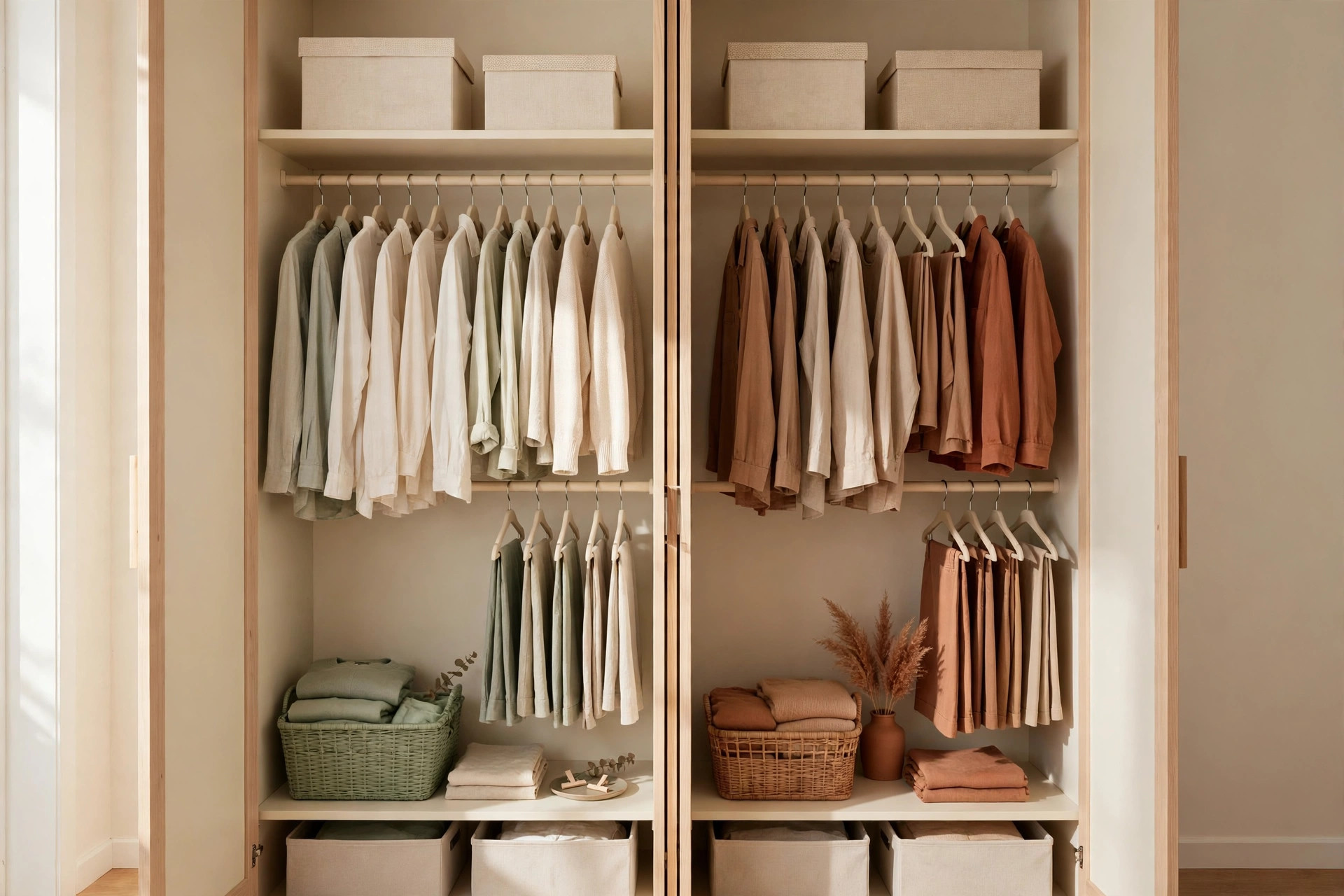
Measure your closet’s interior height. At 80 inches or taller, run two full tiers: top rod about 80 inches from the floor, lower rod about 40 inches. Shirts and blouses need roughly 28 to 32 inches of hang length, so the lower tier clears the floor. In shorter closets, keep the existing rod and add a freestanding or tension-mounted lower rod for short items — no drilling required, which makes this a strong renter move too (see the no-drill options in 17 Renter-Friendly Closet Organization Ideas (No Drilling Required)).
4. Give each partner one full tier, not half of two tiers
Assign the entire top tier to one partner and the entire bottom tier to the other. Full-tier ownership ends mid-rod disputes, and each person’s clothes sit in one column that is easy to scan in the morning. The taller partner usually takes the top tier; the partner with longer garments takes whichever tier has more clearance beneath it.
5. Reclaim the dead space above the top shelf
The 12 to 18 inches between the top shelf and the ceiling is where off-season and rarely worn items should live, not on the rod competing with daily clothes. Add stackable bins labeled by person and season so the shelf becomes two tidy, claimed stacks.
Zones: his, hers, shared — and the no-fly middle
A closet without zones becomes one person’s closet with a guest section. Zones make ownership visible: each partner sees at a glance where their things live and where the other person’s things live.
6. Assign left and right by morning habit
Give the side nearest the door to whoever dresses first — that person gets in and out without crossing the other’s zone.
7. Build one clearly marked shared zone
Some things belong to the household, not to a person: the iron and steamer, the lint roller, spare hangers, the donation bag. Give these one shelf or one basket labeled “shared” so they stop migrating into personal zones. (17 Closet Shelf Organization Ideas That Turn Dead Space Into Storage has bin and divider setups that make top shelves work as zone storage.)
8. Declare the middle of the rod a no-fly zone
Leave a visible gap — about six inches, marked with painter’s tape — between the two partners’ hanging sections. No garment crosses the gap, ever. The buffer absorbs the natural creep of a full wardrobe and makes violations obvious. When the gap disappears, someone’s zone is over capacity: purge rather than annex.
Hanger uniformity: the cheapest peace treaty
Mixed hangers — thick plastic, wire, wooden, hotel freebies — waste rod space and make a closet look chaotic even when it is technically organized. One hanger type for the whole closet is the fastest visual upgrade you can buy.
9. Switch the entire closet to one identical slim hanger
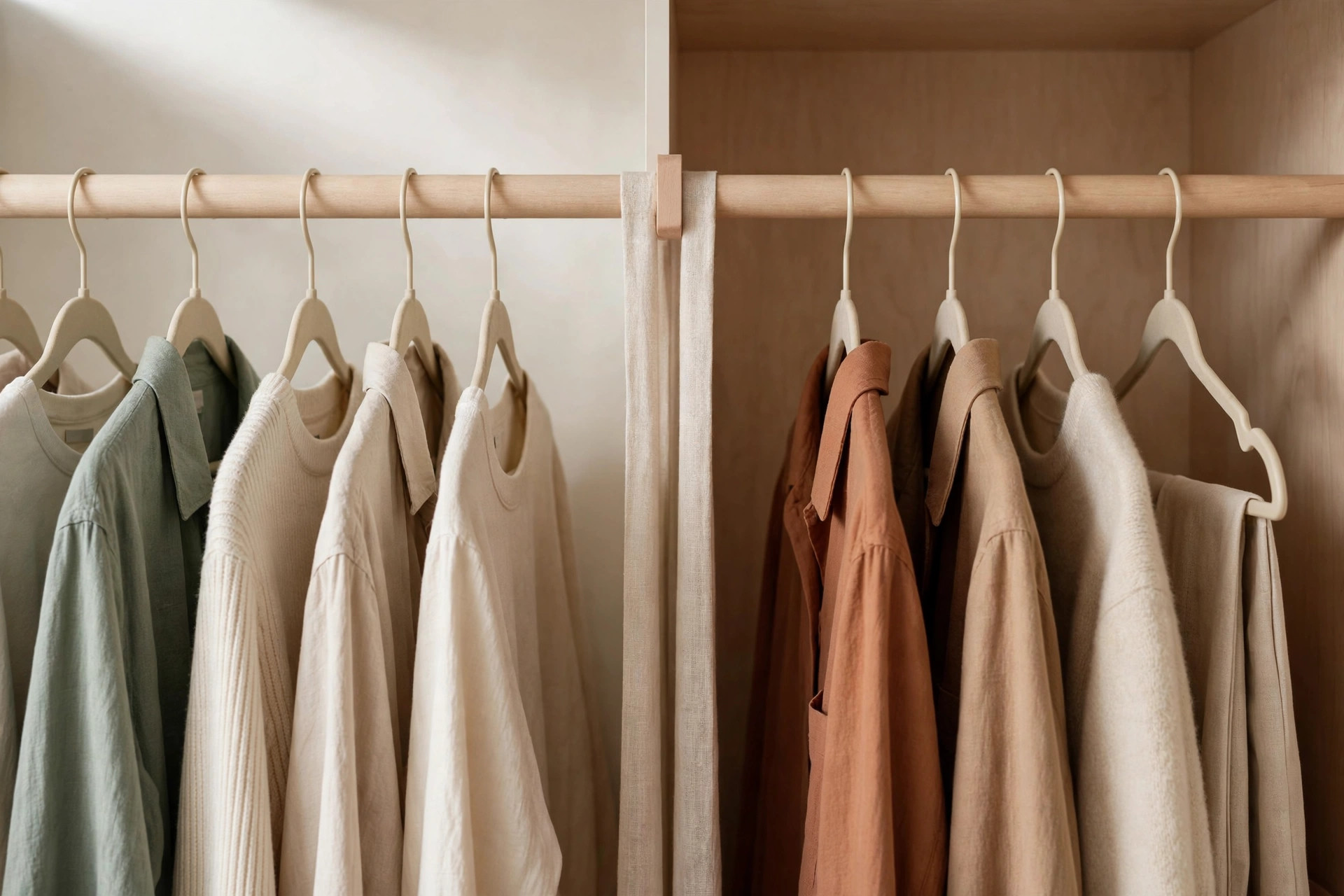
Replace every hanger with the same slim velvet (flocked) style. A standard plastic hanger is roughly twice as thick at the hook as a slim velvet one, so a full rod of slim hangers holds approximately 25 to 30 percent more garments in the same inches. Do the swap as a joint project in one sitting — mismatched hanger types are where uniformity quietly dies.
10. Color-code hangers by person
Pick two hanger colors — one per partner — in the same slim style. Each section becomes readable at a glance, and strays are obvious: a black hanger in the gray-hanger zone goes straight back.
Shoes and accessories: floor and door real estate
Couples usually lose the closet war on the floor, not the rod. Shoes multiply, bags slide off shelves, and accessories scatter. Treat the floor and the door as separate territories with their own rules.
11. Split the floor in half and give each person a hard shoe cap
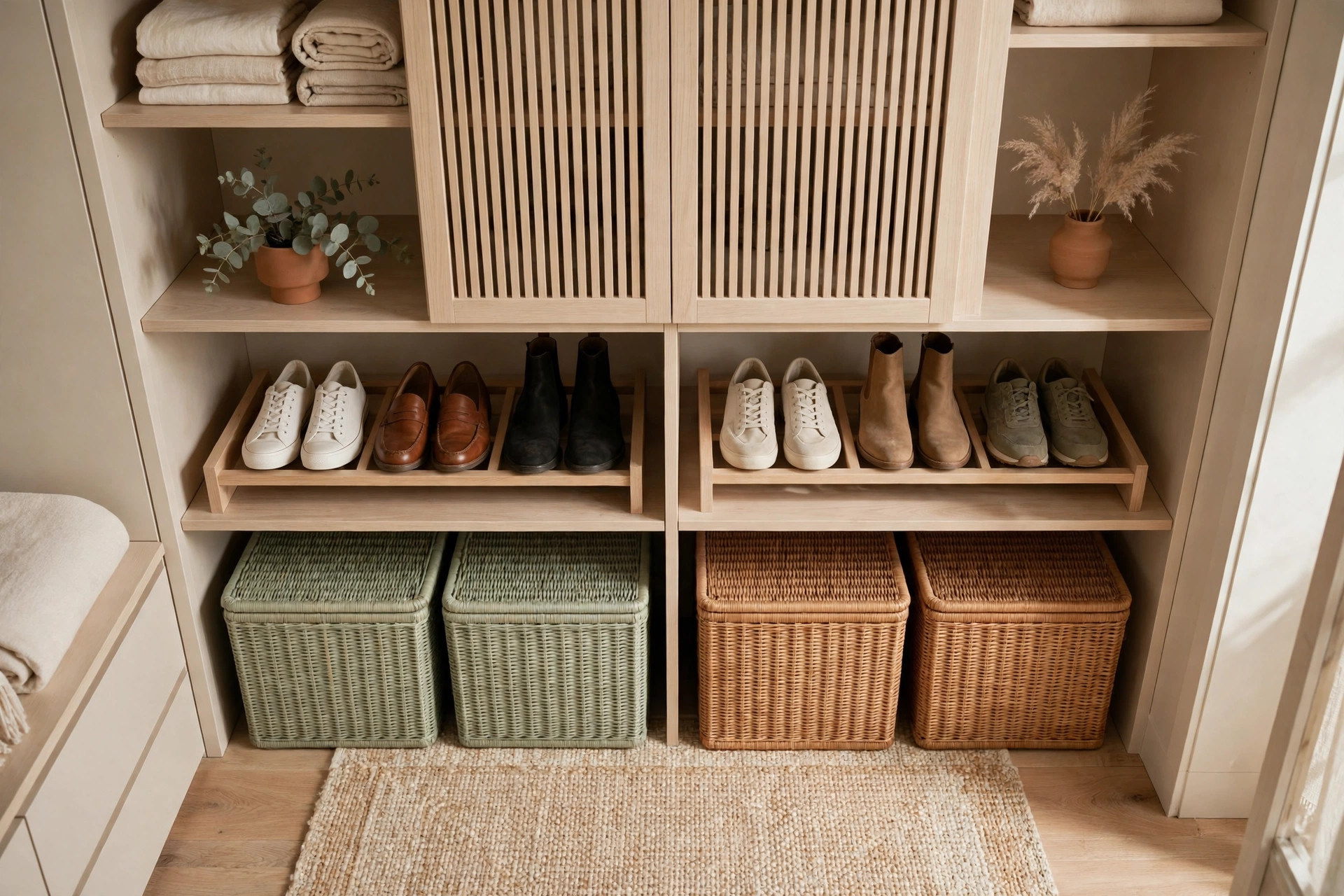
Divide the closet floor down the middle with the same tape you used on the rod. Each partner gets one slim shoe rack or one row of stackable shoe boxes — no more. Most couples find 8 to 10 pairs per person is the realistic maximum a shared closet floor can hold. Pairs beyond the cap live elsewhere or get donated; a lopsided collection’s surplus goes to another room, not the shared floor. For small-space shoe formats that fit a halved floor, 18 Shoe Storage Ideas for Small Apartments (No Pile by the Door) covers slim towers and under-bed options.
12. Claim the back of the door for accessories
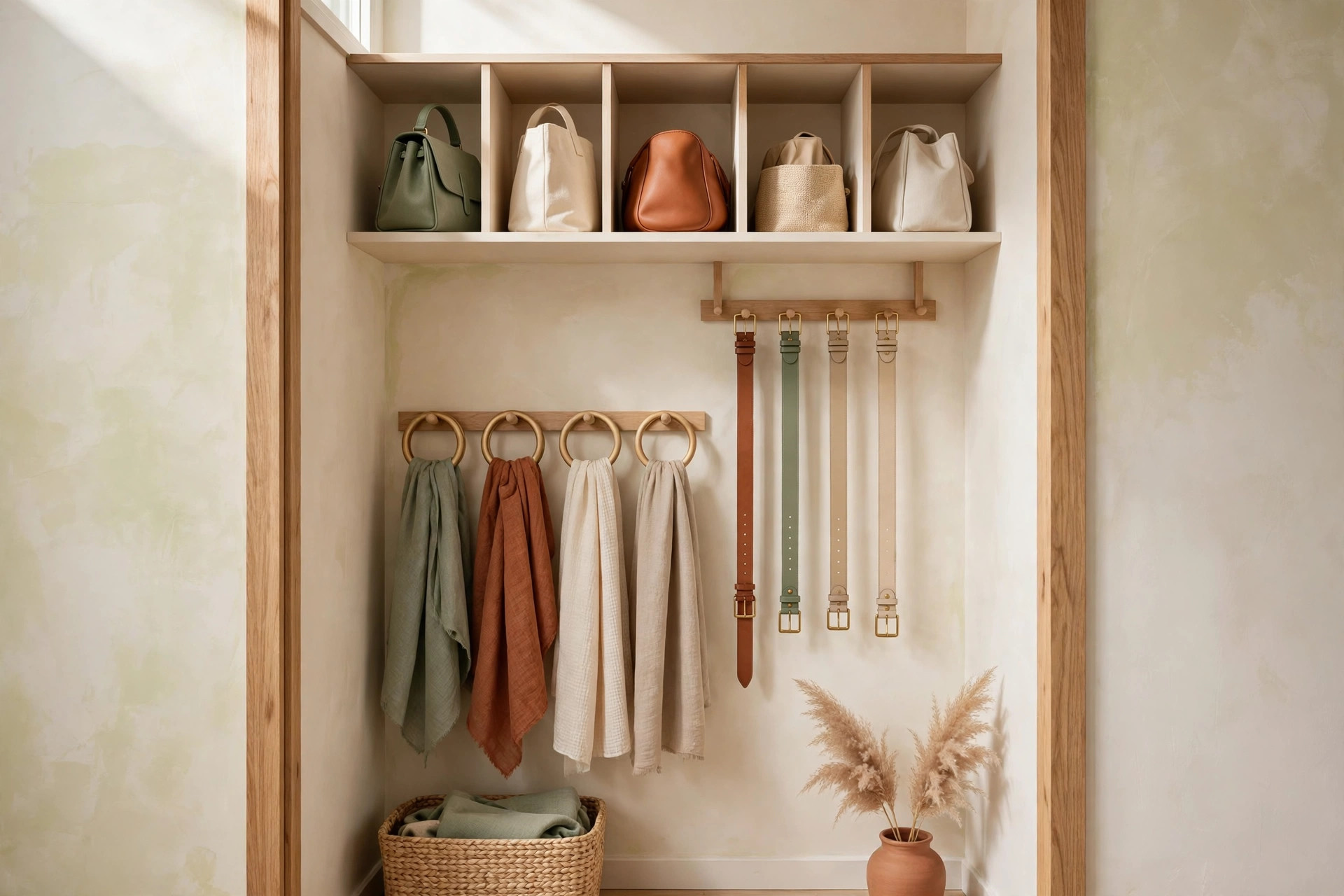
The inside of the closet door is free vertical real estate. Mount an over-the-door organizer with clear pockets and split it down the middle: one side for one partner’s belts, sunglasses, and scarves, the other for the other’s. (Over-the-Door Organization Ideas for Every Room covers renter-safe hanging rules so the organizer does not damage the door.)

Seasonal rotation keeps two closets in one
A shared closet fails fastest in the shoulder seasons, when winter coats and summer dresses compete for the same rod. Seasonal rotation is the pressure valve: only the current season lives in the closet.
13. Move the off-season completely out of the closet
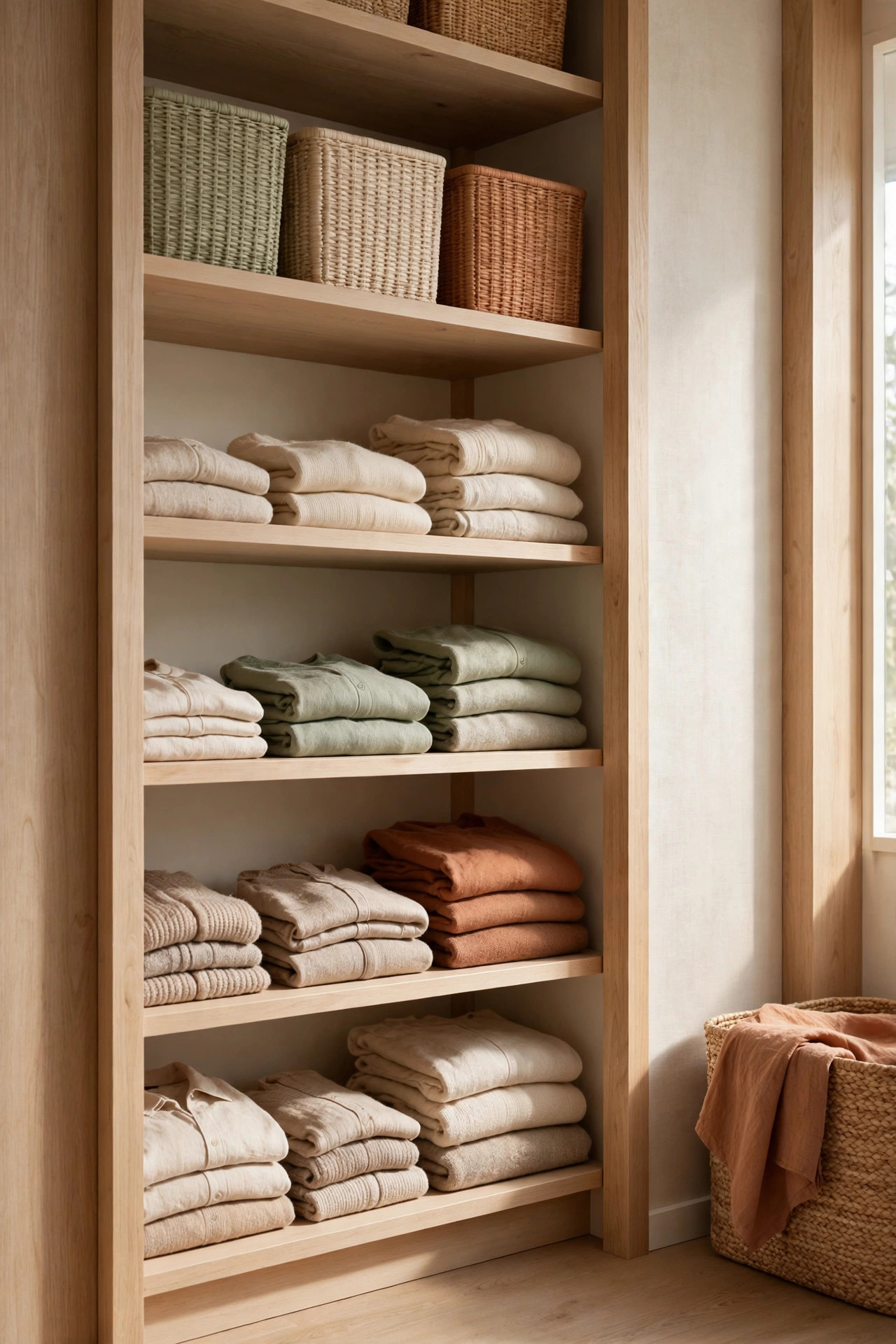
Pack off-season clothing into labeled bins or vacuum bags and store them on the top shelf, under the bed, or in another room — anywhere that is not the rod. Both partners rotate; if only one person rotates, the other person’s off-season clothes still eat half the rod. Label every bin with owner and season.
14. Swap on two fixed dates with both partners present
Pick two dates a year — the first weekend of April and the first weekend of October work for most climates — and do the swap together in one session. Pull the off-season bins down, hang the incoming season, pack the outgoing one, and re-hang both zones. Doing it together keeps the boundaries intact: each person packs and hangs their own clothes, so nobody’s system gets “helpfully” reorganized by the other.
The weekly reset both people can actually do
The reset has to be short, joint, and scheduled.
15. Run a ten-minute Sunday reset together
Set a recurring ten minutes — Sunday evening works for most couples — and do it at the same time. Each person re-hangs their own stray garments, returns shoes to their side of the floor, and drops anything damaged or long unworn into the donation bag in the shared zone. Ten minutes is short enough that neither person dreads it, and doing it together restores the zones weekly.
Mistakes to avoid
Skip the matching his-and-hers closet systems marketed to couples — they cost many times more than a second rod and solve none of the boundary problems. Do not buy bulky wooden hangers; they eat the inches you just fought for. Avoid deep bins labeled “misc” with no owner — they become junk drawers within weeks. And never reorganize your partner’s zone without asking: the fastest way to kill a shared system is to make one person feel their half is not really theirs.

Frequently asked questions
How can two people share a small closet without fighting?
Draw the boundaries once, together: split the rod by garment count, mark zones with tape, assign full tiers instead of halved rods, and agree on a shoe cap. Once the zones are visible and proportional, there is little left to fight about.
How do you split a closet fairly between partners?
Count each person’s hanging garments, convert the ratio into rod inches, and mark the split with painter’s tape. Re-audit once a year, because wardrobes drift. Fair means proportional to what each person owns, not an even 50/50 split.
Can you fit two wardrobes in a reach-in closet?
Yes, with a double-hang conversion and seasonal rotation. Two tiers roughly double hanging capacity, and moving the off-season out frees the rod for what you actually wear. Slim uniform hangers add roughly another quarter of capacity on top.
How many hangers should each person get in a shared closet?
Enough to cover their hanging garments plus about ten percent spare — not an unlimited supply. Capping hangers at the zone’s capacity is a natural purge mechanism: if a garment has no hanger, something has to go.
Two people, one closet, zero drama — it comes down to proportional zones, a doubled rod, identical hangers, and a ten-minute weekly reset. Start with the wardrobe audit this weekend; everything else builds on that one number. Browse the closet collection for more small-storage ideas — and save this pin for later.