Your small garage was built for one car, then asked to hold a mower, forty paint cans, Christmas, and a decade of “fix it later.” Now the car sleeps in the driveway. These small garage organization ideas ask one question: how do you get your parking spot back without losing storage? The answer: zones on the walls, dead airspace above the hood, and one honest purge before you buy a single hook — no double-bay assumptions, no workshop-sized products. Below are 18 ideas with the measurements for a genuinely tiny garage. Walk them in order: pass the parking-spot test, purge the squatters, build the wall zones, claim the ceiling, lock down the chemicals, and set the twice-a-year reset that keeps it all working.
The parking-spot test: what the garage is actually for
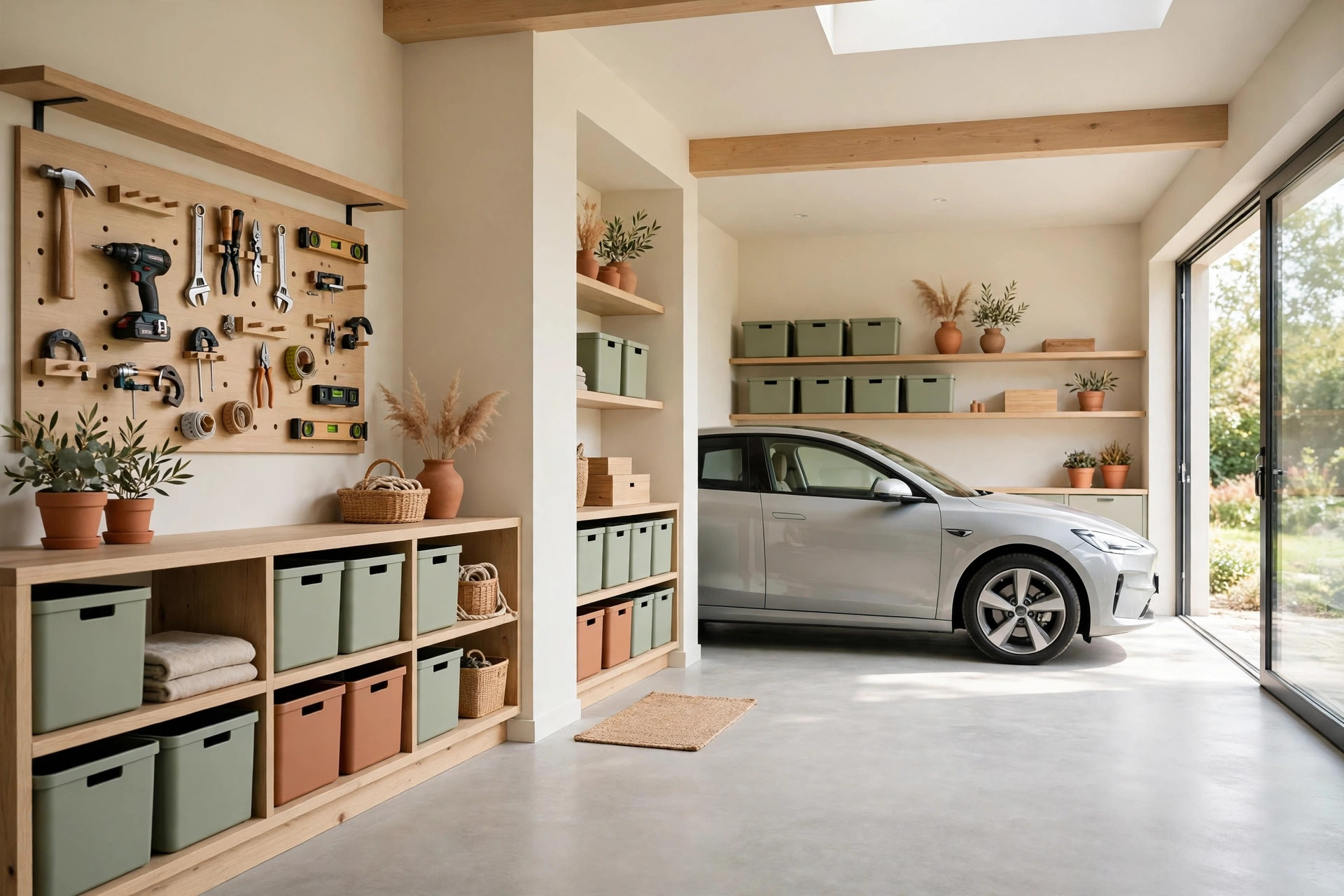
Is this room a parking space or a shed? Every idea below assumes the car wins.
1. Make the car the primary job — everything else is negotiable
Drive in, close the door, and open all four car doors. If anything blocks you, the car is losing — and a typical single-car garage leaves only ~2 feet of margin per side. Tape the rule inside the door: the car gets the floor; storage gets the walls and the ceiling. Every decision from here on gets filtered through it.
2. Tape the car footprint on the floor with painter’s tape
Park the car and outline it on the concrete — nose, tail, both sides — then mark a second line 24–30 inches out per side for door swing. Inside the tape: a permanent no-storage floor zone that ends every “just this one box” argument.
The garage purge: categories that don’t belong inside
Most small garages hold 20–30 percent too much: broken things, misplaced things, and things that never belonged in a hot, dusty room.
3. Sort everything into five piles in one pass
Drag everything onto the driveway and sort: keep in garage, relocate elsewhere, donate, trash, and hazardous (paint, old chemicals, batteries — hazardous-waste drop-off only). The keep pile has one rule: the item must be used at least twice a year and must earn a wall or ceiling home later in this guide. See Our 15-Minute Decluttering Tasks for Busy People for a small-daily-chunks version of this purge.
4. Evict the usual garage squatters first
These categories almost never belong here: dried-out paint cans, expired fertilizer, tools awaiting repair, outgrown kids’ toys, holiday decor that never rotates, a spare tire that doesn’t fit your car, old electronics, and cardboard boxes (moisture + pests).
5. Schedule the purge as a single six-hour day
Block one Saturday, start by 9, and schedule the donation run that same afternoon — bags must leave the same day. The relocate pile goes back inside the house that evening, never into the garage.
Wall zones: tools, sports, garden, car care
The walls are your real square footage. Zone them by use: sports gear by the door, tools at the work corner, garden supplies near the yard exit.
6. Build the tool zone around a lockable cabinet, not loose hooks
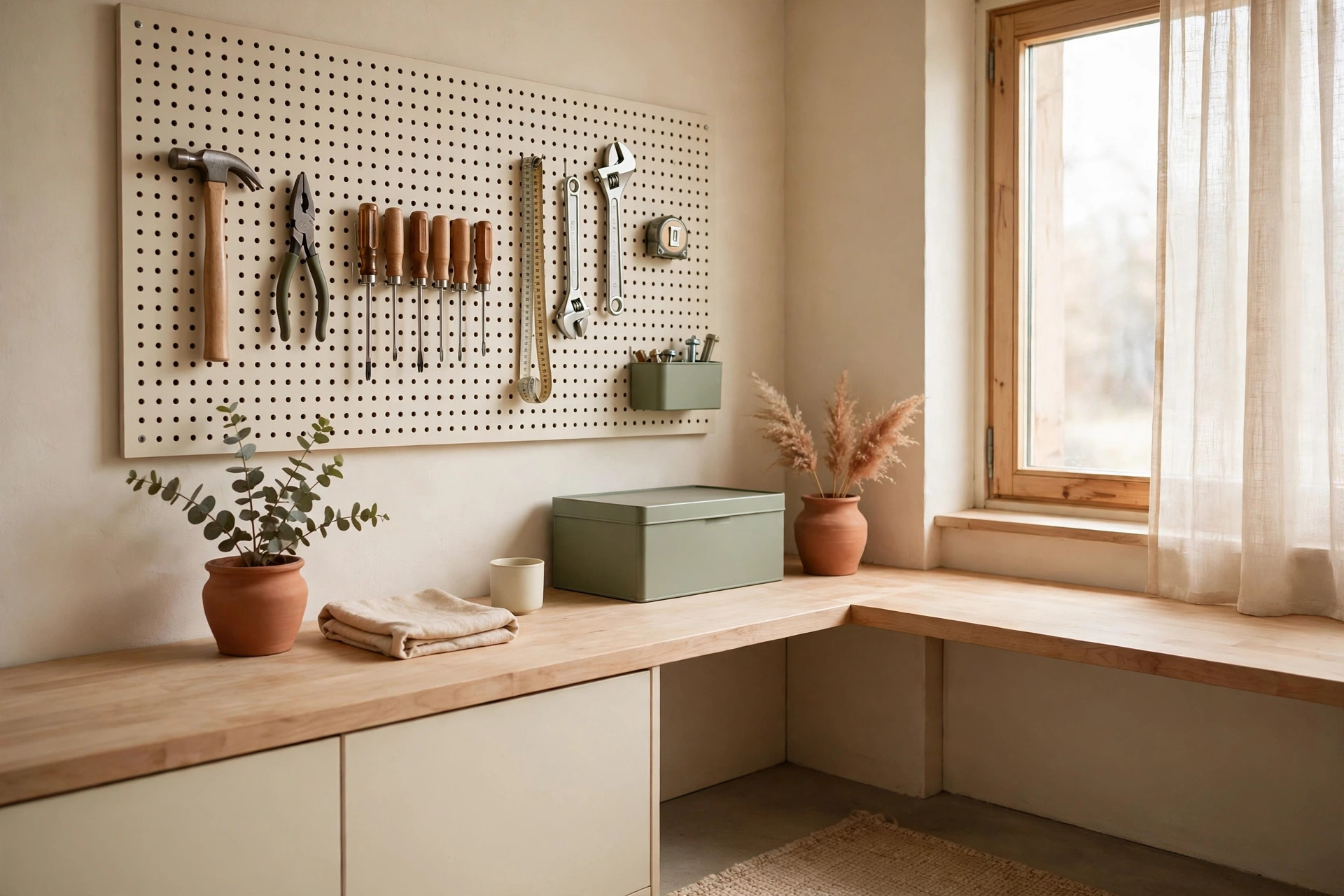
Give tools one wall near your work surface. Mount a 24×48-inch pegboard or slatwall panel so the most-used hand tools sit between hip and shoulder height, and store heavy or dangerous items — circular saw, nail gun — in a 36-inch-wide lockable steel cabinet below, not on hooks. Outline each tool’s spot on the board; a missing tool is then visible at a glance.
7. Put sports gear in a grab-and-go rack by the door
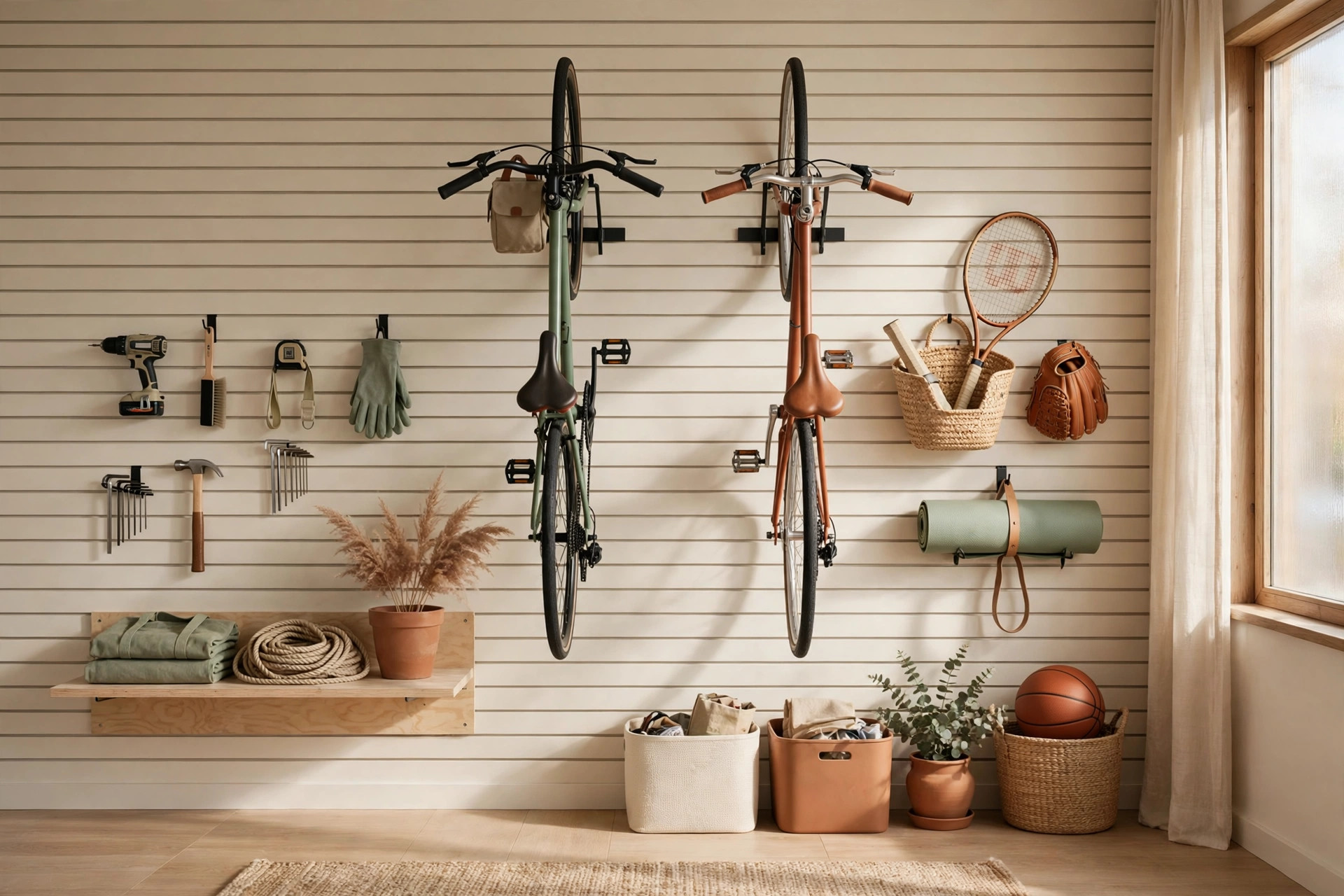
Give sports the wall nearest the garage door so gear comes and goes without crossing the car. Two adult bikes fit a 4-foot vertical rack in the floor space of one; balls go in a bungee-cord wall net; bats and rackets hang on hooks spaced 6 inches apart, one slot each. Measure the door’s swing first — a handlebar that blocks it defeats the zone.

8. Park garden and car-care supplies in a tall, shallow cabinet
Garden chemicals, motor oil, and detailing sprays belong in one tall cabinet — 5–6 feet high, no more than 18–24 inches deep — with latching doors. Shallow matters: deep cabinets swallow small bottles. Place it near the yard-facing door so soil never crosses the parking zone, with liquids in a lidded tray on the bottom shelf.
Overhead and ceiling storage for the rarely used
Anything you touch fewer than four times a year should leave the walls and live above your head. A single-car garage holds roughly 150–200 square feet of empty ceiling airspace — free “floor” most tiny garage storage ideas ignore.
9. Mount a ceiling rack over the parked car’s nose or trunk
Bolt a 48×24-inch steel ceiling rack into the joists with lag screws (never drywall anchors) above the car’s nose or trunk, keeping 6 inches of clearance over its highest point. It holds 200+ pounds of flat bins — holiday decor, camping gear, off-season sports. Label the short end of each bin in 2-inch letters so you can read them from a step stool. Renters: freestanding overhead units that straddle the car give the same win with no holes — see 19 Vertical Storage Ideas for Small Apartments (Think Up, Not Out).
10. Hang bikes and kayaks from pulley hoists
A bike on the floor eats 6–8 square feet; on the ceiling it eats zero. A 100–150-pound-rated pulley hoist lifts a bike flat against the ceiling, and the same system holds a kayak that would otherwise own a wall. Mount it over the car’s nose with a hand’s width of clearance over the windshield. Trade-off: a weekly-use bike belongs on the wall rack from Idea 7.
Slatwall and pegboard: the customizable wall
Hooks drilled into studs lock you into today’s layout. Slatwall and pegboard let the wall evolve — hooks slide, shelves reposition, no scars when your hobbies change.
11. Install a slatwall panel for heavy and frequently rearranged gear
A 4×8-foot slatwall panel across three or more studs holds rated hooks of 50–75 pounds each — shovels, trimmers, even a folded step ladder. Start with one panel per zone and expand only when every hook is full. When you reorganize in two years, the hooks just slide: no new holes, no bracket scars. These are the small garage storage solutions that stay flexible the longest.

12. Use pegboard or French cleats for small tools and fasteners
Use quarter-inch pegboard on one-inch standoff spacers for wrenches, pliers, and drill bits — hooks need clearance behind the board. For custom holders like a charging station, screw 3/4-inch plywood French cleat strips to the studs and hang the holders on them. Caution: standard pegboard hooks wobble past about 3 pounds, so graduate heavy items to slatwall.
Corner and narrow-wall solutions
After zones, ceiling, and slatwall, two or three awkward scraps remain — the corner behind the open door, the strip beside the door frame. Measured, they add real capacity.
13. Fill dead corners with tall, slim freestanding shelving
The corner beside the garage-door track or behind the side entry usually fits an 18-inch-deep, 6-foot-tall shelving unit no car door can reach. Bolt it to the wall with an L-bracket so it can’t tip onto the car. This is your overflow shelf: the mid-week donation box, the seasonal bin waiting for its ceiling slot. Keep the top shelf under 6 feet. For sloped-ceiling corners, plan by height zones — the same logic our Under Stairs Storage Ideas for Small Homes article uses.
14. Claim the narrow strips: 12 to 18 inches is enough
Write down every strip wider than 10 inches — between the door frame and the wall, beside a window. You’ll find three to five: a hook track in a 12-inch strip swallows four garden tools, a magnetic strip holds screwdrivers in a 2-inch band, a slim broom holder fits in 6 inches. Each strip takes one category off the floor.
Paint, chemicals, and safety rules
A garage holds more hazardous material than any other room in the house. These two are non-negotiable.
15. Keep flammables in a labeled metal cabinet, sealed and off the floor
Paint, thinner, mower gasoline, and aerosols belong in a metal cabinet with a latch — at least 12 inches off the floor (fumes pool low) and at least 6 feet from the furnace, water heater, or any pilot light. Keep every container tightly sealed: a half-open thinner can is what turns a garage fire into a house fire. The Consumer Product Safety Commission notes that household chemicals need original labels and locked storage away from children.
16. Lock the cabinet, ventilate the room, and post the rules
Anything marked “keep out of reach of children” goes in a keyed or combination-locked cabinet — kids and pets treat garage chemicals like toys. Crack a window for ten minutes after painting or fueling; never seal fumes in. Write on the inside of the cabinet door: what lives here, and your poison control number.
The seasonal garage reset
An organized garage decays twice a year: spring, when winter gear overstays, and fall, when summer gear does.
17. Run a two-hour spring and fall swap
Twice a year, pull every zone’s bins down and rotate: winter sports to the ceiling rack in April, patio gear down; reverse in October. Toss anything expired, leaked, or broken, and relabel anything faded. Two hours, twice a year — schedule both swaps in your phone now.
18. Keep it alive with a monthly 15-minute reset
Set a recurring reminder: fifteen minutes, first Saturday of the month — every tool back to its outline, every ball to its net, every bin to its ceiling slot. Miss one month and nothing breaks; miss three and you’re back to archaeology.
Mistakes to avoid: what NOT to buy
- More bins before the purge. Storage bought first becomes housing for clutter you’d have donated.
- Open shelving in a dusty garage. Everything gets a grit coating; lidded bins or doors win.
- Cheap plastic hooks for heavy tools. They snap and drop shovels onto hoods — steel, into studs, rated for the weight.
- Anything that narrows the tape rectangle. If it eats the car’s door-swing zone, it fails the parking-spot test.
- Cardboard boxes for long-term storage. Moisture, pests, collapse — plastic totes with lids, labeled on the short end.
Frequently asked questions
How can I organize a small garage without spending much?
Purge first (free), tape the car rectangle (a few dollars), then hang what you own on 2×4 French cleat strips (under twenty dollars in lumber) — everything you need to organize small garage clutter on a budget.
Can I store paint and chemicals in a hot garage?
Sealed latex paint and household chemicals tolerate garage heat well, but keep them off the concrete, out of direct sun, and never near a furnace or water heater.
How do I keep the parking spot clear year-round?
The tape rectangle from Idea 2 is your permanent boundary and the twice-yearly swap from Idea 17 is your maintenance. The real rule: nothing new enters without a named wall or ceiling home.
What if my garage is a rental with no drilling allowed?
Use freestanding overhead shelving that straddles the car, tall locking cabinets, and tension-mounted hook tracks. Check your lease first, and photograph everything at move-in.
Conclusion
A small garage works when the car owns the floor, the walls are zoned by use, the ceiling holds the rarely touched, and chemicals stay locked and separated. That system gives you eighteen ideas, one parking spot, zero storage lost. Save this pin for later and run the purge this weekend.