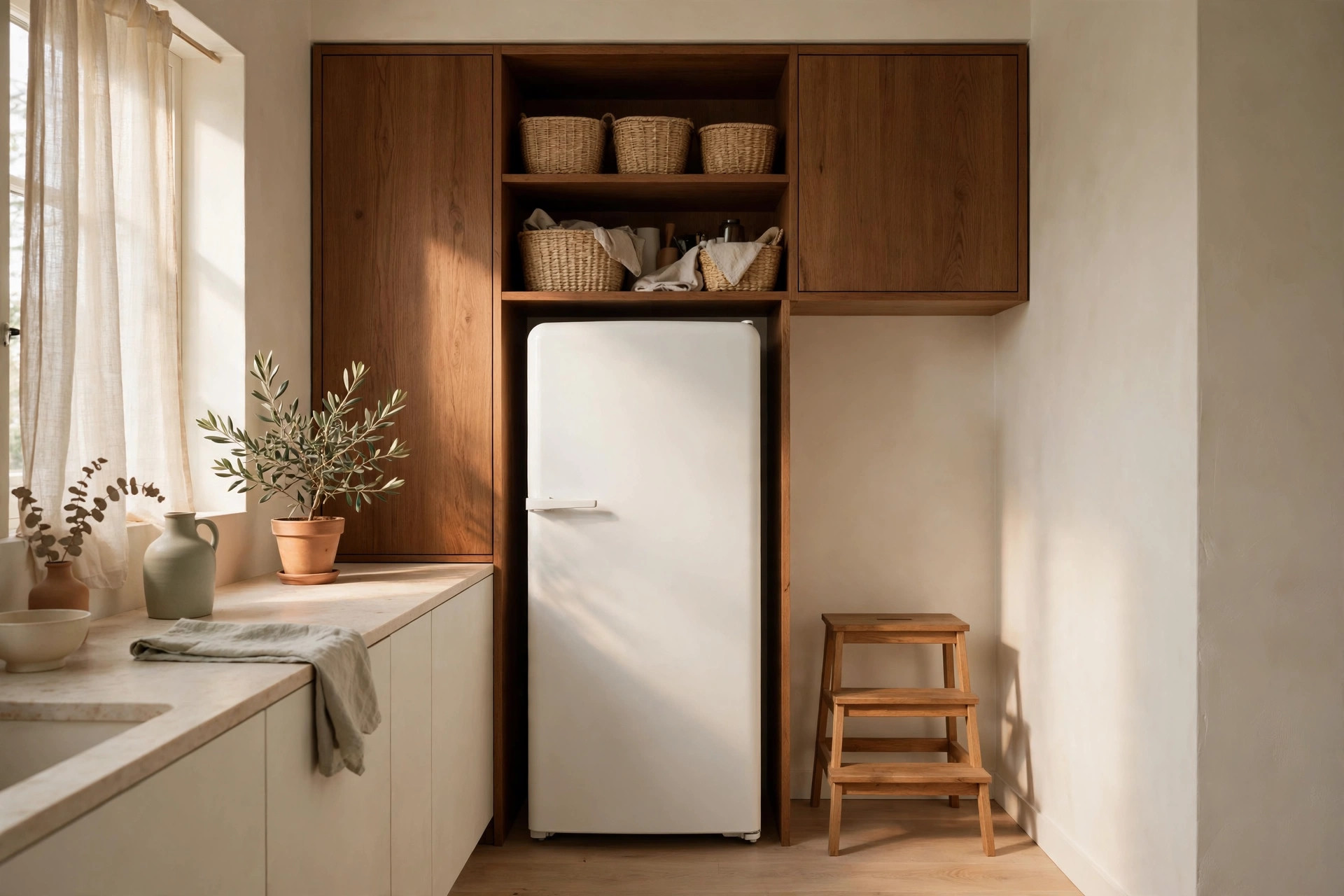
A galley kitchen gives you two walls, one narrow aisle, and nowhere to hide the clutter. There is no island to absorb the overflow and no spare corner for a cart, so every item left on the counter narrows the walkway a little more. Small galley kitchen storage ideas work when they follow one rule: storage goes up and onto doors, never into the aisle. These 16 ideas — wall rails, door racks, pull-outs, and vertical zones — turn your two walls into the storage your kitchen is missing.
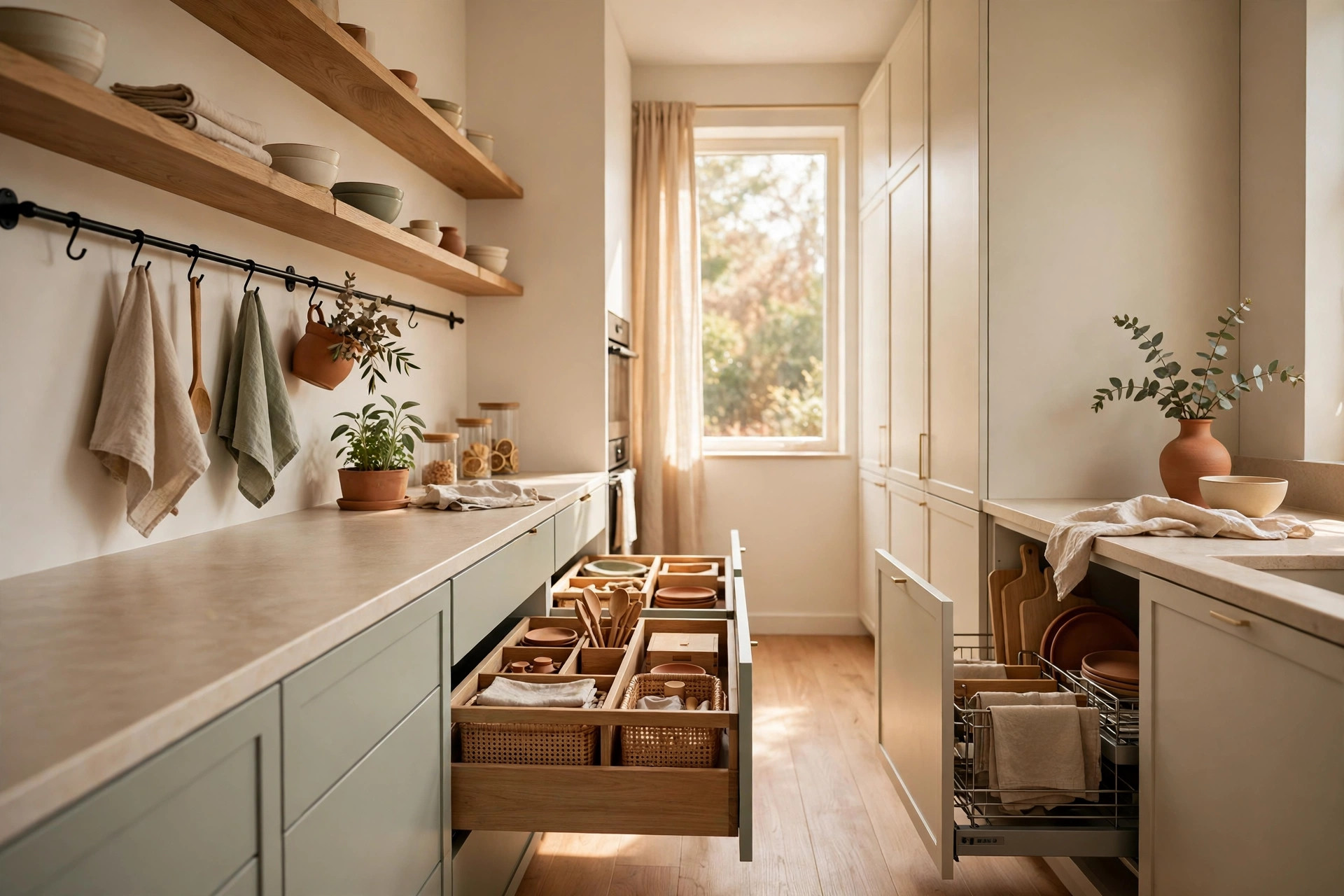
The galley rule: keep the walkway clear, store on the walls
A galley aisle is usually about 3 feet wide — enough for one person to cook, but not enough for a drying rack, a bin, and a person to pass each other. Measure your aisle at its narrowest point (between the dishwasher handle and the opposite counter is usually the pinch point) and write the number down. Nothing you add should shrink the walkway below about 36 inches. The rule is simple: if it can live on a wall, a door, or a shelf, it does not live on a counter or the floor.
1. Audit the aisle before you buy anything
Walk the aisle with a tape measure and note the width at three points, plus anything that sticks out, like an oven handle or a bin lid. Any spot under 36 inches is a problem to fix first, because no storage idea works in a walkway you cannot move through. This ten-minute audit also tells you how much depth each wall can spare, usually 3 to 4 inches.
2. Give every item a wall, a door, or a shelf — never the floor
Assign a home to each category before you shop: cooking tools on the wall rail, spices on a door rack, cleaning supplies under the sink, bulky pans on a high shelf. Items with no home are the ones to declutter first. A galley kitchen has no spare square footage for “I’ll find a place for it later,” so decide now and the kitchen stays clear on its own.
Wall rails and magnetic strips for daily tools
Walls are the biggest unused storage surface in a galley kitchen. The strip between the counter and the upper cabinets — usually 16 to 20 inches tall — is exactly where daily tools belong: in sight, in reach, and off the counter.
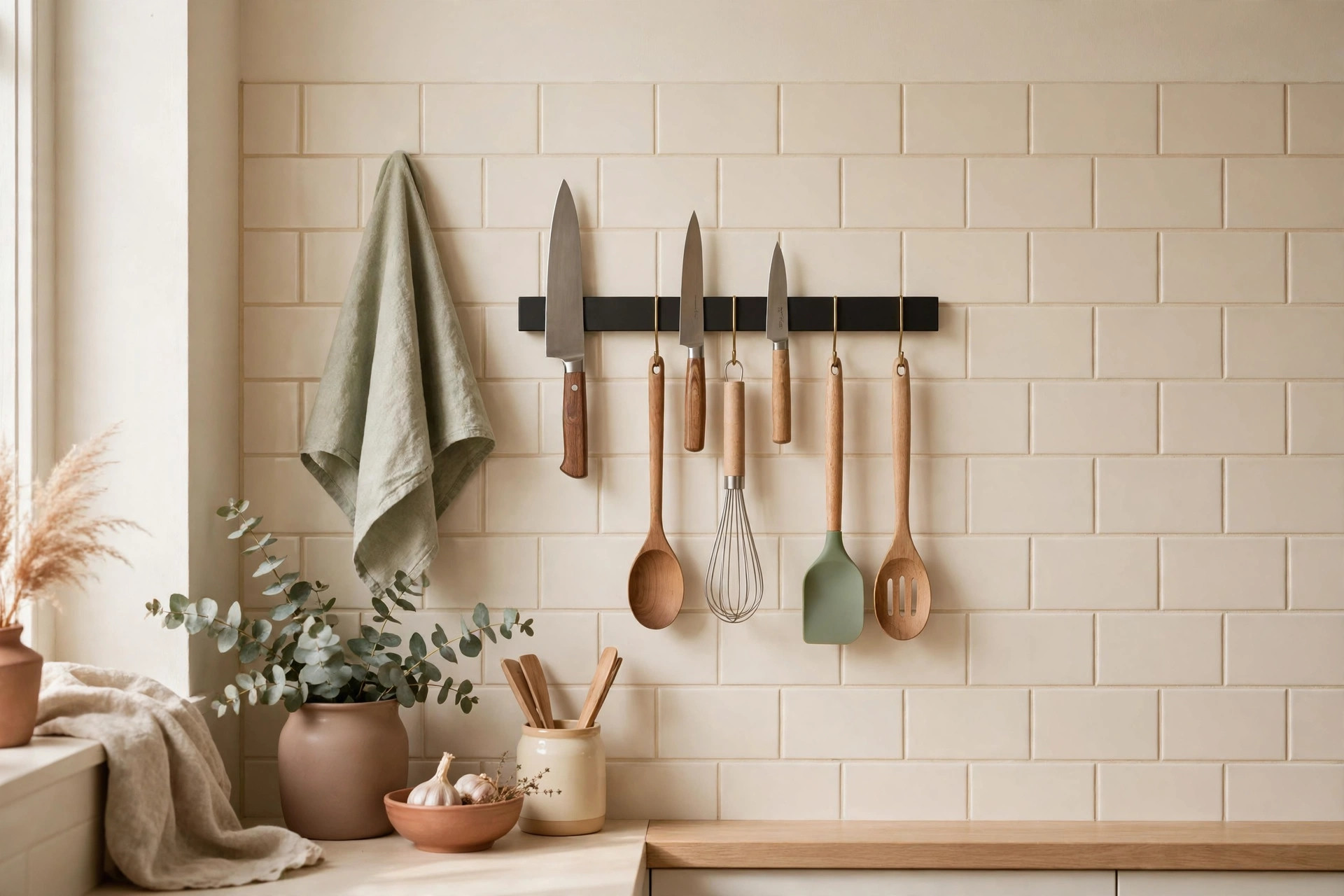
3. Mount a stainless rail with S-hooks for cooking tools
A 24-inch stainless steel rail with S-hooks holds your spatula, tongs, ladle, and whisk above the stove or prep counter, freeing a whole drawer. Mount it at about 60 inches from the floor so tools hang clear of the counter but stay within easy reach. Keep it to the five or six tools you use every day — a rail packed with gadgets you touch twice a year is just a different kind of clutter. For more wall-first thinking, see these kitchen wall storage ideas for small kitchens.
4. Add a magnetic knife strip instead of a knife block
A magnetic strip on the wall beside the prep area holds four to six knives in about 18 inches of wall and removes the knife block from the counter entirely. Choose a strip rated for your heaviest knife, mount it into a stud or with heavy-duty wall anchors, and keep blades pointing up or sideways so handles sit below the strip for a safe grab. Renters can use removable adhesive rated for 5 pounds or more for two or three lighter knives — anything heavier needs a screw.
Upper cabinets: what earns the top shelf
Upper cabinets in a galley kitchen are deep, tall, and easy to waste. The top shelf is the hardest to reach, so it should hold the things you need least — and daily items should never be buried behind it.
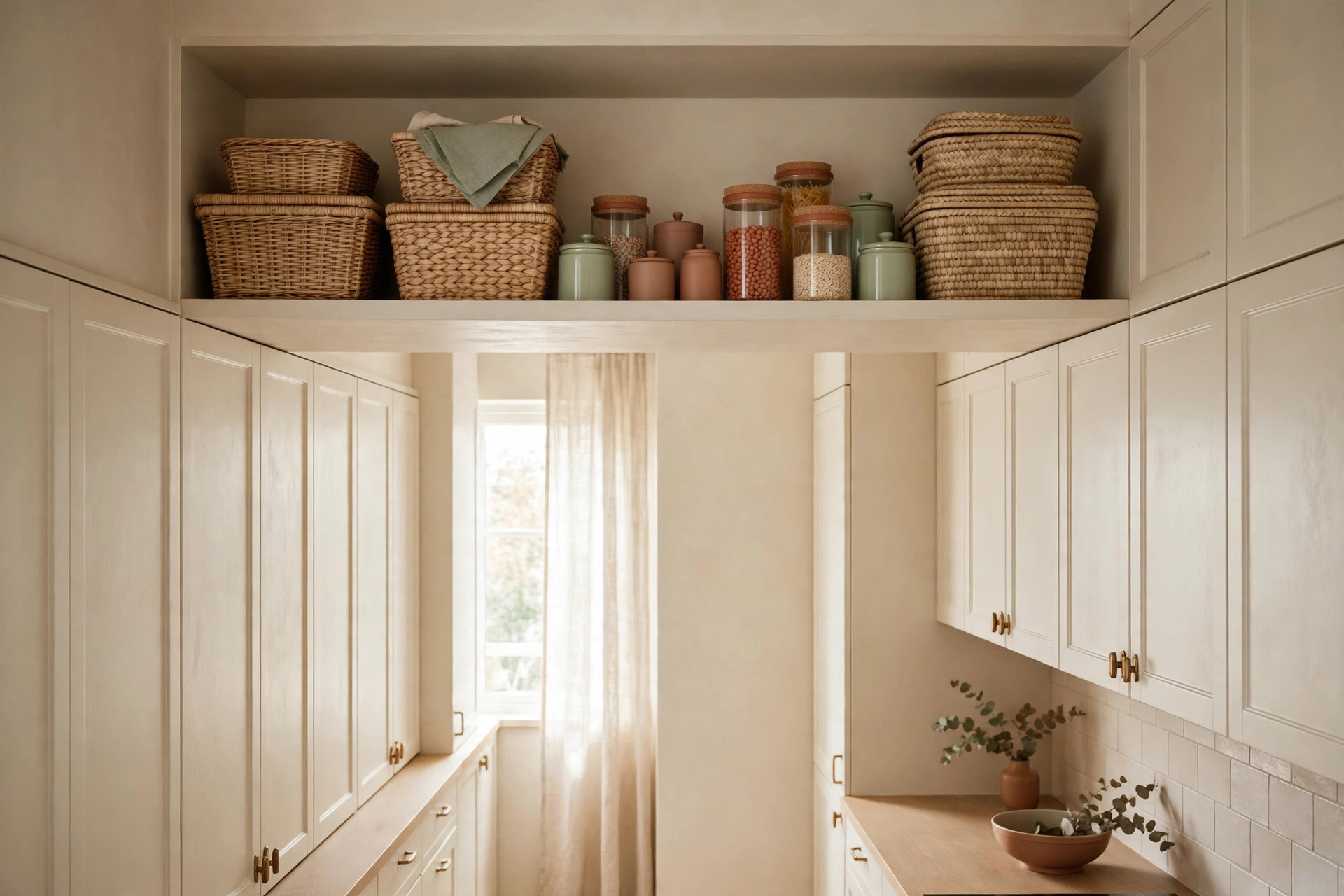
5. Reserve the top shelf for once-a-month items only
Move the holiday platters, the large stockpot, and the blender you use twice a month to the top shelf, and bring daily dishes, mugs, and glasses down to eye level. If you have to stand on a stool to reach it, it does not belong in daily rotation. Label the shelf edge with painter’s tape for a week while the household adjusts — after that, the habit sticks.
6. Add shelf risers so short items stop wasting tall space
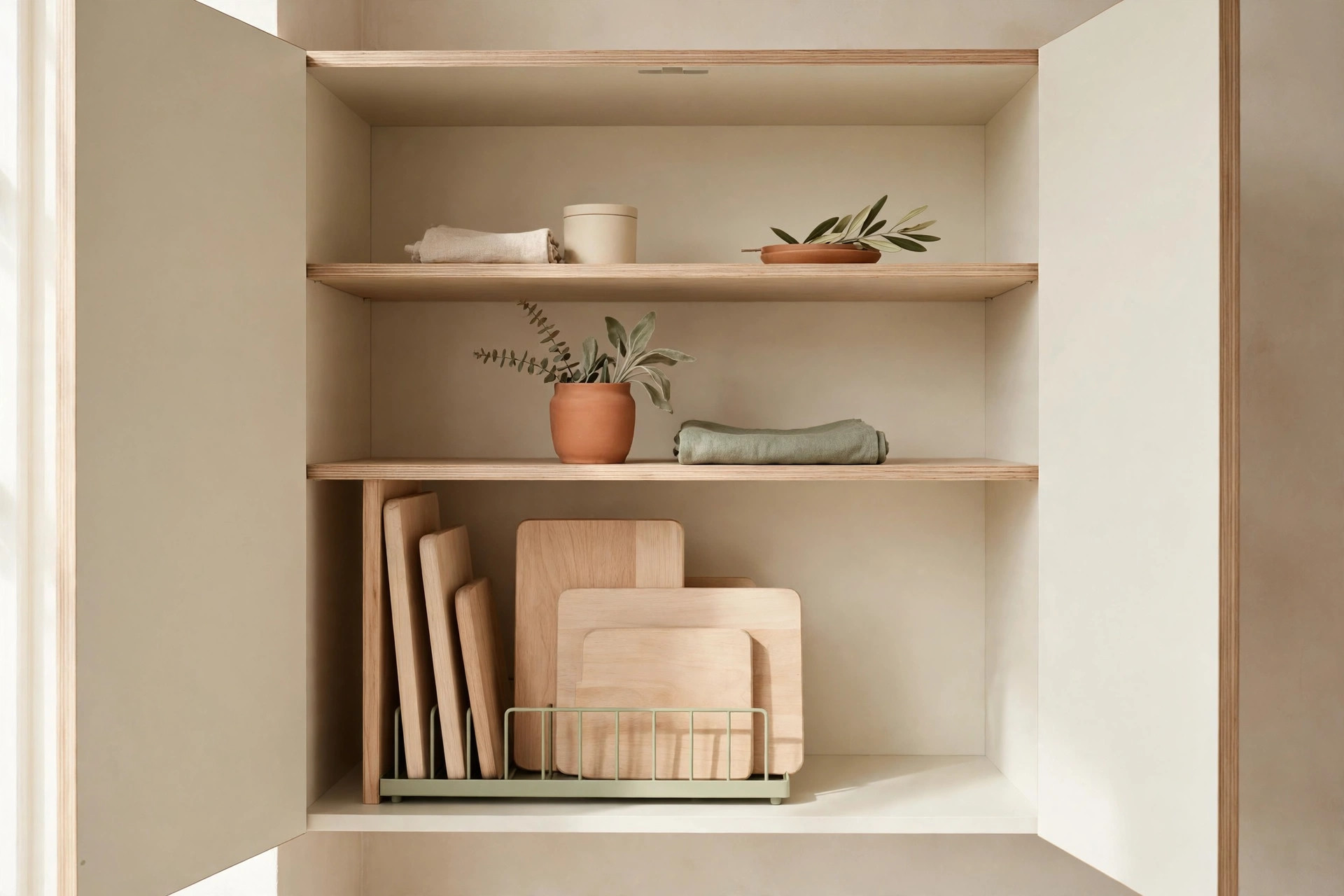
A wire or bamboo shelf riser inside a cabinet creates a second layer for mugs, bowls, or spice jars, roughly doubling usable space on one shelf. Most upper cabinets are about 12 inches tall inside, so a 6-inch riser leaves room for a standard mug underneath and bowls on top. Stackable 10×6×6-inch bins work the same way for packets and lids, keeping small items from sliding to the back and disappearing.
Pull-outs and narrow carts for the gap between counters
Galley kitchens hide dead space: the 6-inch gap beside the fridge, the back of a deep base cabinet. Pull-outs turn that dead space into storage you can actually reach.
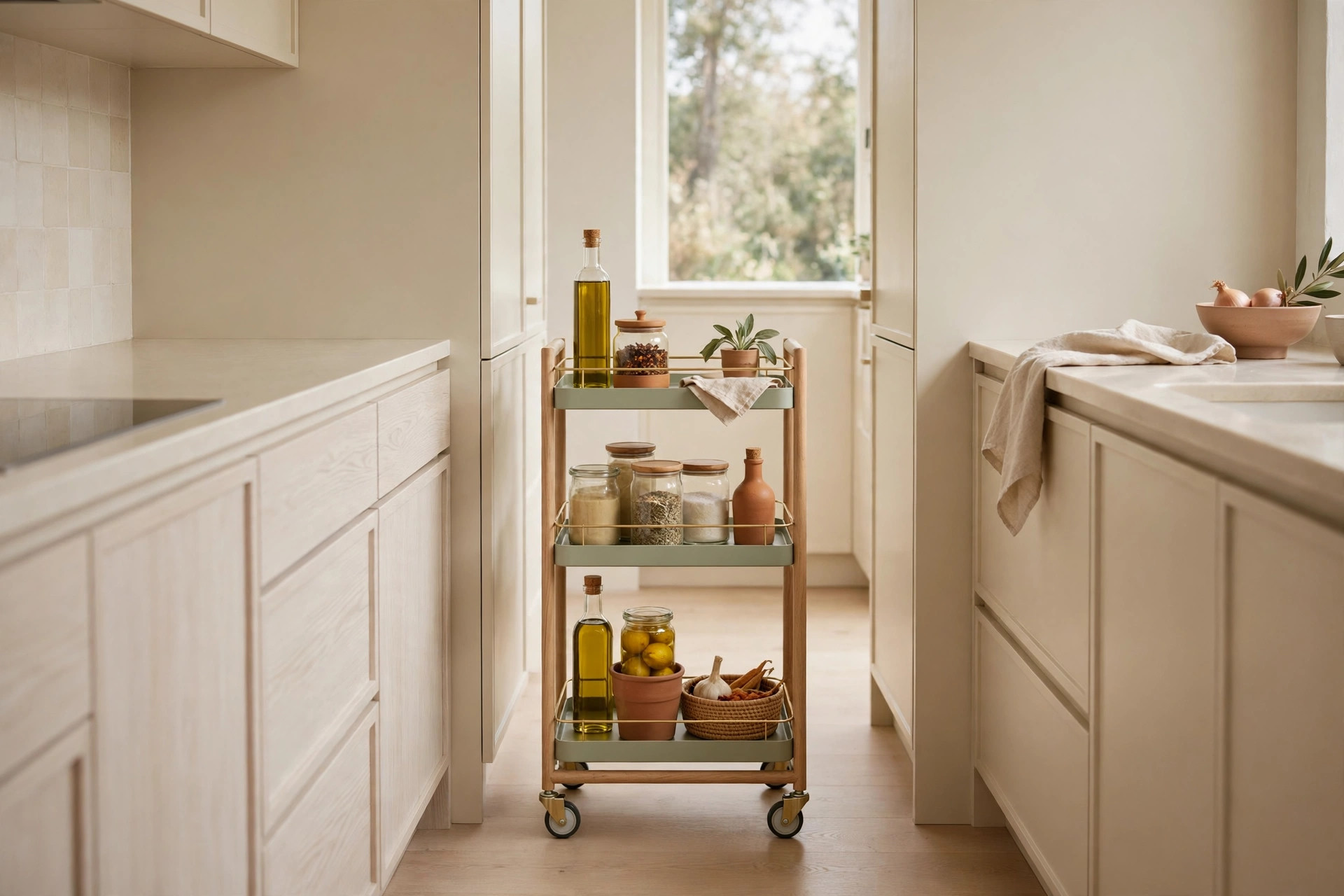
7. Slide a slim rolling cart into the gap beside the fridge
A rolling cart 5 to 6 inches wide and about 24 inches tall fits the gap between the fridge and the counter in most galleys, holding oils, vinegars, or canned goods in three narrow tiers. Because it rolls out, nothing gets lost at the back — the whole cart is the shelf. Measure the gap twice before ordering, including the fridge door swing, and leave at least half an inch of clearance on each side.
8. Fit a pull-out tray inside one deep base cabinet
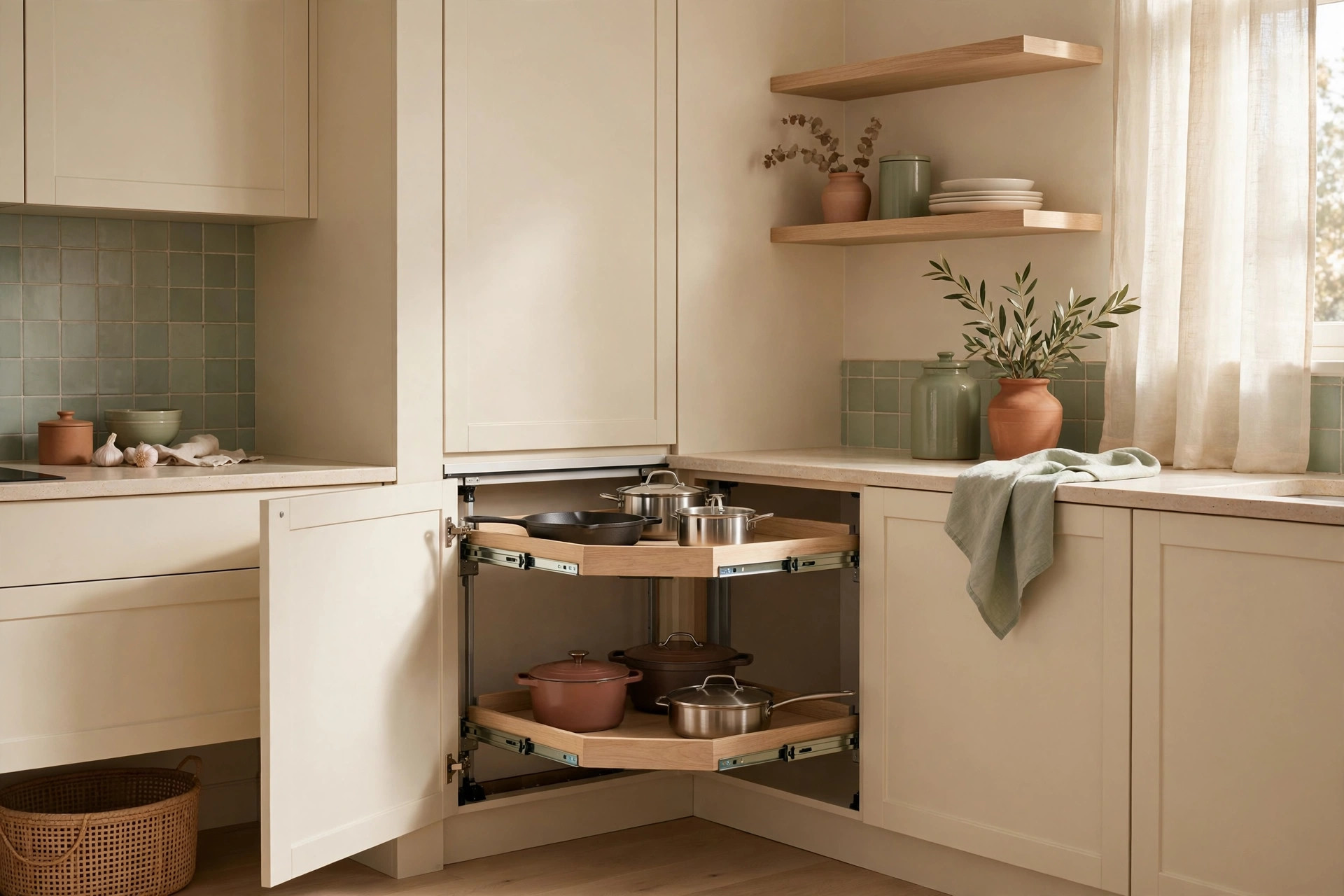
A pull-out drawer tray on the floor of a deep base cabinet brings pots, lids, or small appliances out to you instead of forcing you to kneel and dig. One tray in the cabinet beside the stove is usually enough to transform the worst cabinet in the kitchen. If a full pull-out is beyond the budget, a low-sided 12×16-inch bin on the cabinet floor works as a manual version — pull the bin, not the individual pans.
Door racks: the pantry hiding on the inside of every door
Every cabinet door in a galley kitchen has a flat inside face doing nothing. Door racks turn those faces into a shallow pantry — perfect for flat, light items that otherwise pile up on counters.
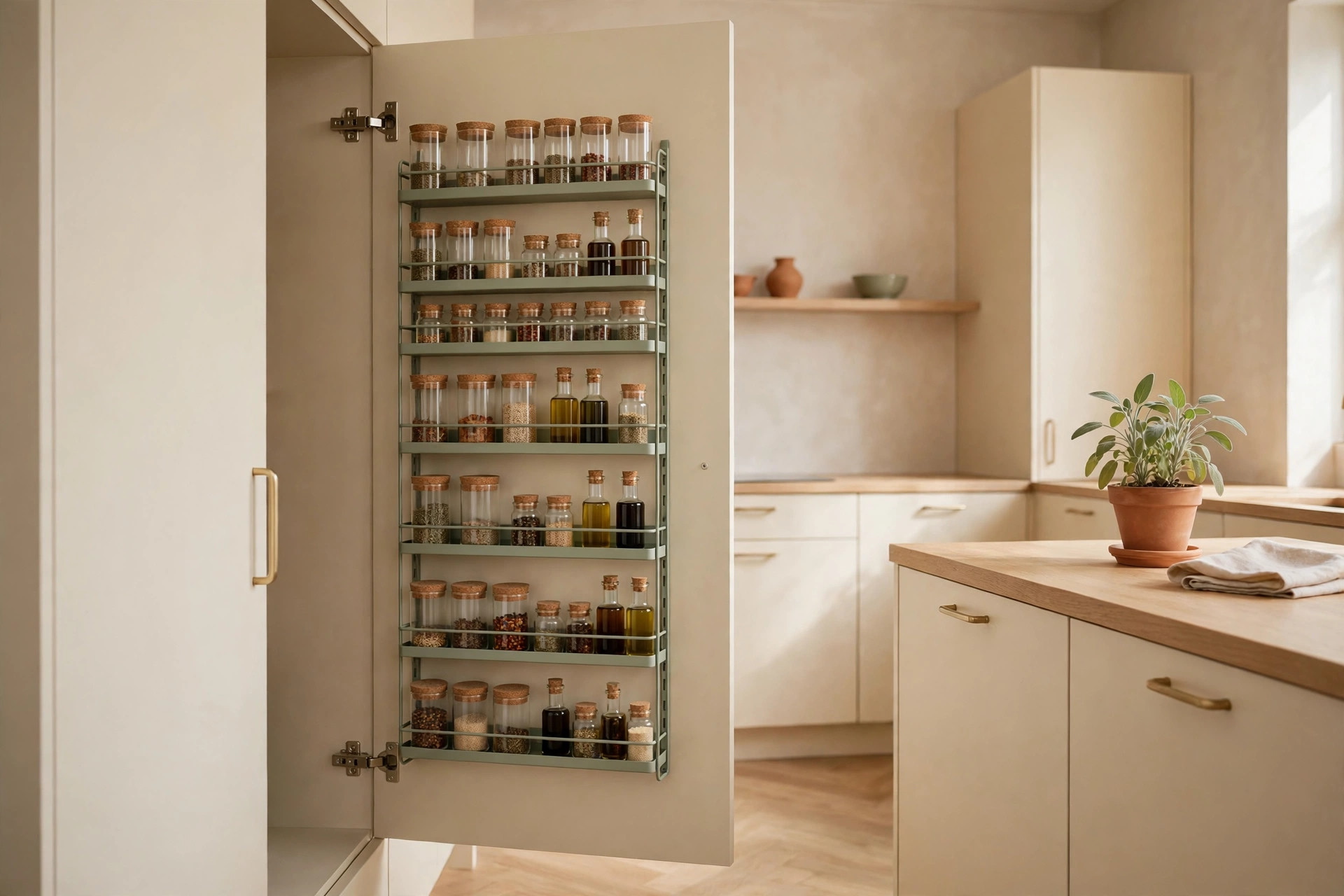
9. Hang a spice rack on the inside of a cabinet door
A two-tier wire rack on the inside of the cabinet door nearest the stove holds 10 to 12 standard spice jars where you can see every label at a glance. Keep the jars small — 4-ounce jars or smaller — so the door still closes cleanly and the rack does not strain the hinges. This one change alone can empty a whole shelf of your upper cabinets.
10. Put a lid and wrap rack on the pantry door
Pot lids, cling wrap, foil, and parchment are flat, awkward, and constantly in the way. A narrow over-door rack or adhesive hooks on the inside of the pantry or under-sink door keeps lids vertical and wrap boxes upright, so they stop sliding around in a drawer. Measure the door’s inside clearance first — most racks need about 2 inches of depth, and a rack that blocks the door from closing is worse than no rack. Renters will find more no-drill options in these renter-friendly kitchen organization ideas.
Counter discipline: what stays out in a 3-foot aisle
In a galley kitchen, the counter is a workspace, not a display shelf. Every item that lives on the counter permanently costs you prep space and narrows the aisle, even if it only takes up a few inches.
11. Keep only three things on the counter — and name them
Pick the three items that genuinely earn a permanent counter spot — for most cooks, the coffee maker, one utensil crock, and the kettle — and move everything else into a cabinet or onto a wall. Write the three down and tape the list inside a cabinet door for a month. The toaster, the stand mixer, and the fruit bowl either rotate in when used or find a shelf home; they do not all live out at once.
12. Use one tray to corral the daily essentials
A single 12×8-inch tray beside the sink or stove holds the dish soap, sponge, and hand towel in one contained zone instead of three items scattered across the counter. When you cook, lift the whole tray aside; when you clean, wipe under it in one pass. The tray is a boundary, not a decoration — if something does not fit on it, it does not live on the counter.
Vertical zones: stacking up instead of spreading out
A galley kitchen cannot spread out, so it has to stack up. Assign each wall height a job — daily items at eye level, weekly items above, rarely used items at the very top — and use the full height of both walls.
13. Stack shelves to the ceiling on one wall
If one wall has no upper cabinets, or only a short run of them, add two or three open shelves running up toward the ceiling. The bottom shelf holds daily dishes and mugs, the middle holds weekly items like mixing bowls, and the top holds things you reach for monthly. Keep the shelves 12 to 14 inches apart so tall items fit without wasted air above them, and never stack anything above the top shelf that you cannot lift down safely.
14. Hang hooks under the upper cabinets for mugs and measuring cups
Screw-in or adhesive hooks under the upper cabinets hold mugs, measuring cups, and small baskets in the dead space between the cabinet bottom and the backsplash — about 2 to 3 inches of vertical space that is otherwise wasted. Four to six hooks under one cabinet can free an entire shelf of mug space inside. Keep the hooks at the front edge so hanging mugs do not knock against the backsplash. If your galley has a blind corner cabinet swallowing items at the back, these blind corner kitchen cabinet storage ideas pair well with this trick.
The nightly reset for a kitchen with no spare inches
A galley kitchen has no buffer: one night of dishes left out and the whole aisle is blocked. A two-minute nightly reset is what keeps the storage system working instead of slowly collapsing back into clutter.
15. Run a two-minute reset: counters clear, sink empty, floor swept
Every night, clear the counters to your three named items, empty the sink or load the dishwasher, and sweep the floor. Two minutes is enough because the system does the heavy lifting — everything already has a wall, door, or shelf home, so the reset is just returning items, not deciding where they go. Do it right after dinner, every night, and the kitchen starts each morning ready to cook in.
16. Do a weekly five-minute audit of what crept back
Once a week, scan the counters and the aisle for anything that crept back in: the gadget that stayed out after one use, the bag that landed on the floor, the jar that never went back to its rack. Return it or rehome it in five minutes. This audit is what separates a system from a one-time tidy — small kitchens drift fast, and a weekly catch keeps the drift from becoming the new normal.
Mistakes to avoid
Buying organizers before measuring. A cart an inch too wide, a rack that blocks a door, or a riser too tall for the cabinet all end up in a drawer of failed purchases. Measure first, buy once.
Storing heavy items above shoulder height. Cast iron and heavy appliances belong below waist level. A heavy pot falling from a top shelf in a 3-foot aisle has nowhere safe to land.
Filling every wall. A galley with rails, shelves, and hooks on every inch of wall feels cramped, not organized. Leave at least one stretch of wall bare — your eyes and your aisle need the breathing room.
Using the aisle as overflow storage. A bin, a step stool, or a drying rack left in the aisle is not storage, it is an obstacle. If it lives on the floor of the walkway, it does not have a real home yet.
Frequently asked questions
Can you make a galley kitchen feel bigger without renovating?
Yes. Clearing the counters, moving daily tools to wall rails, and keeping the aisle at a full 36 inches wide makes a galley feel noticeably bigger, because the eye reads clear surfaces and open floor as space. No renovation is needed — the change is entirely about where things live.
How wide should a galley kitchen aisle be?
Aim for at least 36 inches between facing counters, and 42 to 48 inches if two people cook together regularly. Below 36 inches, even a dishwasher door or an oven handle becomes a blockage, so measure at the narrowest point and protect that width first.
What is the best storage for a very narrow galley kitchen?
Wall-mounted storage wins in the narrowest galleys: rails, magnetic strips, and door racks add capacity without touching the floor or the aisle. Slim rolling carts and pull-out trays come second, because they use gaps and cabinet depth that are already wasted.
How do you organize a galley kitchen as a renter?
Use removable adhesive hooks and rails, over-door racks, tension rods inside cabinets, and freestanding slim carts. Avoid drilling into tile or cabinets, and keep any screw-mounted rail to a wall you can patch with a dab of filler when you move out.
Conclusion
A narrow galley kitchen does not need more space — it needs a rule. Keep the walkway clear, store on the walls and doors, and give every item a home that is not the counter. Start with the rail and the door rack this weekend, then add the pull-out and shelves as you go. Browse more ideas in the kitchen category, and save this pin for later so the 16 ideas are there when your kitchen needs them.