A good knife is only useful if you can reach it without digging through a tangle of utensils — and only safe if its edge is not sliding loose in a drawer. In a small kitchen, that is a real problem: counter space is scarce, drawers are shallow, and the old wooden block eats a full corner of your prep zone. These small kitchen knife storage ideas give every blade a fixed home that protects the edge and your fingers, and frees up the space you actually cook in. Below are 16 ideas, from magnetic strips to renter-friendly no-drill options.
Knife safety first: why loose blades in drawers fail
A knife tossed loose in a drawer fails three ways at once: the edge dulls every time it knocks against other metal, you risk a cut every time you reach in blind, and a heavy chef’s knife sliding around can chip the blade or damage the drawer. The fix is one dedicated spot per knife and a rule that blades never go back loose.
1. Give every knife a slot, not a pile
Count your knives before buying anything. Most home cooks need storage for four to six blades: an 8-inch chef’s knife, a paring knife, a serrated bread knife, and a utility knife. Measure the longest blade, then choose slots at least an inch longer so the tip never pokes through.
2. Never store blades loose with other utensils
If a tray or block is not possible today, use individual blade guards — thin plastic sheaths that cost a few dollars each. Slide one onto each blade first. It stops edge damage and cuts while you decide.
Magnetic wall strips: the small-kitchen favorite
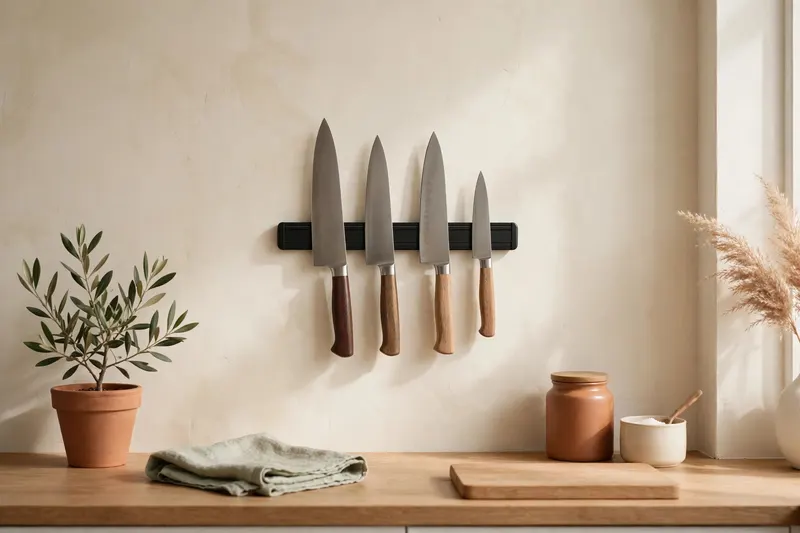
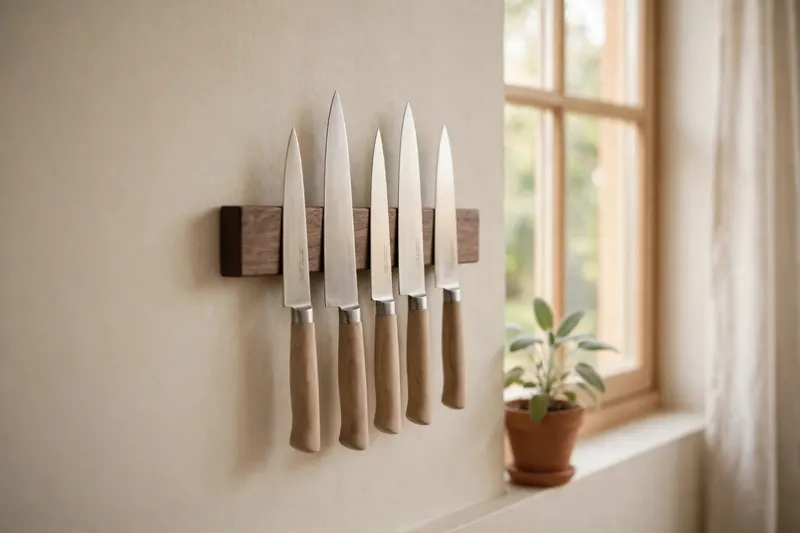
A magnetic strip moves your knives off the counter and onto wall space you were not using — usually the backsplash between the counter and the upper cabinets, or a free stretch of wall beside the stove. It is the best knife storage small kitchen solution for most people — no counter space used, every blade visible and within reach.
3. Mount a wood-covered magnetic strip at eye level
A 12- to 18-inch strip holds four to six knives and fits most small kitchens. Mount it 55 to 60 inches from the floor — above small children’s reach, below your stretch over a hot pan. Wood-covered strips are gentler on blade edges than bare metal ones.
4. Keep the strip clear of the stove and sink
Heat and steam are the enemies of a good edge. Mount at least 12 inches from the stove and out of the splash zone behind the sink, where water spots and rust form. Mount it beside your main prep counter, within one step of your cutting board.
5. Store blades spine-down on the strip
Place each knife with the cutting edge facing up, resting the spine against the magnet first, then roll the blade flat. Lifting straight off the strip drags the edge across the magnet and dulls it over time. That adds months between sharpenings. See 17 Kitchen Wall Storage Ideas for Small Kitchens (No Counter Space Wasted) for more ways to use vertical space.
In-drawer knife trays and angled blocks
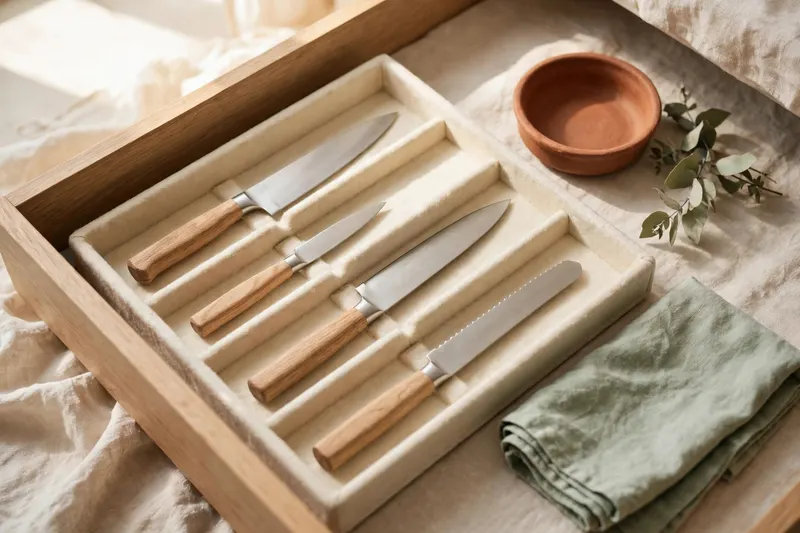
If wall space is tight or you prefer knives out of sight, the drawer is the next best home — as long as each blade sits in its own slot. In-drawer storage keeps counters completely clear, provided the tray fits your drawer and your knives.
6. Use an in-drawer tray sized to your shallowest drawer
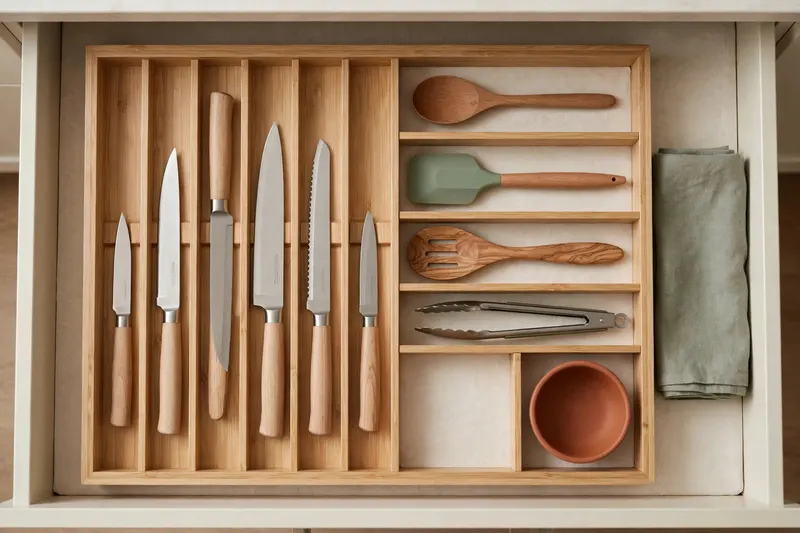
Measure the drawer’s interior depth, width, and height first. Most kitchen drawers are 2 to 3 inches deep inside, and a tray with angled slots holds blades safely. Bamboo trays are a good default: sturdy and easy to wipe.
7. Try an angled in-drawer block for deep drawers
If your drawer is 4 inches or deeper, an angled block with slots cut at roughly 30 degrees keeps handles up and blades flat, so you can grab the right knife without lifting the block. Leave half an inch above the tallest handle or the drawer will jam.
8. Keep the knife drawer separate from the utensil drawer
Sharing a drawer is how blades end up loose again. Dedicate one drawer — even a narrow 12-inch one — to knives only. If you only have one drawer total, use a two-zone tray with a solid divider, as long as blades never cross into the utensil side. See Kitchen Drawer Organization Ideas for Tiny Drawers for how to zone a single drawer when space is tight.
Countertop blocks that earn their footprint
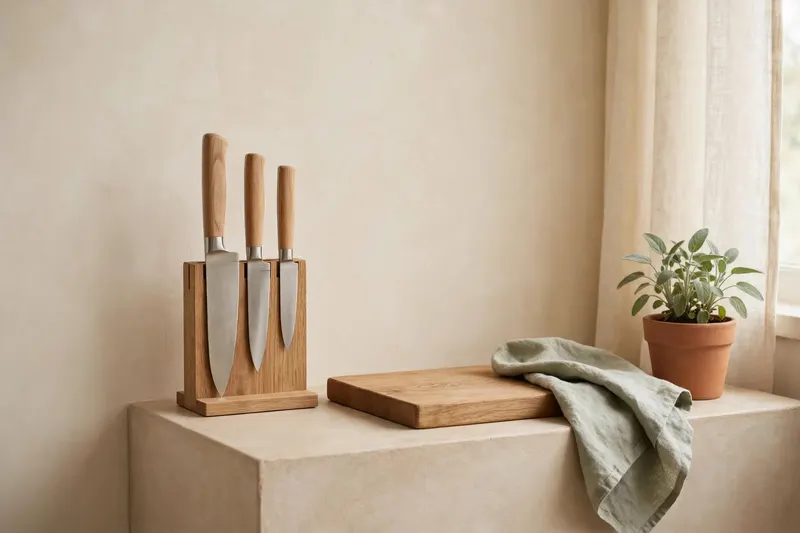
A countertop block only makes sense in a small kitchen if it earns the space it takes. A block that holds eight knives you never use is clutter; a slim block that holds the four you reach for daily is a tool.
9. Choose a slim vertical block with five slots or fewer
A narrow block roughly 5 inches wide and 9 inches tall fits between stove and sink without blocking your prep area. Vertical slots keep blades pointing down and handles up.
10. Try a universal slot block with flexible rods
Instead of fixed slots sized for one set, these blocks use tightly packed flexible rods that grip any blade shape — including wide cleavers and narrow fillet knives. They work well for knives from different brands or sets. See 15 Small Kitchen Cutting Board Storage Ideas (End the Leaning Stack) for the tools that share the counter.
Knife storage for renters: no-drill options
Renters cannot always drill into tile or plaster, but the knives do not have to live in a drawer. Every idea here uses adhesive, clamps, or gravity — nothing that leaves a hole.
11. Use a heavy-duty adhesive magnetic strip
Adhesive strips rated for 5 pounds or more will hold a loaded 12-inch magnetic knife strip on smooth tile or painted drywall. Clean the wall with rubbing alcohol, press firmly for 30 seconds, and wait a full 24 hours before hanging knives.
12. Mount the strip on the side of a cabinet or fridge
A narrow magnetic strip stuck to the side of an upper cabinet or the refrigerator uses dead space and needs no drilling. Keep it away from the stove so heat does not loosen the adhesive. For a full no-drill playbook, see 17 Renter-Friendly Kitchen Organization Ideas (No Drilling, No Damage).
Keeping blades sharp: storage that protects edges
A dull knife is a dangerous knife — it slips instead of cutting, and it needs more force, which is when accidents happen. Storage is half of sharpness: a blade that never bangs against metal stays sharp longer.
13. Store every blade edge-up or in a sheath, never edge-down on hard surfaces
In a block or tray, the blade should rest on its flat side. Without a tray, slip on a blade guard first — bare edges go dull within weeks.
14. Dry knives before storing them, every time
Even stainless steel spots and pits when stored wet, and moisture trapped inside a block slot breeds rust at the edge. A quick towel wipe takes five seconds. Never store a knife straight from the dishwasher — heat, rattling, and detergent all dull and damage edges.
Kids and guests: the safety rules that matter
In a home with children or frequent visitors, knife storage is not just organization — it is safety. The goal is simple: no child or guest should reach a blade by accident, or find one lying loose.
15. Keep everyday knives above 48 inches or behind a closed drawer
That puts blades out of reach of most children under five, while staying comfortable for adults. If your storage is lower, use a drawer with a child lock or a block with a locking cover.
16. Set a house rule: knives go back to their home immediately
The riskiest moment is not storage — it is the knife left on the counter “for a minute” while someone answers the door or helps a child. Make it habit: wash, dry, and return the knife before moving on. A kitchen where every knife has a visible home teaches the rule without a word.
Mistakes to avoid
Skip these errors and any of the 16 ideas above will last years.
- Buying storage before measuring. An 18-inch strip does not fit a 14-inch wall, and a tray a quarter inch too wide will never sit flat. Measure first.
- Storing knives in the dishwasher. The rattling dulls edges, the detergent pits steel, and handles crack. Hand-wash, dry, and store.
- Choosing a block with slots you will never fill. Empty slots collect crumbs and moisture. Buy storage sized for the knives you own.
- Hanging knives above the stove. Heat degrades handles and adhesive mounts, and reaching over a hot burner risks a burn.
- Forgetting the serrated knife. Bread knives do not fit standard straight slots. Check that your storage actually holds a serrated blade before you buy.
Frequently asked questions
Can I store knives in a drawer without a tray?
You can, but only with individual blade guards on every knife. Without guards, blades knock against each other and the drawer, dulling edges and creating a cut risk. A tray is cheaper than replacing a dulled set.
How high should a magnetic knife strip be mounted?
Mount it about 55 to 60 inches from the floor — out of reach of small children and within easy reach of most adults. Keep it within one step of your cutting board and at least 12 inches from the stove.
Is a magnetic strip safe with kids in the house?
Yes, when mounted high enough and used correctly. Keep it above 48 inches, store blades spine-down so the edge faces up, and teach older children the strip is not to be touched. For toddlers, a locked drawer is safer.
What is the best knife storage for a renter who cannot drill?
A heavy-duty adhesive magnetic strip on smooth tile, a cabinet side, or the side of the fridge is the best no-drill option. Use adhesive rated for at least 5 pounds, wait 24 hours before loading it, and test the hold first. An in-drawer tray is the zero-risk backup.
Conclusion
Good knife storage is not about buying the most expensive block — it is about giving every blade one fixed, safe home and putting it back every time. Pick the idea that fits your kitchen, measure before you buy, and start with the knives you use most. Save this pin for later, and browse more ideas in the kitchen collection.