A litter box in a small apartment is hard to ignore. It eats floor space you do not have and shows up in photos of your living room. These cat litter box storage ideas hide the box, keep air moving around it, and cut tracked litter — without making life harder for your cat. Below are 15 ideas for rentals, studios, and one-bedroom flats.
The litter box rules: ventilation, access, and cleaning come first
Before you hide anything, get the basics right. A badly hidden box is worse than a visible one: a cat that cannot get in easily, breathe fresh air inside, or find a clean box will stop using it.
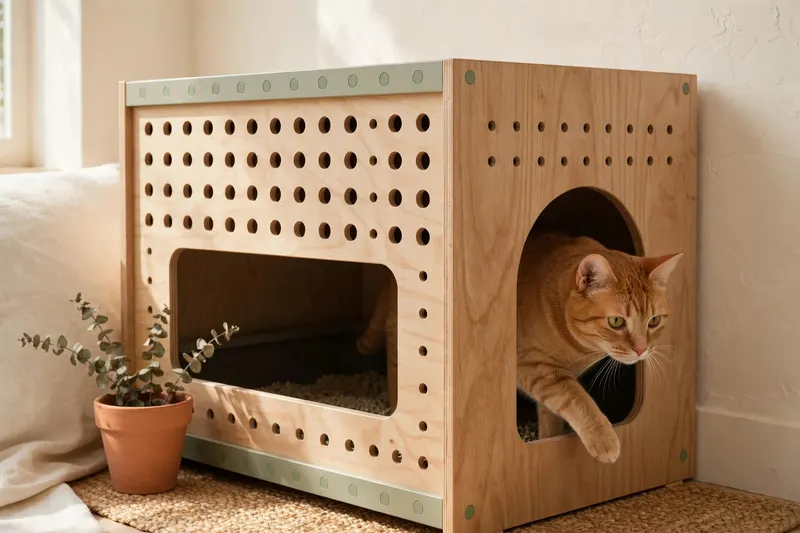
First, the box needs airflow. A fully sealed cabinet traps ammonia smell inside. Any enclosure needs two openings — one entrance for the cat and one vent, ideally on opposite sides.
Second, the entrance must stay open and easy. Cats dislike pushing through heavy flaps or squeezing through small holes. An opening of about 7 by 7 inches works for most adult cats; go bigger for large breeds.
Third, plan cleaning access before you buy or build anything. You scoop daily and deep-clean weekly, so the top, front, or side of the enclosure must open fully.
Hidden litter box furniture: cabinets that look like side tables
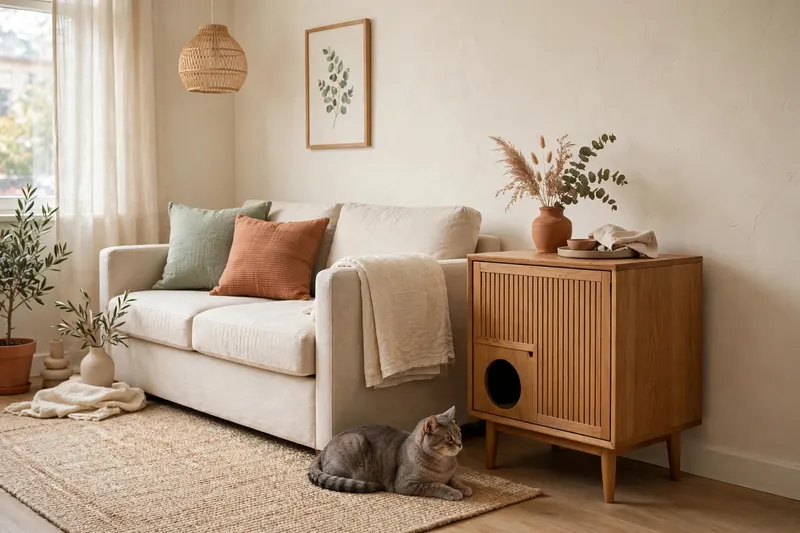
Litter box furniture is the fastest way to make a box disappear in a small apartment.
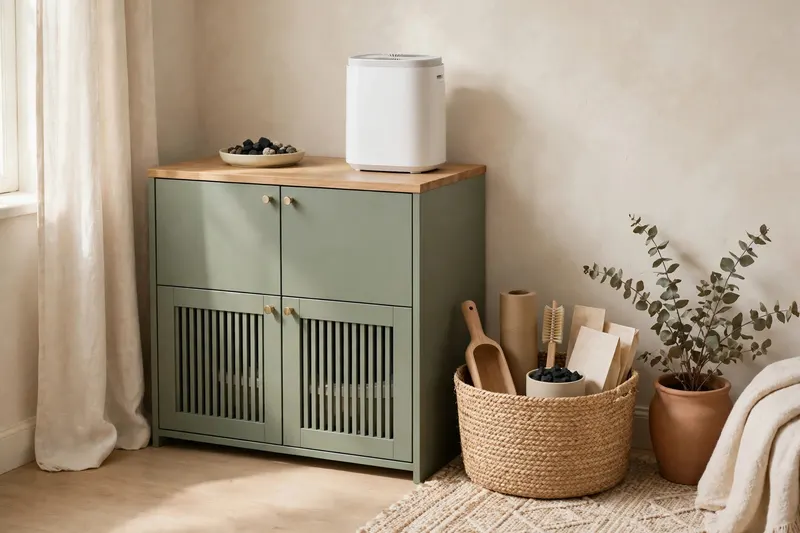
1. Convert a side table or nightstand into a litter cabinet
A standard 18-inch-wide nightstand fits most regular litter boxes. Cut a 7-inch cat entrance in one side panel, add a small vent hole on the opposite side, and line the floor with a washable tray.
2. Use a bench with a hidden compartment by the entryway
A storage bench at the front door hides the box and gives you a seat for putting shoes on. Choose one at least 36 inches long and 16 inches deep so the box fits with room for the cat to turn around. Cut the entrance on the short end, facing away from the door, so guests never see it.
3. Hide the box inside a living room cabinet with a top-loading lid
A low credenza or TV stand with a lift-up top is ideal for living rooms because you can scoop from above without pulling the box out. Leave a 2-inch gap behind the cabinet for airflow, or drill two vent holes in the back panel. For the rest of your pet gear, see 15 Pet Supply Storage Ideas for Small Apartments.
Closet and under-stair litter box conversions (renter-safe)
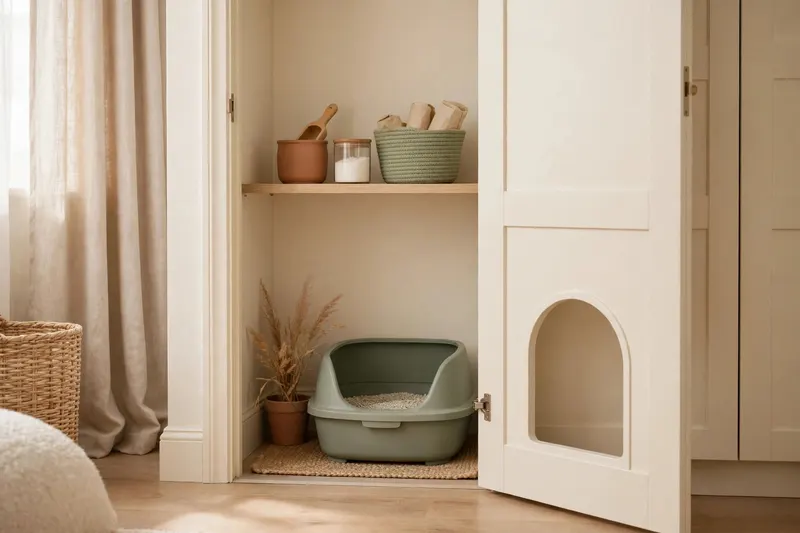
Closets and under-stair nooks are the most underused litter box spots in small apartments.
4. Turn a hall closet into a ventilated litter room
Remove the closet door and replace it with a curtain on a tension rod, or a bi-fold panel with a cat-sized cutout at the bottom — no drilling required. Place the box on a large boot tray to catch spills, and add a small battery-powered fan just outside the closet to keep air moving. More closet ideas: 17 Renter-Friendly Closet Organization Ideas (No Drilling Required).
5. Use a spare bathroom as a dedicated litter station
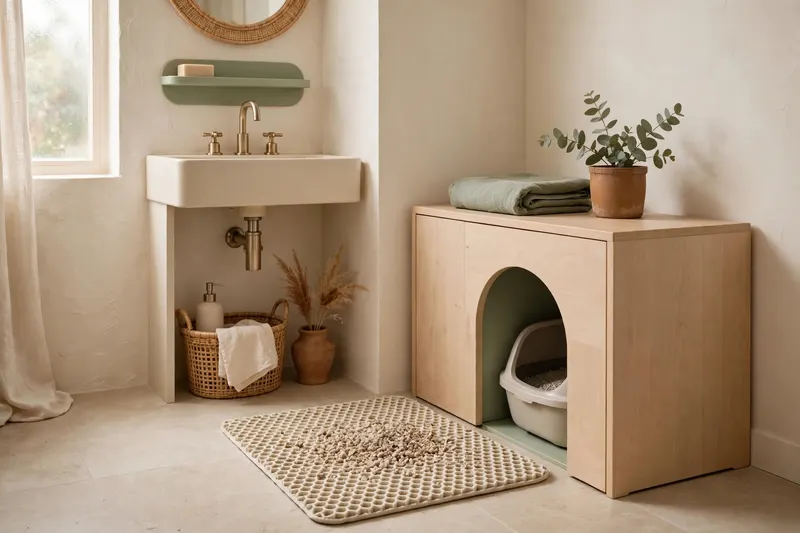
If your flat has a second bathroom or a large main bathroom, the litter box belongs there. Bathrooms have hard floors that are easy to sweep, a fan for ventilation, and a door you can leave ajar. Use a door-strap latch that holds the door open 6 inches so the cat always has access. For tiny bathrooms, see 19 Tiny Bathroom Organization Ideas to Maximize Every Inch.
6. Convert the under-stair cupboard into a cat nook
Under-stair space is often wasted in small homes, but it is the perfect size for a litter box. Clear the cupboard, lay a washable mat, and fit a small battery-operated motion light. If the cupboard has a door, remove it or cut a cat entrance in the lower corner — and keep the door if you are renting, so you can refit it when you move out.
Odor control that actually works: litter, filters, and airflow
Hiding a litter box does nothing for smell if the odor control is wrong.
7. Switch to a clumping litter and scoop twice a day
Clumping litter locks urine into solid clumps you can remove, while non-clumping litter lets urine pool at the bottom of the tray and smell. Scoop in the morning and again in the evening — two minutes each time — and the box never gets bad enough to smell through a cabinet.
8. Add a carbon filter and a vent to any enclosed box
A stick-on activated carbon filter on the inside of the cabinet, near the vent, absorbs odor before it reaches the room. Pair it with a real vent: a 2-inch hole on the back panel, covered with mesh, lets air escape instead of building up inside.
9. Use baking soda under the litter and an enzymatic cleaner weekly
Sprinkle a thin layer of baking soda on the bottom of the empty tray before adding litter; it absorbs odor without adding fragrance. Once a week, empty the tray completely and wash it with warm water and an enzymatic cleaner, which breaks down odor-causing compounds instead of covering them.
Litter tracking: mats, entry lips, and the daily 2-minute sweep
Litter on the floor is the most visible sign of a cat in a small apartment. It gets into carpet, under furniture, and onto bare feet.
10. Put a double-layer honeycomb mat at every box exit
A honeycomb mat traps litter between two layers: the cat steps on the top layer, litter falls through the holes, and you tip the mat out over the bin. Place it directly outside the box entrance, large enough that the cat takes at least two steps on it — about 24 by 18 inches for most cats.
11. Switch to a top-entry box or add a high entry lip
Top-entry boxes force the cat to jump out through the top, which shakes most litter off their paws before they land. If a top-entry box is not right for your cat, use a high-sided tray or a box with a raised entry lip instead — it stops the cat kicking litter out sideways during digging.
12. Do a 2-minute sweep every evening, same time, same spot
Keep a small dustpan and brush — or a handheld vacuum — right next to the litter area, not in another room. Every evening, sweep the 3-foot zone around the box, shake out the mat, and check the floor under the cabinet.
Multi-cat setups in one small apartment
One box per cat, plus one extra, is the standard rule — and in a small apartment that takes planning.
13. Give each cat a box in a different zone, not side by side
Cats are territorial about litter boxes. Two boxes next to each other in the same bathroom count as one location in a cat’s mind. Split them: one in the bathroom, one in a closet or under-stair nook, and the third — if you have two cats — in a bedroom corner behind furniture.
14. Use one large box per cat instead of two small ones
If floor space truly allows only two boxes for two cats, make them large. A box should be at least one and a half times the length of your cat, nose to base of tail — for most adult cats that means a tray around 24 inches long.
Cleaning routine: the weekly deep clean that prevents smells
15. Run a fixed weekly deep clean: empty, wash, dry, refill
Pick one day and stick to it. Empty the tray completely, wash it with warm water and enzymatic cleaner, and let it air-dry for 10 minutes before refilling — damp trays grow odor fast. While it dries, wipe the inside of the cabinet, shake out the mat, and sweep the floor underneath.
Mistakes to avoid
Buying a fully sealed cabinet with no vent. This is the most common mistake, and it makes the smell worse, not better.
Hiding the box in a room with a closed door. A cat that cannot reach the box will find somewhere else — usually your bed or a rug. Every hidden setup needs a permanently open entrance.
Choosing scented litter to cover smell. Strong fragrances bother cats far more than they bother you, and some cats will avoid a heavily scented box entirely.
Using a box that is too small for your cat. A cramped box means litter kicked over the edge and a cat that rushes in and out. Size up before you buy furniture to fit around it.
Putting the box next to food and water. Cats do not want to eat where they toilet. Keep at least a few feet between the litter area and the feeding station, ideally in different rooms.
Frequently asked questions
Can I hide a litter box without my cat refusing to use it?
Yes, as long as the entrance stays open and easy, the inside has airflow, and the box is in a quiet spot your cat already likes.
How do I stop litter box smell in a studio apartment?
Scoop twice a day, use clumping litter at about 3 inches deep, add a vent and a carbon filter to any enclosure, and do a full weekly wash with enzymatic cleaner.
Is litter box furniture safe for cats?
It is safe when it has two openings for airflow, an entrance at least 7 by 7 inches, and a lid or panel you can open fully for cleaning.
How many litter boxes do I need in a small apartment?
One per cat, plus one extra, is the standard advice. In a genuinely small flat, two large boxes in different zones for two cats is a workable minimum.
What is the best litter box setup for renters?
A freestanding cabinet or bench you own, a closet conversion using a tension-rod curtain instead of a drilled door, and a washable mat under the box.
Conclusion
A litter box does not have to dominate a small apartment. Pick a hidden spot your cat already likes, give it airflow and an easy entrance, scoop twice a day, and clean it properly once a week. Save this pin for later, and browse more storage ideas to keep the rest of your small home just as tidy.