Every closet has a dead zone — the top shelf you can barely see, the deep corner behind the hanging clothes, the strip of wall above the door. You know things are up there, but reaching them means dragging a chair across the bedroom, so whatever goes up there tends to stay up there, forgotten. Hard to reach closet space doesn’t have to be wasted space, though. With the right systems, those awkward spots can hold the things you only need a few times a year, and you can get them down without a daily struggle. This guide covers eight practical ways to make the highest, deepest parts of your closet genuinely useful — no renovation, no custom carpentry.
Map the dead zones: top shelf, deep corners, above the door
Before you buy anything, stand in front of your closet and map what you actually can’t reach. Most closets have three dead zones, and each one needs a different fix.
The top shelf sits above the hanging rod, usually 66 to 72 inches off the floor. If you’re under about 5 feet 6 inches tall, you can’t see what’s on it without standing on something. The deep corners are the stretches of shelf and floor on either side of the door opening, hidden behind hanging clothes — in a standard reach-in closet, each side can run 12 to 18 inches into shadow. The above-door strip is the 8 to 12 inches of wall between the top of the door frame and the ceiling, space most people never think about.
Measure the width of your top shelf, the depth of each corner, and the height from the top shelf to the ceiling. Write down what lives in each zone — if you can’t remember what’s up there without looking, it probably doesn’t belong there.
The top-shelf rule: only what you touch twice a year
The single most important rule for hard-to-reach closet space is simple: the top shelf is for things you touch once or twice a year, and nothing else. The moment everyday items migrate up there, the system breaks — you start leaving the step stool out, or you stop putting things away properly.
What belongs up top: out-of-season clothing in sealed bins, holiday decorations, luggage, spare bedding, and keepsakes. What does not belong up top: your current-season sweaters, the shoes you wear this week, anything a child needs for school, or the bag you grab on your way out the door.
Sort by frequency, not by category. A heavy winter coat you wear daily in January belongs on the rod in January and in a top-shelf bin in July.
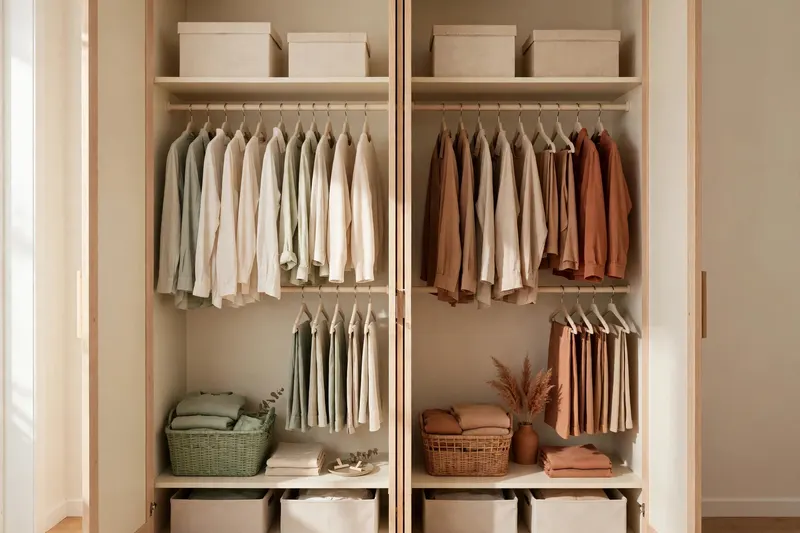
Use bins that match the shelf’s depth. Most closet shelves are 12 inches deep, so a 10- to 11-inch-deep bin leaves a finger gap at the front for pulling it down. Stack no more than two bins high. Keep anything over about 10 pounds at waist height or below; up top, stick to light, bulky things like off-season clothes, spare pillows, and empty luggage.
Pull-down rods: bringing high hanging down to you
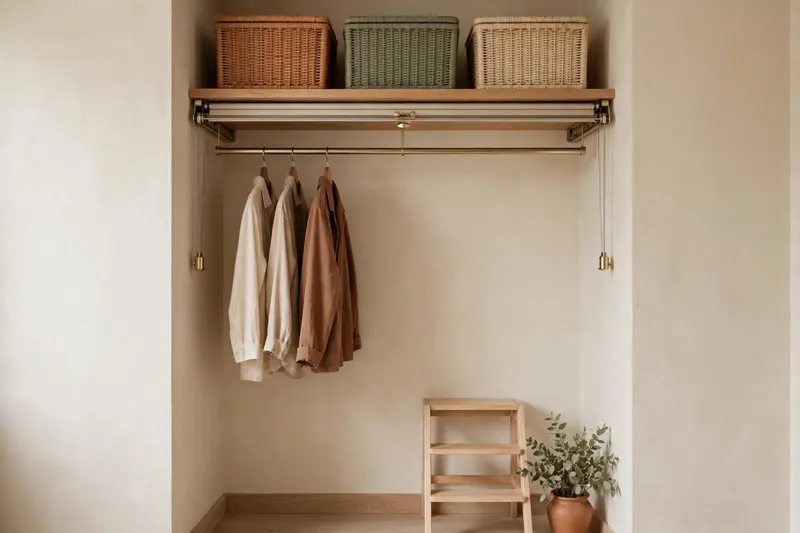
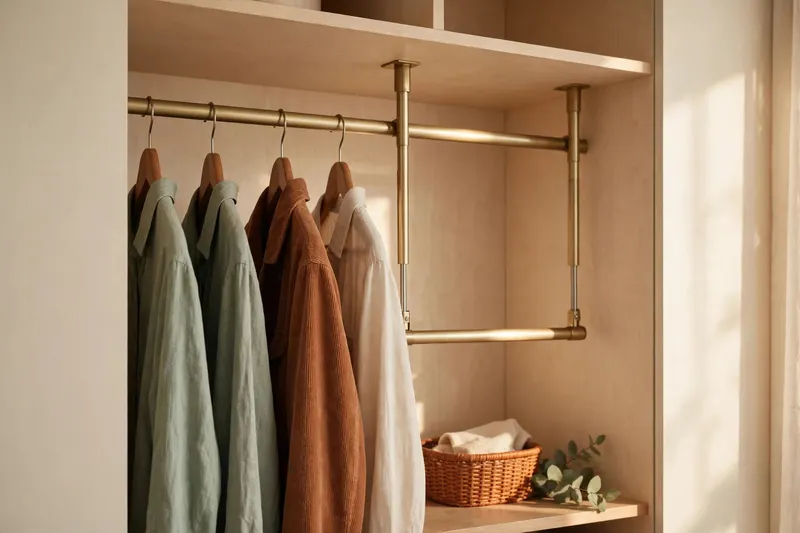
A pull-down closet rod — sometimes called a wardrobe lift — is the best fix for hanging space that’s too high to use. It’s a rod on a spring or gas-strut mechanism: pull a small handle and the whole rod swings down to about chest height, you hang or remove clothes, and you push it back up. It turns a high rod that only tall household members can use into a rod anyone can use.
Most pull-down rods fit a closet 24 to 48 inches wide and hold roughly 20 to 30 pounds of clothing, about 10 to 15 garments on hangers. Prices typically run from about $60 for a basic spring model to $150 or more for a smooth gas-strut version. Installation is two brackets screwed into the side walls or a mounting board, plus a handle — a confident DIY job in under an hour. Renters can mount it on a removable board instead of drilling the walls.
Buy one if your closet has a high rod that currently holds nothing, or if shorter members of the household can’t reach the rod at all. Skip it if your hanging space is already at a comfortable height — the mechanism adds moving parts and upkeep, so it only earns its keep where height is the real problem.
Deep corners: rotating organizers and pull-out bins
Deep corners are where closet items go to disappear. The fix is to stop reaching into the corner and start bringing the corner out to you. Two tools do this well.
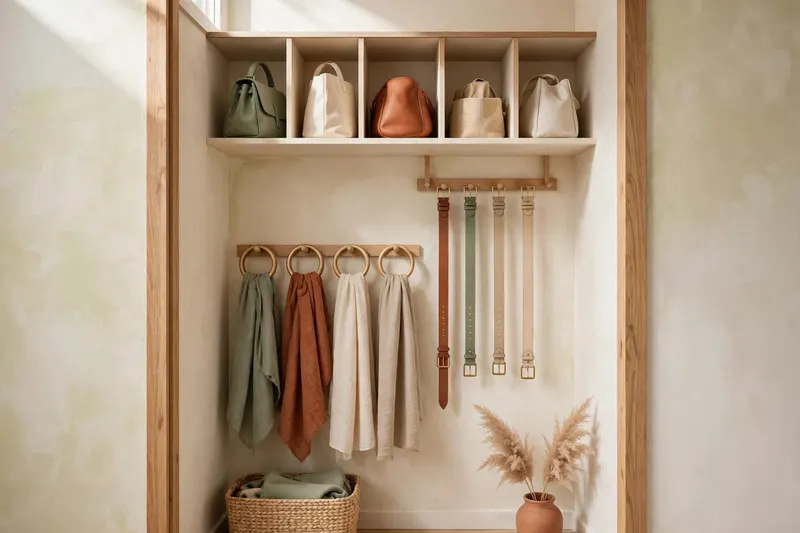
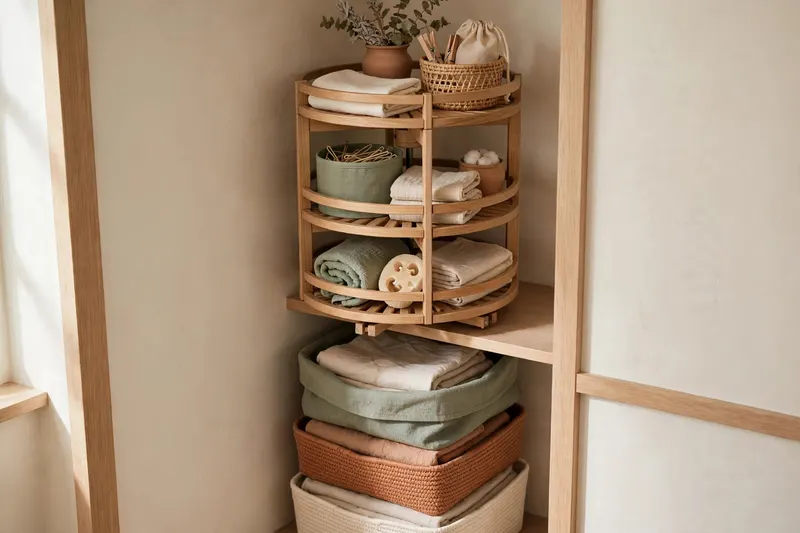
Rotating organizers — small turntables, 10 to 12 inches across — work on corner shelves for folded items and accessories. One spin brings the back row to the front. They cost little, need no installation, and suit light things like scarves, belts, and hats.
Pull-out bins are the stronger solution for the deep corner of a shelf or the floor. A handled bin on a low-friction base, or a simple wire basket on a slide-out track, lets you pull the whole contents toward you like a drawer. Measure the corner’s depth first: a bin that is 16 inches deep in a 14-inch corner will never slide all the way in, and a bin that is too shallow wastes the space you’re trying to reclaim.
For floor-level corners, try low rolling bins or crates on casters — they roll out from under hanging clothes with one hand.
If your corners are part of a wider reach-in layout, the zoning ideas in 18 Small Reach-In Closet Organization Ideas pair well with these fixes — they cover how to divide a shallow closet into working zones so the corners stop collecting stray items.
Labelled bins you can identify from the floor
When a bin lives on a top shelf, you can’t read a label stuck on its front — you’re looking up at it from below, at an angle, in dim light. So label for the view you’ll actually have: from the floor, looking up.
Put the label on the bottom front edge of the bin, angled slightly downward, so it’s readable from below. Large, high-contrast lettering beats neat small print — a 2-inch-tall label in black marker on a white card is readable from six feet away; a printed label in 12-point type is not. If you use a label maker, print at the largest font size and use all caps for the first word.
Color-code by season or by person, and keep the code to three colors at most — for example, blue tape for winter, green for summer, plain white for household items.
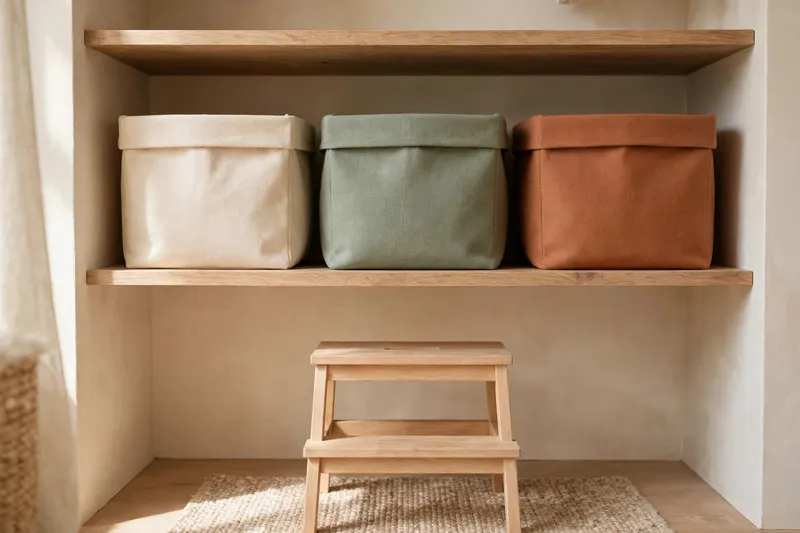
Use clear bins on the top shelf whenever you can. Seeing the contents — even just a glimpse of color or shape — is faster than reading any label, and it stops the “open every bin to find one thing” routine.
The step stool that lives in the closet, not the garage
Every closet with a top shelf needs a step stool, and it needs to live within arm’s reach of the closet — ideally inside it. A stool stored in the garage is a stool you won’t fetch, which means you’ll climb on a chair, a bed, or a wobbly stack of shoe boxes instead.
The right stool for a closet is a folding two-step model, about 16 to 18 inches tall when open, folding flat to roughly 2 inches thick. It should fit in the gap between the closet door and the hanging clothes, or tuck against the side wall. Look for one with a weight rating of at least 225 pounds, rubber feet, and a wide top step — narrow steps are the reason people slip.
Keep the stool’s spot sacred: nothing gets stacked in front of it, and it never becomes a surface for laundry or bags. And never use a rolling office chair or a plastic storage bin as a step — both tip, both slide, and both cause a surprising number of household falls.
Above-door hooks and shelves for the last inches
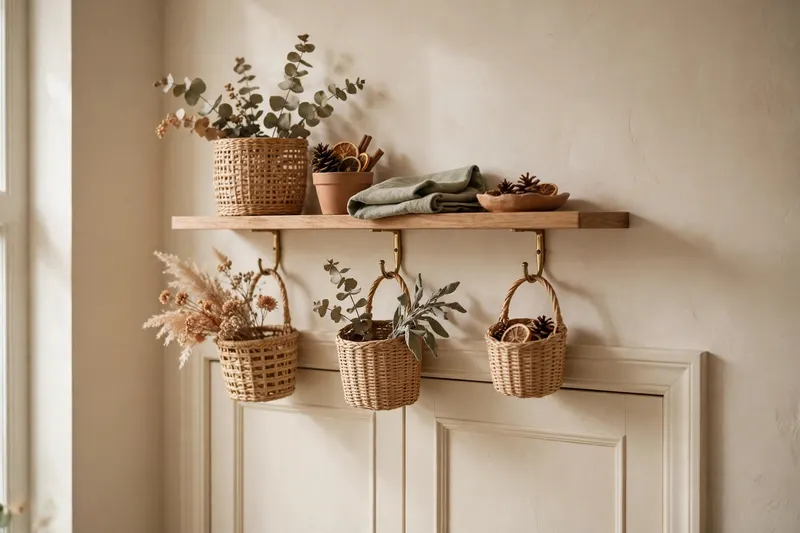
The strip above the door is the last scrap of usable space in most closets, and it’s perfect for flat, light things you need rarely. A narrow shelf — 6 to 8 inches deep — mounted just above the door frame can hold a couple of folded blankets, a spare tote bag, or a board-game box.
Over-the-door hooks on the inside of the closet door are the easier win. A single over-the-door rack with three or four hooks holds tomorrow’s outfit, a robe, a belt, or the bag you’re using this week — all at eye level, all without a single screw. If your door is hollow-core, avoid screwing heavy hooks into it; the over-the-door style distributes the weight and comes off cleanly when you move. For more no-drill ideas, see 17 Renter-Friendly Closet Organization Ideas.
Seasonal rotation: the system that keeps it working
None of the hardware above matters without a rotation habit. The top shelf only works if what’s on it changes with the seasons — otherwise it fills up with things you meant to use and never do, and the dead zone returns, just better organized.
Run the rotation twice a year, when the weather actually turns: once in spring and once in autumn. Set aside 30 minutes. Bring down every top-shelf bin, open it, and ask one question per item: did I use this in the last six months? If the answer is no and it isn’t a genuine keepsake or a once-a-year holiday item, it leaves the closet — donate it, store it elsewhere, or let it go.
Then swap: current-season clothes come down to the rod and the easy shelves; off-season clothes go up into the labelled bins. Update the labels while the bins are down — it takes two minutes and saves ten minutes of hunting later.
Cap the top shelf at two bins per person in the household, or two bins per closet, whichever is smaller. A third bin is a signal that something on the shelf doesn’t belong in the closet at all. When you hit the cap, something has to leave before something new goes up.
Mistakes to avoid with hard-to-reach storage
- Storing daily items up high. If you reach for it more than twice a month, it does not belong on the top shelf. Daily items up high mean daily step-stool trips, and nobody keeps that up.
- Buying bins before measuring. A bin half an inch too deep won’t slide onto the shelf; a bin too tall won’t clear the ceiling when you lift it down. Measure first, then shop.
- Stacking bins three high. The top bin becomes unreachable and unstable. Two high is the limit, and the heavier bin always goes on the bottom.
- Ignoring weight limits. Closet shelves are usually rated for light loads. Heavy bins of books or files can bow a shelf over time.
- Hiding things with no label and no photo. An unlabelled bin on a top shelf is a box you will never open. Label every bin.
- Skipping the step stool. Planning to “just stand on the bed” is not a system. If there’s no stool in or beside the closet, the top shelf is effectively sealed.
Frequently asked questions
How can I reach the top shelf of my closet safely?
Use a folding two-step stool kept inside or right beside the closet, with rubber feet and a weight rating of at least 225 pounds. Never stand on a rolling chair, a plastic bin, or a stack of boxes, and bring bins down to waist height before opening them.
What should I store on the top shelf of a closet?
Only things you use once or twice a year: off-season clothing in sealed bins, holiday decorations, luggage, spare bedding, and keepsakes. Keep anything you use monthly or more often at waist height or below.
How do I organize deep closet corners I can’t reach?
Use pull-out bins or baskets on slide-out tracks so the contents come to you, or a small rotating turntable on corner shelves for accessories and folded items. For floor-level corners, low rolling bins that slide out from under hanging clothes work well.
Can I add a pull-down rod to a rental closet?
Yes, in most cases. Mount the rod’s brackets on a removable wooden board that sits inside the closet rather than screwing directly into the wall, and keep the original rod so you can restore the closet when you move out. The shelf and rod ideas in Small Walk-In Closet Organization on a Budget include more low-cost, renter-safe upgrades.
How often should I rotate the top shelf?
Twice a year — once in spring and once in autumn, when the seasons change. Bring every bin down, check whether each item was used in the last six months, swap current-season clothes down and off-season clothes up, and update the labels while the bins are at waist height.
Final thoughts
Hard-to-reach closet space stops being wasted space the moment you stop treating it like extra room and start treating it like a system: twice-a-year items only on the top shelf, pull-out storage for the deep corners, a pull-down rod for high hanging, labels you can read from the floor, and a step stool that actually lives in the closet. For more closet ideas, browse the full closet organization collection — and save this pin for later, so the next seasonal swap takes half the time.