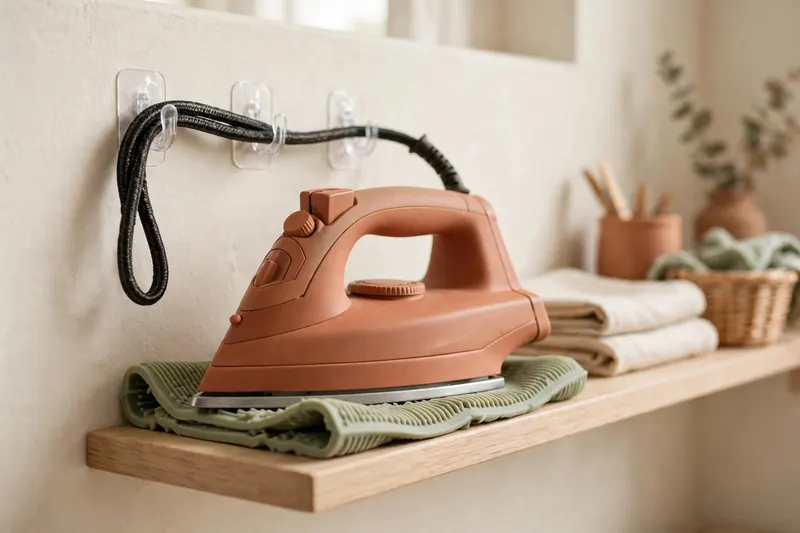
Every small apartment has one: the ironing board leaning in a corner, sliding down the wall at 2 a.m., or wedged behind the bedroom door where it catches every sleeve that passes. Too long for a shelf, too awkward for a drawer, and too useful to throw away. If you are hunting for small apartment ironing board storage ideas that work in a rental with no spare closet, this guide gives you 15 of them — from a five-dollar hook to a board that folds away into the wall — so your board finally has a real home of its own.
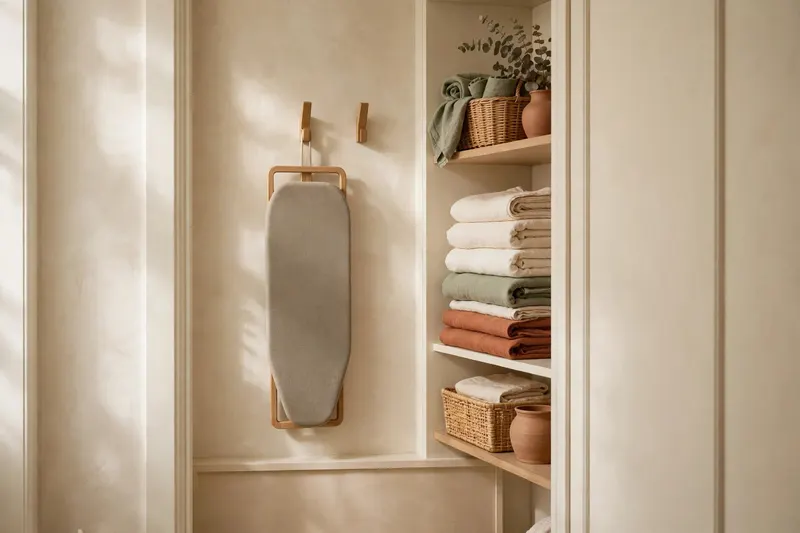
Measure the board: folded length decides the spot
Before you buy a single hook, measure the board. Most standard boards fold to about 48 to 54 inches long and 12 to 15 inches wide; compact and tabletop boards fold to roughly 30 to 38 inches. That folded length decides everything: a 54-inch board will not fit behind a standard door once the handle eats up the clearance, and it will not slide into a 20-inch gap beside the washer.
1. Measure the folded board first. Fold the legs flat and measure its length, its width at the widest point (usually the nose), and its thickness. Every option below only works if the spot is at least 2 inches longer and 1 inch wider than the board.
2. Measure the spot, not just the board. A 30-inch door gives you about 28 inches of usable width once the handle is accounted for. A gap beside the fridge might be 4 inches wide but only 40 inches tall. Check the height, width, and depth of any candidate spot before you commit.
Wall-mounted hooks and holders behind a door
A wall hook is the cheapest, fastest fix, and for most renters the only one they ever need. The board hangs vertically, flat against the wall, taking up about 4 inches of depth and no floor space.
3. Hang it on a pair of sturdy wall hooks. Two adhesive or screw-in hooks, spaced 18 to 24 inches apart, hold a folded board by its frame. Mount them at shoulder height behind a door or inside a closet. Choose hooks rated for at least 5 pounds each — a standard board weighs 4 to 7 pounds.
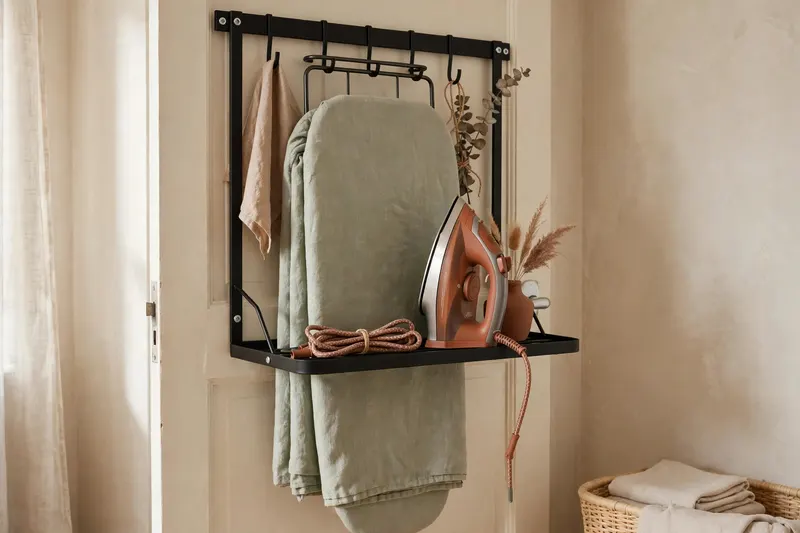
4. Use a wall-mounted holder with a built-in iron shelf. A metal holder cradles the board vertically and adds a shelf for the iron, spray bottle, and pressing cloth. Mount it inside the laundry closet or beside the washer, and the whole kit lives in one 15-inch-wide column.
Over-the-door ironing board racks
If you cannot or will not put holes in the wall, the back of a door is your best friend. Over-the-door racks use the door itself as the mounting surface, so they work in rentals and dorms with a strict no-drilling rule.
5. Hang an over-the-door ironing board rack. These racks hook over the top of a standard interior door and hold the board flat against its back face. Pick padded or rubber-coated hooks so it does not scratch the finish, and check the door still closes fully — a rack adding more than about 3 inches of depth can stop it from latching.
6. Pair the rack with a door-mounted iron caddy. Many racks include, or leave room for, a small wire caddy for the iron, spray bottle, and starch. Hanging the iron on the same door as the board means you never hunt for one half of the kit. For more ways to use the back of a door, see our Over-the-Door Organization Ideas for Every Room.
Fold-away and tabletop boards for the truly tiny
Sometimes the smartest storage idea is a smaller board. If your apartment has no wall space to spare and no door that can take a rack, a board designed to disappear beats any hook.
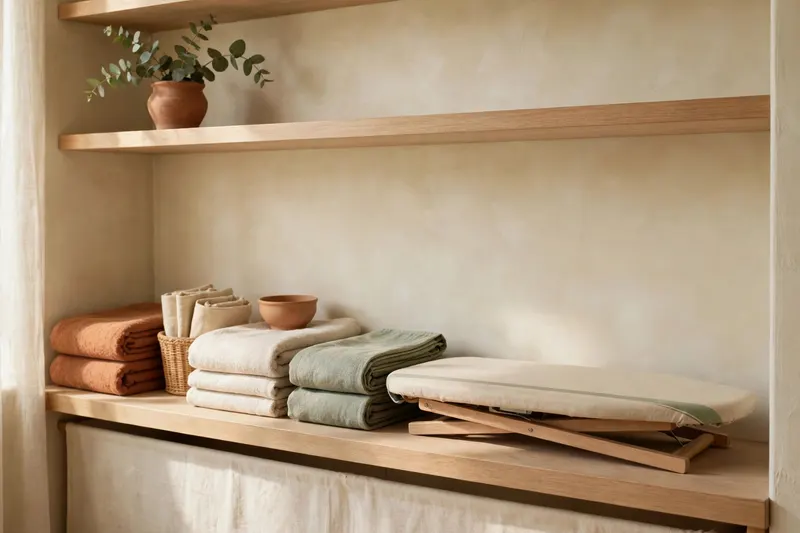
7. Switch to a tabletop ironing board. A tabletop board is about 30 inches long and sits on a counter, a desk, or the washer. It folds flat and slides into a drawer, under the bed, or onto a closet shelf. It will not handle full-length curtains, but for shirts, blouses, and kids’ clothes it is plenty — and it stores anywhere.
8. Install a fold-away wall-mounted board. These boards fold down from a wall-mounted cabinet and fold back up flush when you are done. They cost more than a standard board and need a solid wall or studs, so renters need written landlord permission. If you like furniture that folds away when the job is done, our 15 Folding Furniture Storage Ideas for Small Apartments covers the same trick for tables, desks, and drying racks.
Laundry closet: the natural home for board + iron
The laundry closet is where the board belongs. It is already where wrinkled clothes live, it usually has a door to hide the clutter, and it puts the board within arm’s reach of the washer and dryer.
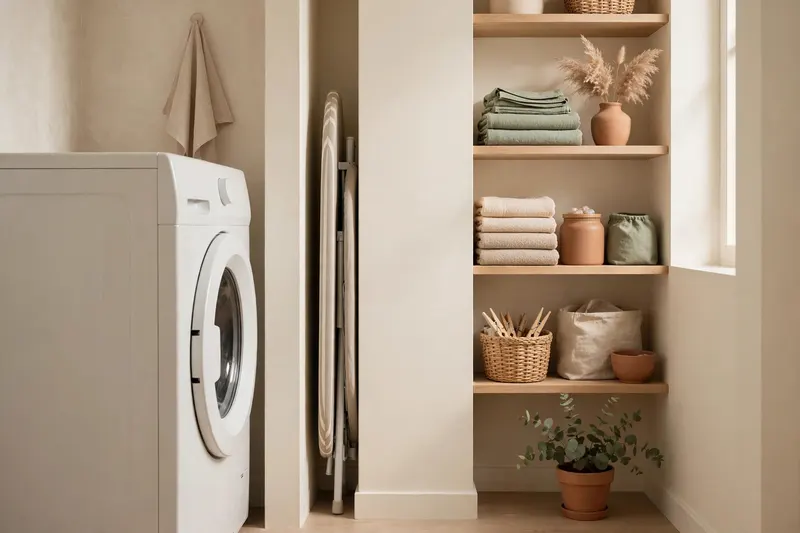
9. Give the board a dedicated slot in the laundry closet. Mount two hooks or a slim holder inside the closet door or on the side wall, and the board hangs out of sight but two seconds from use. Keep the slot at the front of the closet, not buried behind the detergent.
10. Build a one-column ironing station. Dedicate one narrow column of the laundry closet — about 15 inches wide — to the kit: board on a wall holder, iron on a heat-proof shelf, spray bottle and starch above. Our 16 Laundry Room Wall Organization Ideas shows how to stack that column so the kit shares the wall with the detergent.
Hiding it in plain sight: slim gaps and narrow slots
Not every board needs hardware. Apartments are full of slim, wasted gaps — beside the washer, between the wardrobe and the door frame, behind the bedroom door — that are exactly board-shaped.
11. Slide it into the gap beside the washer or dryer. Most laundry setups leave a 3- to 6-inch gap between the machine and the wall, and a folded board is about 2 to 3 inches thick, so it slides in nose-down. Add a felt pad where the board touches the wall to stop scuffs.
12. Claim the slot behind the bedroom or closet door. The space behind a door that opens against a wall is dead space, hidden completely when the door is open. Stand the board there nose-down, legs folded, and it vanishes. This works best on doors that stay open most of the time, and worst on the bathroom door, where steam rusts the frame.
The iron’s home: heat-proof storage that rides along
The board is only half the problem. The iron is heavy, hot, and oddly shaped, and it ends up on top of the dryer, on a shelf it can fall from, or in a drawer where its soleplate melts whatever it touches.
13. Store the iron in a heat-proof caddy attached to the board’s spot. A silicone rest, a metal caddy, or a heat-resistant pouch lets you put the iron away while it is still warm, right next to the board. Mount the caddy on the same wall, door, or closet column as the board so the two are never separated. Wait until the iron is cool before sliding it into a fabric pouch.
Renter-safe mounting that leaves no marks
Renters face one extra constraint: every hole in the wall is a deposit deduction waiting to happen. The good news is that most board storage needs no drilling.
14. Mount everything damage-free. Heavy-duty adhesive hooks rated for 5 to 7 pounds hold a folded board on painted walls, tile, and closet doors. Over-the-door racks need no hardware at all. A tension rod wedged inside a closet can hold a board upright between two shelves. For the rare spot where only screws will do, ask your landlord in writing first and fill the holes with white filler before you move out. Our 17 Renter-Friendly Closet Organization Ideas has more no-damage tricks for the same closets.
The 2-minute iron-and-put-away routine
Storage only works if putting the board away is faster than leaning it in the corner — so make it a routine so short it feels silly to skip.
15. Make put-away part of ironing, not a separate chore. When you finish a shirt, fold the board’s legs, hang it on its hook, set the iron in its caddy, and close the closet door — about two minutes, done while the iron cools. The trick is the order: board first, iron second, door last. If the board’s spot is more than ten steps from where you iron, move the spot.
Mistakes to avoid
Do not hang the board by its cover or nose alone — the cover tears and the board slides off. Do not store the board in the bathroom, where steam rusts the frame and mildews the cover. Do not buy a wall holder before measuring: holders sized for standard boards will not grip a compact board. Do not store the iron on top of the board — it slides off. And do not buy a second board before you have tried storing the one you own; most “I need a smaller board” problems are really “I need a hook” problems.
Frequently asked questions
Where is the best place to store an ironing board in a small apartment?
The back of a door or the inside of the laundry closet door. Both keep the board vertical, hidden, and within reach, and both work with renter-safe racks or adhesive hooks — no drilling required.
Can I hang an ironing board on the wall in a rental?
Yes, with damage-free mounting. Adhesive hooks rated for at least 5 pounds each, or an over-the-door rack, hold a standard board securely and leave no marks. Screwing a holder into a stud needs your landlord’s permission in writing first.
How do I store an ironing board without a laundry room?
Use the gap beside the washer, the slot behind the bedroom door, or a rack on the closet door. A tabletop board is the fallback for the smallest spaces — it folds flat enough to slide into a drawer or under the bed.
Will an over-the-door rack damage my door?
A well-made rack with rubber-coated or padded hooks will not damage a standard door. Avoid bare-metal hooks on painted doors, and check the door still closes and latches fully with the board hanging on it.
Can I store the iron while it is still hot?
You can set a warm iron on a silicone rest or in a metal caddy, but do not slide it into a fabric pouch or drawer until it is cool to the touch. A hot iron stored soleplate-down on wood or fabric will scorch the surface.
Your ironing board does not need a bigger apartment — it needs a fixed address. Measure it once, give it a hook, a rack, or a gap of its own, and keep the iron beside it. Pick one idea from this list, try it today, and save this pin for later — or browse more small-space fixes in our storage ideas.