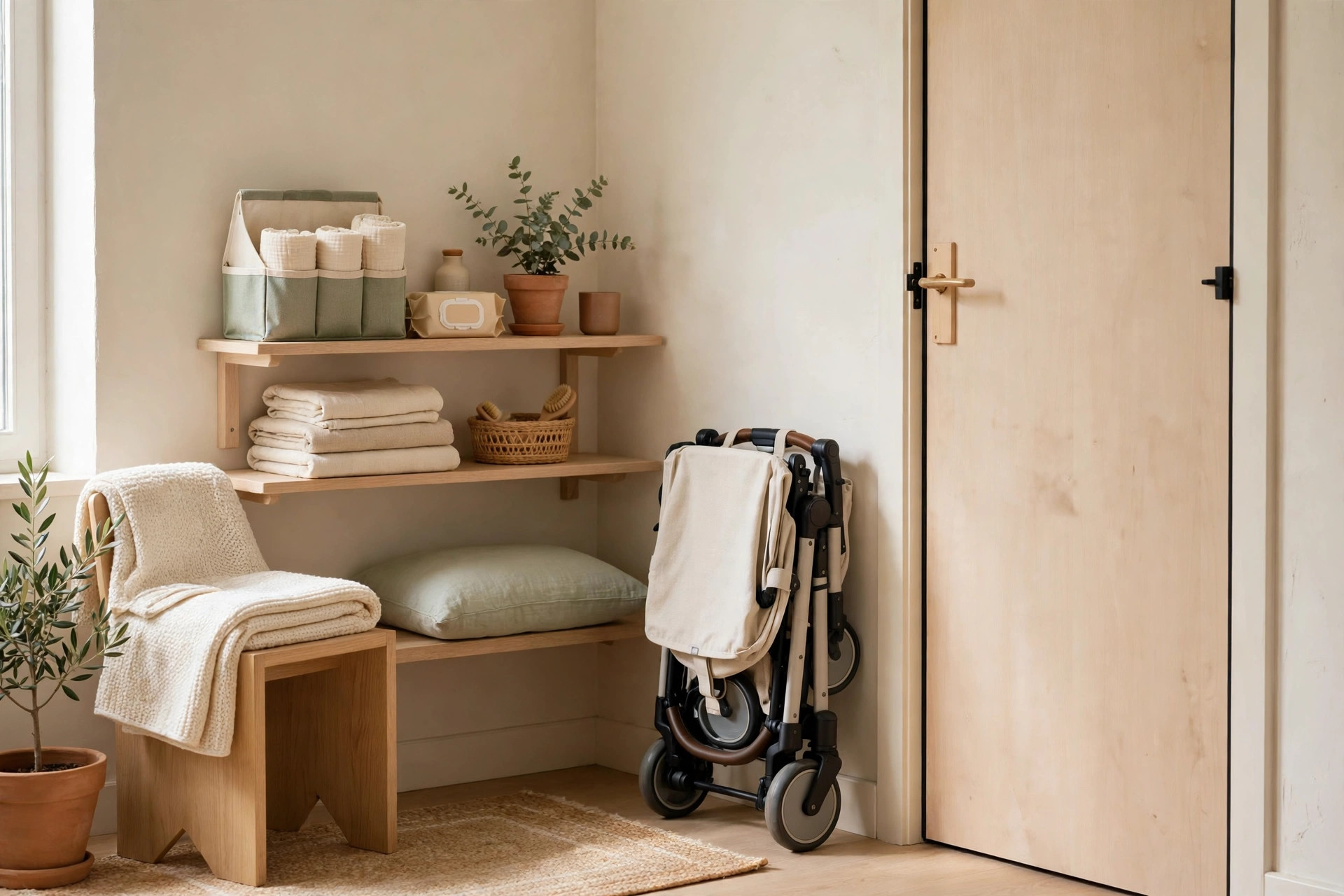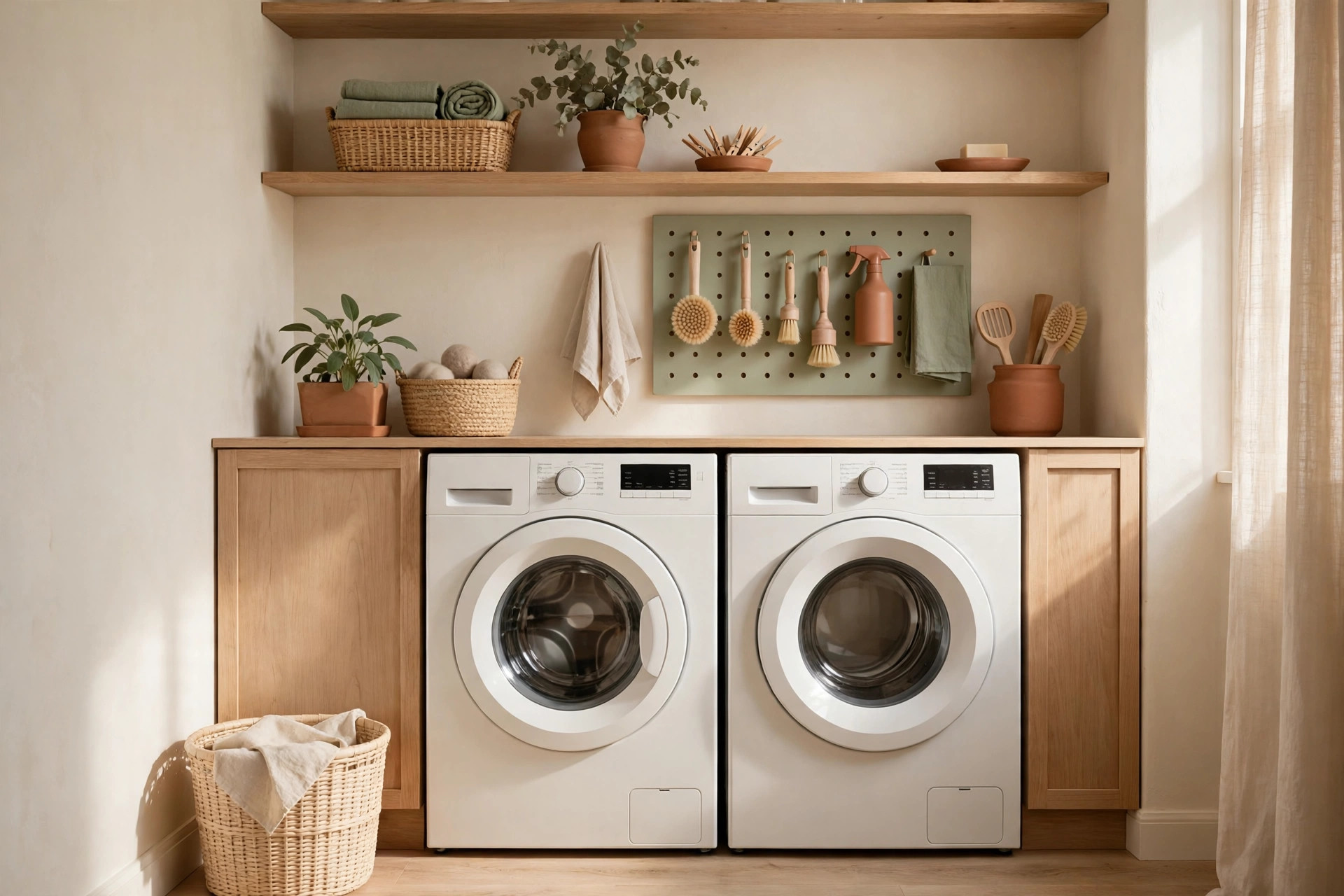
A small laundry room gives you almost nothing: two machines, a sliver of floor, and walls doing exactly nothing. When the floor is gone, the only direction left is up. These laundry room wall organization ideas turn blank drywall into shelving, tool storage, drying space, and folding surfaces — so the floor stays clear and every bottle, brush, and basket has a home. Work through the list from the big wins to the finishing touches, and your laundry wall will carry as much weight as a full closet. Every idea includes real measurements and renter-safe options, so you can pick what fits your space and start this weekend.
The Wall-First Rule for Laundry Spaces
The wall above the machines is about 54 to 60 inches wide with 24 to 36 inches of vertical space — roughly 9 to 12 square feet of storage. Rule: nothing goes on the floor until the walls are full.
1. Map your zones before you mount anything
Divide the wall into three zones: reach zone (machine top to 24 inches up — daily detergent and pods), lift zone (24 to 48 inches — stain removers, softener), and rarely zone (above 48 inches — bulk refills). Every idea below goes into the zone matching how often you touch it.
2. Claim the 6-inch side gap
That narrow strip between the machine and the side wall — usually 4 to 8 inches — is prime apartment laundry wall organization. A slim rail or two narrow magnetic strips hold stain sticks, a lint roller, dryer sheets, and measuring cups on hooks — under $15.
Shelves Above the Machines: What Belongs There
Laundry room wall shelves ideas work best shallow, sturdy, and capped at two tiers. Deeper than 12 inches over a top-loader becomes a reach problem; a third shelf becomes a climbing problem.
3. Install two 12-inch-deep solid shelves, not three narrow ones
Two shelves at 10 to 12 inches deep hold detergent, folded whites, and baskets — all reachable without a step stool. Mount the first about 18 inches above the machine tops, the second 12 to 14 inches above the first. Use brackets rated for at least 30 pounds per pair, driven into studs or toggle anchors — a gallon of detergent weighs about 8 pounds.
4. Corral shelf clutter with shallow trays, not tall bins
Open shelves turn messy because laundry products are tall and tippy. Give each category a low tray (2 to 3 inches high, sized to the shelf depth): wash products, stain treatment, fabric care. Trays catch drips from leaky caps and pull down in one motion. More tray strategies are in our 16 Small Laundry Closet Organization Ideas That Actually Fit.
Pegboards for Brushes, Tools, and Small Supplies
A pegboard is the highest-density small laundry room wall storage you can buy: a 2×4-foot panel holds 30 to 40 hooks and bins.
5. Hang a framed pegboard on the widest free wall
Choose a 24×48-inch board with a solid frame so hooks seat properly. Load by weight and frequency: the iron on double-prong hooks low, spray bottles and lint brushes in baskets at chest height, tiny items (stain pens, dryer balls in a mesh bag) on hooks up top. Keep total load under 50 pounds on two studs.
6. Dedicate one narrow strip to the laundry toolkit
An 8-inch-wide pegboard strip beside the machines or inside the laundry-room door works like a toolkit: scissors, a seam ripper, spare buttons in a pouch, a fabric shaver, a brush set. It fits walls too tight for a full board.
Wall-Mounted Drying Racks and Retractable Lines
In a small laundry space, a freestanding drying rack eats half your floor. Wall-mounted drying is the single biggest floor-space win on this list.
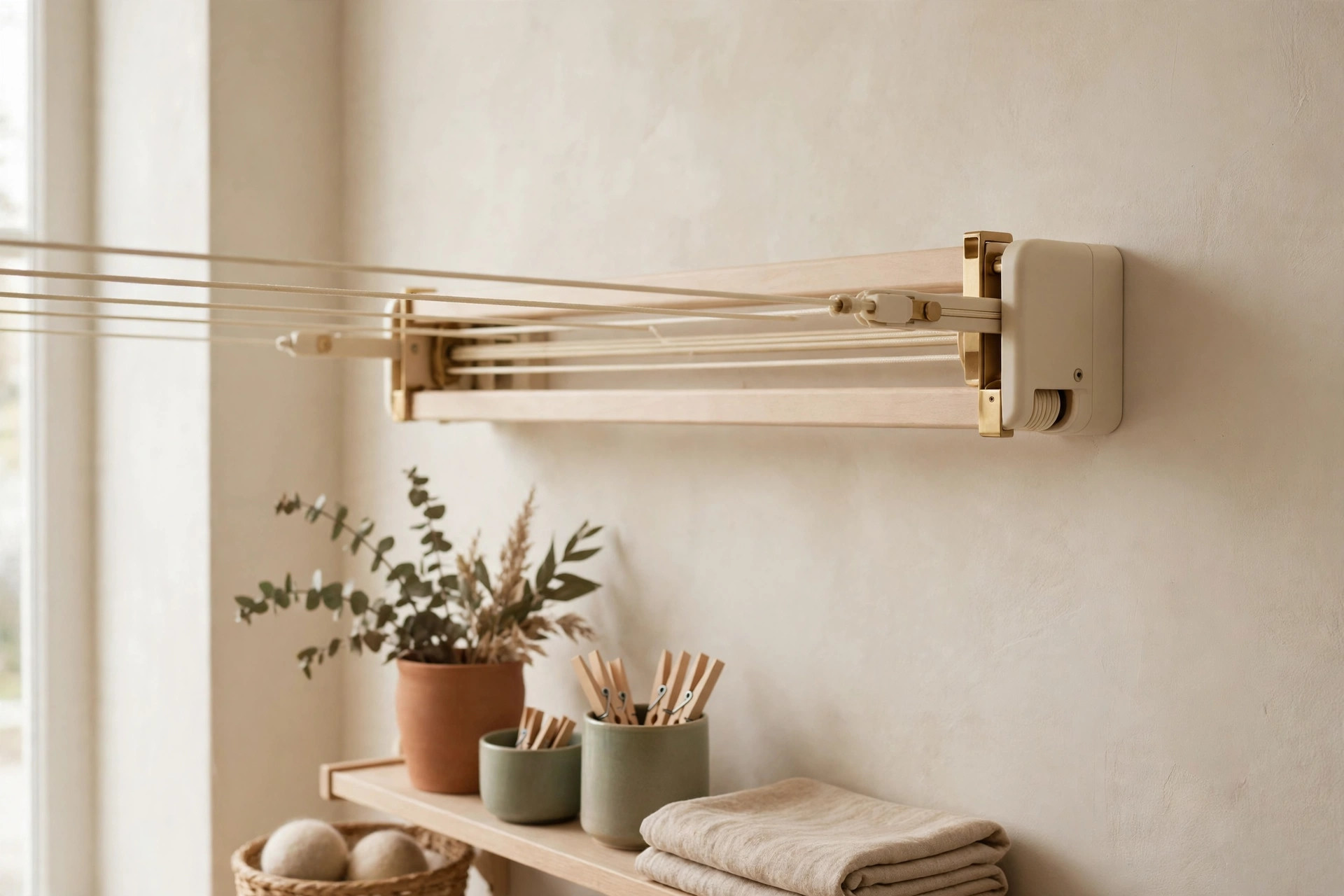
7. Mount an accordion-style wall rack for daily items
An accordion rack folds flat at about 4 inches deep and pulls out to roughly 24 inches when loaded. Mount it at chest height — 48 to 54 inches off the floor — over a washable section of wall, because damp clothes drip. One medium rack holds a full load of delicates, then folds flat again.
8. String a retractable clothesline across the narrow dimension
A retractable unit mounts on one wall, hooks to the other, and gives you up to about 15 feet of line before disappearing into a small housing when done. For rooms under 40 square feet this is the best drying solution — air-dry, then the wall is blank again. If your space has no dryer, see 17 Small Laundry Drying Solutions for Apartments (No Dryer, No Yard).
Ironing Board and Mop Storage on the Wall
Long, awkward tools are why small laundry rooms feel cluttered — they lean in corners, slide behind machines, and eat the corner you needed for the basket.
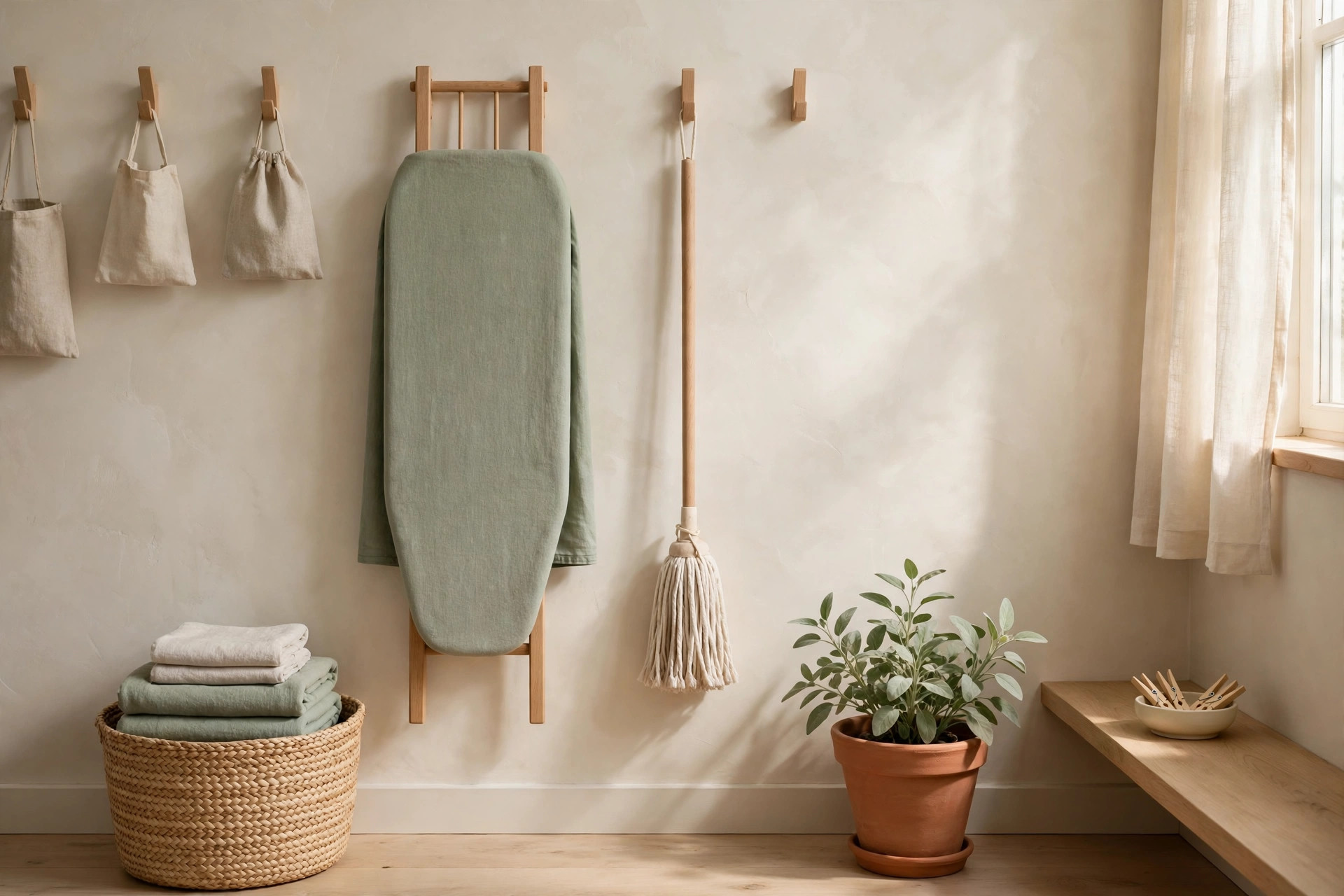
9. Hang the ironing board vertically on a T-slot hook
A T-slot wall hook grips the board’s nose and holds it flat against the wall in about 5 inches of depth. Mount it around 50 inches high, where the nose clears the machine tops — the board stops migrating and stays one-handed grabbable.
10. Get mops and brooms off the floor with a gripper rail
A three-slot gripper rail (about 13 inches long) mounts at shoulder height and holds a mop, broom, and duster in one footprint. Put it on the wall with the most ventilation — near the door or a vent, never inside a closed cabinet — because wet mop heads need airflow. More no-drill vertical tricks: Over-the-Door Organization Ideas for Every Room.
Fold-Down Counters and Tables
Counter space is the rarest thing in a small laundry room. A fold-down surface gives you one exactly when you need it and returns the floor when you do not.
11. Mount a fold-down table for a folding station
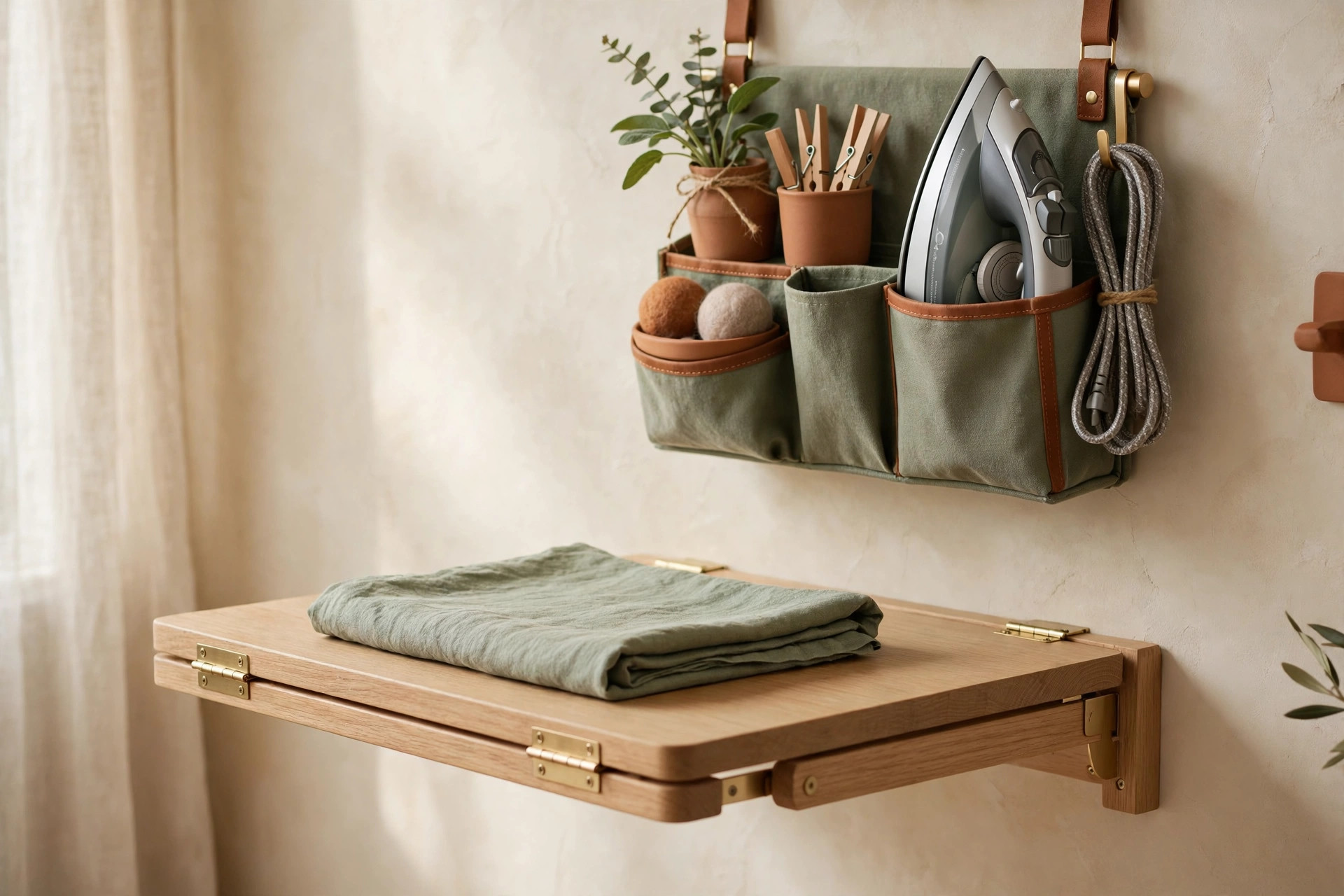
A wall-mounted drop-leaf table, 24 inches deep by 36 inches wide, folds up to 2 inches thick and drops to a full folding surface in seconds. Mount it at 36 inches (counter height) on the wall opposite the machines, or above front-loaders with 20 inches of clearance. Rated brackets handle 50-plus pounds. Rule: folding-only — the moment it becomes a storage shelf, it stops folding.
12. Add a narrow fold-down shelf as a pre-treat ledge
An 8-inch-deep folding bracket shelf, about 24 inches long, mounted at 42 inches beside the washer becomes your sorting and stain-treatment station: a small caddy with stain remover, a brush, and a white cloth. Sort, treat, move on — zero extra furniture.

Renter-Safe Mounting That Holds Laundry Weight
Drilling is not always an option, but renter-safe does not have to mean weak — it means matching the mount to the load.
13. Use toggle bolts for shelves; strips for light stuff only
The honest load math: large adhesive strips top out around 4 to 7 pounds per strip in ideal conditions, and humidity cuts that. Strips are fine for hooks, labels, and light baskets — never for shelves holding detergent. For load-bearing mounts in a rental, use toggle bolts: 50 to 100 pounds each, and the quarter-inch hole patches in five minutes with spackle at move-out.
14. Anchor heavy-duty items to studs, no exceptions
When a shelf will carry detergent or a rack will carry wet clothes (wet laundry weighs roughly twice as much as dry), find the studs and use them. A magnetic stud finder locates drywall screws in about two minutes — mark them with painter’s tape first.
Labels and the Weekly Laundry Reset
Wall storage only stays organized if you can see what goes where at a glance. Labels and a five-minute reset do that job.
15. Label every shelf, tray, and pegboard zone
Label each tray, basket, and shelf edge: “Detergent + Pods,” “Stain Treatment,” “Drying Supplies,” “Bulk Refills.” Use a label maker or waterproof chalk labels — laundry rooms are humid, and paper stickers curl off within a month.
16. Run a five-minute weekly laundry reset
Pick a consistent day, then: return anything that migrated to the machine tops to its labeled spot, wipe shelf edges and trays with a damp cloth, check that hooks and brackets are still tight, and toss empties into recycling. Five weekly minutes keep the system organized for years.
Mistakes to Avoid
Mounting heavy shelves with adhesive strips. Strips are rated for picture frames, not gallons of detergent. Shelves fall, bottles break, and the wall damage is worse than a toggle-bolt hole.
Going three shelves deep. A third tier is too high to reach and too deep to see — it becomes a dust shelf. Two solid shelves beat three useless ones.
Blocking machine access with a drying rack. Sketch the rack’s pull-out arc before drilling so it never blocks the washer door or lint-trap access.
Drying in an airless corner. A wall rack in a closed, unventilated corner grows musty smells. Crack a vent or leave the door open.
Storing daily items in the rarely zone. If you climb for detergent every wash day, the system is upside down. Daily products belong at waist-to-eye level.
Frequently Asked Questions
How much weight can laundry room wall shelves hold?
Brackets into studs hold 30 to 50 pounds per pair — enough for detergent and folded laundry. Toggle bolts hold 50 to 100 pounds each. Adhesive strips hold 4 to 7 pounds and suit only light hooks and labels. When in doubt, mount to studs.
Can I organize a laundry room wall without drilling any holes?
Yes, for light loads. Adhesive strips handle hooks, small baskets, and labels; over-the-door organizers and slim carts cover the rest. But shelves, drying racks, and fold-down tables need real anchors — no renter-safe shortcut holds 30-plus pounds of wet laundry.
Where should a wall-mounted drying rack go in a tiny laundry room?
On the wall with the best airflow, at 48 to 54 inches high, where a pulled-out rack never blocks the washer or dryer doors. Over tile or a vinyl backsplash panel is ideal because damp clothes drip.
What is the best way to store an ironing board in a small laundry room?
Hang it vertically on the wall with a T-slot hook or purpose-built hanger — about 5 inches of depth, one-handed access, corner freed. Renters get the same effect from an over-the-door holder with zero holes.
How do I keep laundry room wall shelves from getting dusty and sticky?
Use washable trays under bottles, wipe edges during your weekly reset, and keep shelving to two tiers. Closed baskets for powders and pods cut dust at the source.
Conclusion
Small laundry spaces do not need more room — they need walls that work as hard as the machines. Shelves above the washer, a pegboard for tools, a drying rack that folds flat, and mounts that actually hold the weight will free your floor. Start with the two ideas that fit your wall today and add the rest one weekend at a time. For more ways to make a tiny home carry more, save this pin for later and browse the small spaces collection next.