Fishing gear is the worst kind of apartment clutter. Rods are six to nine feet long, tackle multiplies every time you visit a shop, and waders come home wet, muddy, and smelling like the river. Without a garage, it all ends up leaning in a corner or draped over a chair until someone trips over it. These small apartment storage ideas for fishing gear fix that with vertical rod racks, a labeled tackle wall, a real drying zone, and a grab-and-go kit — so the whole setup fits in one closet corner and you can be out the door in five minutes. Below are 15 small apartment storage ideas fishing gear owners can use without a garage, a basement, or a shed.
The gear audit: rods, reels, tackle, and waders — what you really use
Before buying a single hook or bin, lay everything out and sort it into four piles: rods, reels, tackle, and waders. Most anglers find rods they never touch and lures for fish they stopped targeting years ago.
1. Keep only the rods you fished with in the last year
If a rod has not left the apartment in twelve months, it is decoration, not gear. Keep two or three working rods — one spinning setup, one baitcasting or fly setup, and one backup — and sell, gift, or donate the rest.
2. Count tackle by trip, not by box
Empty every tackle box onto a towel and sort lures, hooks, and line into “used last season” and “not used in two seasons.” Most anglers keep 40 to 60 percent more tackle than they fish with. Bag the unused half for a high shelf or pass it on; what stays should fit in one medium tackle bag, about 14×9×9 inches.
Vertical rod storage: wall racks and ceiling mounts that save floor
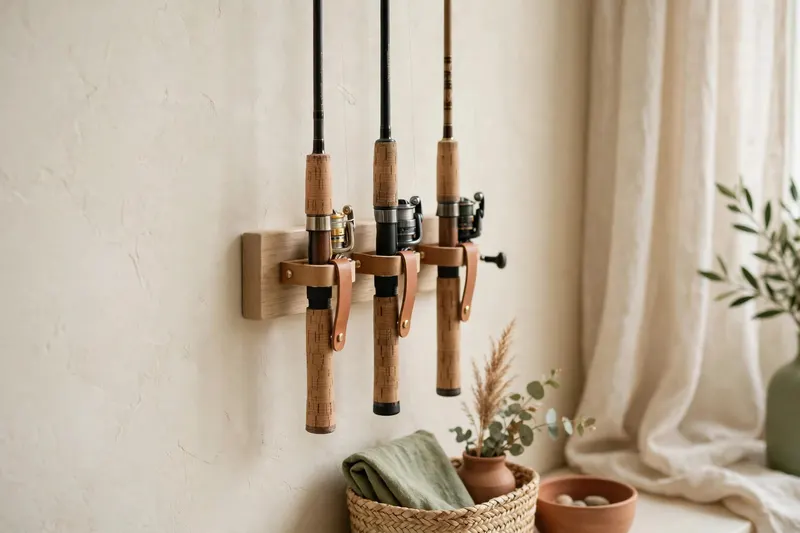
Rods stored horizontally eat floor space and snap; stored vertically, they take up almost none. A 7-foot rod leaning in a corner occupies about 2 square feet of floor, but in a vertical wall rack it takes about 4 square inches of wall.
3. Mount a vertical rod rack on one closet wall
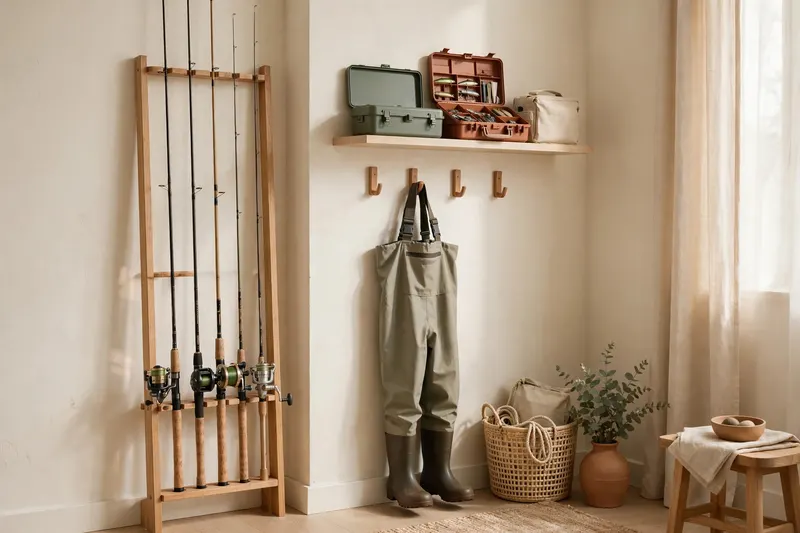
A wall-mounted vertical rack holds rods upright by the butt, with tips secured in a top cradle. A 6-rod rack is roughly 24 inches wide and 30 inches tall, and it mounts with two screws — or, for renters, heavy-duty adhesive strips rated for 10 pounds or more, since a rack with three rods weighs under 8 pounds. Keep rod tips at least 6 inches below the ceiling so you can lift rods out without scraping them.
4. Hang rods from the ceiling in a hallway or over a door
When wall space is gone, use the ceiling. A ceiling rod rack — two parallel foam-lined rails mounted 24 to 36 inches apart — holds rods horizontally overhead, best in a hallway or above a closet door with at least 8 feet of clearance. A pair of rails costs roughly $25 to $40 and holds four to six rods; keep it at least 12 inches clear of light fixtures. The same overhead logic works for bike storage ideas for small apartments, where long, awkward gear goes up instead of out.
5. Use a freestanding rod stand for a renter-safe corner
If you cannot drill and cannot use adhesive, a freestanding rod stand is your answer. These weighted-base stands hold four to eight rods upright in a 12-inch-diameter footprint and tuck into the corner behind a door or beside a wardrobe. Pick one with a rubberized base and individual slots, not a single open tube — slots stop rods from clacking together and chipping guides.
Tackle organization: small boxes, labels, and one box per trip
Tackle is where apartment fishing storage goes wrong: small parts in unlabeled boxes become a junk drawer within a month. Use small containers, visible labels, and a hard limit — one working box per trip type.
6. Build a pegboard tackle wall inside a closet door
A 24×36-inch pegboard on the inside of a closet door turns dead space into your tackle station. Hang small clear bins for hooks and swivels, peg hooks for pliers, line clippers, and leader spools, and a small shelf at the bottom for your working tackle box. Label every bin — “Size 6 hooks,” “3/8 oz jigs,” “Leaders 12 lb” — with a label maker or masking tape and a marker.
7. Switch to small, stackable, labeled tackle boxes
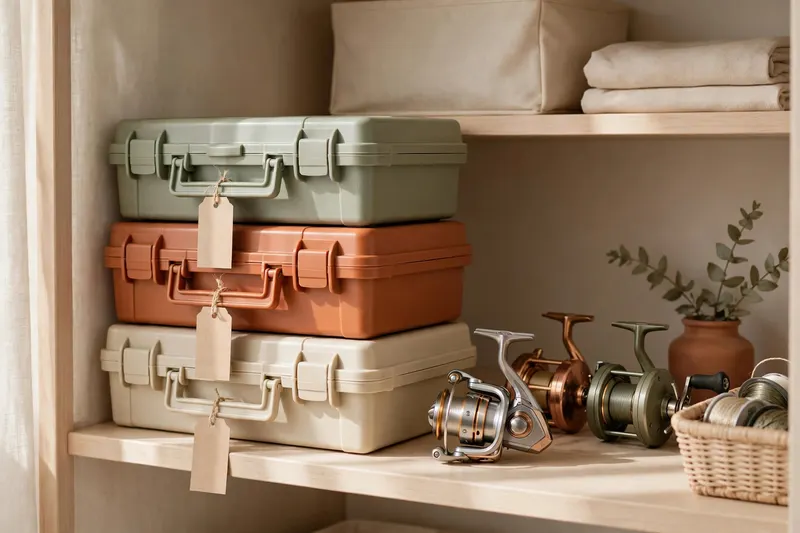
One giant tackle box is a trap in a small apartment: it is heavy, wastes vertical space, and finding one jig means dumping the whole tray. Replace it with three or four small boxes, each about 11×7×2 inches, one per fishing style — bass lures, panfish and trout, terminal tackle. Stack them on a single shelf, spines facing out, with the contents written on the spine.
8. Follow the one-box-per-trip rule
For any single trip, take exactly one small tackle box, chosen for that water and that species. Load it from your wall stock the night before and return anything unused afterward. This stops the slow creep where every trip adds a new box to the pile by the door. The same grab-and-go logic works for camping gear storage in a small apartment, where one packed kit beats a closet full of maybe-someday supplies.
Waders and boots: drying, drip zones, and smell control
Waders are the smelliest part of the kit: they trap moisture, and wet boots breed odor in a closed closet within a day. Waders need air, a drip zone, and a drying routine — not a dark corner.
9. Hang waders upside down on wide hooks with a drip tray below
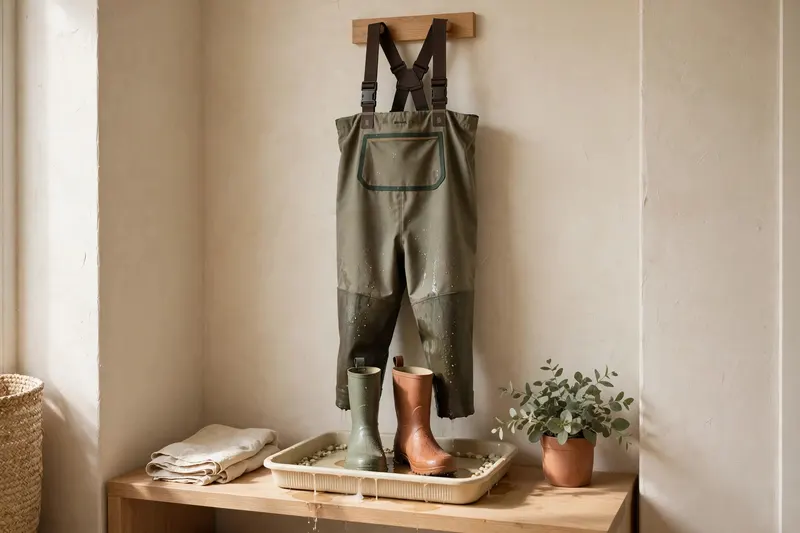
Hang waders by their boot feet from two wide, padded hooks mounted about 18 inches apart on a closet wall or the back of a door, so the legs hang straight down and air circulates inside. Never fold waders in half — repeated creases crack the waterproof membrane at the fold line. Put a boot tray or shallow tub (about 24×16 inches) underneath to catch drips.
10. Build a boot drying station with a fan and odor control
Fishing boots need airflow, not just time. Set a small USB fan — about $10 — on a shelf aimed at the boots and run it for two to three hours after a trip. Stuff boots with newspaper or cedar shoe inserts overnight, then remove the stuffing in the morning so air can finish the job. Never store boots in a sealed bin while damp: sealed plus wet equals mildew in about 48 hours.
The grab-and-go kit: one bag that holds a whole fishing trip
The grab-and-go kit is the payoff: when rods, tackle, and waders each have a home, the trip becomes one bag you can lift off a hook and carry out the door.
11. Pack one bag with rod, reel, tackle box, and license
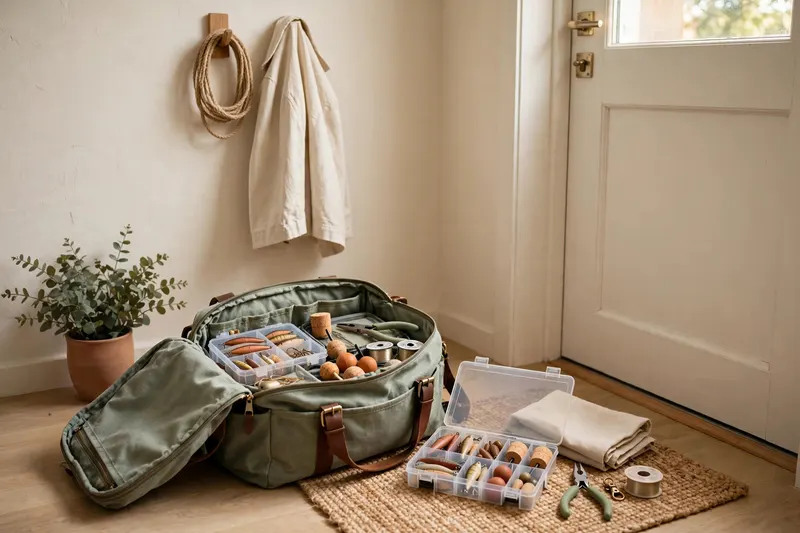
Use a single rod-and-reel sling bag or a 30-inch duffel as your trip bag. It holds one rod (broken down or in a rod tube), one reel, your one-box-per-trip tackle box, line clippers, pliers, a small first-aid kit, sunscreen, and your fishing license in a zip pocket. Keep the bag packed between trips so the only pre-trip job is checking the tackle box and grabbing the waders. Hang it on a heavy-duty hook beside the rod rack, at shoulder height.
Balcony and closet corners: what can live outside safely
Not everything needs to live inside. A balcony can hold bulky, weather-tolerant gear — but only the right items, stored the right way. Anything with fabric, foam, or electronics stays indoors.
12. Store only hard, sealed gear on the balcony
A weatherproof deck box (about 30×20×20 inches) on the balcony can hold your landing net, a folding stool or bucket seat, a bait cooler, and spare line spools in sealed zip bags. These are plastic, metal, or sealed, and they tolerate temperature swings. Never store rods, reels, waders, or tackle boxes on a balcony: UV light degrades rod blanks and line, humidity corrodes reels, and temperature swings crack wader seams. For more on weatherproofing a balcony setup, see our apartment balcony storage ideas.
13. Claim one closet corner and defend it with zones
Give fishing gear exactly one corner of one closet — not the whole closet, not a shelf here and a hook there. Inside that corner, mark three zones: rods on the wall (vertical rack), tackle on a shelf (stacked small boxes), and waders on hooks with a tray below. A strip of painter’s tape on the shelf edge, labeled “FISHING ONLY,” stops other household items from colonizing the space.
Keeping gear clean and dry between trips
Gear that is clean and dry lasts years longer and smells like nothing — which matters when it lives in your bedroom closet. Skipping the routine is what turns a storage system into a smell problem.
14. Rinse, wipe, and air-dry everything within 24 hours
Within a day of every trip, rinse rods and reels under fresh lukewarm water, wipe them dry with a microfiber cloth, and leave them out for two hours before they go back on the rack. Wipe tackle boxes dry before stacking them, and check hooks for rust — a rusted hook in a closed box spreads rust to its neighbors. Oil reel handles with one drop of reel oil every three or four trips, and replace monofilament line after a full season. For a renter-safe version of the whole setup, the no-drill tricks in our renter-friendly storage ideas for small apartments work just as well for a rod rack as they do for a shelf.
The post-trip reset: rinse, dry, and re-pack in 20 minutes
The post-trip reset is the habit that keeps the other fourteen ideas working: returning gear must take less time and effort than dumping it in a pile.
15. Run a 20-minute reset the same evening you get home
Set a timer for 20 minutes and run the same sequence every time: rods rinsed and back on the rack (5 minutes), waders rinsed and hung over the drip tray with the fan on (5 minutes), tackle box checked — restock what you used, toss rusted hooks — and back on the shelf (5 minutes), boots stuffed with newspaper and set on the tray (3 minutes), trip bag re-packed and hung by the door (2 minutes). Never skip the rinse — one skipped rinse after a saltwater trip can cost you a reel.
Mistakes to avoid
Storing rods horizontally across a closet. They roll, they tangle, and the tip section snaps the first time something shifts.
Buying a giant tackle bag “for growth.” A 20-inch tackle bag becomes a junk drawer with a zipper.
Sealing damp waders in a plastic bin. Trapped moisture grows mildew in two days and the smell never fully leaves neoprene.
Hanging rods by their tips. Tip-mounted storage puts the rod’s whole weight on its thinnest section.
Storing reels with the drag tightened. A tight drag compresses the drag washers permanently.
Keeping “someday” gear. The rod you have not used in two years is not a backup, it is clutter with sentimental value.
Frequently asked questions
Can I store fishing rods in a small apartment without drilling?
Yes. A freestanding rod stand holds four to eight rods in a 12-inch footprint with no drilling, and heavy-duty adhesive strips rated for 10 pounds or more can hold a light vertical rack on a closet wall. Test one strip first — some paints peel.
How do I keep fishing gear from smelling in an apartment?
Rinse waders and boots after every trip, hang waders upside down with air circulating, run a small fan on boots for two to three hours, and never store anything damp in a sealed container. Baking soda on the shelf and cedar inserts in boots handle residual odor. For stubborn smells, use a wader-specific cleaner, never regular detergent.
What is the best way to store fishing rods in a closet?
Vertically, butt-down in a wall rack or freestanding stand, with tips in a cradle at least 6 inches below the ceiling. Keep the rack on the closet’s side wall so it does not block hanging clothes.
Can fishing gear be stored on a balcony?
Only hard, sealed items: landing nets, folding stools, bait coolers, and line spools in zip bags inside a weatherproof deck box. Rods, reels, tackle, and waders must stay indoors — UV light, humidity, and temperature swings damage them.
How much space does fishing gear really need in a small apartment?
One closet corner, roughly 2 feet wide and 2 feet deep, holds three rods on a wall rack, four small tackle boxes on one shelf, waders on two hooks, boots on a tray, and a packed trip bag.
Conclusion
Fishing gear fits in a small apartment when it goes vertical, gets labeled, and dries properly — a wall rack for rods, small boxes for tackle, hooks and a drip tray for waders, and one packed bag for the trip. Run the 20-minute reset after every outing, and the system holds itself together. Browse more ideas in our small spaces category and save this pin for later.