A guitar leaning against the sofa, cables snaking across the rug — in a small apartment, music gear spreads fast. The problem is not that you own too much. It is that instruments are bulky, fragile, and used every day, so they never stay where you put them. The small apartment storage ideas musicians actually use are simple: wall mounts that get instruments up and safe, one small practice corner that holds everything you reach for, and cable control that ends the daily tangle. Every idea below works in a rental, needs no renovation, and uses gear you probably already own.
The gear audit: what you play daily vs what can live away
Before you buy a single hook, lay everything out and sort it into three piles: daily players, weekly players, and everything else. The daily pile is the instrument you touch most days plus the one cable, tuner, and stand it needs.
1. Give every instrument a named home
Write down one spot per instrument — “guitar: wall hook by the window,” “violin: case on the top shelf” — and stick to it for two weeks.
2. Audit by touch, not by guilt
Keep the instruments you actually played in the last month within reach; move the rest to a higher shelf, under the bed, or into a closet.
Wall-mounted instruments: guitars and cases up and safe
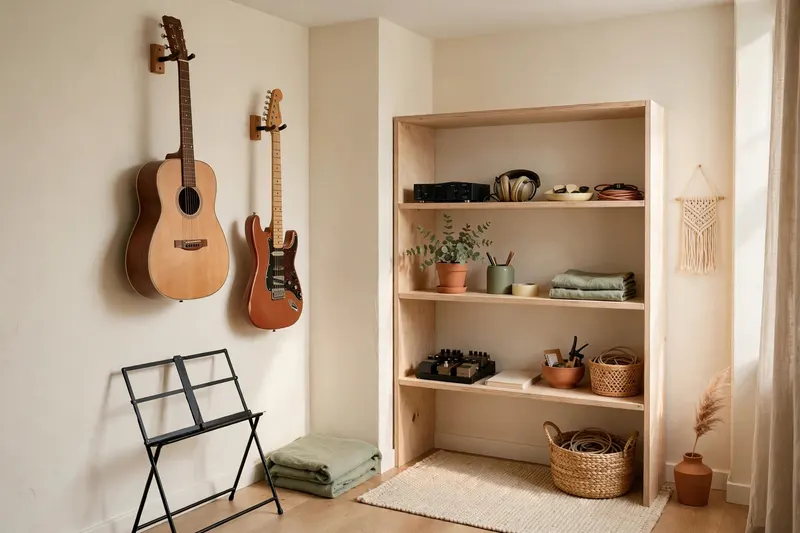
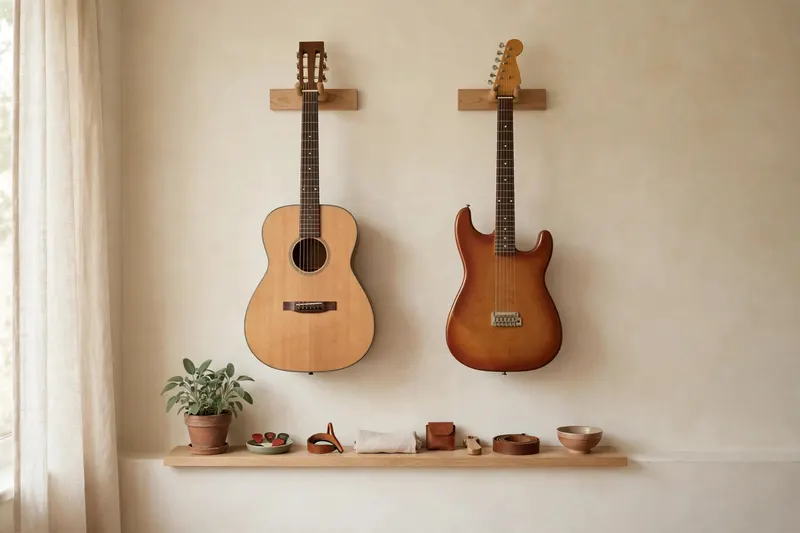
Wall storage is the single biggest win for musicians in small apartments: instruments are tall and thin, the shape that wastes floor space and fits a wall perfectly. A guitar on a padded hanger takes up zero floor and is safer than leaning against furniture. If you search for instrument storage apartment ideas, most guides start with wall mounts — for good reason.
3. Mount guitars on padded, locking wall hangers
Choose hangers with a padded cradle and a pivoting arm that closes around the neck, so the guitar cannot bounce out if someone brushes past. Space hangers 12 inches apart, and hang your main guitar at shoulder height.
4. Store cases vertically on a narrow shelf, not stacked on the floor
Stand cases upright in a row on a 12-inch-deep shelf or in a tall, narrow cubby, spines out, like books. A bookend or tension rod keeps them from dominoing when you pull one out. The same vertical logic works for any tall, awkward gear: the approach in 15 Bike Storage Ideas for Small Apartments (No Garage Needed) shows how it frees floor space.
The practice corner: one chair, one stand, one small footprint
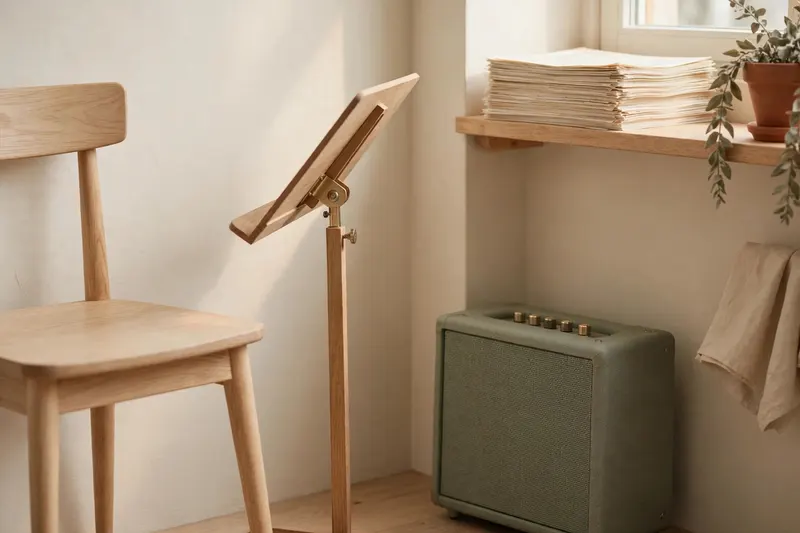
A practice corner is not a room — it is a zone about 4 feet wide and 3 feet deep, and it works because everything you need lives inside it. Pick the corner with the best light and commit to it.
5. Build the corner around one armless chair and a folding music stand
An armless chair (or a piano bench, or a stool with a footrest) lets you hold a guitar or violin without armrests pushing your elbow out. Add a folding wire music stand and a 12-inch shelf at elbow height for your tuner and phone.
6. Anchor the corner with a small rug and a wall hook for the instrument
A 3-by-5-foot rug marks the zone so housemates know where the gear lives, and it protects the floor from stand feet and case corners. A single wall hook right above the chair means the instrument goes from hook to hands in seconds.
Cable and accessory control: the tangled mess, solved
Cables multiply when you are not looking. One guitar needs a cable, a tuner, a capo, and picks; add an amp and you add a power cable, a patch cable, and a power supply. The fix is not a bigger drawer — it is fewer cables in play and a fixed home for each one.
7. Coil cables with the over-under method and hang them on labeled hooks
The over-under coil (alternate one loop over, one loop under) keeps a cable from twisting into knots and doubles its life. Hang each coiled cable on its own labeled hook inside a closet door or on a pegboard. It is the cheapest music gear storage small space fix there is.
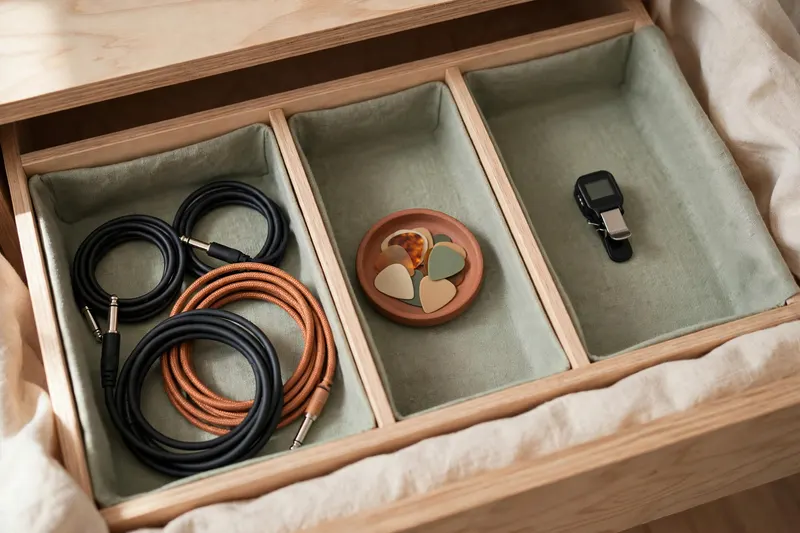
8. Keep accessories in one small divided box, not five small piles
A single 10-by-6-by-4-inch divided craft box holds picks, capos, tuners, spare strings, rosin, reeds, and valve oil with one home per compartment. The same cable discipline that keeps a media console calm works here: 15 Small Apartment Media Storage Ideas for TVs, Consoles, and Cables covers cable routing and labeling in detail.
Sheet music and books: slim shelves and binders that fit
Sheet music is the quiet clutter of a musician’s apartment: loose pages breed, method books are thick, and a stack on the piano is always one bump from the floor. Keep this week’s music within arm’s reach of the practice corner and move the rest to a shelf.
9. Use one binder per project, with tab dividers for sections
A 1.5-inch three-ring binder holds roughly 100 pages of sheet music and fits upright on a 10-inch-deep shelf. One binder for your current pieces, one for technique and scales, one for the band setlist — and that is the limit.
10. Install one slim picture ledge for current music, not a deep shelf
A 3-inch-deep picture ledge mounted at eye level beside the practice corner holds the open book or the week’s sheet music at a readable angle, and it is too shallow to become a dumping ground. The same slim-shelf and rotation ideas in 18 Small Apartment Book Storage Ideas (No Bookshelf Required) work word for word for sheet music.
Amps and pedals: stacking, hiding, and quick setup
Amps are the heaviest, bulkiest part of a musician’s setup, and pedals are the smallest and easiest to lose. The goal is a setup you can be playing through in under a minute and packed away in five.
11. Give the amp a permanent low spot with ventilation on all sides
A small practice amp (5–20 watts) fits on the bottom shelf of a bookcase, on a low rolling plant stand, or on the floor beside the practice corner — but never inside a closed cabinet while it is on, and never with less than 2 inches of air space on every side. A rolling stand is the renter-friendly winner: wheel it out to play, back to live.
12. Keep pedals on one small board with a single power supply
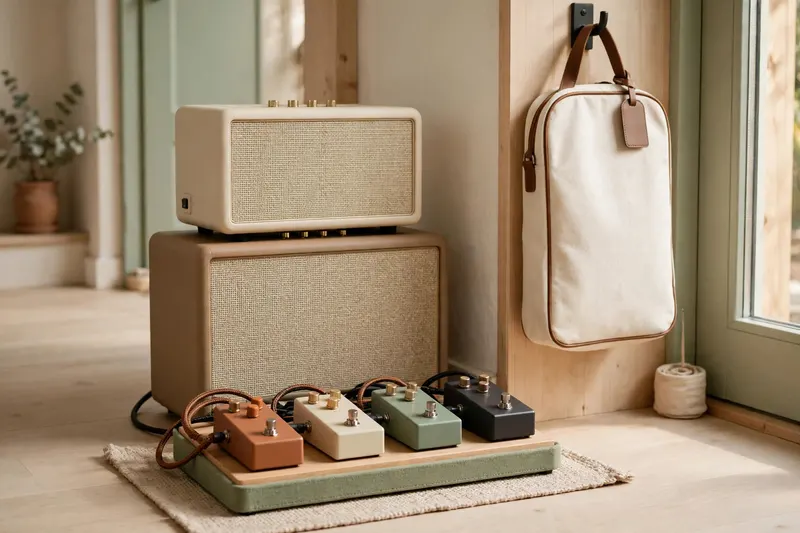
A pedalboard the size of a laptop (roughly 14 by 10 inches) holds three to five pedals and one power supply, and it moves as a unit: pick it up, plug in one cable to the amp and one to the guitar, and you are playing. Store the board upright beside the practice corner.
Sound-friendly storage: keeping gear safe from heat and humidity
Instruments are wood, glue, and strings, and all three react to the room they live in. Very dry air (below about 40 percent relative humidity) can crack a guitar top, while damp air (above about 60 percent) swells wood and dulls strings. Radiators, sunny windows, and steamy bathrooms all sit within a few feet of your gear in a small apartment.
13. Keep instruments away from radiators, sunny windows, and the bathroom door
The safe zone is an interior wall, out of direct sun, at least 3 feet from any radiator or heating vent, and nowhere near the bathroom.
14. Use a case humidifier in dry months and a cheap hygrometer year-round
A small soundhole humidifier costs a few dollars, sits inside the guitar or the case, and keeps the wood near 45–50 percent humidity through winter heating season — refill it about once a week. A $10 digital hygrometer on the shelf tells you the room’s actual humidity.
The 5-minute pack-up: gig-ready without the living-room explosion
Everything above only works if putting it away is fast. The pack-up is a routine, not a decision: same order, same spots, every time. When you finish playing, the instrument goes back on its hook, the cable gets one over-under coil and goes on its hook, and the picks go back in the divided box.
15. Pack a grab-and-go gig bag by the door, not in the closet
Keep one bag by the entryway with the gig essentials: a spare cable, a tuner, picks, a capo, a set of strings, and a copy of the setlist. Restock it after every gig, not before the next one.
Mistakes to avoid
The most common mistake is buying storage before doing the audit: a wall full of hooks for instruments you never play. Buy after you know what lives where. Second, never lean a guitar against furniture or a wall — it slides, it falls, and a headstock crack costs far more than a $15 hanger. Third, do not store instruments in a hot car, a damp basement storage cage, or on top of a radiator. Finally, do not hide your daily instrument in a closet: an instrument you cannot see is an instrument you stop playing.
Frequently asked questions
How can I store a guitar in a small apartment without drilling?
Use a freestanding guitar rack, a leaning ladder shelf with a padded hook, or a tension-mounted vertical pole with instrument hangers. A folding A-frame floor stand also works.
Can I hang instruments on the wall in a rental apartment?
Usually yes. Small screws into a stud leave holes the size of a picture hook, and most leases allow those. If your lease bans all holes, use adhesive-backed hangers rated for the instrument’s weight or a freestanding rack.
What is the best humidity level for storing guitars and violins?
Aim for roughly 45–50 percent relative humidity at normal room temperature. Below about 40 percent, wood dries and can crack; above about 60 percent, wood swells and strings corrode faster.
How do I keep cables from tangling in a small space?
Coil each cable with the over-under method and hang it on its own labeled hook. Keep only the cables you use weekly in the practice corner; spares go in a labeled pouch in the closet.
Where should I put my amp in a small apartment?
On a low, ventilated spot beside your practice corner — the bottom shelf of a bookcase, a rolling stand, or the floor against an interior wall. Keep at least 2 inches of air space around it.
Start with the audit and one wall hook — those two moves alone clear the floor and put your daily instrument within reach. Then build the practice corner around them, one piece at a time. Save this pin for later, or browse more ideas in the small-spaces category.