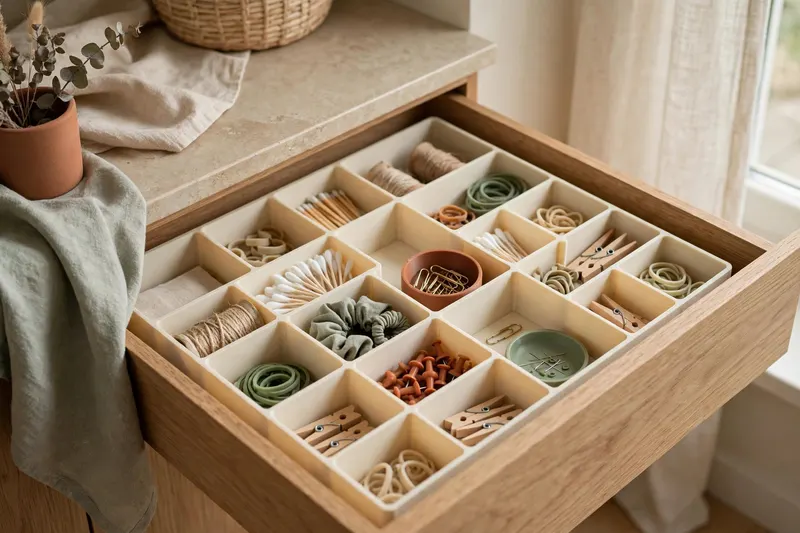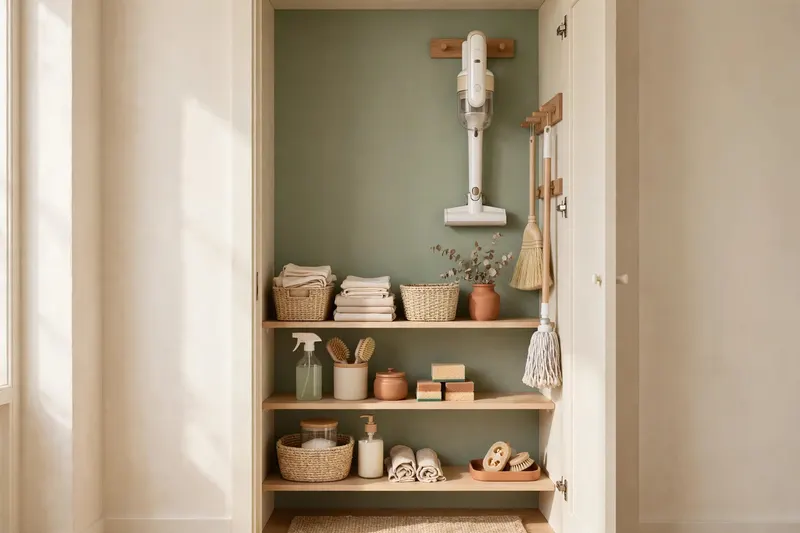
A vacuum cleaner is the hardest thing to store in a small apartment: tall, top-heavy, and awkwardly shaped, with a hose, a cord, and attachments that never stay put. Brooms and mops are no better — they slide over and end up leaning by the front door. These small apartment vacuum storage ideas give every tool a real home, even with almost no spare space. From wall hooks and behind-door racks to slim cabinets and renter-safe mounts, every idea uses space you already have. The 17 ideas below work in rentals, need little or no drilling, and most cost less than a takeout dinner.
Measure the tools first: the vacuum’s real footprint
A standard upright is roughly 42 to 45 inches tall, 12 to 14 inches wide, and 11 to 13 inches deep, and the hose sticks out past those numbers. A stick vacuum is slimmer but often taller, around 44 to 48 inches. Measure your vacuum, then the spot, leaving 2 inches of clearance on each side.
1. Measure height, width, and depth — including the hose. Keep the three numbers in your phone. Every hook, cabinet, and rack you consider has to beat all three, not just one.
2. Find the real reason your closet fails. In most small apartments, the closet is not too small — it is too full. Before you buy anything, pull everything out and check the floor space left. The vacuum may already fit once the clutter is gone.
Closet door and wall hooks: hanging the vacuum upright
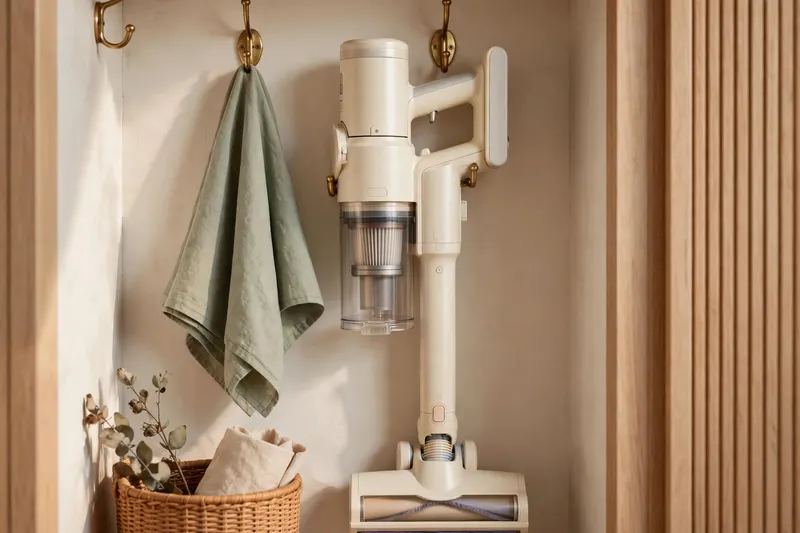
Hanging the vacuum turns dead wall space into storage. An upright hangs from a hook about 36 to 40 inches high, handle in the hook and base on the floor. A stick vacuum needs a wall mount or a hook near the top.
3. Hang the upright vacuum from a heavy-duty wall hook. A single J-hook rated for at least 15 pounds holds most upright vacuums. Mount it into a stud, or use a toggle bolt.
4. Use a stick vacuum wall mount with a charging dock. Most stick vacuums come with a wall mount, many with a charging dock. Mount it inside the closet or on a hallway wall, base 4 to 6 inches off the floor.
5. Add a small hook for the hose and attachments. The hose is what makes a stored vacuum look messy. A small hook beside the vacuum holds the hose in a loop, and a mesh bag on the same hook keeps the crevice tool and brush head together. Our guide to 18 Cleaning Supply Closet Organization Ideas for Small Homes shows how to pair hooks with labeled zones.
Behind-door racks for brooms, mops, and dustpans
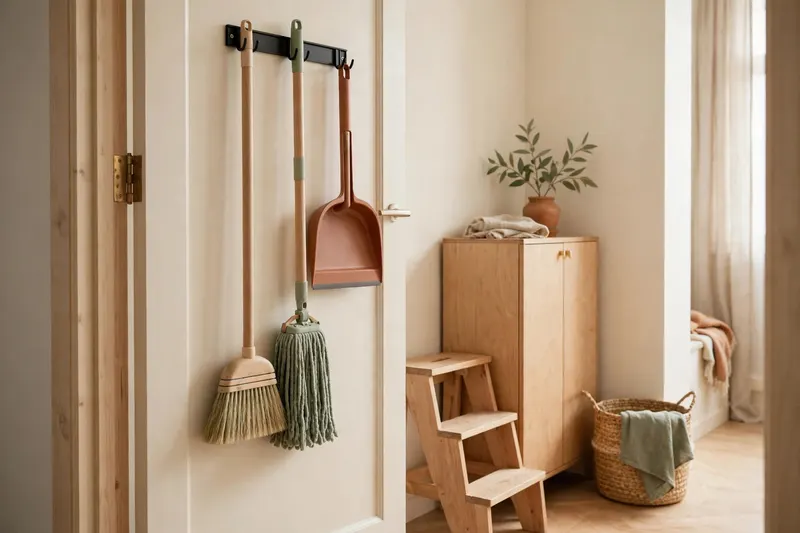
The back of a door is wasted space in almost every apartment, and it is exactly the right shape for long-handled tools. A behind-door rack keeps brooms and mops vertical and reachable without taking floor or shelf space. Measure the door thickness first.
6. Mount a grip-style broom holder on the back of a closet door. Spring-loaded rubber grips hold handles of different thicknesses and release them with a quick pull. A three-grip holder, about 12 to 16 inches wide, fits a broom, a mop, and a duster side by side. Mount it about 48 inches high so the heads clear the floor.
7. Hang a slim over-the-door rack for the dustpan and hand tools. A narrow wire rack that hooks over the door holds the dustpan, a hand brush, spray bottles, and cloths in one column. Keep the depth under 4 inches so the door still closes fully. For more door-storage ideas, see Over-the-Door Organization Ideas for Every Room.
Slim cabinets and tall narrow storage that looks like furniture
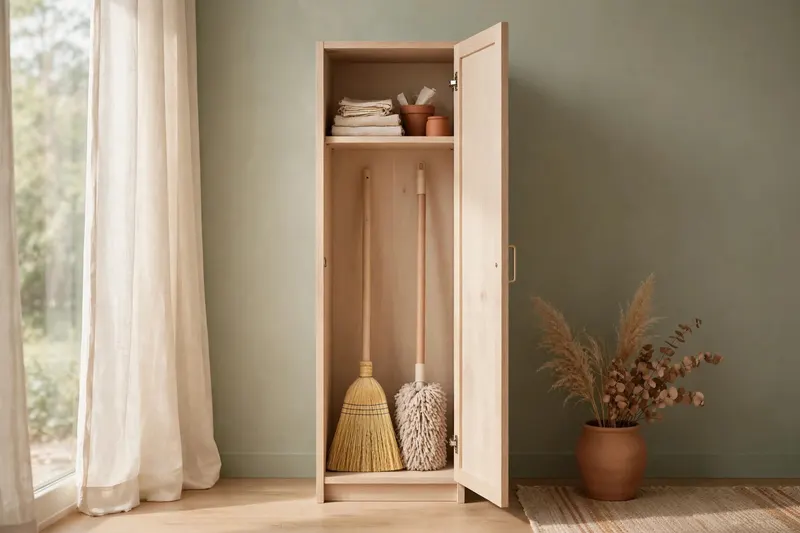
When you have no closet to spare, a slim cabinet does the job and looks like furniture. The best options are 10 to 14 inches deep — deep enough for a vacuum, shallow enough not to block a walkway. Choose one with a full-height door and no fixed shelves.
8. Use a tall narrow cabinet as a vacuum garage. A pantry-style cabinet about 15 inches wide and 70 inches tall swallows an upright vacuum, a broom, and a mop. Remove the middle shelf if there is one, and add a small hook inside the door for the dustpan.
9. Hide the vacuum behind a freestanding divider or curtain. If a cabinet is not in the budget, a slim tension rod with a floor-length curtain across an awkward alcove or the gap beside a wardrobe creates a hidden vacuum nook. Pick a curtain close to your wall color.
The cleaning closet: turning a sliver of space into a station
You do not need a full closet to have a cleaning station. A sliver of space — the gap beside the washer, the end of a hallway, a 12-inch strip by the front door — can hold everything if you build upward. The goal: grab the vacuum, broom, and spray bottle in one motion.
10. Build a vertical cleaning station in a 12-inch gap. Mount two rows of hooks and one grip holder: the vacuum hangs below, brooms and mops grip above, and a small shelf at eye level holds sprays and cloths.
11. Keep a small shelf at eye level for daily supplies. One 10-inch-deep shelf above the vacuum holds all-purpose spray, glass cleaner, and microfiber cloths. When everyday supplies live at eye level and bulky tools live below, one quick cleanup needs just one stop. The bottle and caddy ideas in 15 Cleaning Supply Storage Ideas for Small Apartments (No Cluttered Closet) keep the shelf from turning into a pile.
Ironing board and step stool: the flat-and-tall problem, solved
The ironing board is the forgotten member of the cleaning-tool family. It is flat, wide, and almost 5 feet long, so it does not fit where the vacuum fits. The step stool is small but oddly shaped, with no home of its own.
12. Hang the ironing board flat against the inside of a closet door. An over-the-door holder, or two hooks spaced about 24 inches apart, holds a standard folding board vertically against the door. The board’s own hook catches on the holder, and it sits less than 3 inches off the door.
13. Store the step stool on a hook or on top of the vacuum cabinet. A folding step stool hangs from a single large hook inside the closet, or lives flat on top of a tall cabinet.
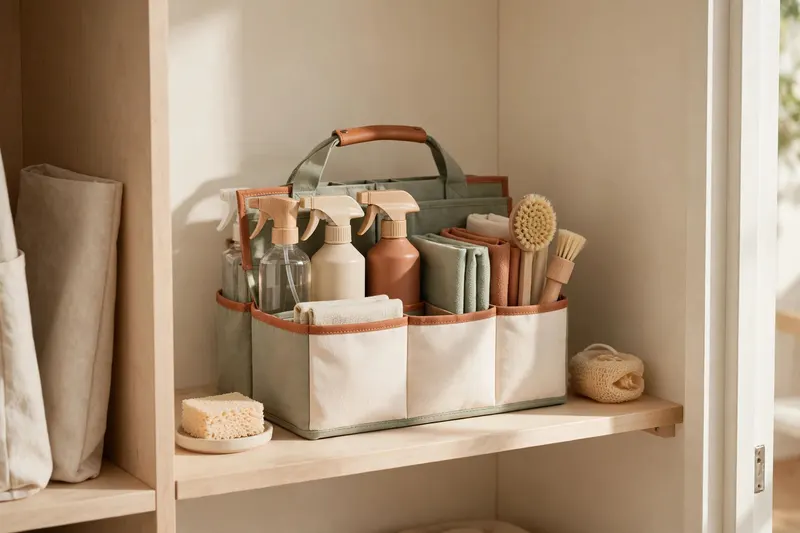
The grab-and-go caddy: daily tools stay out, bulky tools stay hidden
Not every cleaning tool needs to be hidden. The tools you use every day — a spray bottle, cloths, a dustpan — should be easy to grab, while the bulky vacuum and mop stay tucked away. A grab-and-go caddy is the bridge: one portable carrier for the daily tools.
14. Keep one caddy for daily cleaning and nothing else. A small handled caddy, roughly 12 by 8 inches, holds one all-purpose spray, one glass cleaner, two microfiber cloths, and a scrub brush. Park it under the kitchen sink or by the door — when it is time to clean, you carry one thing, not five.
15. Give the caddy a fixed parking spot with a label. A caddy without a home ends up on the counter. Mark its spot with a small label or a tray it always sits on. If more than one person cleans, the label keeps the system alive.
Renter-safe mounting that holds real weight
Renters often skip wall mounting because they fear losing the deposit, but several renter-safe options hold real weight. Match the fastener to the load and wall type: adhesive strips work on smooth painted walls and tile, tension rods work between two solid surfaces, and over-the-door hardware needs no holes.
16. Use heavy-duty adhesive hooks rated above your vacuum’s weight. Large adhesive strips and hooks rated for 7 to 15 pounds hold a stick vacuum, a broom holder, or a dustpan. Clean the wall with rubbing alcohol, press firmly for 30 seconds, and wait a full hour before hanging anything. On textured walls or brick, adhesive fails — use a tension-mounted or over-the-door option instead.
17. Use a tension rod or a freestanding rack when walls are off-limits. A tension rod wedged across a closet or an alcove gives you a hanging rail for sprays and hooks for tools, with zero holes. A freestanding narrow rack, about 12 inches wide, does the same job and moves with you when your lease ends.
Mistakes to avoid
Buying storage before measuring. The most common mistake is ordering a cabinet, rack, or hook set and discovering the vacuum is two inches too tall. Measure first, buy second.
Storing the vacuum with a full dustbin or a wet mop head. A full bin smells within days, and a damp mop head grows mildew. Empty the vacuum and let mop heads dry before they go back.
Hanging heavy tools from weak adhesive. A broom weighs little, but a full-size upright vacuum does not belong on a small adhesive hook. Match the rating to the tool, and use a stud or toggle bolt over 10 pounds.
Hiding the tools so well you never use them. Storage that takes five minutes to undo is storage you will abandon. If the vacuum lives behind three other things, move it to the front.
Forgetting the cord and attachments. A vacuum with its cord trailing across the floor is not stored — it is dropped. Wrap the cord on its hooks and keep the attachments in one bag or pouch.
Frequently Asked Questions
How can I store a vacuum in a small apartment with no closet?
Use a slim tall cabinet, a behind-door rack, or a wall hook. A stick vacuum on a wall mount takes almost no floor space, and a curtain across a small alcove hides an upright vacuum with no building work.
Can I hang a vacuum on the wall in a rental?
Yes. Use heavy-duty adhesive hooks rated above the vacuum’s weight, a stick vacuum wall mount, or an over-the-door rack that needs no holes. Check your lease for mounting rules and use removable fasteners where required.
How do I store brooms and mops so they do not fall over?
Store them vertically in a grip-style holder, which clamps the handle and releases it with a pull. Leaning brooms against a wall always ends with them on the floor.
Can a stick vacuum replace an upright in a small apartment?
For most small apartments, yes. A stick vacuum is lighter, slimmer, and easier to store on a wall mount, and it handles hard floors and low-pile rugs well. Keep an upright only for thick carpet throughout.
Conclusion
A vacuum does not need a big closet — it needs a measured spot, a hook or cabinet that fits it, and a home you can reach in seconds. Start with the tape measure, hang what you can, and give the daily tools a caddy. Browse the full storage ideas collection and save this pin for later.