A stroller eats a hallway alive. One folded frame leaning by the front door turns a 36-inch passage into a squeeze, trips you at midnight, and blocks the door every time you carry groceries in. Small apartment stroller storage is not about finding more square footage — it is about giving the stroller one fixed home that never sits in the walkway. These apartment stroller storage ideas cover folding tricks, wall hooks, closet parking, and balcony-safe options, so you can pick the one that fits your stroller, your floor plan, and how often you go out. By the end, you will know exactly where your stroller belongs.
The stroller audit: size, fold, and how often it goes out
Measure your folded stroller before you buy anything: length, width, and depth. Most umbrella strollers fold to roughly 42 x 12 x 10 inches; a full-size travel system folds closer to 36 x 24 x 18 inches. That decides everything — a 12-inch-deep umbrella stroller fits a slim gap, while a 24-inch-wide travel system needs a closet bay.
Test the fold, too — you will fold it in the hallway while holding a baby. If it takes more than 20 seconds, it will end up parked open in the hallway.
Then be honest about frequency: daily use belongs near the front door, twice a week can live deeper in a closet, and once a month does not belong in the entryway at all. The stroller is usually one part of a bigger baby-gear pile; see our 16 baby gear storage ideas for small apartments for the full system.
Folded-flat parking: behind doors, under stairs, and slim gaps
Folded-flat parking is the cheapest win: no building, no drilling — just dead space your apartment already has.
1. Park it behind the door
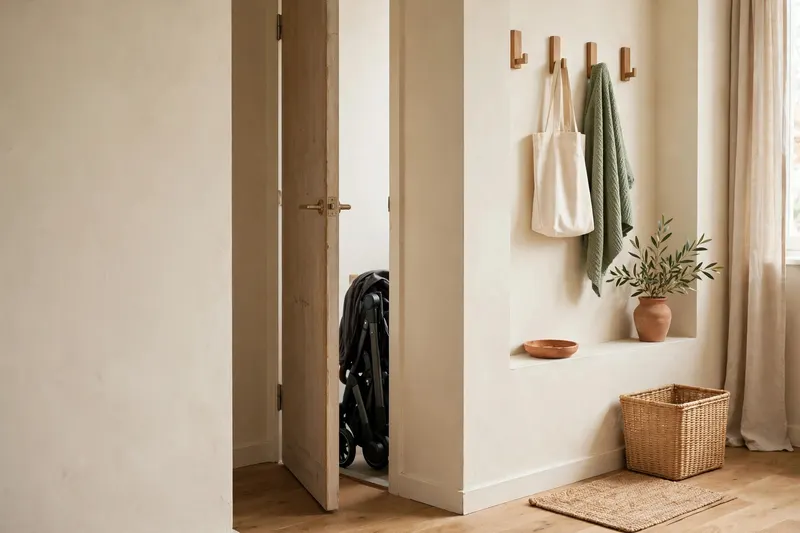
The space behind an inward-opening door is usually 4 to 8 inches of wasted depth — a folded umbrella stroller slides right in. A hook-and-loop strap stops it springing open.
2. Turn the under-stair triangle into a stroller nook
Clear the triangle under a short flight of stairs, lay a 24 x 18-inch rubber mat on the floor, and park the folded stroller upright in the corner.
3. Claim a slim gap between furniture and wall
A 10- to 14-inch gap between a bookshelf and the wall, or the fridge and a cabinet, fits a folded umbrella stroller. Slide it in wheels-first and put a felt pad on the furniture edge to prevent scuffs.
Wall hooks and vertical hanging for lightweight strollers
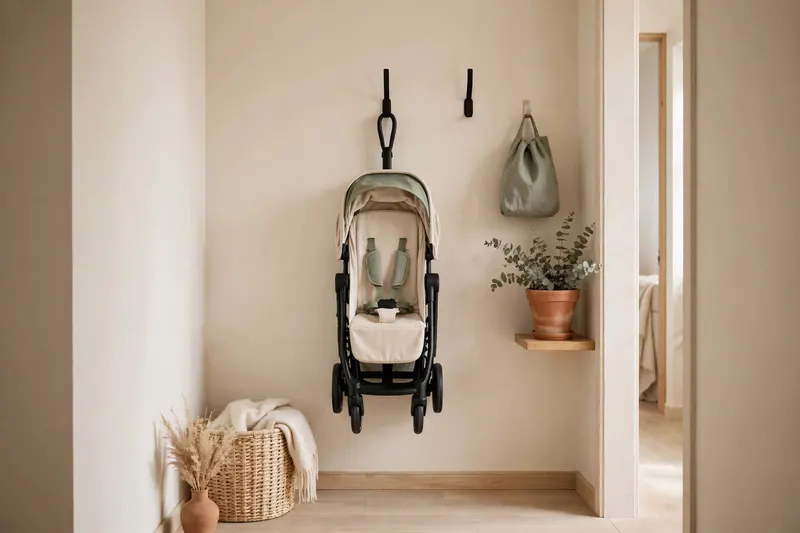
Wall hanging works when floor space is gone but wall space is not, and it suits umbrella strollers and lightweight models under about 15 pounds.
4. Hang it from two heavy-duty hooks
Mount two rubber-coated hooks 12 to 16 inches apart on a wall stud at chest height, and rest the folded stroller across them. Use hooks rated for at least 20 pounds each — drywall anchors alone pull out over time. Hang it folded, wheels facing the wall.
5. Use a folding wall bracket that disappears when empty
A folding wall bracket — the kind sold for bikes — mounts flat to the wall and folds out into a small arm. When the stroller is out, it folds away. Mount it at hip height with 6 inches of clearance so the handlebar does not gouge the wall.
Closet parking: turning dead closet floor into a stroller bay
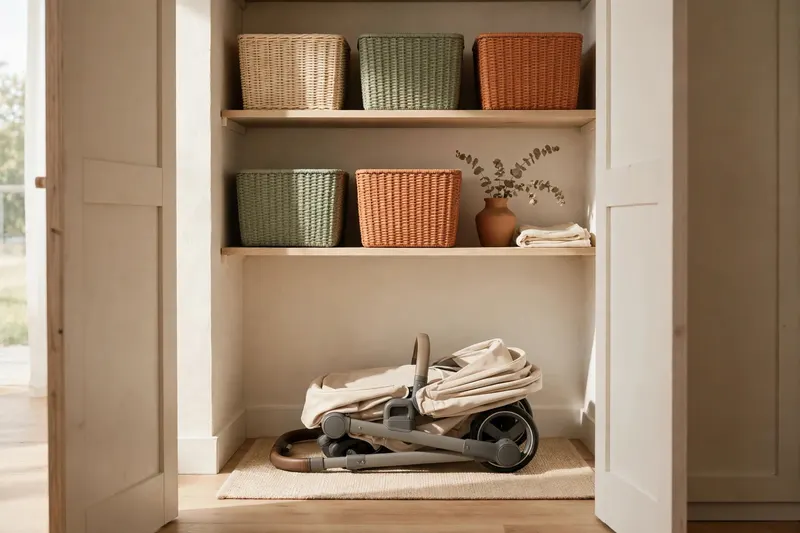
The bottom 18 inches of a hall closet is usually a pile of shoes, and the stroller is a better use of it.
6. Build a stroller bay on the closet floor
Clear the closet floor, move shoes to a wall-mounted rack, and park the folded stroller upright in the freed bay — it needs roughly 24 inches of width and 18 inches of depth. Keep a basket above for the rain cover.
7. Raise the closet rail and park underneath
Raise your hall closet rail from 66 to 72 inches with a simple rod and two brackets. The extra clearance lets a taller folded stroller stand upright underneath, coats above and stroller below.
The entryway stroller station that doesn’t block the door
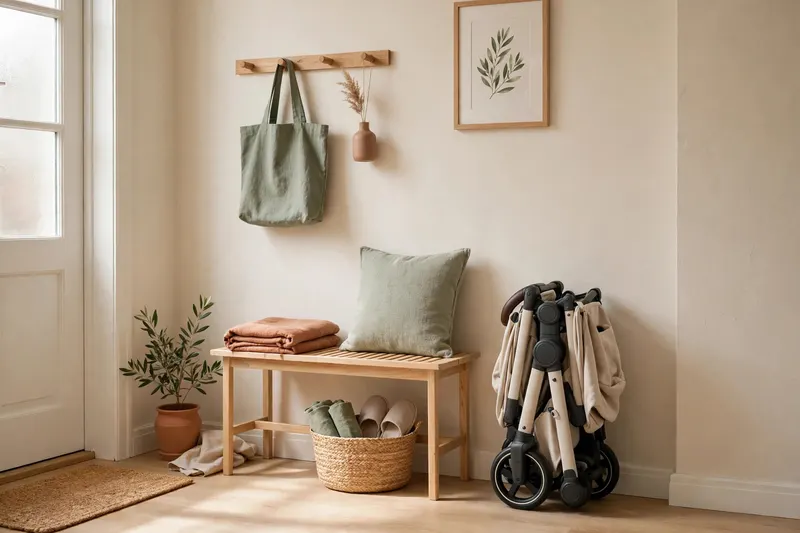
A daily-use stroller needs a station near the door, narrow enough that the door still opens and the walkway still works.
8. Build a slim station along one wall
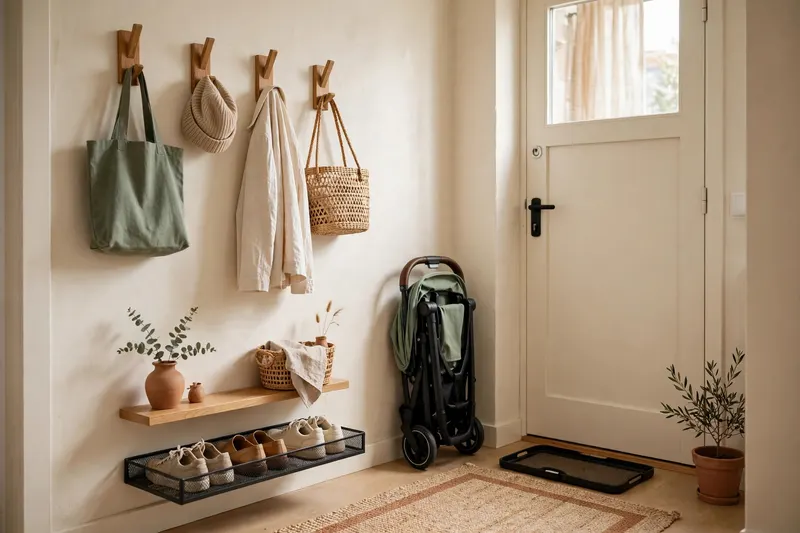
Pick the wall opposite the door swing. A station needs only 14 inches of depth: the folded stroller, a wall hook above it for the diaper bag, and a small shelf for keys and the rain cover. Mark the footprint with painter’s tape, then walk through carrying a laundry basket — if you pass without turning sideways, the station works. A narrow hallway rewards the same discipline; our 17 narrow hallway storage ideas show how to keep a tight passage usable.
9. Put the grab-and-go rail above the stroller
One hook each for the diaper bag, baby carrier, and rain cover, plus a small tray for keys and the building fob. Mounted at 60 inches, the rail turns parking into a departure station. Keep it to four hooks maximum — more hooks invite clutter.
Balcony and shared-space storage: what is safe and what is not
Outdoor storage is the last resort: sun, rain, and temperature swings age fabric and seize folding mechanisms. Use it only when no indoor spot exists, and only with protection.
10. Use a weatherproof deck box with a cover
A hard deck box — roughly 46 x 22 x 22 inches — keeps rain off, but the stroller inside still needs its own waterproof cover, because condensation forms inside a closed box. Store it folded and dry, and open the box weekly to air it out. Never store a stroller on an open balcony without a box or cover: UV weakens fabric and straps in a single summer, and a rain-soaked stroller grows mildew fast. For the rest of the balcony, see our 16 small apartment balcony storage ideas for weatherproof, renter-safe setups.
11. Use shared building storage only with a lock and a label
Some buildings offer a basement cage or a shared storage closet. These work for a second stroller, not for the daily driver — the trip downstairs kills the point of a quick exit. If you use one, lock the stroller to a fixed rail and label it with your unit number. Check your lease first: most buildings ban hallway storage outright, and a stroller in a shared hallway is a fire-code problem.
Two-stroller households and the one-stroller rule
Two strollers in a small apartment is one too many — the second one lives in the hallway, because the good spot is already taken.
12. Apply the one-stroller rule
Keep the stroller you use most; sell or lend the other one. If you genuinely need two, the second must be a lightweight umbrella model that folds flat enough for a wall hook or a slim gap.
13. Swap the frame, not the whole stroller
A car-seat frame stroller — the bare frame a car seat clicks into — folds smaller and weighs less than a full travel system. Retire the frame when your child outgrows the car seat. Buying secondhand is fine, but check the U.S. Consumer Product Safety Commission’s recall list first — a cracked frame or a recalled model is not a bargain.
The 2-minute in-and-out routine that keeps the hallway clear
Storage only works if the routine around it works — a stroller in the perfect spot still ends up in the hallway when you come home tired and drop it where you stand.
14. Run the dock-and-go routine every time
Coming home: fold the stroller at the door, wipe the wheels, and roll it straight to its spot. Going out: unfold at the door and grab the bag from the rail. It takes about two minutes, and it only sticks if the spot is within three steps of the door.
15. Do the weekly wheel-and-fold check
Once a week, flip the stroller over and check the wheels for hair and grit around the axles — the most common reason a stroller stops folding smoothly. Lubricate the folding joints monthly. A stroller that folds in five seconds gets parked; one that fights you gets abandoned.
Mistakes to avoid
The most common mistake is parking the stroller open. An unfolded stroller takes roughly twice the floor space — fold it every single time, even for a five-minute trip.
Do not store a stroller in front of a radiator, a water heater, or a fuse box — heat degrades fabric and straps, and a blocked fuse box is a safety problem. Do not hang a heavy travel system from a single hook, and do not trust a suction or adhesive hook.
Do not buy storage before measuring. A wall bracket two inches too shallow or a deck box three inches too short ends the same way: the product goes back, the stroller goes back in the hallway. And never store a wet stroller in a closed closet — air-dry it in the entryway for an hour first.
Frequently asked questions
Where should I store a stroller in a small apartment?
The closest indoor place to the front door that does not block the walkway — a hall closet floor, the space behind the door, or a wall hook. A daily-use stroller belongs within three steps of the door.
Can I store a stroller on my balcony?
Only in a weatherproof deck box with a waterproof cover, and only if the stroller goes inside dry. An uncovered stroller faces UV damage, rain, and mildew.
How do I hang a stroller on the wall?
Use two rubber-coated hooks anchored into wall studs, rated for at least 20 pounds each, 12 to 16 inches apart. Hang the stroller folded, wheels facing the wall. This works for strollers under about 15 pounds.
What is the best stroller storage for a one-bedroom apartment?
A closet-floor stroller bay or a folding wall bracket — both hide the stroller or fold away when empty, and both keep the hallway clear. Pair either one with a grab-and-go rail.
Can I keep two strollers in a small apartment?
Only if the second one is a lightweight umbrella stroller that folds flat enough for a wall hook or a slim gap. Two full-size strollers will not fit any small-apartment storage system.
Conclusion
A stroller does not need a garage — just one measured, fixed spot and a two-minute routine that puts it there every time. Pick the idea that matches your stroller’s folded size and your routine. Browse more ideas in our storage ideas category, and save this pin for later.