A small attic should be the easiest storage in your house. It is already there, it costs nothing extra, and it holds the things you only need twice a year. Instead, most attics become a dark slope full of unmarked boxes, where every trip up the ladder ends with kneeling on joists and guessing. Small attic storage organization is not about buying more bins. It is about deciding what earns attic space, giving every item a zone that matches the ceiling height above it, and building a system you can actually use in the dark and with both hands full.
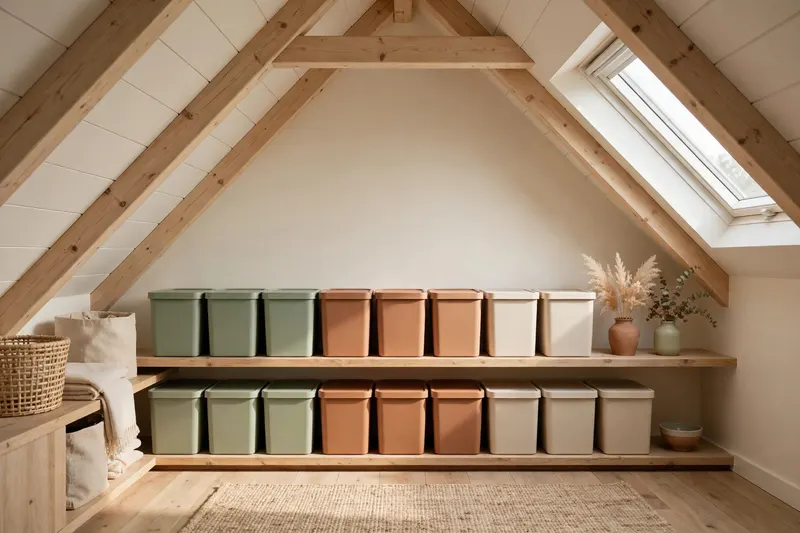
The attic audit: what deserves attic space and what doesn’t
Before a single bin goes up, empty the attic in your head first. Everything stored there should pass one test: you need it rarely, it survives temperature swings, and you can carry it up and down a ladder safely. If an item fails any part of that test, it does not belong in the attic.
1. Run a keep-or-remove pass before you organize anything
Open every box and sort into three piles: keep in the attic, move elsewhere in the house, and donate or toss. Holiday decorations, keepsakes, luggage, and camping gear usually stay. Old electronics with batteries, paint cans, and anything untouched for three years usually go. Sorting first means you organize half the volume you started with.
2. Sort what stays into four honest groups
Use seasonal, keepsakes, rarely used gear, and household overflow. Seasonal means holiday decor and off-season clothes. Keepsakes means photo albums, school projects, and family heirlooms. Rarely used gear means camping equipment, suitcases, and sports kit. Household overflow means spare bedding and extra kitchenware. The same swap logic from our 18 Small Apartment Seasonal Storage Rotation Ideas (Swap, Don’t Stack) works up here too: only the current season’s overflow comes down, and everything else waits in its zone.
Zones by height: tall center, low eaves, and the dead corners
An attic is not one room. It is three rooms side by side: a tall center where you can stand, low eaves where you can only kneel, and dead corners behind the roofline that nobody can reach without crawling.
3. Put the tall center to work first
The strip under the ridge, usually 5 to 7 feet high, is your prime real estate. Reserve it for the things you reach for most: holiday decor bins, suitcases, and the seasonal box you swap twice a year. Keep it clear of anything you touch once a decade.
4. Turn the low eaves into deep, flat storage
Where the ceiling drops below about 3 feet, store flat, rarely needed items: wrapping paper rolls, folded spare blankets in vacuum bags, and flat-packed seasonal wreaths. Slide in shallow under-eave drawers or low 12-inch-high bins on their sides, and pull them out like drawers.
5. Claim the dead corners with a “once a year” rule
The triangular corners behind the roofline are the hardest to reach, so give them only items you touch once a year or less: the artificial Christmas tree, the camping tent, the box of baby clothes you are saving. Put the least-used items deepest, and write the contents on the box end facing out.

Bins that survive attics: sealed, labeled, and stackable
Attics are harsh on storage. Summer temperatures can climb past 120 degrees F, winter brings damp, and dust settles on everything. Cardboard boxes soften, sag, and attract pests. Your bins are the system, so choose them like it matters.
6. Switch to sealed, latching plastic bins
Use clear or translucent bins with snap-latch lids in the 18 to 27-gallon range, roughly 24 by 16 by 12 inches. Sealed lids keep out dust, damp, and insects, so skip open-top crates and cardboard entirely up here. The packing methods in our 16 Holiday Decoration Storage Ideas for Small Apartments pair well with these bins: wrap fragile ornaments in tissue, nest them in divided trays, and let the sealed bin do the rest.
7. Standardize on one bin size, with one smaller size for heavy items
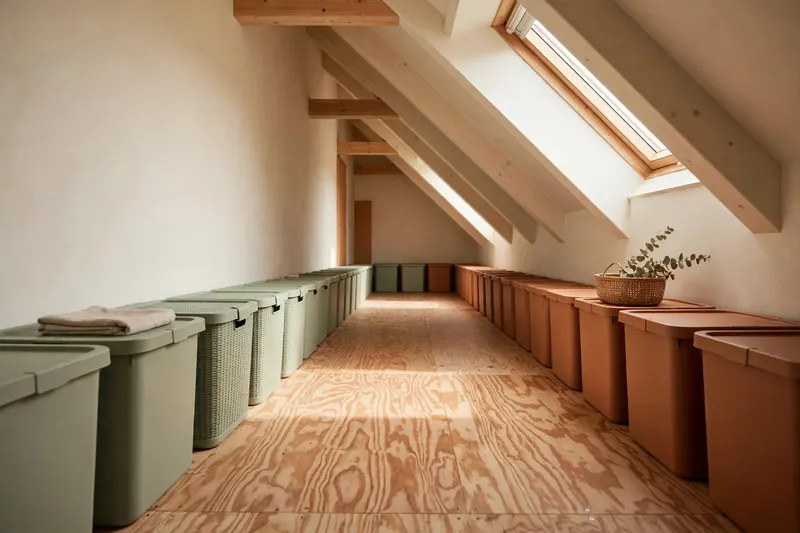
Pick a single standard bin for almost everything, and a smaller 12-gallon size for anything heavy, like books, photo albums, or tools. Uniform bins stack neatly, line up along the eaves without wasted gaps, and let you swap a bin from any zone to any other.
8. Stack no more than three high, heaviest at the bottom
Three bins high is stable, reachable, and safe on attic flooring. Put the heaviest bin at the bottom, the lightest on top, and never stack above shoulder height when you are standing on a ladder.
Flooring and access: safe walkways before more storage
Nothing in this guide works until you can walk safely in your attic.
9. Lay a walkway down the tall center before adding storage
Install plywood or attic decking panels, at least 24 inches wide, running from the hatch to the far end along the ridge. Screw panels to the joists rather than laying them loose, and keep the walkway clear at all times.
10. Add a pull-down ladder or sturdy step, plus a handhold at the top
If your attic still uses a wobbly step stool or a loose ladder, replace it with a proper pull-down attic ladder rated for at least 250 pounds, or a fixed set of steps if you have the room. Mount a grab handle or a short rail beside the hatch opening so you can steady yourself with one hand while carrying a bin with the other.
Labeling that works in the dark: big, bright, and on two sides
Attic lighting is usually one bare bulb, and half your bins sit in shadow.
11. Label two sides of every bin, in letters at least 2 inches tall
Write the contents on the short end and one long side of each bin, using a thick black marker on white adhesive labels or a label maker with large print. List the three most important contents, not a vague category: “Christmas lights, tree skirt, stockings” beats “Christmas stuff” every time.
12. Color-code by group, and add a number to each bin
Assign one color per group: red for holiday decor, blue for seasonal clothes, green for keepsakes, yellow for gear. Use colored tape or colored labels so you can spot the right group from the hatch without reading a word. Then number the bins within each group, red 1 through red 6, for example, and keep a one-page master list taped inside the hatch or on your phone. The zone logic in our 18 Small Basement Storage Ideas for Small Homes (Dry, Labeled, Reachable) uses the same principles in a space with the same damp and darkness problems.
What never goes in an attic: heat, moisture, and pest rules
Some things should never live in an attic, no matter how neatly you pack them. Heat warps, moisture rots, and pests chew.
13. Keep heat-sensitive items out, full stop
Never store candles, vinyl records, photographs, film negatives, or anything with adhesive in an attic. Summer heat melts candles into their neighbors, warps records, and fuses photo prints together. Store photos and film in a closet inside the house instead, and keep candles in a cool cupboard.
14. Ban liquids, batteries, and food from the attic
Paint cans, cleaning chemicals, and aerosol cans can leak, rust, or burst in temperature swings. Batteries corrode and can leak acid onto everything below them. Food, including pet food and birdseed, invites mice and insects, and once pests find one food source they explore every bin. For safe, ventilated spots for paint and chemicals, see our 18 Small Garage Organization Ideas That Reclaim Your Parking Spot.
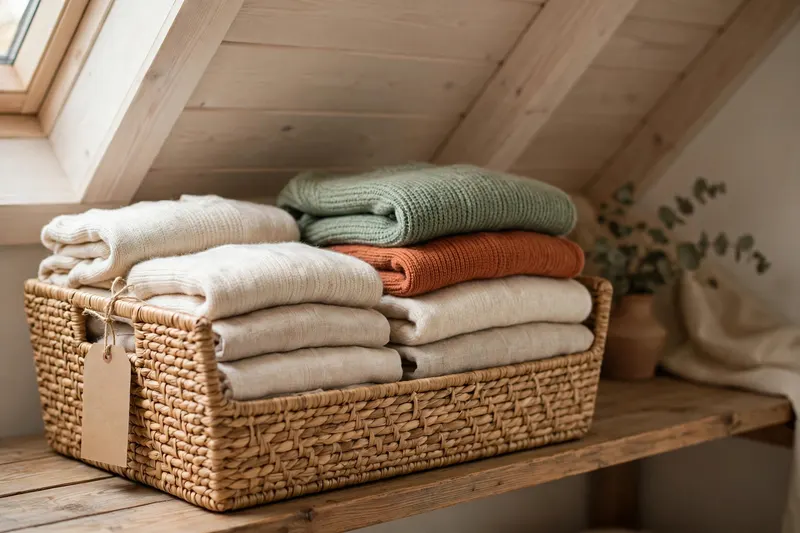
The yearly attic sweep: keeping it from becoming a dumping ground
Every attic drifts toward chaos. The system only survives if you return to it once a year, on a fixed date, and reset it. Pick a date you will remember, like the first weekend of October, before the holiday season starts, and treat it like an appointment.
15. Do one full sweep every October, and time it to the holiday season
Once a year, pull every bin into the center, check the labels, open anything you have not opened in twelve months, and ask whether it still earns its spot. October works because you are about to bring the holiday bins down anyway, so the trip is already happening.
16. Enforce a one-in, one-out rule for attic items
Every time something new goes up into the attic, something of the same group comes down or goes out. A new set of holiday lights means the oldest set gets donated. A new suitcase means the broken one leaves. Without this rule, the attic fills up by one box a year until you are back to crawling over piles.
17. Keep a running inventory on your phone
Photograph each bin’s label and contents when you pack it, and keep the photos in one album called “Attic” on your phone. Add the bin number to each photo’s caption. Next December, you can search the album for “tree skirt” instead of climbing up and opening six red bins.

Mistakes to avoid
Buying bins before the audit. Bins are the last step, not the first. Buy them after you know how many groups you have and how much each group holds, or you will own twelve bins for eight bins’ worth of stuff and no floor space left.
Storing by room instead of by use. Boxes labeled “bedroom” or “kitchen” mix seasonal items with keepsakes and make every retrieval a treasure hunt.
Ignoring ventilation. Never block soffit vents or ridge vents with bins or insulation. Blocked vents trap moisture, grow mold, and rot roof decking.
Skipping the floor. Storing bins directly on insulation crushes it, kills its insulating value, and hides the joists underfoot.
Frequently asked questions
How do I organize a small attic with a low ceiling?
Work with the height you have, not against it. Use the tall center for anything you reach often, slide shallow bins into the low eaves for flat and rarely used items, and reserve the dead corners for once-a-year things like the Christmas tree.
Can I store clothes in an attic?
Yes, if they are clean, completely dry, and sealed in latching plastic bins or vacuum bags. Heat and damp are the risks, so never store leather, fur, or delicate fabrics up there, and check bins once a year for moisture or pests.
What is the best storage for a small attic?
Sealed, stackable plastic bins in one standard size, with a smaller size for heavy items. Clear bins help you see contents at a glance, latching lids keep out dust and pests, and uniform sizes stack safely and line up neatly along the eaves.
How do I keep my attic from getting too hot for storage?
You cannot cool an attic to room temperature, so choose what goes up there accordingly. Keep heat-sensitive items like photos, candles, and vinyl inside the house. Make sure soffit and ridge vents stay clear so hot air can escape.
How often should I clean out my attic?
Do a full sweep once a year, ideally in October before the holiday season. Pull bins out, check labels, remove anything you have not used in a year, and enforce a one-in, one-out rule the rest of the year.
Conclusion
Small attic storage organization comes down to four habits: audit first, zone by ceiling height, use sealed labeled bins, and sweep once a year. Do those four things and every sloped inch starts working for you instead of against you. Browse more ideas in the storage ideas category, and save this pin for later so your next trip up the ladder starts with a plan, not a guess.