A dresser should be the hardest-working piece of furniture in a small bedroom, but for most people it is the opposite: a deep box where folded clothes go to disappear. You open the top drawer, dig past three layers of t-shirts, and by the time you find the one you wanted, the drawer looks worse than before. These small bedroom dresser organization ideas fix that by giving every drawer a job and every fold a visible place. File folding plus simple dividers doubles the usable space in a standard dresser — not by adding drawers, but by ending the digging and the mystery piles. Below are 17 ideas that take about one afternoon to set up and five minutes a night to keep.
The dresser audit: what actually belongs in drawers
Before you buy a single divider, empty the dresser completely. A dresser only works when what lives inside it earns its place, and the audit is where you decide.
1. Sort everything into keep, relocate, and let go. Keep only what you wear at least once a month in the current season. Relocate what belongs elsewhere — charging cables to your desk, spare sheets to the linen closet. Let go of anything stained, stretched, missing its match, or unworn for a year. Most dressers hold 20 to 30 percent dead weight, and removing it is the fastest space you will ever gain.
2. Measure each drawer before you buy anything. Note the inside width, depth, and height of every drawer. Standard dresser drawers run about 28 to 34 inches wide and 15 to 17 inches deep, but shallow top drawers are often only 3 to 4 inches tall inside. Buying dividers before measuring is the number-one reason organization systems fail on day one.
File folding: seeing everything without digging
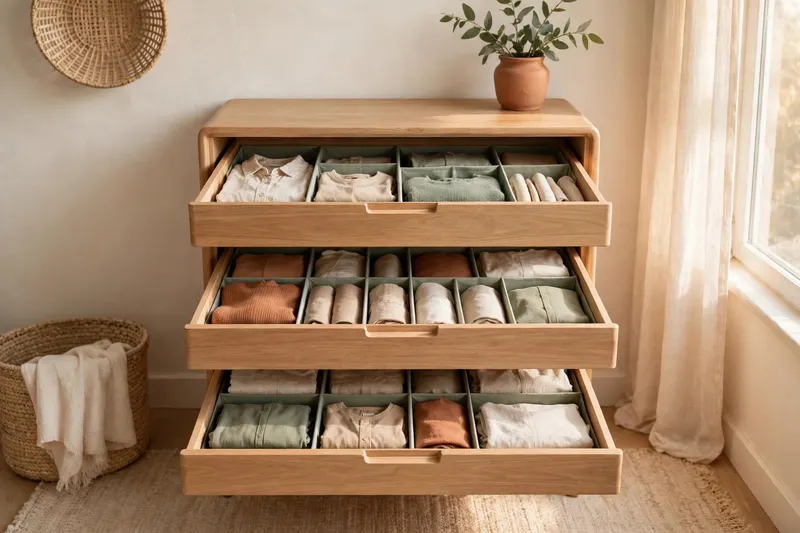
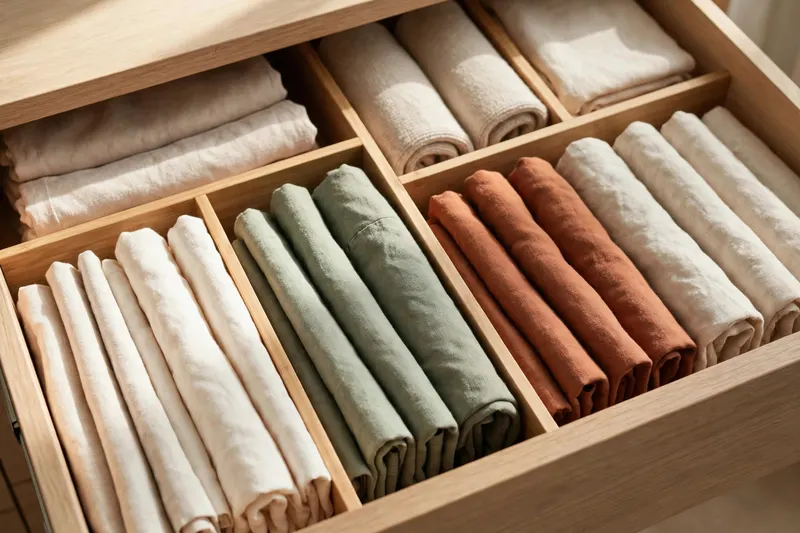
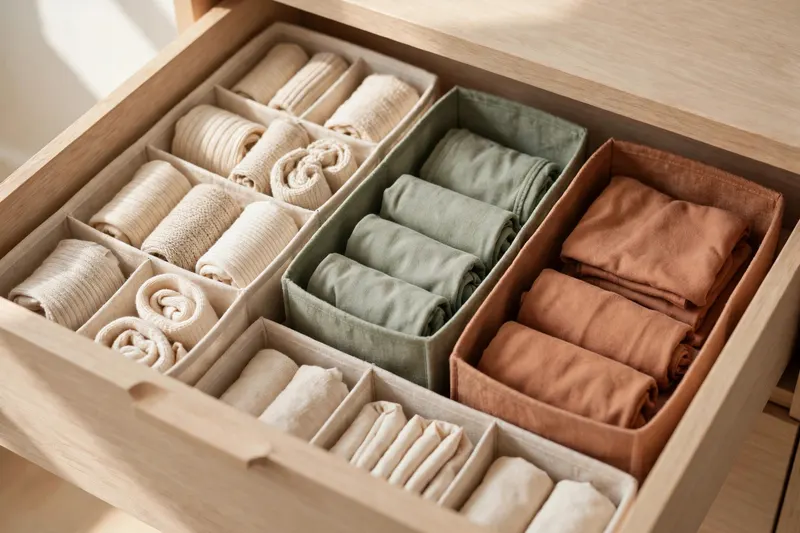
Flat stacks hide everything below the top item. File folding — standing each folded piece on its edge like a file in a cabinet — turns every drawer into a display you can read at a glance.
3. Fold clothes into rectangles that stand on their own. For a t-shirt, fold the sides in, fold the sleeves back, then fold the shirt into thirds so it forms a firm rectangle about 6 inches wide. It should stand upright without flopping. If it flops, fold it once more.
4. Sort each drawer by color, light to dark, left to right. This sounds decorative, but it is practical: when every grey shirt sits together, you find the one you want without unfolding three others.
Drawer dividers and inserts that fit any dresser
Dividers are what keep file folding from collapsing into a pile the first time you pull a shirt out. The right insert costs little and fits any dresser, rented or owned, because nothing is screwed in or glued down.
5. Use spring-loaded dividers in deep drawers. For drawers deeper than 6 inches, a pair of adjustable spring-loaded dividers creates two or three lanes that hold folded clothes upright even when a lane is half empty. They need no tools and come out in seconds when you move.
6. Line shallow drawers with small open-top boxes. In drawers under 4 inches tall, skip tall dividers and use low boxes instead: 6-by-6-inch or 10-by-6-inch fabric or bamboo boxes, one category per box. Lift a whole box out to pick what you need — no rummaging inside the drawer.
One drawer, one job: assigning zones by category
A drawer with two jobs always becomes a drawer with no system. Each drawer holds exactly one category — label it until the habit sticks.
7. Put your most-used category in the top drawer. For most people that is underwear, socks, and sleepwear — the items you reach for every morning and night. Heavy things — jeans, sweaters, hoodies — go in the bottom drawers, where their weight will not wear out the drawer slides.
8. Give the “homeless” items a drawer of their own instead of scattering them. Every bedroom has a handful of things that belong nowhere: a sleep mask, a lint roller, a spare phone charger, hand cream. Instead of letting them drift across the dresser top, assign one shallow drawer — or one divided section of a drawer — as the bedroom essentials drawer. It is the same one-drawer-per-task thinking behind our kitchen drawer organization ideas for tiny drawers, and it works because the rule is easy to remember at 11 p.m.
Top-of-dresser zones: lamp, essentials, nothing else
The top of a dresser is prime real estate, which is exactly why it becomes a dumping ground. Treat it like a countertop with a strict limit: three zones, nothing outside them.
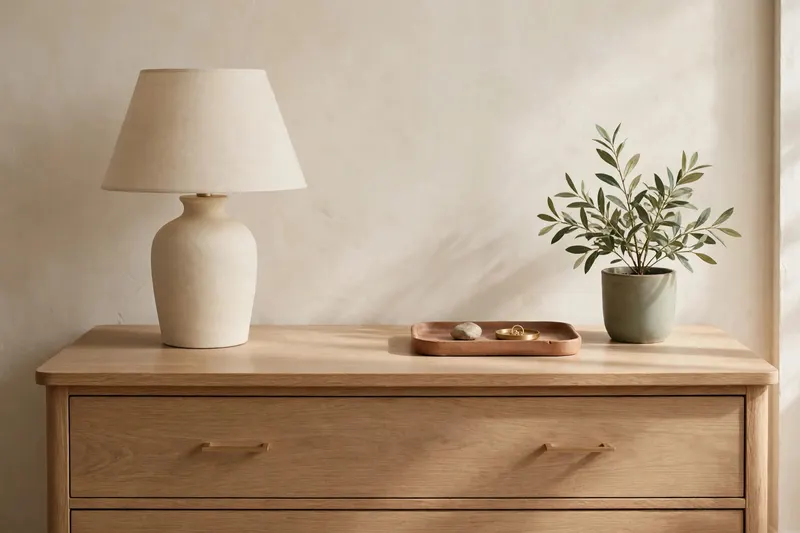
9. Anchor the top with a lamp on one side and a tray on the other. A lamp takes the left third, a tray about 12 inches wide takes the right third, and the middle stays clear. The tray holds the three things you use daily — watch, earrings or ring dish, lip balm. When the tray is full, something has to leave before anything new goes in.
10. Keep a “tonight” spot for tomorrow’s clothes. Lay out tomorrow’s outfit on the clear middle of the dresser top, or hang it on a single hook on the wall beside the dresser. It takes ten seconds at night and saves a full drawer excavation in the morning. If you have no closet at all, pair this with the freestanding options in our guide to bedroom storage ideas for small rooms with no closet.
Small items: socks, underwear, and accessories solved
Small items cause the most dresser chaos. The answer is always the same: smaller containers, inside the drawer, one category per container.
11. Roll socks and underwear instead of folding them. Rolled pairs take up roughly the same space as folded ones but stay put in small boxes and are far easier to grab one-handed in the dark. Roll each pair into a tight cylinder and stand the rolls upright in a 6-by-6-inch box, about 8 to 10 pairs per box. If a pair loses its match, it goes straight into a small pouch at the back of the drawer — never loose, where singles breed.
12. Corral accessories in a shallow divided tray. Belts rolled into 3-inch coils, scarves folded into loose rectangles, and jewelry in a tray with compartments no deeper than 2 inches. One tray, one drawer, and the rule that nothing accessory-shaped lives anywhere else. The same principle as our junk drawer organization ideas: small things need small boundaries.
Seasonal rotation for dressers with no spare room
A small dresser cannot hold four seasons at once. It needs to hold this season only, with the swap taking under an hour, twice a year.
13. Swap seasons in one sitting, drawer by drawer. Twice a year, pull one drawer at a time, remove the out-of-season items, and replace them with the in-season items from your storage spot. Work drawer by drawer so the job stays manageable. The core rule, from our seasonal storage rotation guide: only the current season earns drawer space.
14. Store off-season clothes in labeled, breathable bags under the bed or on a high shelf. Vacuum-sealed bags compress a bulky sweater collection to about a third of its volume, but they can crease delicate knits — use breathable cotton bags for wool and cashmere. Label each bag with its contents and season (“Winter sweaters, 6 pcs”) in big letters on the outside.
The 5-minute nightly dresser reset
Organization systems fail at night, not in the morning. The nightly reset keeps the dresser working for months — but only if it takes five minutes, not twenty.
15. Do the “three things back” rule before bed. Every night, return three things to their drawer homes: the clothes you tried on and rejected, the accessories from the dresser top, and anything that migrated to the bed or chair. Three things is small enough to actually do when you are tired.
16. Re-stand anything that fell over, then close the drawers. Run one hand along each row and push upright anything that flopped during the day. This takes about thirty seconds per drawer and is the single habit that keeps file folding alive — a collapsed row invites more collapsing, while a tidy row stays tidy.
17. End the week with a two-minute drawer check. Once a week — Sunday night works for most people — open each drawer and pull out anything that does not belong: a stray sock, a receipt, a charger that wandered in. Two minutes, no deep cleaning, no re-folding.
Mistakes to avoid: what NOT to buy
Not every organizer deserves your money or your drawer space. Skip the giant multi-compartment hanging organizers meant for closets — they waste depth in a dresser drawer and tangle everything. Skip matching “drawer organizer sets” sold in bulk before you have measured; half the pieces never fit and the rest slide around. Skip drawer liners with strong adhesive backing in a rental — they peel paint and finish when removed. And skip buying anything at all until you have done the audit above: most people discover they need two or three boxes, not a twenty-piece set. One more safety note for families: if your dresser is tall or top-heavy, anchor it to the wall with a furniture strap. The U.S. Consumer Product Safety Commission’s Anchor It! campaign explains how.
Frequently asked questions
How do I organize a small dresser with no extra storage space?
Start with the audit — most dressers hold 20 to 30 percent items that can leave. Then file-fold everything so you can see it, and use the one-drawer-one-job rule. If you still overflow, off-season clothes go under the bed and rarely used items go to a high shelf.
Can file folding really double my dresser space?
It roughly doubles usable space, yes — not because folding shrinks clothes, but because standing them on edge lets you use the full depth of the drawer instead of only the top layer.
What size drawer dividers fit a standard dresser?
Measure first, but as a guide, standard dresser drawers are about 28 to 34 inches wide and 15 to 17 inches deep inside. Spring-loaded dividers adjust to fit, and 6-by-6-inch or 10-by-6-inch low boxes work in most shallow drawers.
How often should I reorganize my dresser?
A full reorganization twice a year, timed with the seasonal swap, is enough if you keep up the five-minute nightly reset. The reset matters more than the reorganization.
What is the one-in-one-out rule for dressers?
For every new item of clothing that enters the dresser, one old item leaves — donated, recycled, or binned. It is the only rule that keeps a small dresser from slowly refilling after a big declutter.
Conclusion
A small dresser does not need more drawers — it needs a job for every drawer, folds you can actually see, and a five-minute reset that keeps the system alive. Start with the audit, file-fold one drawer tonight, and let the rest follow. For more small-space ideas, browse the small-spaces category, and save this pin for later for your next seasonal swap.