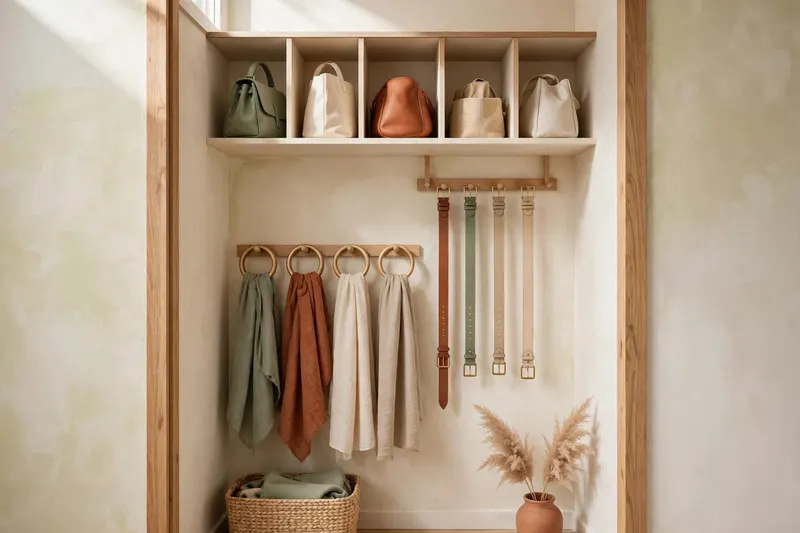
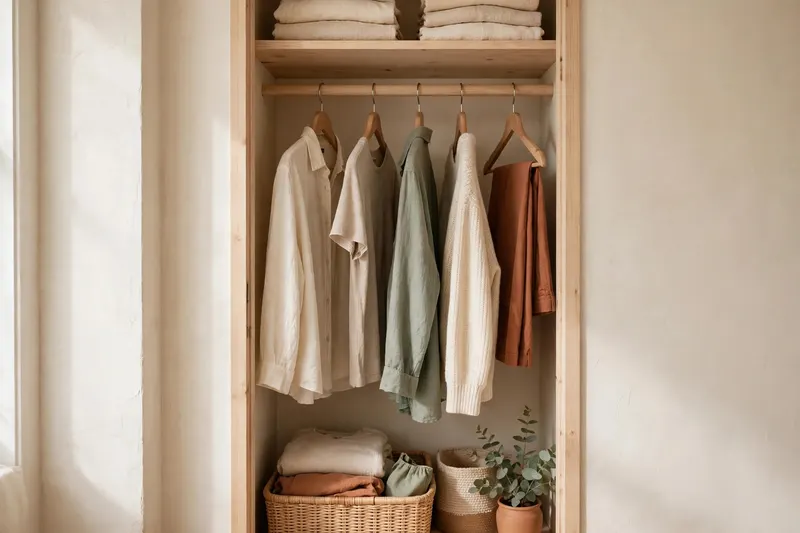
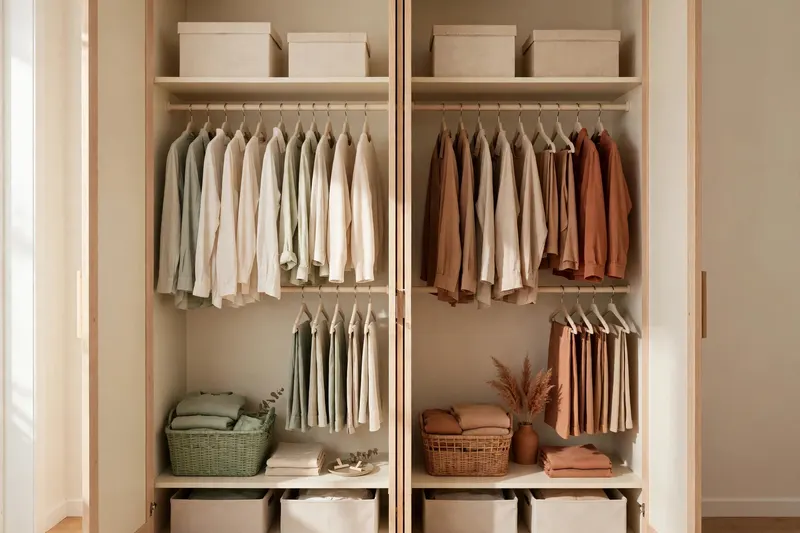
You open the closet door, the hallway light barely reaches past the first row of hangers, and you hold two near-identical shirts up to tell navy from black. Small closet lighting ideas fix that — and none need an electrician, a permit, or a hole in the wall. With battery LED strips and motion-sensor pucks, you can light a dark closet in twenty minutes.
Why closets stay dark (and what light actually fixes)
Most closets were never designed to be lit: one bare ceiling bulb gets blocked by the rod, shelves, and boxes, leaving a cave bright at the door and dark at the back. Good lighting fixes three things: the rod, so you can tell colors apart; the shelves, so you can find things without digging; and the floor, so you can see shoes.
1. Light the front of the clothes, not the ceiling
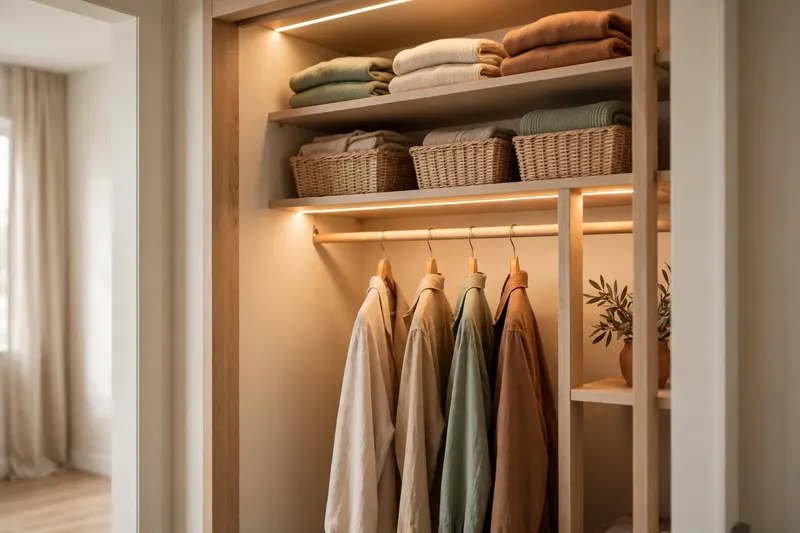
A ceiling bulb throws light straight down onto the tops of your hangers, leaving the fronts in shadow. Move the light to the front edge of the shelf above the rod and it falls across your garments instead.
2. Aim for even light, not bright light
A closet does not need a floodlight — just even, shadow-free light about as bright as a well-lit hallway. One 12-inch bar per shelf section, or a strip across the rod, gives you that. Two small, well-placed lights beat one big bright one.
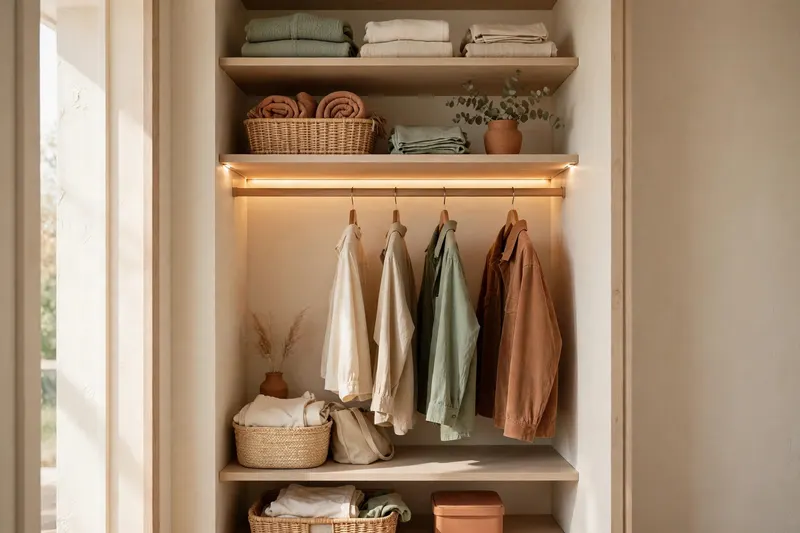
Battery LED strip lights: the easiest first upgrade
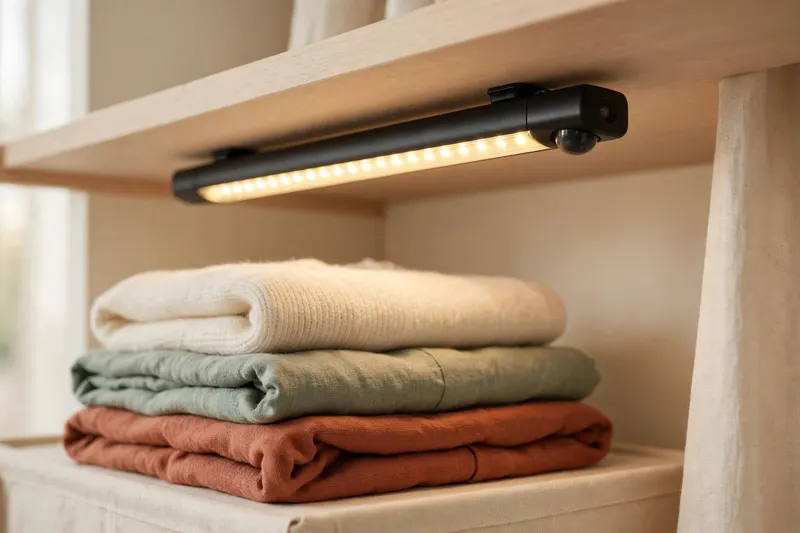
LED strips are the fastest way to transform a dark closet. They come on flexible adhesive-backed tape, run on batteries or a rechargeable pack, and bend around corners rigid bars cannot reach.
3. Run one strip under the shelf above the rod
This is the highest-impact placement in the whole article. Stick a battery LED strip under the shelf above your hanging rod, close to the front edge. Light washes down the front of every garment. Cut it to length at the marked cut lines.
4. Line the inside of the door frame for instant depth
If there is no shelf above the rod, or it is packed full, run a strip vertically down each side of the door frame, just inside the opening. The light hits your clothes from both sides at once, killing the shadows a single top-down light leaves behind.
Motion-sensor puck lights and bars for hands-free light
Puck lights are small round battery lights, usually 3–4 inches across, that stick to any flat surface; motion-sensor bars are their longer cousins. Both switch on when you open the door and off after 20–30 seconds of no movement, so batteries last months instead of weeks.
5. Stick a puck light on the ceiling for a quick win
One motion-sensor puck on the closet ceiling takes thirty seconds to install and fixes the “open the door, see nothing” problem. It is the best zero-commitment test if you rent.
6. Mount a motion bar on the side wall for hands-free light
A 10–12 inch motion-sensor bar mounted vertically on a side wall, at chest height, lights a reach-in closet every time you open the door.
Rechargeable vs battery vs plug-in: picking your power source
Every closet light runs on one of three power sources; the right choice depends on how often you open it.
7. Choose rechargeable for closets you open daily
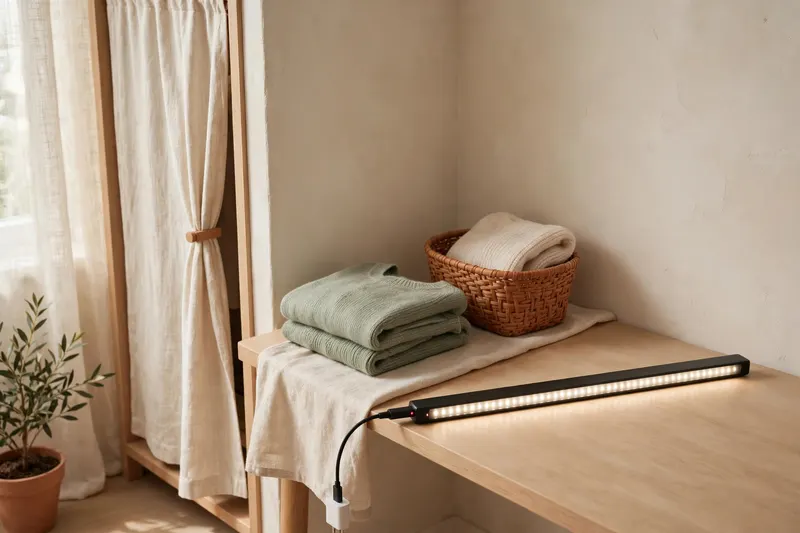
If you open the closet two or three times a day, a rechargeable LED bar is the cheapest option. Most recharge over USB in 2–3 hours and run 4–8 weeks between charges on motion-sensor mode.
8. Choose battery-powered for closets you open weekly
Guest-room closets and seasonal storage do not justify a rechargeable light you have to babysit. Three AAAs in a puck light last 6–12 months in a closet opened a few times a week. Plug-in lights only make sense if your closet already has an outlet — an extension cord across a bedroom floor is a trip hazard, not a solution. The same no-damage thinking applies to the rest of the closet, as these 17 renter-friendly closet organization ideas show.
Light the zones: rod, shelves, floor, and the dark corners
A closet is four zones stacked on top of each other, and each goes dark in its own way. Treat each zone separately and the whole closet becomes usable.
9. Put a short strip under every shelf, not just the top one
Folded clothes on lower shelves are hardest to find because the shelf above blocks the light. A 12-inch battery strip under the front edge of each shelf fixes this for about $5 a shelf. Start with the shelf you reach for most, usually the one at eye level.
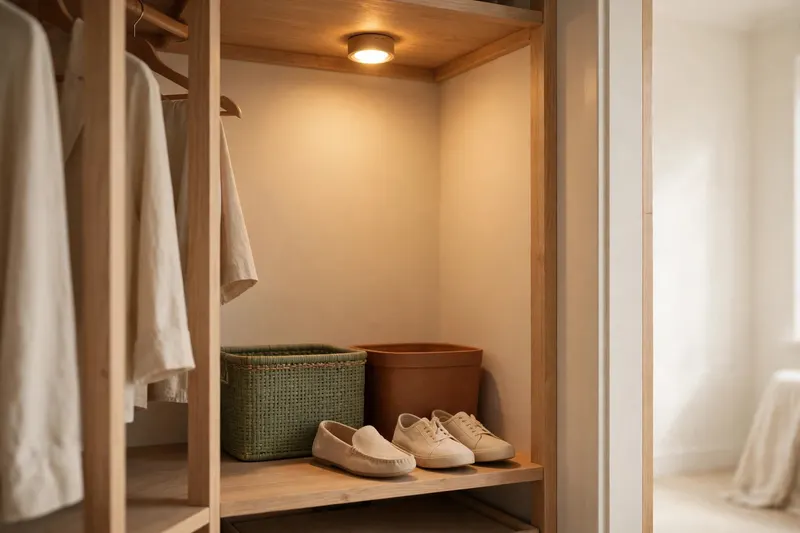
10. Add a low light for the shoe zone
Shoes live on the floor, which is the darkest part of any closet. A puck light under the lowest shelf, aimed down, or a short strip along the baseboard turns dark shoes into a row you can choose from. Pair it with the shelf lighting in our guide to 17 closet shelf organization ideas.
11. Light the dark corner with a puck, not a strip
Every closet has one corner that eats light — usually the far side away from the door. One puck light stuck to the wall in that corner, at shoulder height, fills it in. A strip is wasted here: the corner is small and the light would spill everywhere except where you need it.
Renter-safe mounting: no holes, no wiring, no damage
Everything here is renter-safe, but the mounting method matters: the wrong adhesive can peel paint or cost you part of a deposit.
12. Use Command strips, not screws, for bars and pucks
Small Command strips rated for 1–3 pounds hold a motion bar or puck on painted drywall, wood, and laminate, and peel off without damage when you move out. Use two strips per bar, one near each end, so it cannot sag and fall. Skip nails and screws: a closet light weighs almost nothing, and a screw hole is a repair you do not need.
13. Use the strip’s own adhesive only on smooth surfaces
LED strip adhesive bonds well to smooth, clean surfaces like painted wood and laminate — and badly to textured walls and dusty surfaces. Wipe the surface clean and dry before you stick. On textured surfaces, use small adhesive cable clips every 6 inches instead.
Warm vs cool light: what flatters clothes and skin tones
Light color matters more in a closet than in almost any other room: you judge colors and try things on in front of a mirror. The wrong temperature makes white shirts look yellow and navy look black.
14. Pick warm white (2700–3000K) for everyday closets
Warm white, around 2700–3000K, flatters skin tones and makes fabrics look the way they do in indoor daylight. It is the safest bedroom-closet default and matches the warm bulbs most bedrooms already have.
15. Use neutral white (4000K) only if you match outfits precisely
Neutral white, around 4000K, shows colors more accurately — the better choice if you need to tell navy from black or match a top to a bottom. Avoid cool daylight above 5000K — it makes everything look blue.
The 20-minute install plan and the once-a-year battery check
Here is the whole project in one sitting — no weekend, toolbox, or second pair of hands needed.
16. Install in this order: rod strip, motion bar, shelf strips, corner puck
Start with the strip under the shelf above the rod — the light you will notice most. Then the motion bar on the side wall, then a strip under the eye-level shelf, then the corner puck. Twenty minutes, four lights, done. After that, set one phone reminder for a year from today: check every battery and recharge every rechargeable light. LEDs use at least 75% less energy than incandescent bulbs, per the US Department of Energy, which is why a battery LED can run for months. Pair the new lighting with a tighter wardrobe — these 17 capsule wardrobe organization ideas for tiny closets work even better once you can see what you own.
Mistakes to avoid
Buying the cheapest strip on the shelf. Ultra-cheap strips often have weak adhesive, uneven brightness, and a color temperature the box misstates. Spend a few dollars more on a reviewed brand.
Lighting only the ceiling. A single ceiling light is what made the closet dark in the first place. If you buy one light, put it at the front of the shelf above the rod, not on the ceiling.
Using cool daylight bulbs. Anything above 5000K makes clothes look blue and skin look washed out. Stick to 2700–3000K warm white, or 4000K neutral white at most.
Blocking your own lights. A shelf packed to the very front edge, or hangers pushed tight against a strip, blocks the light you just installed. Leave a finger-width gap between strip and hanger.
Forgetting the batteries. A battery light with dead batteries is a decoration. Set the annual reminder from idea 16 and keep spare AAAs in the closet.
Frequently asked questions
Do I need an electrician to light a small closet?
No. Every idea here uses battery or rechargeable lights that stick on with adhesive or Command strips. No wiring, no drilling, no electrician — which is also why they are safe for renters.
What is the best closet light with no wiring?
A battery or rechargeable LED strip under the shelf above the rod is the best first choice — it lights the fronts of your clothes, where you actually look. Add a motion-sensor puck or bar for hands-free light, and a short strip under each shelf for folded clothes.
How long do battery closet lights last?
A motion-sensor puck or bar on three AAA batteries typically lasts 6–12 months in a closet opened a few times a week, and 2–3 months in one opened several times a day. Rechargeable bars usually run 4–8 weeks per charge.
Can I put LED strip lights in a closet safely?
Yes — LEDs run cool to the touch, so they are safe near fabric. Keep strips a few inches from clothes, never cover them with fabric, and never run a mains extension cord into the closet.
What color light is best for a closet?
Warm white, 2700–3000K, is the best default: it flatters skin tones and matches bedroom lighting. Use neutral white, around 4000K, if you need to judge colors precisely — for example, telling navy from black. Avoid cool daylight above 5000K.
Conclusion
A dark closet is not a storage problem — it is a lighting problem, and one of the cheapest problems in a small home to fix. One strip above the rod, one motion light on the wall, and a little light on the shelves turn a cave into a closet you can actually use every morning. Start with the rod strip tonight; the rest can follow this weekend. Browse more in our closet organization category and save this pin for later.