Baking sheets are the quiet chaos of a small kitchen. They slide off stacks, jam in cabinets, and take up an entire shelf while holding nothing. If your cookie sheets live in a leaning pile that crashes down every time you reach for one, you need better small kitchen baking sheet storage. The fix: store sheets upright, like files in a drawer, and give every tray a slot it fits. These 16 ideas work in rentals and galley kitchens. You will learn how to file sheets upright, use the gaps your kitchen already has, and keep your nonstick coatings scratch-free.
Why baking sheets are the hardest thing to store in a small kitchen
Baking sheets break every normal storage rule. Flat, wide, and rigid, they do not stack neatly or fit in bins, and they waste the vertical space above them when laid flat. A standard half-sheet pan measures about 18 by 13 inches, while most cabinet openings are only 12 to 15 inches across. That is why a pile of sheets always ends up horizontal, taking a whole shelf. Most kitchens also hold a mixed set, and different sizes and rims mean no stack ever sits flat. The answer is to stop stacking and start filing.
1. Measure every sheet before you buy anything
Pull out every sheet, tray, and rack and measure the longest side of each one. Then measure the inside of the cabinet or gap where you plan to store them. Buy nothing until the numbers match — a rack that fits a 13-inch pan is useless if your roasting tray is 16 inches wide.
2. Sort sheets by size, then store them in that order
Group your sheets into three piles — large, medium, and small — and file each group together, largest at the back.
Vertical dividers: the upright filing system for sheets and trays
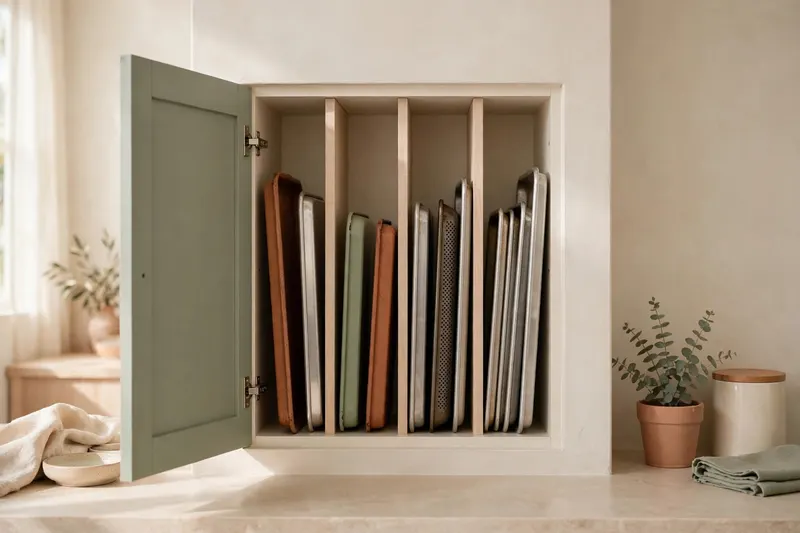
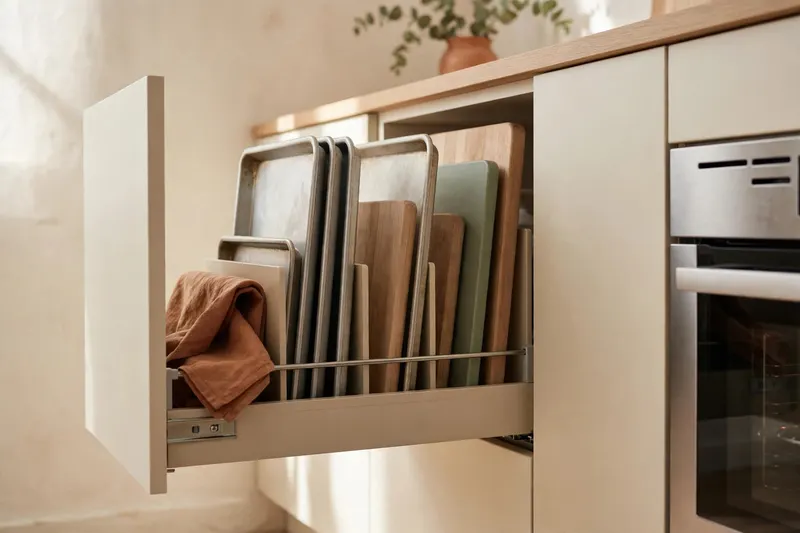
Vertical storage is the single biggest upgrade you can make. A sheet stored upright takes about an inch of width and uses the cabinet’s full height, so the same cabinet that holds six flat pans can hold ten or twelve filed upright — and you can pull any one out without moving the rest.
3. Add a tension-rod divider inside a deep cabinet
Place two or three spring-loaded tension rods vertically inside a base cabinet, about 2 inches apart, to create instant slots. This costs a few dollars and needs no screws. It works best in cabinets at least 12 inches deep.
4. Use a purpose-built vertical pan rack
A metal vertical organizer with fixed slots — the kind sold as a baking sheet organizer for a small kitchen — holds sheets, cutting boards, and muffin tins in one unit. Look for slots at least 2 inches apart so rimmed pans slide in freely. A standard rack about 10 inches wide fits most base cabinets and holds six to eight pans.
5. Turn a lid organizer into a sheet file
A pot-lid organizer does the same job as a pan rack at about half the price. The adjustable dividers grip thin sheets well and fit under shelves a tall rack cannot. Our guide to small kitchen pot and pan storage ideas covers lid racks that actually work.
6. File cutting boards with your sheets
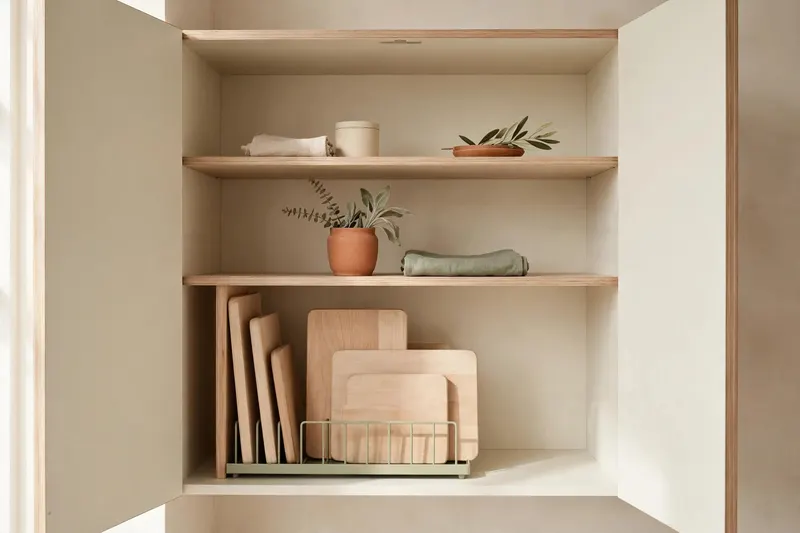
Cutting boards are the same shape problem, so store them in the same vertical system. Keep the board you use daily at the front of the file so it is the first thing your hand finds. For more board-specific setups, see our 15 small kitchen cutting board storage ideas.
Above the cabinets and fridge: using the dead zone
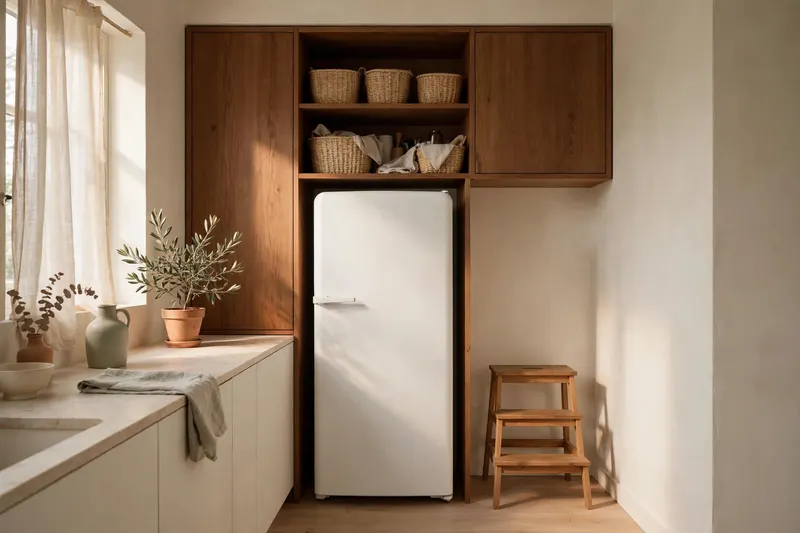
The space above your wall cabinets and fridge is the most underused storage in a small kitchen. It is too high for daily items, which makes it perfect for the roasting pan you use twice a month and the extra half-sheets you only need at holidays.
7. Store occasional-use trays above the fridge
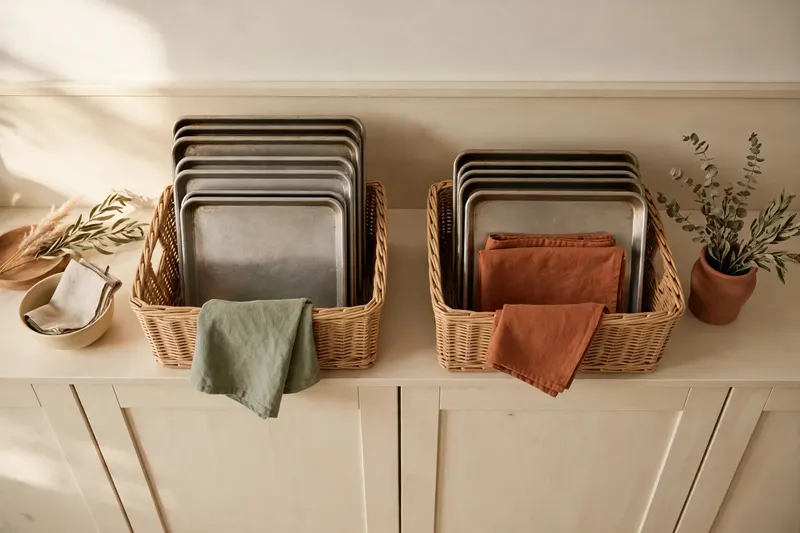
The top of the fridge holds two or three flat trays easily, and the heat from the fridge is not enough to damage metal pans. Put the holiday roasting tray and the spare half-sheet up there in a shallow basket so they cannot slide off the back. Our 16 above-fridge storage ideas for small kitchens cover the full setup, including what never belongs up there.
8. Line the top of the wall cabinets with a tray row
If the gap between your wall cabinets and the ceiling is at least 6 inches, stand your least-used trays upright along it, leaning against the wall. A tension rod or non-slip shelf liner at the base stops them sliding forward. Keep it to three or four trays.
Inside cabinet doors and narrow gaps
Small kitchens are full of gaps too narrow for a shelf but perfect for a flat pan: beside the fridge, inside a cabinet door, the six-inch strip beside the oven.
9. Mount a rack on the inside of a cabinet door
A slim wire rack on the inside of a tall pantry or cabinet door holds one or two flat sheets and a cooling rack. Measure clearance first — rack plus sheet must be thinner than the gap to the shelf edge, or the door will not close.
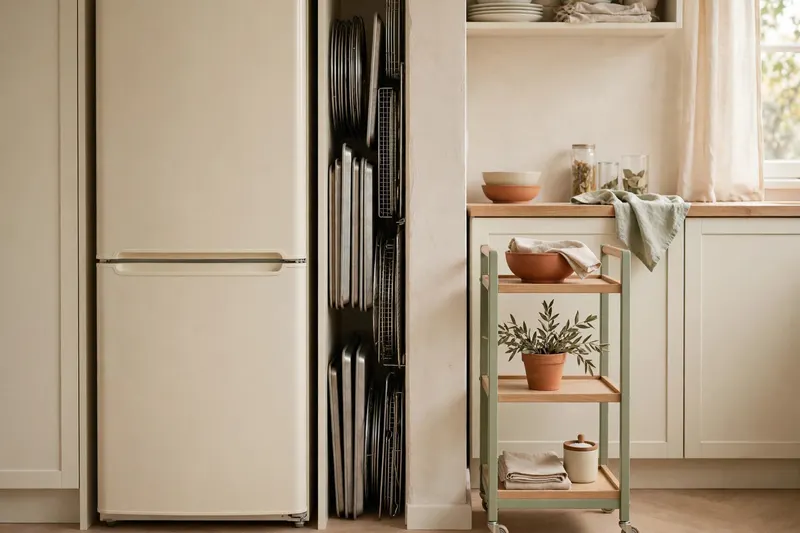
10. Slide sheets into the gap beside the fridge or oven
A gap of 4 to 6 inches between the fridge and the wall is a ready-made sheet slot. Stand two or three sheets in it, rims down. Never use the gap beside the oven — heat warps thin aluminum, and grease splatter coats everything stored there.
Rolling carts and pull-outs for sheet storage
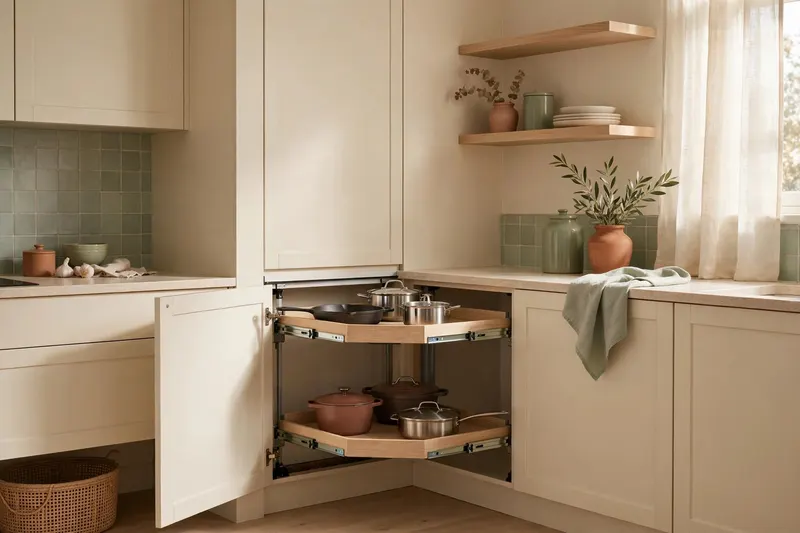
When no cabinet fits your sheets, give them their own piece of furniture. A slim cart or a pull-out turns a dead corner into a filing cabinet for pans.
11. Use a slim rolling cart as a sheet tower
A three-tier rolling cart about 6 inches wide holds sheets upright on the bottom tier and smaller trays and parchment rolls above. Park it between the counter and the fridge, and roll it out when you bake.
12. Add a pull-out divider to a base cabinet
If you own your kitchen, a pull-out vertical divider — a narrow drawer fitted with slots — is the most satisfying option here. You pull the drawer, the whole file comes out to you, and you slide it back. They need exact measurements and a drill, so treat it as a weekend project. If you are rethinking the whole cabinet, our 18 small kitchen cabinet organization ideas will help you plan around it.
Nesting and stacking trays without scratching them
Sometimes vertical storage genuinely does not fit — a shallow drawer, a low shelf, a full cabinet. When stacking is the only option, stack smart.
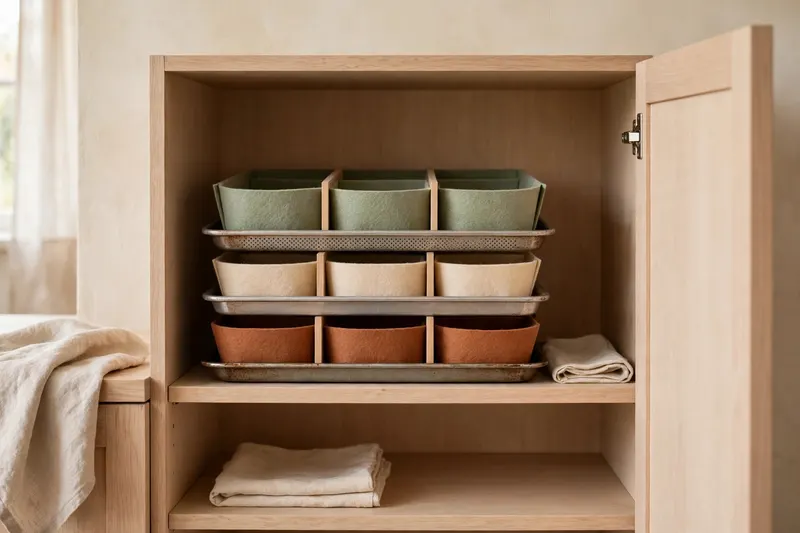
13. Separate stacked pans with parchment or pan protectors
Place parchment paper, a silicone baking mat, or a felt pan protector between every two pans in a stack. It costs almost nothing and stops rims grinding the coating off the pan below.
14. Nest same-size pans and retire the odd ones
Pans nest cleanly only when they are the same size and shape — two identical half-sheets take half the space of two mismatched ones. If you have five pans and only two match, the three odd ones are costing you more space than they are worth.
The one-in-one-out rule for sheet pans
Storage systems fail when the collection keeps growing — every idea above assumes a fixed number of sheets.
15. Cap your collection at what your rack holds
Count the slots in your organizer and let that be your limit: if the rack holds eight sheets, you own eight. When a new pan arrives, an old one leaves the same day.
16. Audit your sheets every six months
Twice a year, pull every sheet out and check: is it warped, is the coating peeling, have you used it in the last six months? A warped pan bakes unevenly, and a peeling coating belongs in the recycling. Retire the failures on the spot. Pair this with our 16 small kitchen baking station organization ideas so your pans and supplies stay in one working zone.
Mistakes to avoid
- Stacking everything flat in one pile. Every grab scratches the pans above it. File upright wherever you can.
- Buying an organizer before measuring. Cabinet interiors are smaller than they look. Measure twice, buy once.
- Storing sheets beside the oven. Heat warps thin aluminum and coats stored pans in grease. The fridge gap is fine; the oven gap is not.
- Keeping warped or peeling pans “just in case.” A warped pan bakes unevenly and a flaking coating is not worth saving. Retire them.
- Filling the dead zone with daily pans. Anything above the fridge or wall cabinets should be used monthly at most. Daily sheets belong at waist height or below.
- Overloading a door rack. A rack holding more than about 5 pounds will sag the hinges over time. Two flat sheets is the limit for most adhesive mounts.
Frequently asked questions
Can I store baking sheets above the fridge?
Yes, for occasional-use trays like a roasting pan or spare half-sheets. Keep them in a shallow basket so they cannot slide off, and keep a step stool nearby.
How do I stop my sheet pans from scratching each other?
File them upright so the surfaces never touch, or separate stacked pans with parchment paper, silicone mats, or felt pan protectors.
What is the best organizer for cookie sheets in a small kitchen?
A vertical divider rack inside a base cabinet is the best all-round choice: it holds six to eight sheets in about 10 inches of width. For renters, tension rods or a slim rolling cart give the same upright filing with no drilling.
Can I store baking sheets in a drawer?
Yes, if the drawer is at least 19 inches deep for a half-sheet pan. Use dividers to file sheets upright, or lay them flat with pan protectors between each one.
How many baking sheets does a small kitchen need?
Two half-sheets, one quarter-sheet, and one roasting tray cover almost all home baking. Add a jelly-roll pan only if you bake rolled cakes or roast vegetables often.
Conclusion
Baking sheets do not need a bigger cabinet — they need a system. File them upright, use the narrow gaps and dead zones your kitchen already has, and cap the collection at what your rack holds. Start with the vertical divider, and your next bake will begin without the crash of a falling pan pile. Save this pin for later, and browse more ideas in our kitchen organization collection.