Pots and pans are the biggest space thieves in a small kitchen. A single 12-inch skillet can swallow a whole cabinet shelf, and a stack of nested pans becomes a wobbly tower you have to dismantle every time you cook. These small kitchen pot and pan storage ideas fix that by changing how your cookware sits: filed vertically instead of stacked, hung instead of hidden, and separated from its lids.
The pot and pan audit: count, measure, and purge
Before you buy a single rack, find out what you actually own. Most small kitchens hold two or three pans that never get used, and those are the ones eating your cabinet space.
1. Count every pot, pan, and lid — then cut the duplicates
Pull everything out onto the counter and count it. Most cooks use two skillets, one saucepan, and one stockpot for most of their meals. If you have four skillets, two can go.
2. Measure your cabinets before buying anything
Measure the inside height, depth, and width of each cabinet you plan to use. A 12-inch skillet needs at least 13 inches of clear width to file vertically, and usable shelf height is often only 11 to 12 inches.
3. Purge the warped, wobbly, and lidless
Check every pan for a warped base that rocks on the counter, a loose handle, or a nonstick surface scratched down to bare metal. A warped pan heats unevenly and is not worth the space it takes, and a pot without a lid is rarely the one you reach for.
Lid storage: racks, files, and door mounts
Lids cause half the chaos. They are round, awkward, and impossible to stack neatly, so they slide around on top of the pans they belong to. Separating lids from pans is the single highest-impact change you can make.
4. File lids upright in a tension-rod slot
Stand lids on edge in a row, like books on a shelf. A spring-loaded tension rod mounted horizontally across a cabinet, about 4 inches from the back wall, creates a narrow channel that holds lids upright and easy to pull out one at a time.
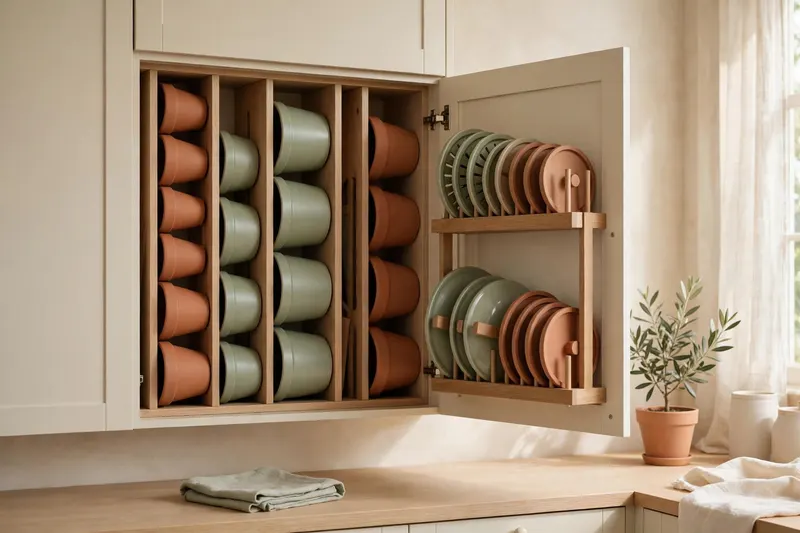
5. Mount a lid rack on the inside of a cabinet door
The inside of a cabinet door is dead space in most kitchens, and it is perfect for lids. A door-mounted wire rack holds two to four lids flat against the door, using screws or strong adhesive hooks.
Wall hanging: hooks, rails, and pegboards
Wall space is the most underused storage in a small kitchen. Hanging pans frees an entire cabinet and puts your everyday cookware at arm’s reach.
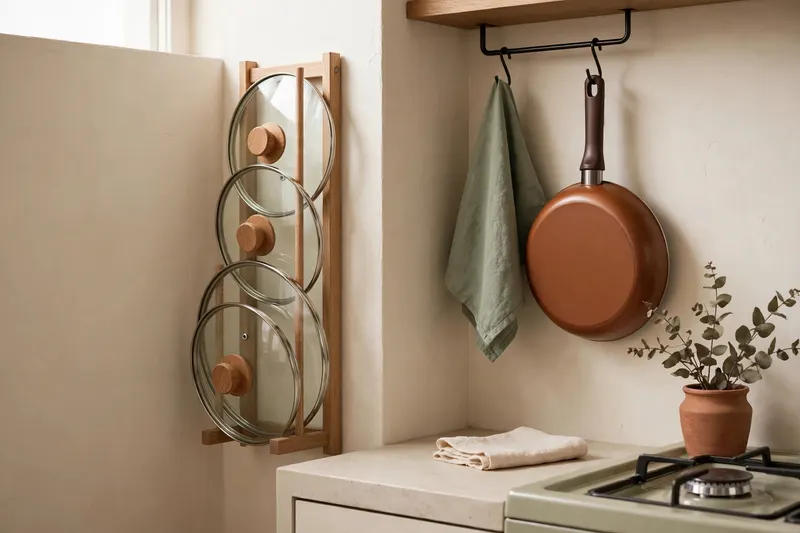
6. Hang pans from a wall-mounted rail with S-hooks
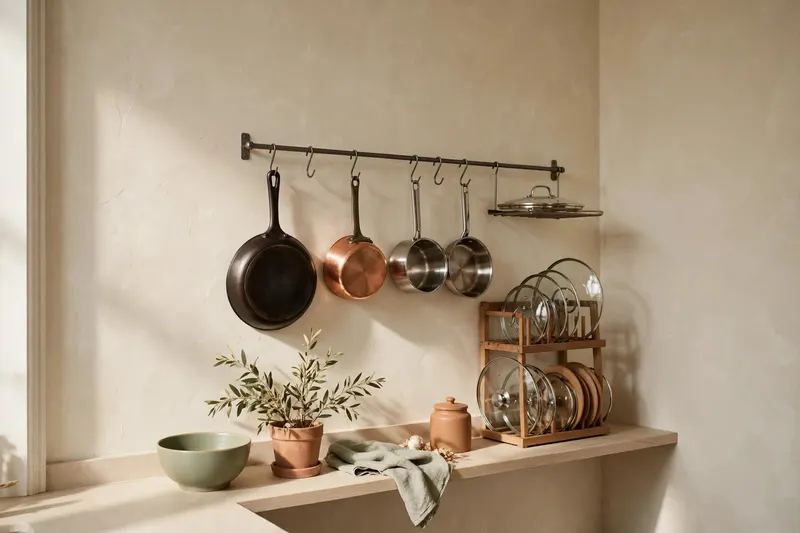
A stainless steel rail, about 24 inches long, mounted beside or above your stove, holds four to six pans on S-hooks. Mount it into studs or use heavy-duty wall anchors rated for at least 30 pounds — a cast-iron skillet alone weighs 7 to 8 pounds.
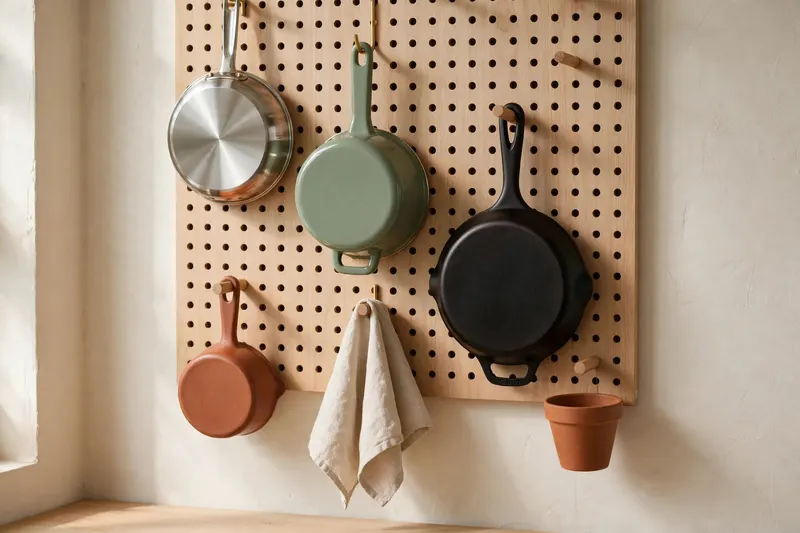
7. Use a pegboard for a flexible hanging wall
A pegboard panel, roughly 24 by 36 inches, gives you a wall you can rearrange whenever your cookware changes. Use metal hooks and small baskets to hold pans, lids, and measuring cups in one place, at least 18 inches from the stovetop.
8. Hang a pot rack from the ceiling over an island or peninsula
If you have an island or peninsula with open space above it, a ceiling-mounted pot rack uses air that nothing else can. Hang it so the bottom of the lowest pan sits at least 6 feet 6 inches off the floor, and secure it into ceiling joists, not just drywall. For more ways to get cookware off your counters, see these kitchen wall storage ideas for small kitchens.
Drawer dividers for pans and lids
Deep drawers are often better pan storage than cabinets. You can see everything at a glance, and you never have to reach into a dark cabinet and pull out a stack to get the pan at the bottom.
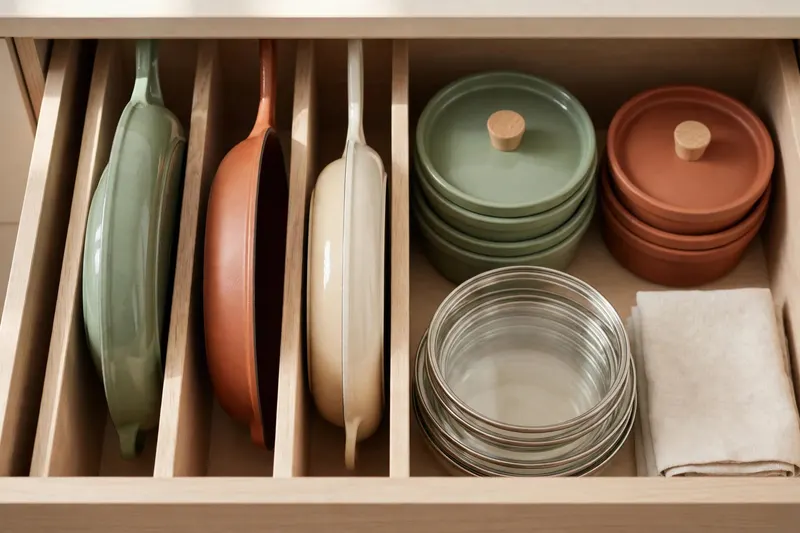
9. Fit a deep drawer with adjustable pan dividers
A deep drawer — 8 to 10 inches tall — can hold three to four pans filed vertically with adjustable dividers. The dividers hold each pan on its side like a file folder, but a 12-inch skillet needs a drawer at least 13 inches wide and 13 inches deep.
10. Keep lids in a separate shallow drawer with a file organizer
Lids stored in the same drawer as pans always end up sliding under them. Give lids their own shallow drawer with a small file organizer or a row of tension rods, and they stay upright and sorted by size. For a full drawer-by-drawer plan, these kitchen drawer organization ideas for tiny drawers cover zones, dividers, and the one-drawer-per-task system.
Vertical filing inside deep cabinets
Stacking is the default in most kitchens, and it is the worst way to store pans. Every pan on the bottom of a stack is a pan you avoid using, because getting it out means moving everything above it.
11. Stand pans on edge with a vertical pan rack
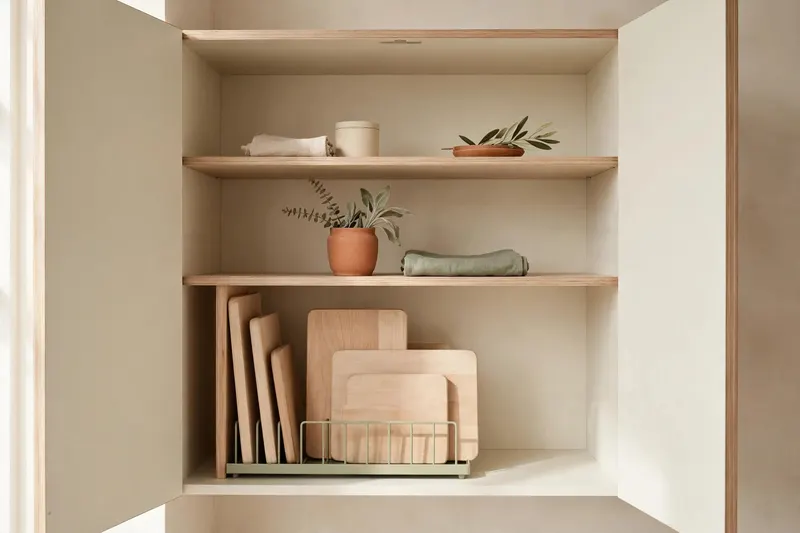
A vertical pan organizer — a wire or metal frame with slots — lets you slide pans in on their sides, handles up, like books on a shelf. Place it in a deep base cabinet and sort pans by size, largest at the back, smallest at the front.
12. Use a pull-out cabinet organizer for the bottom shelf
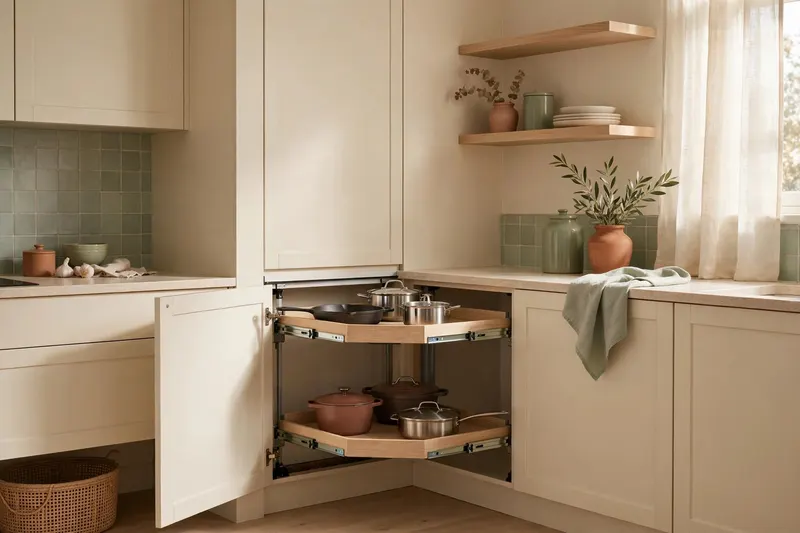
A pull-out sliding shelf turns the back of a deep cabinet from a black hole into usable space. Mount a two-tier pull-out organizer on the cabinet floor, load pans vertically on the lower tier and lids on the upper one, and slide the whole thing out to reach anything without crouching.
13. Stack with pan protectors if you must stack
Sometimes vertical filing is not possible, especially in a cabinet with a fixed shelf that is too short. If you have to stack, put felt or silicone pan protectors between each pan to stop nonstick coatings from scratching, and never stack more than three.
The everyday pan rule: what lives within reach
Not every pan deserves the same spot. The two or three pans you use most should be the easiest to reach, and everything else can live further away. This is the rule that keeps an organized cabinet organized.
14. Keep only your daily pans in the prime cabinet
Pick your two or three daily pans — usually a skillet, a saucepan, and a saute pan — and give them the cabinet closest to the stove, at waist height. If you have not used a pan in the last month, it does not belong in the prime spot.
15. Store the everyday lid with its pan, not in the lid file
The one exception to the separate-lids rule is your daily pan. Keep its lid on top of the pan, handle up, so you can grab both in one motion while cooking. The rest of the lids stay in the file or on the door rack.
Small-space fixes for tiny kitchens
When your kitchen has two cabinets and no wall space, the standard advice falls apart. These fixes work when you have almost nothing to work with.
16. Use the side of the fridge or a narrow gap for a slim rack
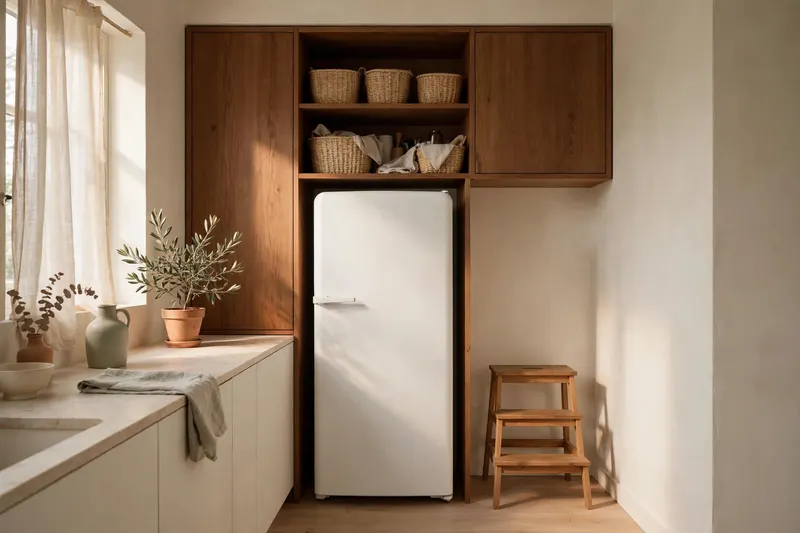
The side of a refrigerator holds a magnetic rack or a slim adhesive rail that can carry two or three lightweight pans or lids. A gap of even 6 inches between the fridge and the wall fits a narrow rolling cart for lids, baking sheets, and one or two thin pans.
17. Move seasonal and specialty pans out of the kitchen
The turkey roaster, the paella pan, and the fondue pot do not need to live in a kitchen with three cabinets. Store them in a labeled bin on a closet shelf, under the bed, or on top of a wardrobe, and bring them out only when you need them. If your whole cabinet system needs a reset, these small kitchen cabinet organization ideas walk through zones, shelf risers, and door storage.
Mistakes to avoid
Do not buy organizers before measuring. A rack that is an inch too tall or too wide is useless. Do not stack lids on top of nested pans — they slide off and chip things, so lids need their own system: a file, a door rack, or a drawer.
Never hang heavy cast iron on adhesive hooks or suction mounts. Adhesive fails slowly, usually at night, and a falling skillet can crack a tile or a toe. Screws into studs or proper anchors are the only safe mount for anything over 5 pounds. Finally, do not keep every pan you have ever owned — the pans you never use block the ones you do, so organize around the pans you actually cook with.
Frequently asked questions
How do I store pots and pans in a small kitchen without a pantry?
File pans vertically in your deepest cabinet or drawer, store lids separately in a file or on a cabinet door, and move one or two daily pans to a wall rail.
Can I hang pots and pans on the wall in a rental?
Yes, with renter-safe mounts. Use adhesive rails and hooks rated for the weight of each pan, or a tension-rod system inside a cabinet. Avoid drilling into tile, and keep cast iron in a cabinet.
Should lids be stored with their pots or separately?
Separately, with one exception. Storing lids in a file, a door rack, or their own drawer stops the sliding tower problem and makes every pan easier to grab. The exception is your daily pan — keep its lid on top.
What is the best way to store a cast-iron skillet?
Store it in a dry spot with the lid off or ajar so moisture does not collect inside, and place a paper towel or pan protector between it and any pan stacked above it. A light coat of oil on the cooking surface before storage helps prevent rust.
How many pots and pans does a small kitchen actually need?
Most home cooks need five or six pieces: a 10- or 12-inch skillet, a small saucepan, a medium saucepan or saute pan, a stockpot, and one baking sheet. Add one specialty piece you genuinely use weekly.
Conclusion
Pots and pans take up the space they do because of how they sit, not how many you own. File them vertically, separate the lids, hang the daily pans where you can reach them, and move the seasonal pieces out of the kitchen. Start with the audit and the lid file today — those two steps alone usually free a full shelf. Save this pin for later, and explore more ideas in the kitchen category.