Small kitchen open shelving ideas look effortless in photos and chaotic in real life, usually within a week of installation. The shelves are not the problem. Open shelves have no doors to hide behind, so every extra mug, mismatched bowl, and half-empty box is on display all day. The fix is not more shelves or prettier dishes. It is a strict rule: only daily-use items earn a spot, everything matches, and the whole setup gets a five-minute reset once a week. These 16 ideas show you how to run open shelves in a small kitchen so they stay tidy long after the novelty wears off.
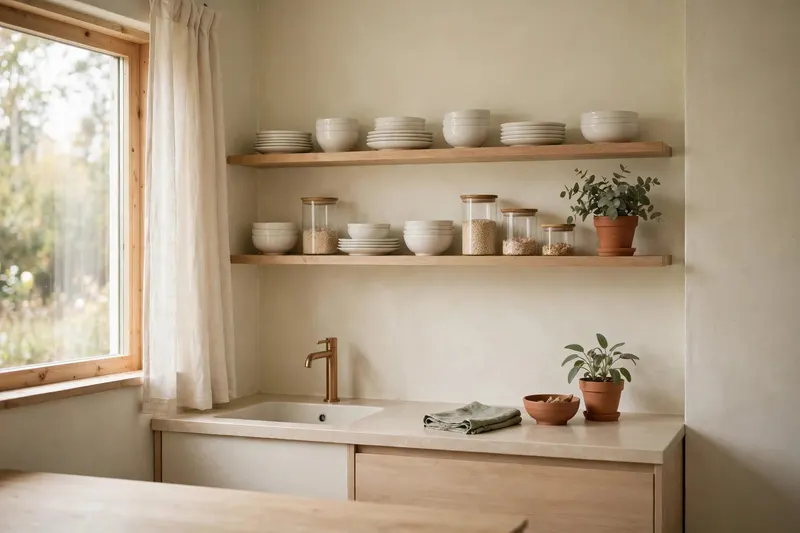
The open-shelf audit: what earns a spot and what hides in a cabinet
Before you put a single thing on a shelf, audit what you own. The audit takes about 20 minutes and decides whether your shelves look curated or cluttered.
1. Apply the daily-use test to everything
Hold each item and ask: do I use this at least four times a week? Plates, bowls, your two favorite mugs, and the glasses you reach for every morning pass. The fondue set, the holiday platter, and the third water bottle fail. Daily-use items earn the shelves; the rest goes in a cabinet or out of the kitchen.
2. Make a hides-in-a-cabinet list and stick to it
Write down what never belongs on open shelves: cleaning supplies, plastic food containers and their lids, small appliances you use less than weekly, and open snack bags with bright labels. Tape the list inside a cabinet door for the first month. Open shelves fail slowly, one “just for now” item at a time, and this list stops the drift.
Uniform stacks: matching dishes and glassware that look intentional
Uniformity is what makes open shelves look calm instead of busy. You need items that share a color, a shape, or a material, stacked the same way every time.
3. Commit to one matching set of everyday dishes
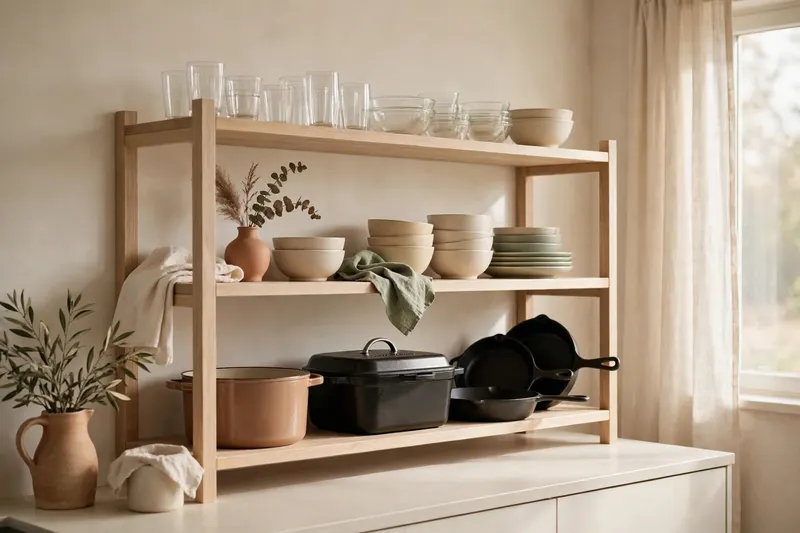
Pick one set of plates and bowls in a single color, ideally white or cream, for the shelves. Four to six place settings is enough; spares and novelty plates live in a cabinet. Stack plates in piles of four to six and bowls in piles of three to four, keeping every stack the same height.
4. Line up glassware in a single row, one style only
Glasses multiply faster than any other kitchen item. Keep one style of drinking glass on the shelf, six to eight at most, in a single row with about an inch between each. Store wine glasses upside down by the base, or keep them in a cabinet if the shelf is too short. Retire souvenir glasses and chipped ones to a donation box the same day you do the audit.
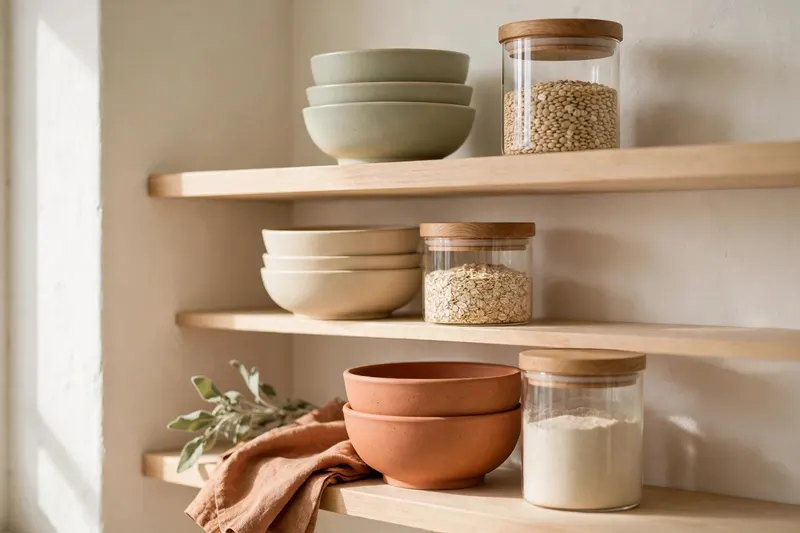
Daily-use zone: keep the everyday within arm’s reach
A daily-use zone means the things you touch every morning sit between your shoulders and your waist. Everything else goes higher or lower.
5. Put the breakfast shelf at arm’s reach
Dedicate the shelf at chest to shoulder height to breakfast: bowls, mugs, the coffee or tea canister, and small plates. You will touch this shelf three times before 9 a.m., so it should work without thinking. Keep one category per shelf section, about 12 to 18 inches wide per group, with a small gap between groups.
6. Build a tiny coffee or tea station on one shelf end
Give your coffee or tea setup a fixed 12-inch-wide home at one end of the daily-use shelf: canister, two mugs, and a small spoon jar, nothing else. Keeping the station together ends the three-shelf morning hunt. If counter space is tight, a renter-friendly kitchen organization setup shows how to pair this shelf station with the rest of the kitchen without drilling a single hole.
Containers and jars: the uniform rule for open shelves
Containers are where open shelves look styled or cluttered. The rule is simple: same jar, same lid, same label style, or it does not go on the shelf.
7. Decant dry goods into matching jars
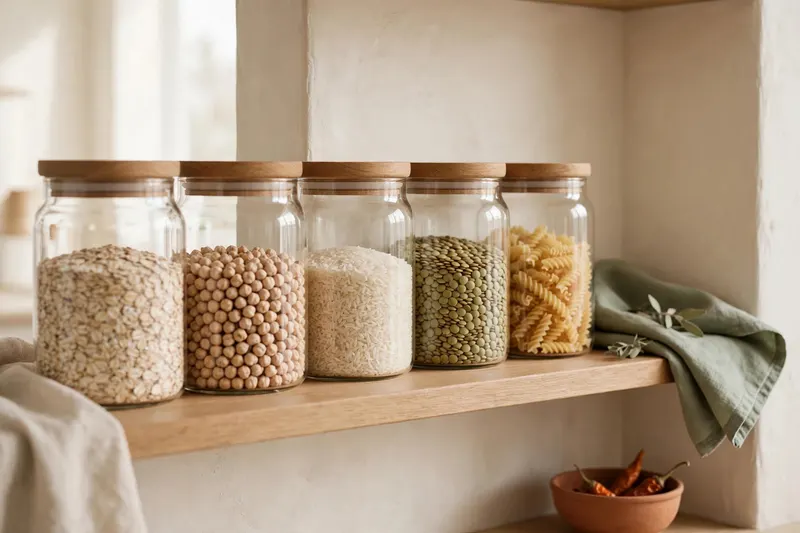
Move flour, rice, pasta, oats, sugar, and coffee into identical airtight glass jars: roughly 32-ounce jars for flour and sugar, 16-ounce for coffee and oats. Buy one set of six to eight jars rather than collecting them one at a time. Keep refill bags in a cabinet.
8. Label every jar the same way, in the same spot
Use one label style for every jar, either a small chalk label or a plain printed label, placed at the same height on the front of each jar, about one inch from the base. Write the contents and, for anything perishable, the month you opened it. Skip decorative labels with different fonts and colors, because on an open shelf they read as visual noise.
The styling line: where storage ends and clutter begins
Open shelves are storage first and decoration second. The styling line is the point where adding one more item makes the shelf look worse, not better.
9. Leave one-third of every shelf empty
Aim for roughly two-thirds full and one-third breathing room on every shelf. That empty space is what makes the shelf read as organized. When a shelf is full edge to edge, even matching dishes look crowded. If you cannot reach two-thirds, move items to a cabinet.
10. Allow one decorative piece per shelf, no more
One small plant in a plain pot, one small framed print, or one wooden board leaning against the wall is enough decoration per shelf. Two or more decorative items per shelf start competing with the dishes for attention. Put the plant at one end, not the middle, so it frames the dishes instead of splitting them. For the walls around your shelves, our kitchen wall storage ideas cover rails, hooks, and racks.
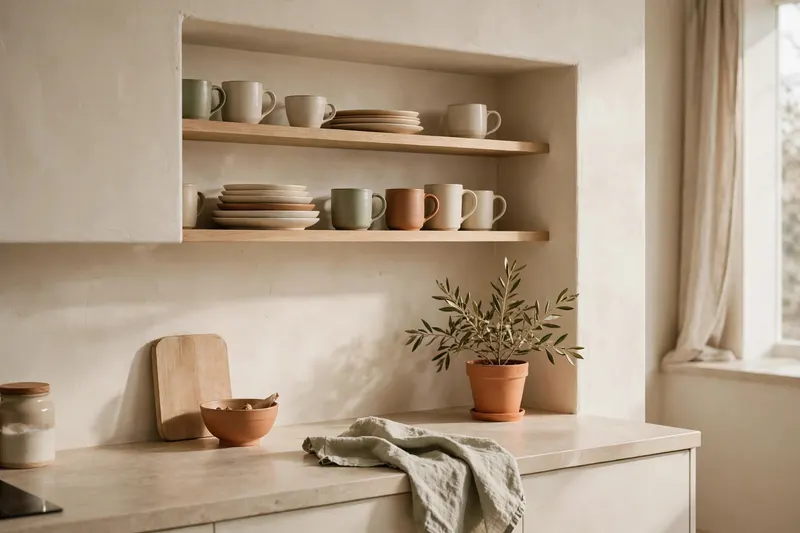
Heavy stuff low, light stuff high: the safety rule
Open shelves have no doors to catch a falling stack, so weight placement is a safety rule. Heavy items low, light items high.
11. Keep heavy items on the lowest shelf
Cast-iron skillets, ceramic baking dishes, large mixing bowls, and full canisters belong on the lowest shelf, at waist height or below, where you can lift them safely with both hands. Never store a stack of heavy plates above shoulder height. As a rough guide, anything over about 3 pounds should sit low.
12. Reserve the top shelf for light, rarely used items
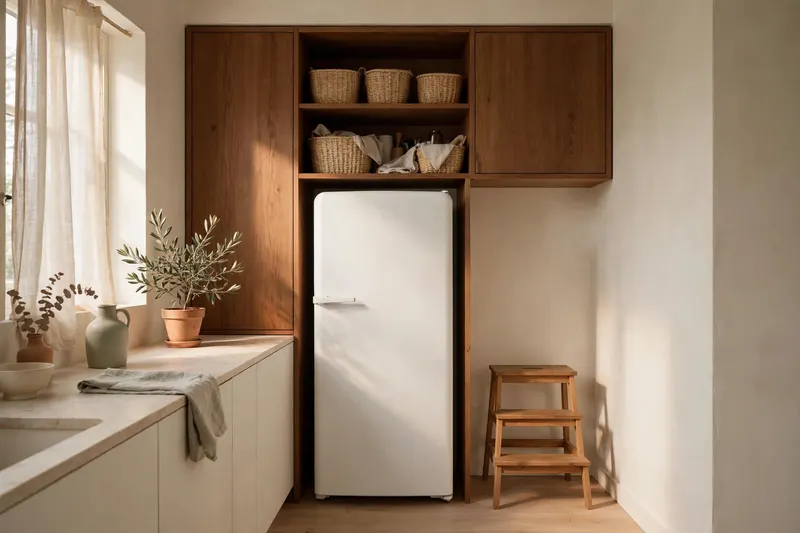
The top shelf is for the lightest things you own: a few spare linen napkins in a basket, a lightweight serving platter, or the pretty pitcher you use twice a month. Keep a folding step stool in a nearby closet for the rare times you need to reach it. If you have to climb onto a counter to reach something you use weekly, it belongs lower down.
Dust and grease: keeping open shelves clean in a real kitchen
Dust and cooking grease are the honest reason many people give up on open shelves. Both are manageable if you plan for them.
13. Let daily use do half the cleaning for you
Items you use every day do not gather dust, because they get washed and handled constantly. For pieces you use less often, give them a quick wipe when you put them back. A damp microfiber cloth takes about 20 seconds per shelf.
14. Wipe shelves weekly and line them against grease
Wipe the shelf boards once a week with a damp cloth and a drop of dish soap, especially the shelf nearest the stove, where grease settles fastest. If your stove is within about three feet of the shelves, use removable shelf liners you can rinse in the sink. Do not store anything directly above the stove or toaster: heat and steam loosen shelf brackets over time.
The weekly 5-minute shelf reset
A reset is not a deep clean. It is a short routine that returns the shelves to their day-one state before small drifts become a weekend project.
15. Run the reset every Sunday in five steps
Set a timer for five minutes and work left to right: pull off anything that fails the daily-use test and return it to a cabinet; restack any leaning piles; push every jar label to face forward; wipe the shelf fronts with a damp cloth; step back and check for one empty gap per shelf.
16. Enforce one-in, one-out for everything on the shelves
Every time a new mug, jar, or dish joins the shelves, an old one leaves. This rule keeps the system working after month three, when new things start arriving. Keep a donation box in a nearby closet so the outgoing item leaves immediately. If you cannot name what will leave, the new item stays in its bag until you can.
Mistakes to avoid
The most common mistake is treating open shelves as overflow storage for everything that does not fit elsewhere. Overflow goes on open shelves last, not first. The second mistake is buying display pieces before doing the audit: pretty jars are the reward for a good audit, not a substitute for one. Finally, do not install shelves you cannot reach: a shelf that needs a chair will sit empty or hold something you never use.
Frequently asked questions
How many open shelves should a small kitchen have?
Two to three shelves is the sweet spot, usually 24 to 36 inches wide each. More than that and you run out of daily-use items to fill them, so the extra shelves collect dust instead of earning their keep.
Can open shelves work in a rental kitchen?
Yes, with renter-friendly mounting. Heavy-duty adhesive brackets and tension-rod systems work for light loads, and a freestanding leaning shelf needs no wall fixing at all. Check your lease first, and keep the load under the stated limit, usually 10 to 15 pounds per bracket pair.
How do I keep open shelves from looking messy?
Apply the three rules in this guide: daily-use items only, everything matches, and one-third of each shelf stays empty. If a shelf still looks messy, remove items one at a time until it looks calm.
What should I do with the dishes that do not fit on the shelves?
Store them in a closed cabinet, grouped by use: baking dishes together, serving pieces together, spares together. Our small kitchen cabinet organization guide covers risers and bins that roughly double what fits inside.
How often should I clean open kitchen shelves?
Wipe the shelf boards weekly with a damp cloth, about two minutes for two to three shelves. Daily-use pieces get washed through use; rarely used pieces just need a rinse first.
The bottom line
Open shelves stay tidy when the rules are strict and simple: daily-use items only, matching stacks and jars, heavy low and light high, and a five-minute reset every week. Do the audit first, keep one-third of each shelf empty, and let one-in-one-out protect the system. Browse more ideas in our kitchen category and save this pin for later.