You open the drawer for the cumin and a dozen jars roll, clink, and tip over. The paprika you need is buried at the back — or is that the chili powder? Small kitchen spice organization ideas are not about a magazine spread. They are about ending that daily hunt, and the money lost buying spices twice because you could not find the first jar. These 16 ideas fit real small kitchens, and every one is cheap, reversible, or both.
The spice audit: what you actually use vs what expires quietly
Before you buy a rack or jar, sort what you own. Most small kitchens hold 20 to 30 spice jars, and a third are duplicates, one-recipe blends, or jars past their best.
1. Pull every jar out and sort it into three piles: weekly, monthly, and never. Weekly spices — salt, pepper, garlic powder, cumin, your most-used chili — earn the best spot. Monthly spices go one step back. The “never” pile, anything you cannot name or have not touched in a year, gets tossed. If a jar has no date and smells like dust, it is done.
2. Write the purchase date on the bottom of every jar you keep. Ground spices stay at their best for roughly six months to a year, whole spices for two to three years, and dried herbs for about a year. Masking tape and a marker cost almost nothing and turn the next audit into a two-minute job. When in doubt, check FoodSafety.gov for storage times.
Pull-out spice racks for narrow cabinet gaps
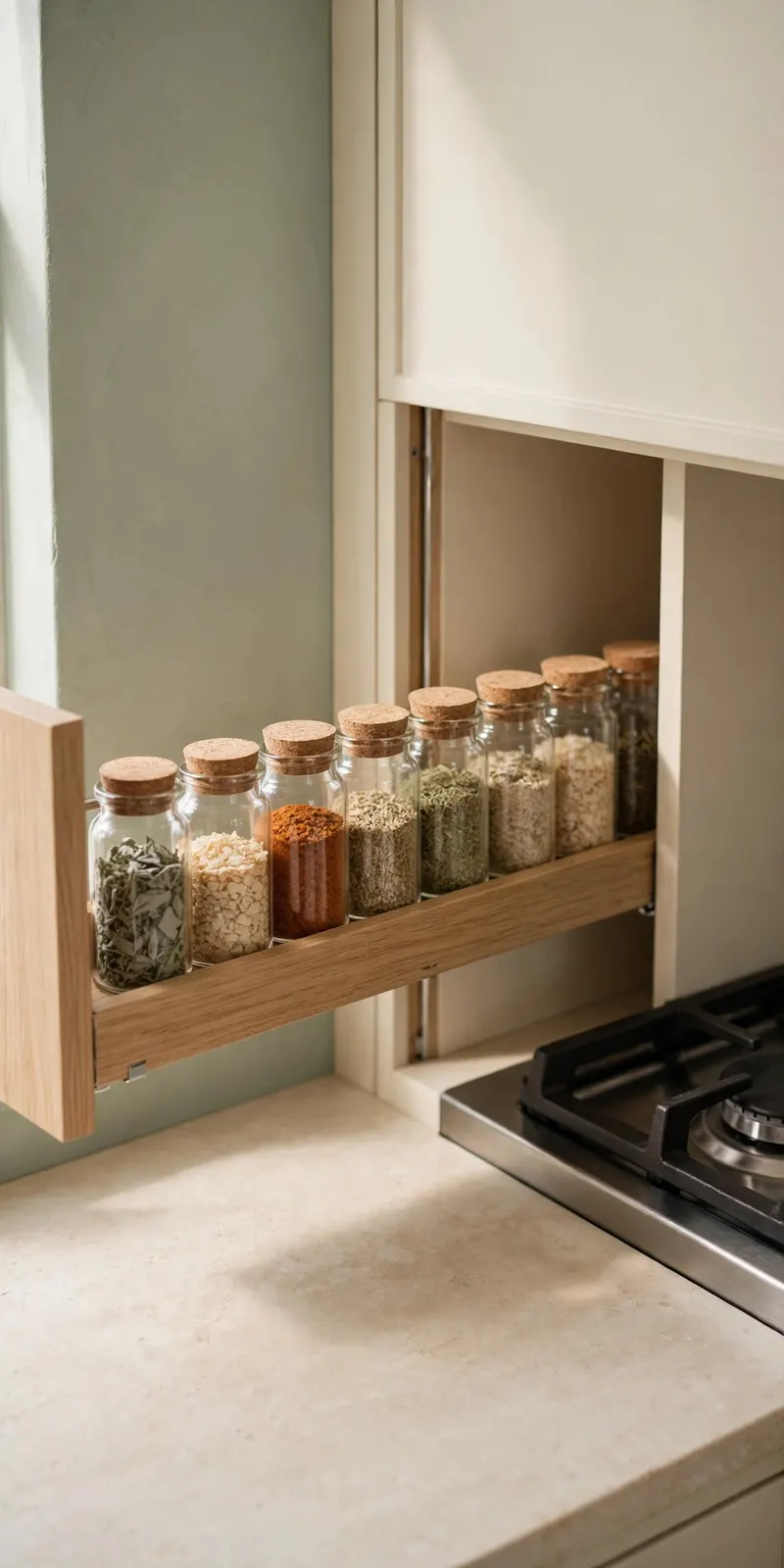
That 3-inch gap beside the fridge or stove is wasted space. A pull-out rack turns it into the best spice storage in the room, because every jar slides out to you.
3. Install a narrow pull-out rack in the gap beside the stove or fridge. Slim pull-outs come in 3-inch and 6-inch widths and hold two or three tiers. Measure first — depth matters more than width, since most cabinets are 24 inches deep and a rack that is too long will not close. Renters should pick a freestanding pull-out that sits inside an existing cabinet.
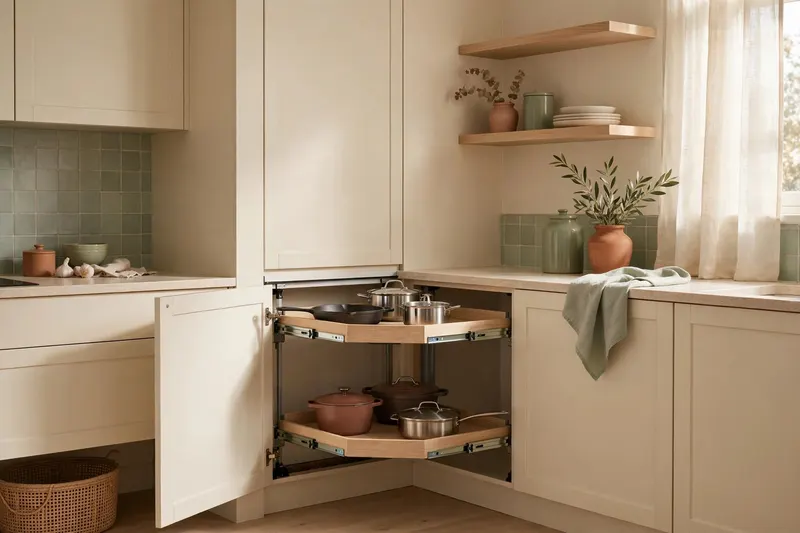
4. Use a two-tier pull-out inside a standard base cabinet. Two shallow shelves hold roughly 20 standard jars, visible from above, so you stop buying duplicates. Pick this if you cook daily and want every spice within arm’s reach of the stove. For a blind corner, a pull-out is only part of the answer — our guide to blind corner kitchen cabinet storage covers the rest.
Tiered risers: seeing every jar at a glance
Spices vanish because of depth: one shelf row hides the back row. Tiered risers fix that with steps, so the back jar sits higher and every label stays readable.
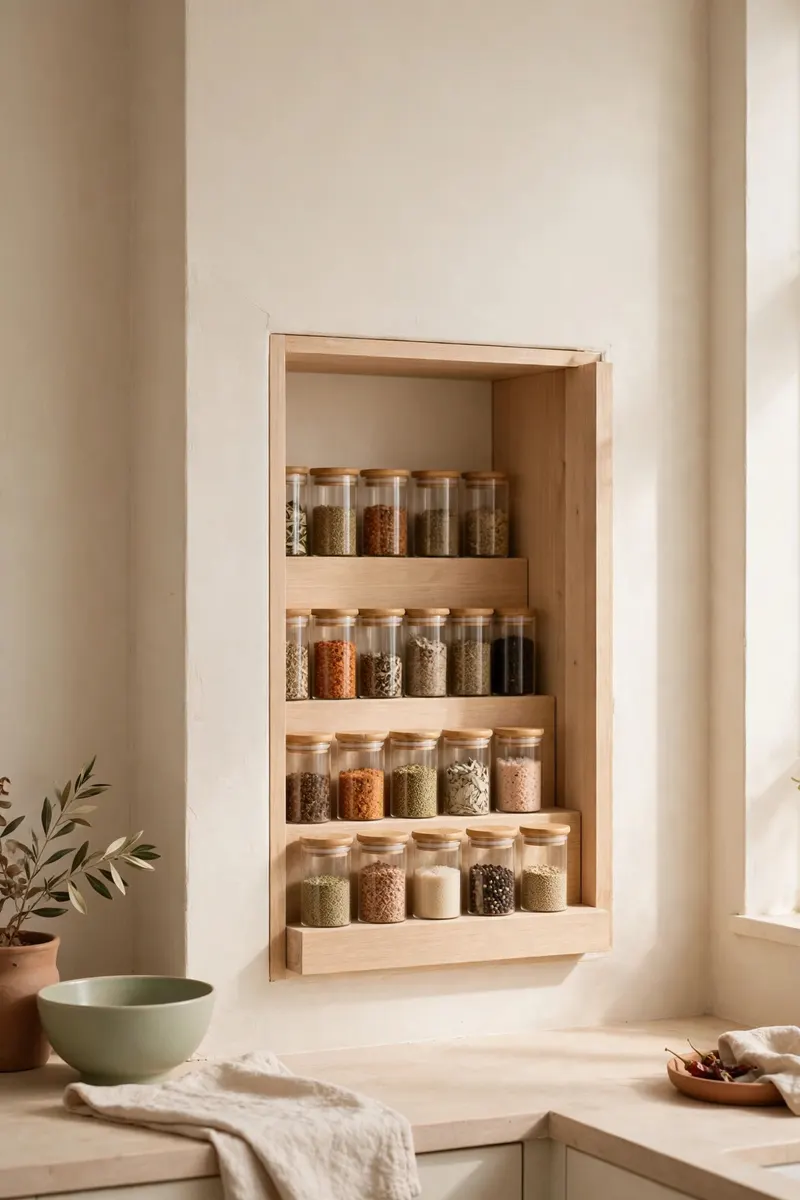
5. Add a three-step expandable riser to one cabinet shelf. A bamboo or plastic riser expanding from about 10 to 16 inches wide fits most small cabinets and holds 12 to 15 jars. Daily spices go on the front step, occasional ones at the back, still visible. Risers cost less than most spice racks and move with you when you move house.
6. Put a turntable on the riser’s top step for the extras. A 10-inch lazy Susan holds the odd-shaped jars — tall chili flakes, short curry paste — that do not sit neatly in rows. One spin shows everything. Keep it to one shelf.
The spice drawer conversion (and the right jars for it)
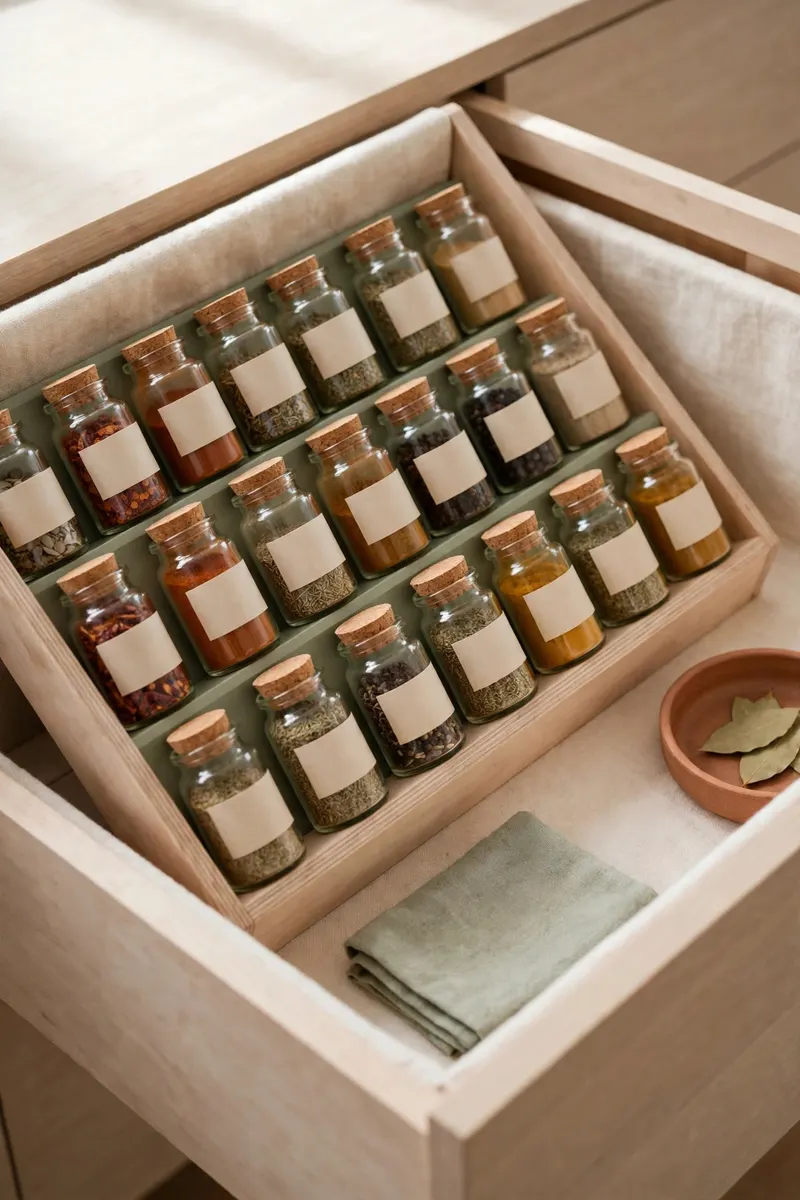
One shallow drawer near the stove may be the best spice home in a small kitchen. A drawer conversion lays jars flat, labels up, so you see the whole collection at a glance.
7. Convert the shallow drawer beside the stove into a spice drawer. A drawer at least 3 inches deep and 12 inches wide holds one layer of jars lying on their sides. Line it with non-slip liner, then add an angled insert or strips of foam shelf liner to stop jars rolling when it opens. Our guide to kitchen drawer organization for tiny drawers covers dividers and zones.
8. Choose short, wide jars with flat lids for drawer storage. Tall narrow jars waste depth and roll; short wide jars (about 2 inches tall and 2.5 inches across) sit stable in a single layer. Square jars pack tighter than round ones. Always label the lid — you read lids, not sides, in a drawer.
Door and wall storage: magnetic strips and slim racks
When cabinets are full, the inside of a cabinet door and a strip of empty wall are the most underused surfaces in a small kitchen — both hold spices without taking shelf or counter space.
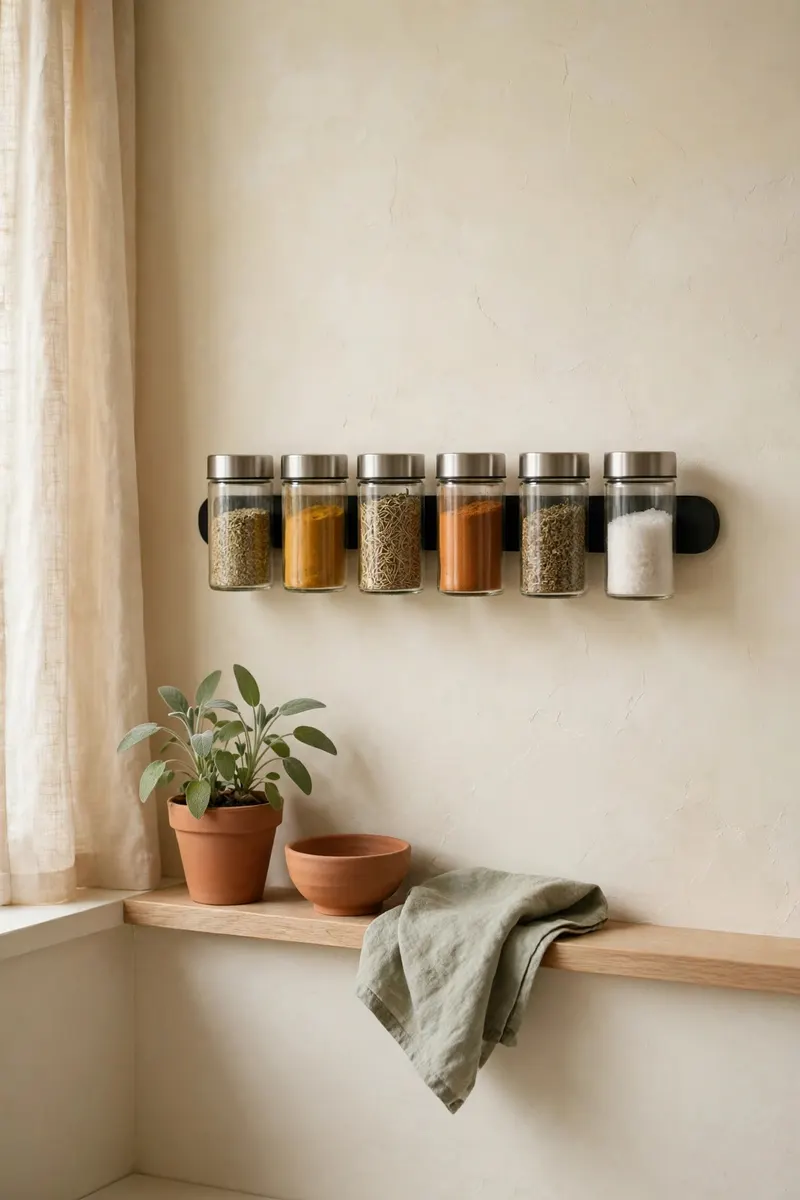
9. Mount a magnetic strip on the wall beside the stove, with metal-lid jars. A 12- to 18-inch strip holds six to ten small jars at eye level, off the counter. Keep it at least 12 inches from the burner so heat and steam do not cook the spices inside. Renters can use adhesive mounting rated for the jar weight.
10. Hang a slim over-door rack on the inside of a pantry or cabinet door. A rack 2 to 3 inches deep holds two rows of standard jars without blocking the door — measure the clearance first, since many cabinets allow only about 2 inches. This suits spices you use weekly but not daily, because the door swings them into view every time you open it. If your pantry needs a bigger rethink, our small apartment pantry organization ideas cover door racks, risers, and decanting together.
Uniform jars and labels that survive steam and heat
A spice system fails when jars do not match: mixed sizes waste space, mixed lids do not stack, and paper labels peel off the first time steam hits them. Uniform jars and durable labels make every other idea work.
11. Decant into one uniform jar size — 4 ounces for most spices, 2 ounces for the rarely used. One size means every rack, riser, and drawer insert fits every jar. Glass jars with airtight lids keep spices fresher than the thin plastic shakers they arrive in. Buy them once, in a single batch, so lids and heights truly match.
12. Label with waterproof labels or a label maker, and put the name on the lid and the side. Chalk labels smudge, paper labels peel in steam, and handwritten tape fades. A basic label maker or a pack of waterproof vinyl labels costs a few dollars and survives years of cooking. Add the purchase month under the name, so the label doubles as a freshness tracker.
Buying and refilling: the small-batch spice rule
Organization is not only storage — it is also what you buy. A small kitchen cannot hold a warehouse, and spices lose flavour on the shelf.
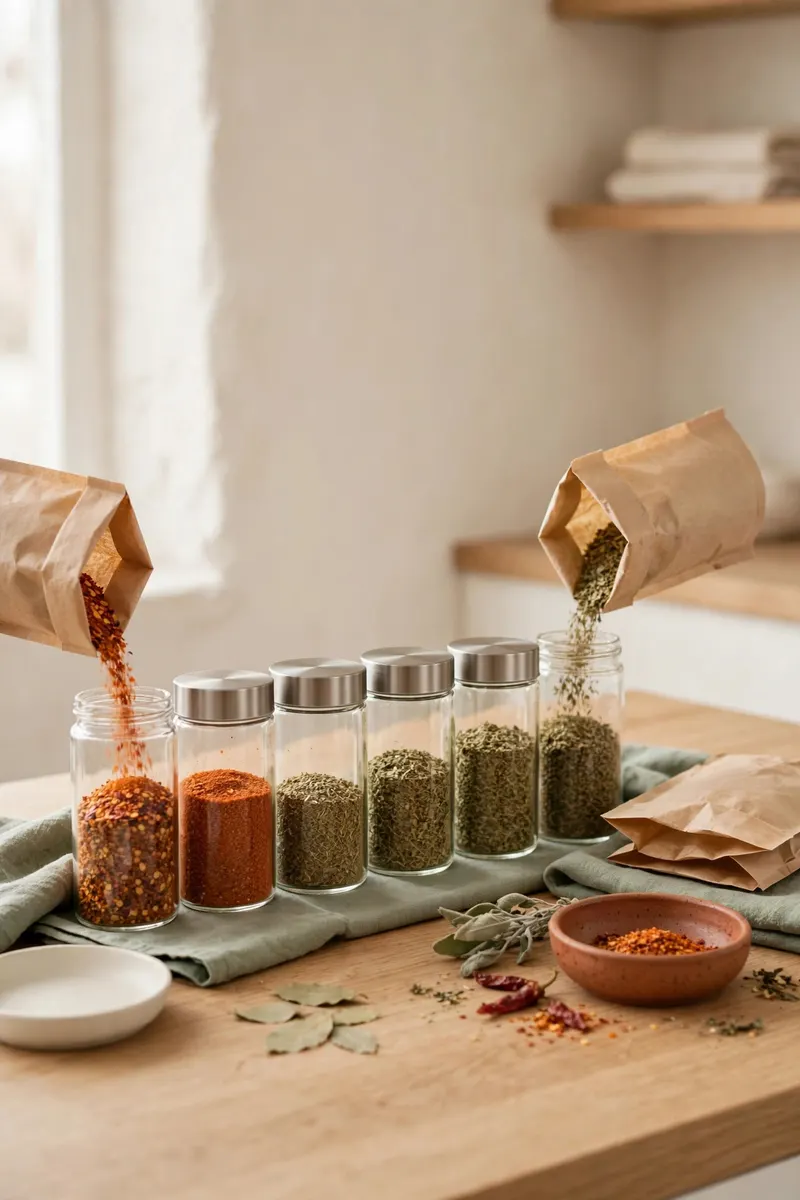
13. Buy small quantities and refill from a bulk bag stored elsewhere. Buy the 2-ounce jar, not the 8-ounce tub, for anything used less than once a week. Keep the bulk bag in a cool, dark cupboard away from the stove, or in the freezer in a sealed bag, and refill as needed. You spend less, waste less, and everyday jars stay fresh.
14. Keep a running “spice shopping list” on the inside of the cabinet door. A small notepad or strip of tape holds the names of spices running low, so you never come home with a third jar of oregano while the cumin sits empty. Check it before every grocery trip. This habit stops the collection growing faster than the space.
The 10-minute monthly spice check
A spice system nobody maintains slides back into a jumbled drawer within a month. The fix is a ten-minute check, once a month, alongside another kitchen job, so it becomes a habit instead of a project.
15. Set a monthly reminder and check five things: dates, smells, duplicates, empties, and labels. Sniff anything older than six months; if the scent is faint, replace it. Toss empties, merge duplicates, and rewrite faded labels. Ten minutes is enough — you are maintaining a system, not rebuilding one.
16. Rotate the front row every month so nothing sits forgotten at the back. Move back-row jars forward and front-row jars back. This one-minute shuffle keeps the turmeric you bought for one recipe from expiring untouched a year later. Pair it with your monthly check.
Mistakes to avoid
Storing spices above the stove. Heat and steam kill flavour fast. Move spices at least a foot away from heat and moisture.
Buying a spice rack before measuring. A rack half an inch too tall or too deep is useless. Measure height, width, depth, and door clearance before you order anything.
Keeping every free sample and gift set. Tiny jars from gift baskets double a collection overnight. If you would not buy it yourself, do not keep it.
Decanting without labeling first. An unlabeled jar of red powder could be paprika, chili powder, or cayenne — and guessing wrong ruins dinner. Label the jar before the spice goes in, not after.
Organizing by colour instead of by use. A rainbow shelf looks good in a photo and works badly in real life. Group by how often you cook with each spice.
Frequently asked questions
How can I organize spices in a very small kitchen with no pantry?
Start with the drawer or the door, not a new rack. A shallow drawer conversion or an over-door rack holds 15 to 20 jars, and a magnetic strip adds another six to ten. Those three spots cover most collections.
Can I store spices above the stove if that is my only free cabinet?
It beats a jumbled drawer, but it is the worst spot for freshness because heat and steam break spices down faster. If it is the only option, keep only hardy whole spices there — peppercorns, bay leaves, whole cloves — and keep ground spices somewhere cooler.
How do I keep spice labels from peeling off in a steamy kitchen?
Use waterproof vinyl labels or a label maker instead of paper or chalk labels, stuck on clean, dry glass. Put the name on the lid as well as the side, so it survives a splash. Replace a label the moment it starts lifting, before the jar becomes a mystery.
What is the best spice storage for renters who cannot drill?
A drawer conversion, an over-door rack, and a freestanding tiered riser need zero drilling and move out with you. For wall storage, use adhesive-mounted magnetic strips rated for the jar weight, or a tension-rod shelf inside a cabinet. Our kitchen wall storage ideas for small kitchens include renter-safe mounts.
The bottom line
Spice organization comes down to four moves: audit what you use, give every jar a visible home, switch to uniform jars with steam-proof labels, and check the collection for ten minutes a month. Pick one idea today — the drawer, the riser, or the door rack — and the jumbled drawer starts fixing itself. For more storage that works the same way, browse our kitchen organization ideas and save this pin for later.