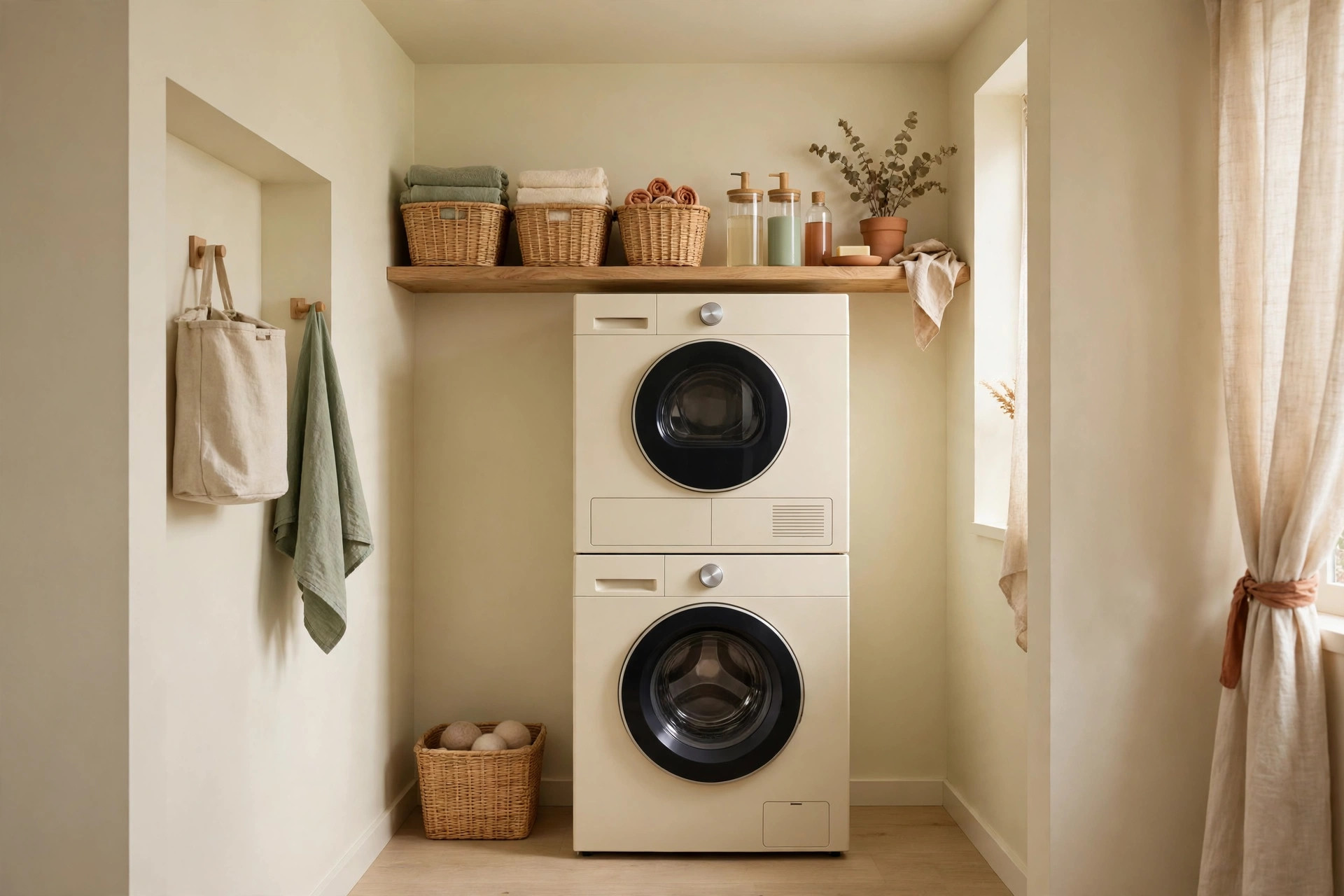
A stacked washer and dryer saves floor space, but it takes away almost everything else: the shelf, the counter, and the spot where the detergent lived. What is left is a tall tower in a narrow room, a few inches of gap on each side, and a wall above the dryer too high to reach without a step stool.
This small laundry room organization stacked washer dryer guide works with the tower instead of against it: storage goes in the side gap, on a shelf above the stack, and on the wall — never on the floor, because there is no floor to spare.
Measure the tower first: height, depth, and the side gaps
A standard stacked pair runs about 27 inches wide, 75 to 76 inches tall, and 27 to 32 inches deep — but “about” is not good enough when you are buying storage for a 4-inch gap. Measure first.
1. Measure the tower’s real height, not the spec sheet number. Run a tape from the floor to the top of the dryer, then add the stacking kit and leveling feet — usually another inch. Then measure dryer top to ceiling: under 12 inches means one shallow shelf at most; 18 or more fits two.
2. Map the side gaps and the door swing before you shop. Measure each gap at the floor, waist height, and top. Then open both doors fully and mark the swing arc with painter’s tape — anything inside it gets hit every load.
The side-gap cart: the 6 inches beside the machines
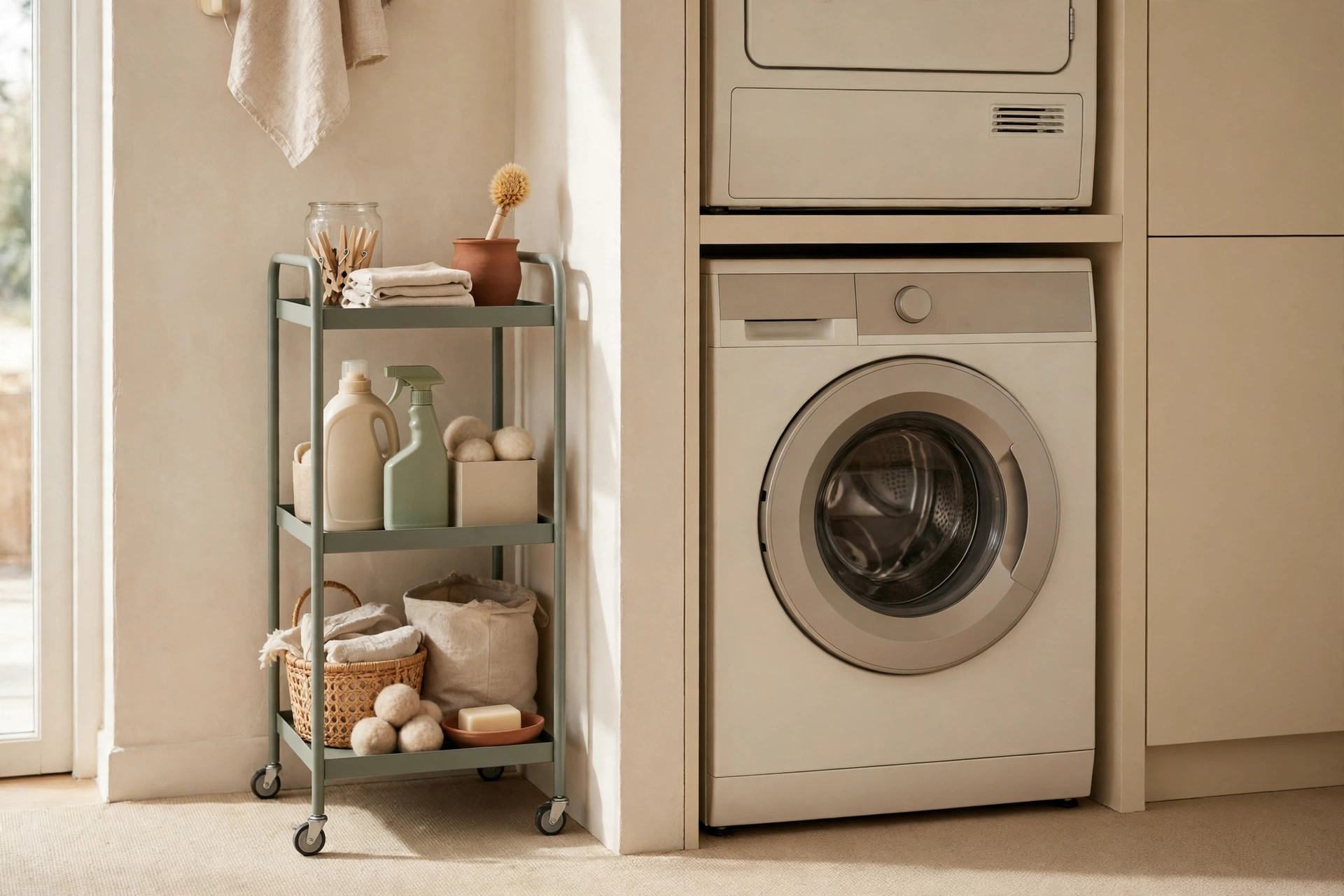
The gap beside a stacked pair is the most useful space in the room, and most people leave it empty. A slim rolling cart turns that dead strip into a detergent station within arm’s reach.
3. Slide in a 6-inch rolling cart for detergent and stain treatment. Most stacked pairs leave 4 to 8 inches of clearance on one side. A 3-tier cart, 6 inches wide and about 15 inches deep, holds a full lineup: detergent on top, stain remover in the middle, dryer balls at the bottom. Measure your narrowest point first — carts come in 4, 6, and 8-inch widths.
4. Put the cart on the washer side, not the dryer side. The dryer side runs hotter and vibrates more — bad for liquid detergent. The washer side is cooler and steadier, and it puts the detergent where your hand goes when you load the machine. A second gap fits a narrow cart for dryer sheets and the lint roller.
Shelf above the stack: what belongs up high
The wall above the dryer is the biggest storage surface in a stacked laundry room — and the easiest to get wrong. Put the right things up there and the room finally breathes. More ideas: 16 Laundry Room Wall Organization Ideas.
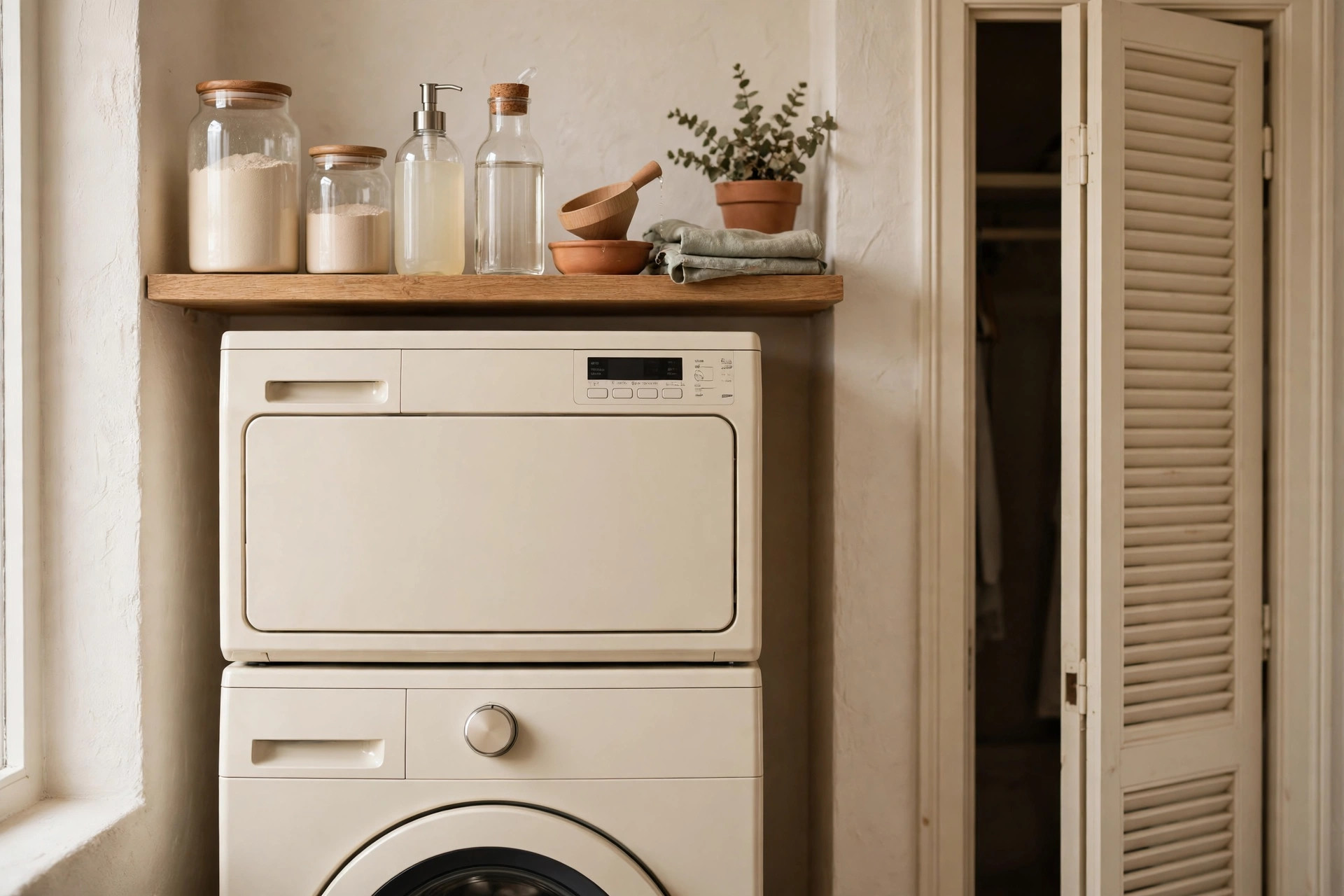
5. Mount one deep shelf 8 to 10 inches above the dryer top. Eight inches clears the dryer door; ten inches fits taller bottles. Go 12 to 14 inches deep — a standard 10-inch shelf wastes the space above a 27-inch-deep machine. Use brackets rated for at least 25 pounds each, screwed into studs. Renters: a freestanding over-the-machine rack costs about $40 to $60 and needs no drilling.
6. Keep only weekly-use items on that shelf — five things, maximum: detergent, stain treatment, dryer sheets or wool dryer balls, a small bin of clothespins, and wrinkle-release spray.
7. Add a second, higher shelf for backups and out-of-season supplies. The step-stool shelf holds what you touch once a month: the backup detergent jug, the extra box of dryer sheets, the delicates bags for winter sweaters.
Detergent station: decanting for a narrow shelf
Full-size detergent jugs are shaped for a wide shelf in a big laundry room. On a 12-inch-deep shelf above a stacked dryer, they waste space and tip over. Decanting into smaller containers makes a narrow shelf feel twice as big.
8. Decant detergent into slim pump bottles and labeled jars. Pour liquid detergent into a 16-ounce pump bottle — one pump is roughly one load. Powder goes in a wide-mouth jar with a scoop; pods in a lidded jar, label facing out. Slim bottles line up in a row, and you can see at a glance when you are running low.
9. Build a one-load caddy that lives on the shelf and travels to the machine. A small handled caddy — about 10 by 6 inches — holds exactly what one load needs: the detergent pump bottle, a stain stick, and two dryer balls. Grab it, run the load, put it back. It is the same contained-system trick behind 16 Small Laundry Closet Organization Ideas.
The folding zone: a shelf that pulls out, not a table
There is no room for a folding table beside a stacked pair, and the dryer top sits about 6 feet off the floor.
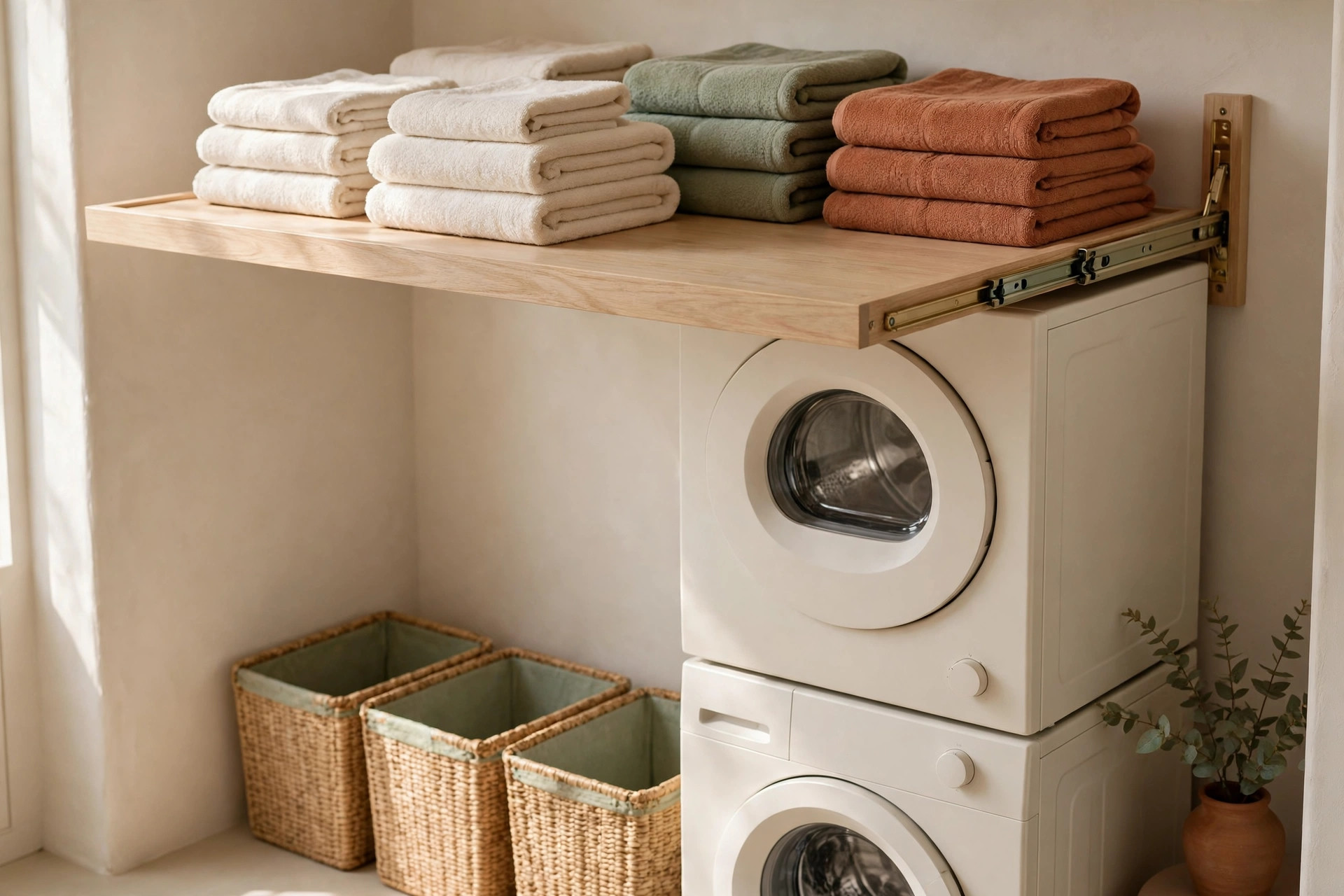
10. Mount a fold-down wall shelf at counter height, 36 inches off the floor. A drop-leaf shelf, about 24 by 16 inches, folds flat against the wall and drops down to a sturdy folding surface when you need it. Use brackets rated for 20 pounds or more, screwed into studs.
11. Use a rolling cart’s flat top or a pull-out shelf as your folding surface. If you cannot mount anything, the top of a sturdy rolling cart at waist height works — fold one item at a time and drop it into a basket below. Better still is a 12-inch-deep pull-out shelf on drawer slides at 36 inches.
Drying solutions that don’t block the door
A stacked laundry room has one door, one walkway, and no spare floor. A freestanding drying rack blocks the door, blocks the machines, and gets knocked over.
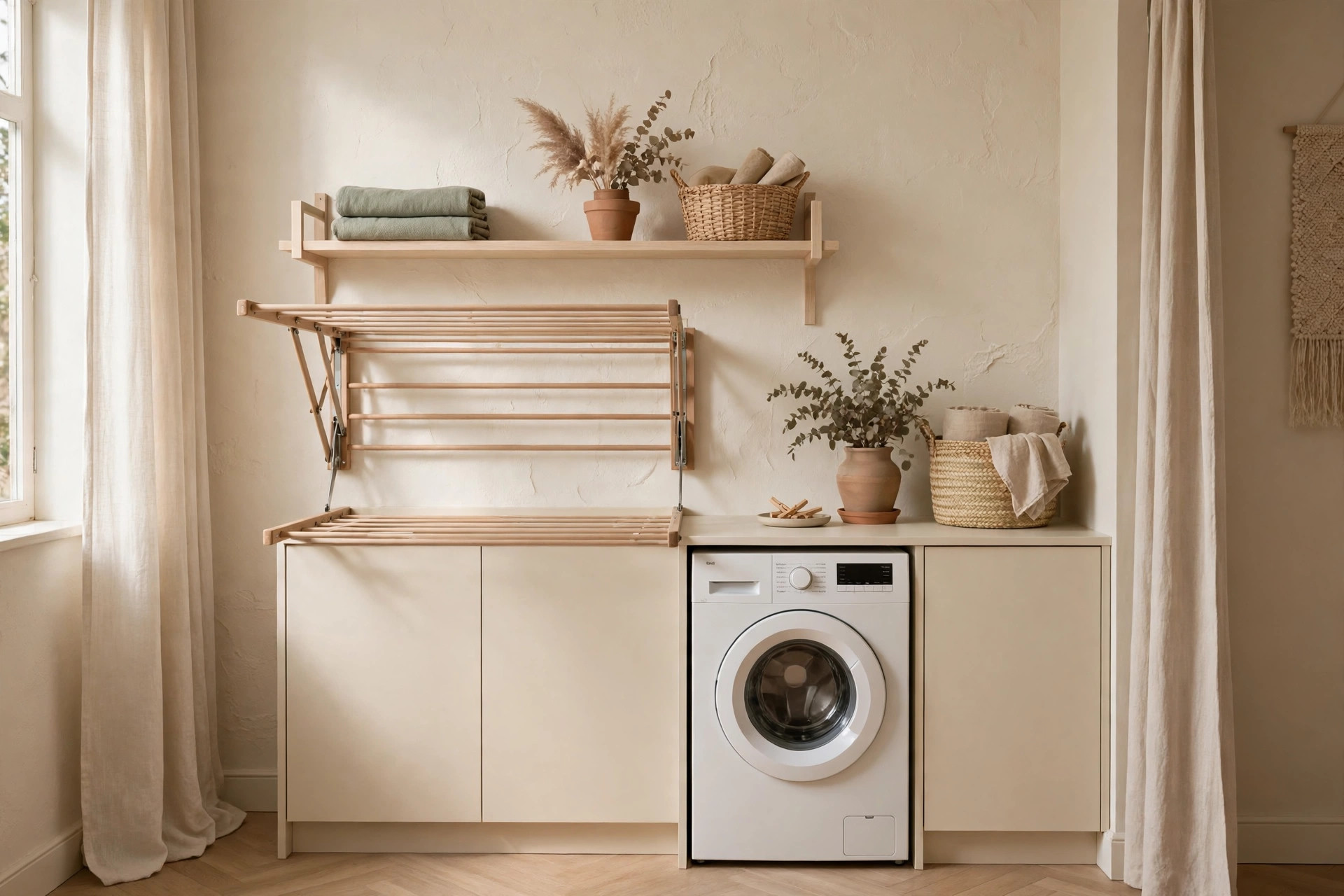
12. Hang a retractable clothesline across the wall above the machines. It mounts on one wall, pulls across to a hook opposite, about 6 feet off the floor — high enough to clear the dryer door, low enough to reach. It holds a full load of delicates, then retracts into its housing, leaving the wall bare. More apartment drying ideas: 17 Small Laundry Drying Solutions for Apartments.
13. Use a wall-mounted accordion drying rack that folds flat. It pulls out to about 20 inches deep in use, then folds flat to 3 inches when you are done. Mount it on the side wall at shoulder height, away from the door swing you marked in idea 2. It holds shirts and delicates, and the room is back to full width once they are dry.
Sorting system for one tiny room: 2 hampers, not 4
A full sorting system — lights, darks, colors, delicates — needs four bins, and four bins do not fit in a room that barely fits one person.
14. Sort into two hampers only: lights and darks. Two slim hampers, each about 12 inches wide, fit side by side in the gap beside the machines. Lights go in one, darks in the other, and delicates go in a mesh bag clipped inside the lights hamper — the bag goes straight into the machine, so delicates never need their own bin.
15. Use slim, stackable hampers or hanging sorter bags on the door. If floor space is truly zero, hang two sorter bags on the back of the door — one labeled lights, one darks — on over-door hooks that need no screws. Each bag holds about one load. When one is full, unhook it, carry it to the machine, and hang it back empty. More sorting ideas: 16 Small Laundry Sorting System Ideas for Apartments.
Keeping a stacked laundry closet ventilated and clean
Stacked machines in a small room trap heat and moisture, and a front-load washer left closed grows mildew in the gasket within weeks.
16. Leave the washer door ajar and wipe the gasket after every wash. Front-loaders seal tight, and the rubber gasket stays damp after a cycle. Leave the door open a few inches — a magnetic prop or rolled towel keeps it ajar — and wipe the gasket folds dry once a week.
17. Clean the dryer vent and lint path on a schedule. Pull the lint filter after every load. Once a month, vacuum the lint trap housing with a narrow nozzle and check the vent hose for kinks or lint buildup. A blocked vent makes the dryer run longer and hotter, and it is a genuine fire risk: the U.S. Fire Administration lists failure to clean dryers as a leading cause of dryer fires. See the U.S. Fire Administration’s dryer fire safety page.
Mistakes to avoid
- Buying a standard 12-inch cart for a 6-inch gap. Measure the narrowest point first.
- Storing heavy detergent jugs above the dryer. A full jug weighs 8 to 10 pounds, and lifting it overhead is a spill waiting to happen.
- Blocking the dryer vent with storage. Nothing goes behind the tower — the vent hose needs clear space.
- Using tension rods or tension shelves on vibrating machines. Machines shake, tension fails, and glass jars fall 6 feet.
- Buying a four-bin sorter for a two-bin room. Four hampers become floor piles — two hampers and a mesh delicates bag is the whole system.
- Putting a folding table in front of the machines. It blocks the doors, the walkway, and becomes a dumping ground.
Frequently asked questions
Can I put a shelf directly above a stacked washer and dryer?
Yes — 8 to 10 inches above the dryer top is the standard setup. Use brackets rated for at least 25 pounds each, screwed into studs, and keep it to five weekly-use items.
How much clearance do I need beside a stacked washer and dryer?
At least 4 inches on one side for a slim cart; 6 inches is the sweet spot. Measure at the floor, waist height, and top — the narrowest point decides what fits.
How do I dry clothes in a tiny laundry room with no space?
Dry on the wall, not the floor: a retractable clothesline or folding accordion rack at shoulder height holds a full load and folds away to 3 inches deep when done.
The bottom line
A stacked laundry room works when storage goes up, into the side gap, and onto the wall — never onto the floor. Measure the tower, claim the side gap with a slim cart, put five weekly items on the shelf above, and let a fold-down shelf and a wall rack handle the rest. Save this pin for later, and browse more ideas in the small-spaces category.