A tiny vanity gives you about two feet of counter and one shallow drawer, yet it has to hold foundation, brushes, palettes, lipsticks, and everything else you reach for each morning. Without a system, products pile up in front of the mirror and dry out before you finish them. These small makeup organization ideas fix that by giving every product a home sized to how often you actually use it. Below are 16 practical ideas, in order: audit first, contain second, go vertical, then keep it tidy with a weekly reset.
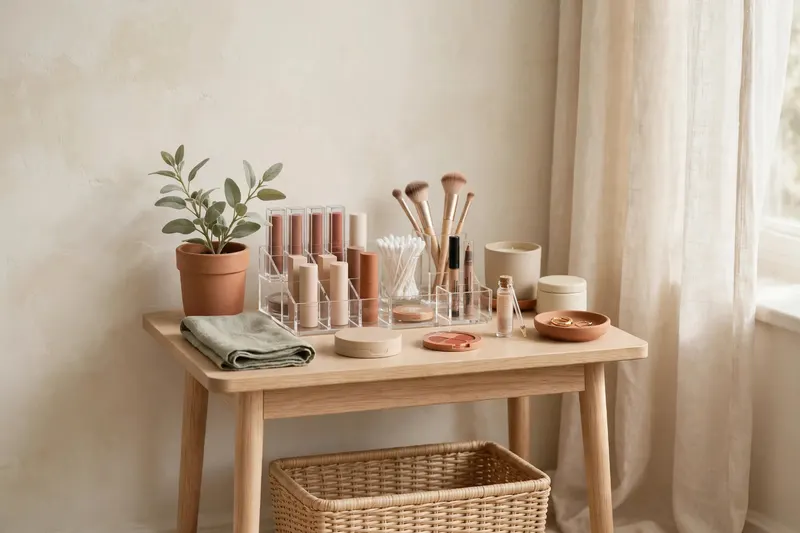
The makeup audit: what you actually use vs what you store
Most vanity clutter is makeup you keep, not use: dried-out mascaras, shades that never suited you, and duplicates bought because the original was buried. The audit takes twenty minutes.
1. Empty the whole vanity onto a towel
Take everything out and lay it on a clean towel. Sort into four piles: daily, weekly, occasional, and let go. Anything dried out, separated, smelling off, or past its use-by window goes in the bin.
2. Build a daily kit of ten items or fewer
Your daily kit is the only makeup that earns counter space: foundation, concealer, one powder or blush, one eye product, mascara, one lip product, and your brushes. Everything else lives in the drawer or cabinet, grouped by type. If you reach for a product three mornings in a row and it is not in the kit, swap it in. This pairs with the zone approach in 16 Vanity Organization Ideas for Small Bathrooms.
Drawer dividers: the single highest-impact change
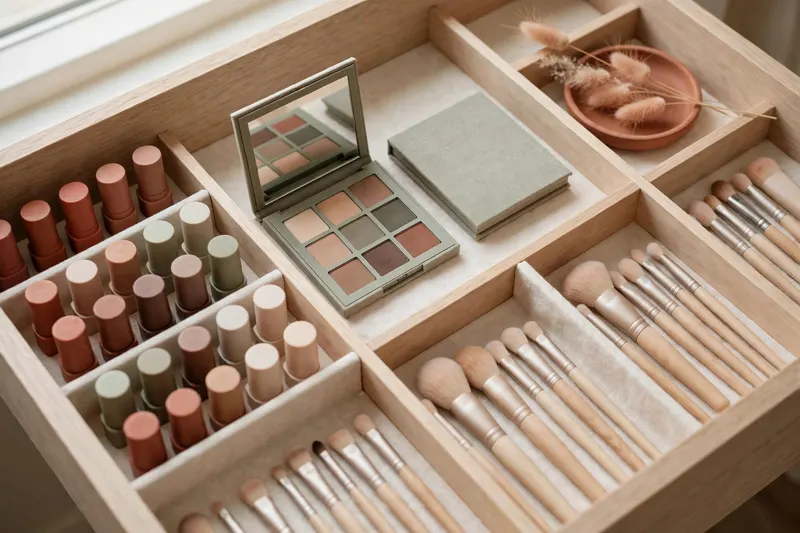
A bare drawer is where makeup disappears: lipsticks roll under palettes, eyeshadows slide to the back, and you buy a second black eyeliner because you cannot find the first.
3. Measure first, then buy expandable dividers
Measure the inside of the drawer — length, width, and depth — before ordering anything. A standard vanity drawer is roughly 14 to 18 inches wide and 12 to 14 inches deep, but drawers under 3 inches tall will not fit tall bottles upright. Expandable dividers fill the space without gaps, and gaps are where small items migrate.
4. Give every category its own compartment
Assign one compartment per category: lips, eyes, face, and tools. Stand lipsticks upright in a small insert so you can read the shade from the top, and keep concealers and foundations flat in the deepest compartment, labels up. Put cotton pads and buds in the smallest compartment at the front.
Acrylic risers and tiered organizers for the counter
The counter is your most visible and scarcest surface. Risers use the vertical air above it, and clear acrylic keeps a small bathroom looking open.
5. Add a two-tier riser for daily products
A two-tier acrylic riser about 10 inches wide and 6 inches deep holds your daily kit on two levels. Put taller bottles — foundation, setting spray — on the back of the top tier, and shorter items — concealer, lip balm, brow gel — on the front of the lower tier. Keep the riser to one side of the sink.
6. Use a small turntable inside the cabinet
A 10-inch lazy Susan turntable inside the vanity cabinet turns a deep cupboard into usable storage. Group backup products on it by category, tallest at the center, and one spin brings the back row to the front. For more ways to free up counter space, see 16 Small Bathroom Counter Organization Ideas (Clear the Counter, Keep the Essentials).
Vertical storage: wall-mounted shelves and magnetic boards
When the counter and drawer are full, the only direction left is up. The wall beside the mirror and the inside of the cabinet door are free space in almost every small bathroom.
7. Mount one narrow shelf at eye level beside the mirror
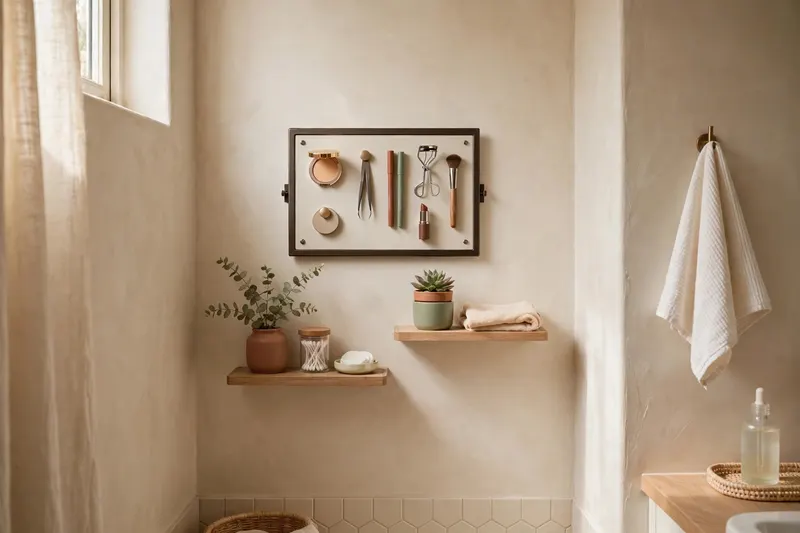
A single floating shelf about 16 inches wide and 4 inches deep, mounted at eye level beside the mirror, holds the five or six products you reach for mid-routine: setting spray, brow gel, lipstick, and a small hand mirror. Keep it to one shelf, not three. Use adhesive-mount brackets rated for at least 5 pounds if you cannot drill.
8. Stick a magnetic board inside the cabinet door
A magnetic board about 8 by 10 inches, fixed inside the cabinet door with removable adhesive strips, holds small metal items: bobby pins, tweezers, eyelash curlers, and small palettes with magnetic backs. Glue a small round magnet to the back of any plastic compact you want to hang. If the door is mirrored inside, use suction-cup hooks instead.
Brush storage that keeps bristles clean and upright
Brushes touch your face every day, so their storage is a hygiene question too. Lying flat, bristles pick up powder fallout and bend against the drawer sides.
9. Stand brushes upright in a weighted holder filled with beads
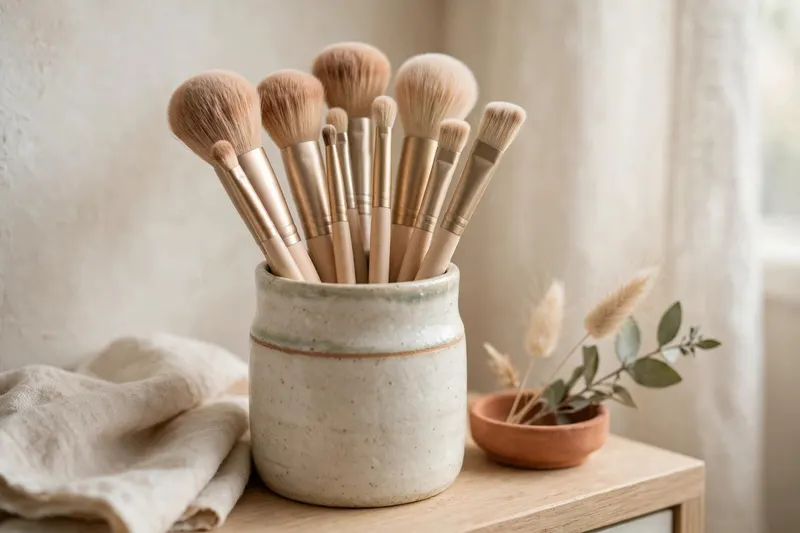
A heavy ceramic or glass holder about 4 inches tall, filled with small glass beads or dried rice, holds brushes upright and will not tip when you pull one out. Face brushes go in the tallest holder, eye brushes in a shorter one. Wash the beads monthly and let them dry fully before refilling, or they trap moisture.
10. Keep one brush roll for travel and overflow
A brush roll — a flat wrap with individual slots that rolls closed — holds brushes you use weekly but not daily, and it doubles as your travel case. Rolled up, it takes up about as much space as a single palette. Never store damp brushes in a closed roll; dry them bristle-down on a towel first.
Palettes and compacts: file them like books
Palettes are flat, wide, and heavy — the worst shape for a drawer and the best shape for vertical filing. Stacked flat, the one at the bottom never gets used.
11. File palettes upright in a small desk organizer
A small metal or acrylic file organizer, about 6 inches wide, holds palettes upright like books on a shelf. Sort them by use — everyday neutrals at the front, bold shades at the back — and keep the total to what fits. Place it on the bottom shelf of the cabinet or in the drawer if it is deep enough; palettes are heavy, so a high shelf is a dropping risk.
12. Use a plate rack or letter holder for the overflow
A small wooden plate rack or upright letter holder, about 8 inches wide, costs very little and holds overflow palettes, large compacts, and a small mirror upright. Keep the rack to one row deep; a second row behind the first hides the spines and defeats the purpose.
Skincare vs makeup: separating the two routines
Makeup and skincare share a bathroom but need different storage: skincare bottles are tall and used with wet hands, while makeup is smaller and used in sequence in front of the mirror.
13. Split the counter into a wet zone and a dry zone
Put skincare nearest the sink and makeup nearest the mirror. The wet zone holds cleanser, toner, moisturizer, and sunscreen; the dry zone holds your daily kit. A small tray under each zone, about 10 by 6 inches, marks the boundary and catches drips. The same zone logic works across the whole room, as shown in 18 Small Bathroom Storage Ideas That Make a Tiny Bathroom Work Harder.
14. Store backups and empties in separate labeled boxes
Keep one small box labeled “backups” for unopened products and one labeled “empties to finish” for products you are using up. The backups box lives on a high shelf or in the cabinet; the empties box lives in the drawer, so the half-used concealer is always in reach. When the backups box is full, stop buying more.
The 5-minute weekly makeup reset
No organizer stays tidy on its own. A five-minute reset once a week, tied to something you already do — Sunday evening, or laundry day — keeps the system working.
15. Run the same five checks every week
Set a timer for five minutes and run the same checks in order: wipe the counter and riser, return stray products to their zones, toss cotton pads past their use, check for leaks or cracked compacts, and move one untouched product back to the drawer. The same order every time turns the reset into a habit.
16. Rotate one seasonal product in and one out
Each week, swap a single product: bring in the seasonal shade or the lip color you have been meaning to wear, and move the product it replaces back to the drawer. If you cannot name the product you would swap out, the new one stays in the drawer.
Mistakes to avoid
Buying organizers before the audit. A drawer of products you do not use still needs the same dividers, just for the wrong things. Audit first, measure second, buy third.
Choosing open baskets for small items. Open baskets look tidy on day one and become a mixed pile by day three. Use divided inserts for anything smaller than a foundation bottle.
Storing makeup in the shower area. Heat and steam shorten the life of powders and creams and loosen the glue on false lashes. Keep makeup at least an arm’s length from the shower, even if that means a shelf in the bedroom.
Keeping every free sample. Samples multiply fast and rarely get used. Keep three at most — one skincare, one base, one color — and use them within the month.
Overfilling the counter to look organized. A counter with every product visible is not organized; it is crowded. If you cannot wipe it in under a minute, too much is living on it.
Frequently Asked Questions
How do I organize makeup in a very small bathroom with no vanity?
Use the inside of the cabinet door for a magnetic board, file palettes upright in the drawer, and keep your daily kit in a caddy 10 by 6 inches.
Can I store makeup in the bathroom if it gets steamy?
You can, but keep it away from steam and heat. Store powders and creams in a closed drawer or cabinet, close lids tightly, and keep expensive palettes in the bedroom if the room stays damp for hours.
What is the best organizer for a tiny vanity drawer?
Expandable dividers measured to fit are the best start: they turn one open box into labeled zones without wasting space. Add a small upright insert for lipsticks.
How often should I declutter my makeup?
Do a quick check during your weekly reset and a full audit every three to four months. Mascara and liquid eyeliner should be replaced about every three months; powders last longer if kept dry and closed.
How many makeup products should I keep on the counter?
Ten or fewer daily-use items is a realistic ceiling for a tiny vanity. Everything else belongs in the drawer or cabinet, grouped by type, so the counter stays clear enough to wipe quickly.
Conclusion
A tiny vanity works when every product has a home sized to how often you use it: audit first, divide the drawer, lift daily products onto a riser, file palettes upright, and keep skincare and makeup apart. Start with the audit this weekend. Save this pin for later, and browse the small spaces category.