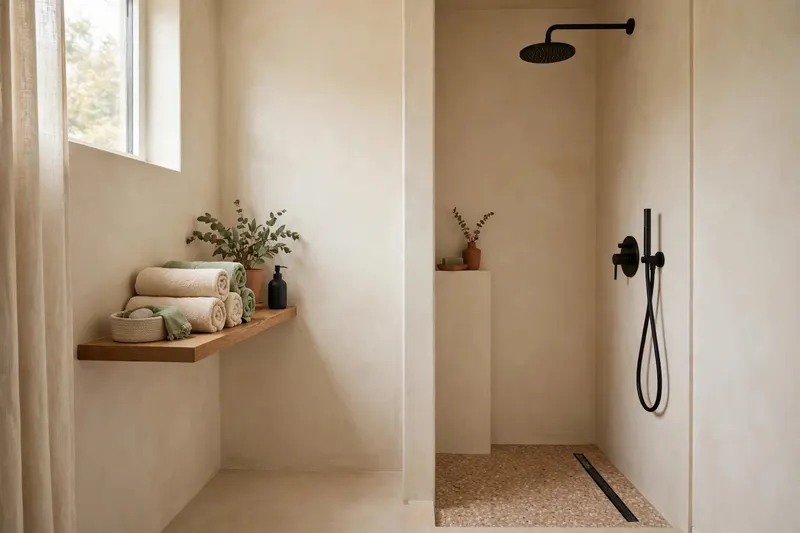
A wet room looks wonderful on a brochure: one open, tiled space, no shower tray, no curtain, water draining neatly away. Then you move in and discover the problem nobody mentions — every single thing in the room gets wet. Shampoo bottles sit in a puddle and the towel you hung by the door is damp by morning. These wet room storage ideas are built for exactly that reality: storage that drains, dries, and survives daily steam and splashes.
What makes wet room storage different: everything gets wet
In a normal bathroom, only the shower gets wet. In a wet room, the whole floor is the shower tray, and steam reaches every corner. Anything on the floor stands in water, anything porous stays damp, and anything metal rusts faster than you expect.
1. Go wall-hung before you buy anything else
Anything that touches the floor in a wet room will sit in water at least once a day. Wall-hung shelves, baskets, and cabinets keep your things above the splash line and let the floor drain properly, so treat the floor as a no-storage zone. Our guide to 18 Small Bathroom Storage Ideas has more wall-first layouts for the same tiny footprint.
2. Map your splash zones before you drill a single hole
Picture where water lands: the direct spray zone (about 3–4 feet from the shower head), the splash ring just outside it, and the dry zone near the door. Keep daily items in the splash ring and anything paper, fabric, or electronic in the dry zone.
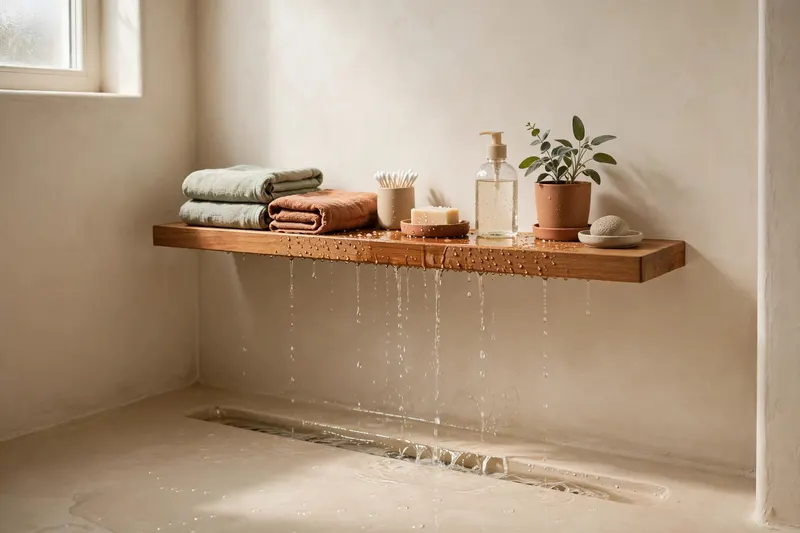
Wall-hung shelves that drain and dry: teak, glass, stainless
Look for slatted or perforated designs, mounted with a 2–3 degree forward tilt so water runs off the front edge.
3. Choose a slatted teak shelf for the shower wall
Teak is naturally oily and resists water far better than pine or bamboo, and slats let water drain straight through. A 12-inch-wide, two-tier teak shelf holds shampoo, conditioner, and a razor without turning into a puddle. Oil it every 3–4 months, and avoid solid back panels.
4. Use tempered glass or stainless steel where steam is heaviest
Glass shelves wipe clean in seconds, never rust, and make a small room feel bigger. A 10-inch tempered glass shelf with stainless brackets costs roughly $15–25 and holds two or three bottles. Stainless steel corner shelves are the other safe bet: a two-tier unit uses dead space and keeps bottles off the floor.
Shower niches vs caddies: what actually stays put
The shower area is where storage fails most often: bottles fall, caddies slide, and suction cups give up mid-shampoo.
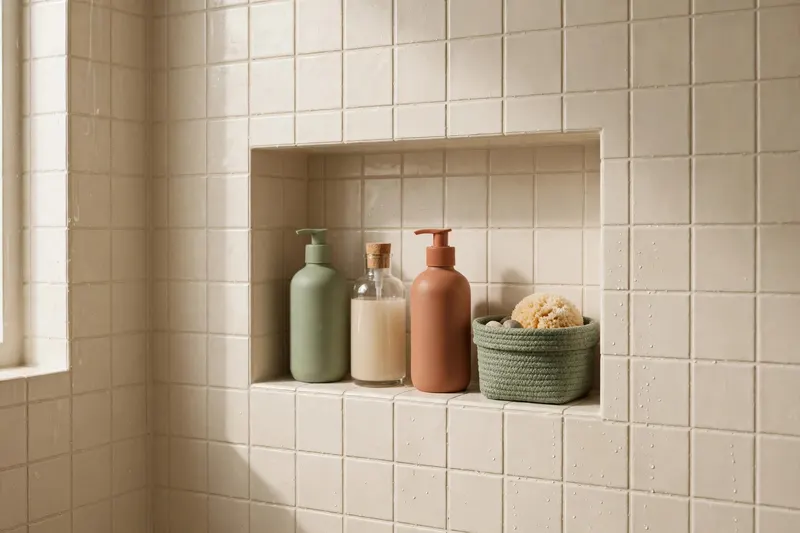
5. Build or buy a recessed shower niche
A niche is a shallow box set into the wall, about 12 inches wide and 24 inches tall, tiled to match the room. It holds everything at arm’s height, with nothing sticking out and nothing to fall off. If you are renovating, a niche costs little extra at the tiling stage; if not, a surface-mounted stainless niche box (about 12 × 24 inches) gives most of the benefit. For more shower layouts, see our 16 Shower Storage Ideas for Small Bathrooms (No Drilling).
6. Pick a tension-pole caddy only if your ceiling is solid and flat
Tension poles wedge between floor and ceiling and hold two or three baskets without a screw — ideal for renters. They work best under flat 8-foot ceilings; a sloped or textured ceiling lets the pole slip. Load it with full bottles and leave it overnight before trusting it. On smooth tiles, a large suction-cup caddy is safer: press it on, flip the lever, and check the seal weekly.
Waterproof baskets and bins for toiletries
In a wet room, a basket must either drain completely or seal completely — anything in between stays wet.
7. Use baskets with drainage holes for anything that gets splashed
Look for plastic, coated-wire, or silicone baskets with open slats in the base. A 10 × 6 × 6-inch basket holds one person’s daily toiletries and dries between showers because air moves through it. Stack two on a wall-mounted rail for a mini cabinet that never holds standing water.
8. Keep sealed, lidded bins for spares and refills
Spare razors, cotton pads, and refills belong in a sealed plastic bin with a snap-shut lid, stored in the dry zone near the door. A clear 12-quart bin lets you see inside without opening it in a steamy room, and the lid keeps condensation out.
No-drill hooks and rails for renters
You cannot drill into the landlord’s tiles, but suction cups fail on textured surfaces and adhesive hooks peel off in steam.
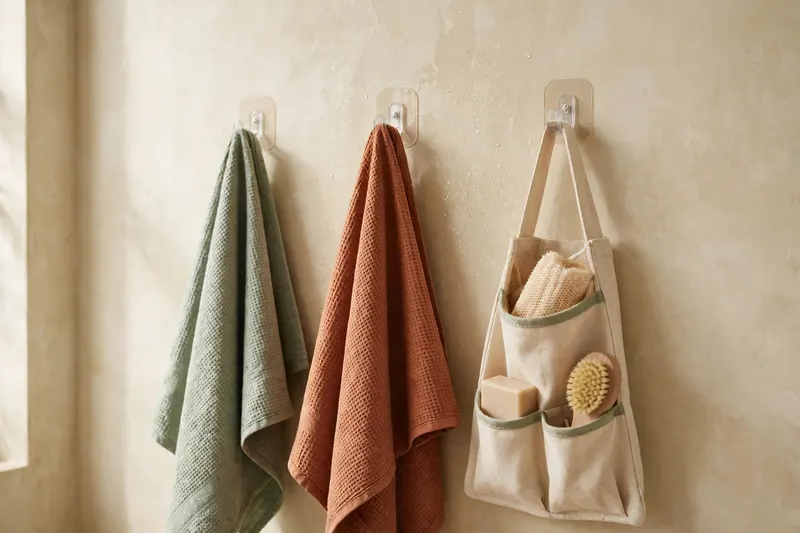
9. Use lever-lock suction hooks on smooth, glossy tiles
Ordinary push-on suction cups fail in wet rooms because steam creeps under the seal. Lever-lock suction hooks (with a flip lever that pulls a vacuum) hold 5–7 pounds each on smooth tiles and can be repositioned without damage. Mount them on a single flat tile, never across a grout line, and re-seat them every couple of weeks — even a hook that has held for a month can drop without warning.
10. Hang an over-door rail or adhesive rail for robes and wash bags
An over-the-door rail instantly gives you three or four hooks with zero damage — pick one with rubber bumpers so it does not rattle or mark the door. Heavy-duty adhesive rails rated for wet areas stick well to smooth tiles and come off cleanly with a hairdryer when you move out. Hang wash bags and robes here, never towels — they need airflow.
Towel storage that dries fast in a steamy room
Towels are the hardest thing to store in a wet room: they need airflow to dry, and a steamy room has almost none. A towel folded on a shelf stays damp for a day; spread flat on a heated rail, it dries in a couple of hours.
11. Fit a heated towel rail and use it as your main towel store
A slim wall-mounted heated rail, about 20 inches wide, holds two bath towels spread flat and dries them between showers. It also warms the room slightly, cutting condensation on the walls. A standard chrome rail in the dry zone works too — spread the towel flat in a single layer, never folded double. See our 16 Small Bathroom Towel Storage Ideas for more towel-drying ideas.
12. Add a towel ladder or spaced hooks for hand towels
A leaning ladder with 3–4 rungs gives each towel its own rung and airflow, and needs no fixing — just lean it against a dry-zone wall. For hand towels, space individual hooks at least 6 inches apart so towels do not touch while drying.
Under-sink and vanity storage that survives splashes
The under-sink area gets splashed from the floor and steamed from above, so it needs the same waterproof thinking.
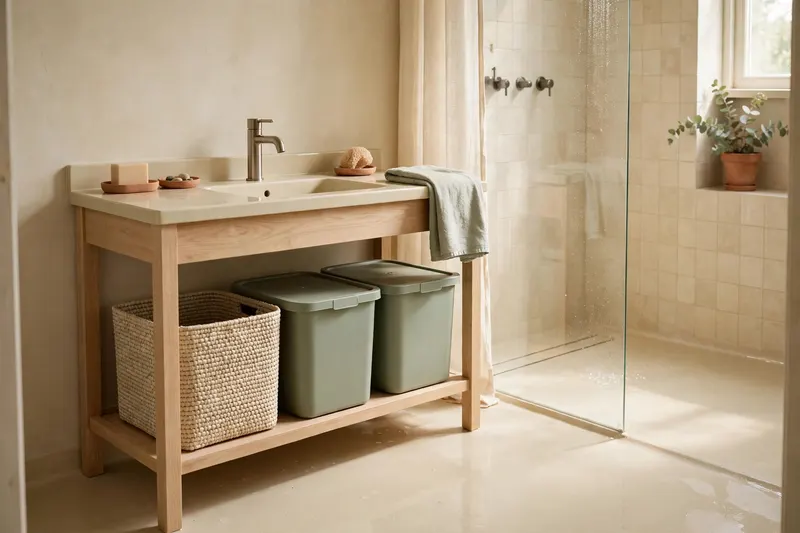
13. Choose a wall-hung vanity with sealed, soft-close drawers
A wall-hung vanity keeps the cabinet off the wet floor, and sealed drawers with a rubber gasket keep steam out. Pick a solid-surface or resin top — it wipes dry in one pass and has no grout lines to trap water. Leave a 2-inch gap at the side so you can wipe the floor underneath. For a full plan, see our 17 Under-Sink Bathroom Storage Ideas for Tiny Vanities.
14. Use waterproof bins and a door-mounted caddy around the pipes
Measure around the trap first — most under-sink areas have only 8–10 inches of usable depth beside the pipes. Slim stackable bins (about 6 inches wide) fit those gaps and keep cleaning products upright off the cabinet floor. Line the cabinet floor with a waterproof tray or silicone mat so a small leak stays contained.
What to avoid: rust, mould, and soggy wood
15. Skip untreated wood, chrome-plated steel, and fabric organisers
Untreated pine, MDF, and bamboo swell and go black with mould — if you love wood, use teak or a marine-grade sealed finish only. Chrome-plated steel looks like stainless but is not: once the plating chips, rust spreads unseen under the coating. Fabric hanging organisers and canvas baskets absorb steam and never fully dry — mould factories in a wet room. The U.S. Environmental Protection Agency’s guide to mould, moisture, and your home explains why keeping surfaces dry matters most.
16. Never store anything in cardboard, and never block the drain
Cardboard boxes and paper packaging dissolve in a wet room — decant everything into plastic or sealed containers on day one. And check weekly that nothing sits on or near the floor drain: a blocked drain turns a wet room into a paddling pool.
Frequently asked questions
Can you put wooden furniture in a wet room?
Yes, but only sealed hardwoods like teak or marine-grade finished wood, wall-hung or raised so it never sits in standing water. Untreated pine, MDF, and bamboo swell and grow mould within weeks.
How do you store towels in a wet room so they dry?
Spread each towel flat on a heated rail or a ladder with spaced rungs, and run the fan for 20 minutes after showering. Never stack damp towels or store them in a closed cupboard.
What is the best no-drill storage for a rented wet room?
Lever-lock suction hooks on smooth tiles, tension-pole caddies, over-door rails, and adhesive rails rated for wet areas. Match the fixing to your surface.
Do shower niches work in a small wet room?
Yes — a niche stores bottles inside the wall instead of sticking out into the room. A 12 × 24-inch niche holds a full set of daily products without taking up any floor or wall space.
How do I stop mould growing on my bathroom storage?
Keep storage off the floor, choose materials that drain or seal, and dry the room after every shower. Mould needs constant moisture, so anything that dries between showers stays mould-free.
The bottom line
Wet room storage works when you respect the water: hang things on the wall, choose materials that drain or seal, and give everything room to dry between showers. Start with one wall-hung shelf and one set of drainage baskets, then add hooks and a heated rail as you learn where water lands. For more small-space ideas, browse the small-spaces category, and save this pin for later.