A golf bag leaning against the hallway wall is a tripping hazard, a scuffed-paint machine, and a daily annoyance all at once. In a small apartment with no garage, the bag migrates from the front door to the bedroom corner to behind the sofa, and every move risks a dented clubhead or a torn grip. These small apartment golf club storage ideas give your clubs a permanent spot without eating the floor you live on: slim stands, wall racks, and closet systems that keep clubs safe and floors clear. Pick the setup that fits your space and your lease, and your next round starts the moment you grab the bag.
The golf bag’s footprint: measure before you buy a rack
A standard stand bag is about 35 to 36 inches tall, roughly 10 inches wide at the base, and 14 to 15 pounds empty — closer to 25 pounds once it holds 14 clubs, balls, and a water bottle. Measure before you spend anything, and the rack you buy will actually fit.
1. Tape out the bag’s footprint on the floor
Mark a 12-by-12-inch square with painter’s tape where you think the bag should live, then set the bag inside it and live with the outline for a day. Open every nearby door fully and walk past it carrying laundry or groceries. If you keep stepping on the tape or a door clips the bag, that spot is wrong — and you learned it for free instead of after drilling holes. This is the same measure-first habit that works for 15 bike storage ideas for small apartments, because bulky sports gear punishes guesswork the same way every time.
2. Measure height, door swing, and grip clearance
Measure from the floor to the top of your longest club — usually the driver at about 45 to 46 inches. Then check the ceiling and any shelf above the spot: you need at least 4 to 6 inches of clearance above the tallest clubhead so you can lift clubs out without scraping the ceiling. Also check that the bag’s legs, if it has them, can extend fully without hitting a baseboard or a door frame.
Slim floor stands that fit a hallway corner
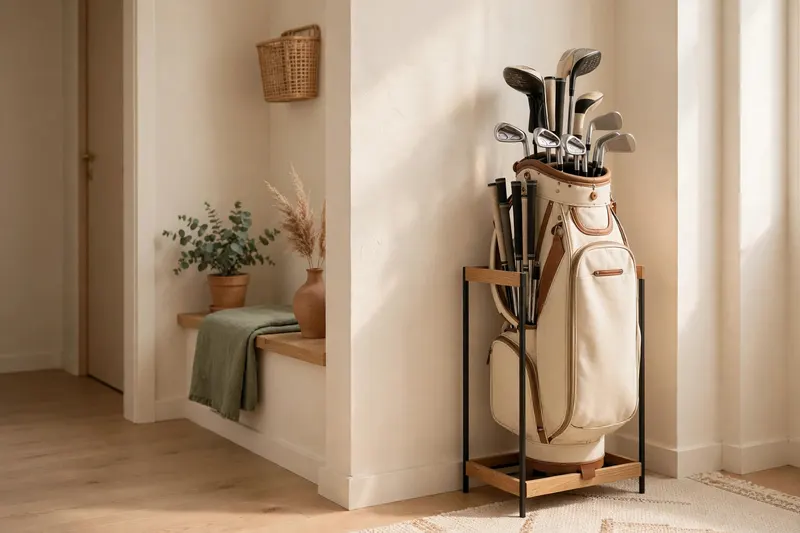
The right stand holds the bag upright in a footprint barely bigger than the bag itself, so a hallway corner or the gap beside a bookshelf becomes useful storage.
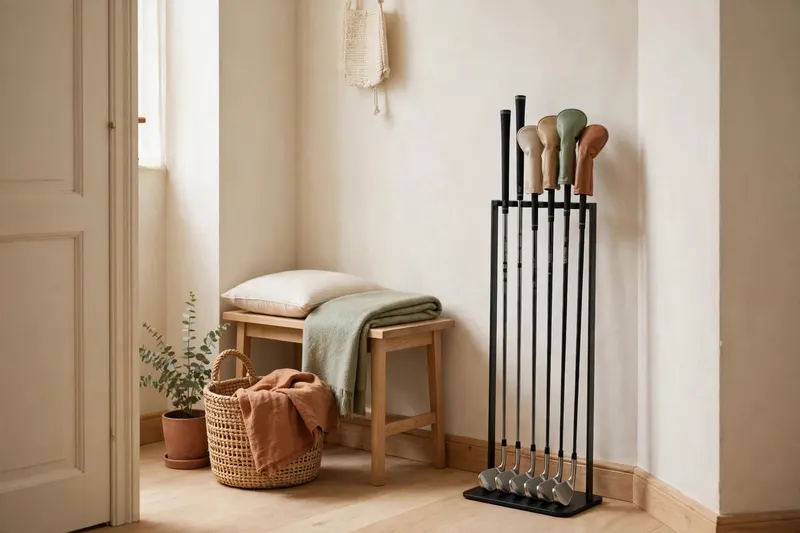
3. Use a slim vertical bag stand in a dead corner
A vertical bag stand — a simple metal or wooden frame with a ring at the top and a small base — holds the bag upright in about 12 inches of floor space. Look for a rubberized ring so the bag doesn’t slide, and a weighted base so it can’t tip when you pull a club out one-handed. The dead corner beside the front door is the natural spot: out of the walking path and ready to grab on your way out.
4. Pick a corner stand with a built-in club organizer
Some stands add a top tray with individual club slots or a small shelf for balls and tees. That organizer top keeps clubs separated so shafts don’t clatter, and gives small accessories a home instead of the bag’s side pocket. Measure the stand’s total height before buying — organizer-top stands run 40 to 48 inches tall, so confirm your ceiling clearance first.
Wall-mounted club racks: vertical, visible, safe
Wall storage gets the bag completely off the floor, which is the single biggest win in a small apartment.
5. Mount a vertical wall rack with padded hooks
A vertical wall rack holds the bag upright against the wall with two padded hooks or a cradle: one near the top of the bag, one near the base. The padding matters — bare metal hooks wear through bag fabric and scratch shafts over time. Mount into a wall stud, not just drywall, because a loaded bag weighs 20 to 25 pounds and pulls outward every time you lift a club out. If you cannot find a stud in the right spot, use toggle bolts rated for at least 50 pounds.
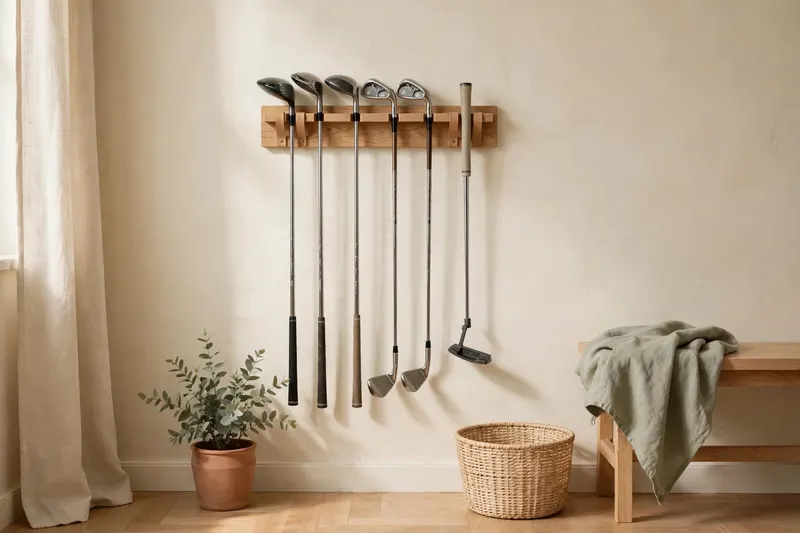
6. Hang clubs on a horizontal rail with headcover hooks
If your bag lives in the closet but you play often, a short horizontal rail with S-hooks lets you hang your most-used clubs — driver, putter, favorite wedge — by their headcovers, ready to grab. Mount the rail at about 48 inches high so clubheads clear the floor, and keep it short, 18 to 24 inches, so it fits a narrow wall between a door frame and a corner.
Closet conversion: a golf nook in 2 square feet
A closet is the most underused golf storage in an apartment. Two square feet of closet floor is enough for a full bag, and the door hides everything when guests come over.
7. Turn two square feet of closet into a golf nook
Clear the floor of one closet section, add a small bag stand or a rubber mat to keep the bag from sliding, and hang a hook on the inside of the door for your towel and glove. Measure the closet opening before you commit, because a loaded bag is about 10 inches wide and needs to pass through the doorway without catching. If the opening is tight, store the bag with the clubs facing out so the narrower base goes in first. For more closet ideas that work in tight rentals, see our renter-friendly closet organization ideas.
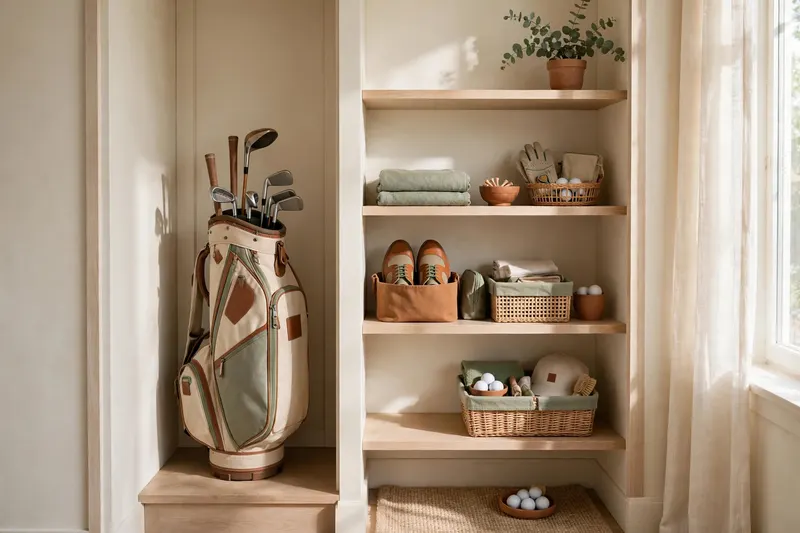
8. Add a shelf and hooks for shoes, balls, and gloves
A single 12-inch-deep shelf mounted at about 60 inches high inside the closet holds a shoe bin, a ball pouch, and a glove case — everything that normally ends up scattered across the bag’s pockets. Add two adhesive hooks on the closet wall for your cap and rangefinder case. Keeping accessories on a shelf keeps the bag lighter and shows at a glance what needs restocking.
Balcony and entryway: the grab-and-go spots
The entryway and the balcony are the two spots closest to the door, which makes them perfect for golf gear — if you handle the weather and the clutter.
9. Build a grab-and-go station by the front door
Pair a slim floor stand with a small wall hook rail by the front door: the bag stands in the corner, and the rail holds your cap, towel, and glove. Add a small boot tray underneath the stand to catch dirt and grass from your shoes. The whole station takes about 18 inches of wall and 12 inches of floor, and it turns leaving for a round into a thirty-second job. If your entryway is tight, our entryway coat storage ideas for homes with no closet show how to squeeze a hook rail into a narrow wall without blocking the door.
10. Store the bag in a weatherproof balcony cabinet
A balcony can work for golf storage, but only inside a weatherproof cabinet — never out in the open. Rain rusts clubheads, sun fades grips, and temperature swings warp shafts over time. A small resin deck box or outdoor cabinet, roughly 30 by 18 inches, fits a stand bag upright and keeps it dry. Add a silica gel pack inside, and check the cabinet after heavy rain for the first month. For more balcony storage that survives the weather, see 16 small apartment balcony storage ideas.
Protecting clubs and grips in small spaces
Every ding on a clubhead comes from clubs stored too close together with nothing between them. Protection is cheap; replacing a driver is not.
11. Keep headcovers on and grips off hard surfaces
Headcovers are not optional in an apartment. With clubs stored upright in a stand or on a wall rack, the heads sit close together and clatter every time you pull one out. Keep covers on the driver, fairway woods, and putter, and keep grips off bare walls and concrete floors — a rubber mat or felt strip stops grips wearing flat on one side.
12. Use dividers or club tubes to stop shaft clatter
If your bag has fewer than the usual 4-way or 5-way dividers, add individual club tubes — thin plastic sleeves that slide into the bag and keep each shaft separated. Tubes cost very little, weigh almost nothing, and end the clinking that damages shafts and annoys everyone in the next room.
Shoes, balls, and accessories in one caddy
The bag holds the clubs. Everything else — shoes, balls, tees, gloves, sunscreen, rangefinder — needs its own home, or it spreads across every surface in the apartment. One caddy keeps it all together.
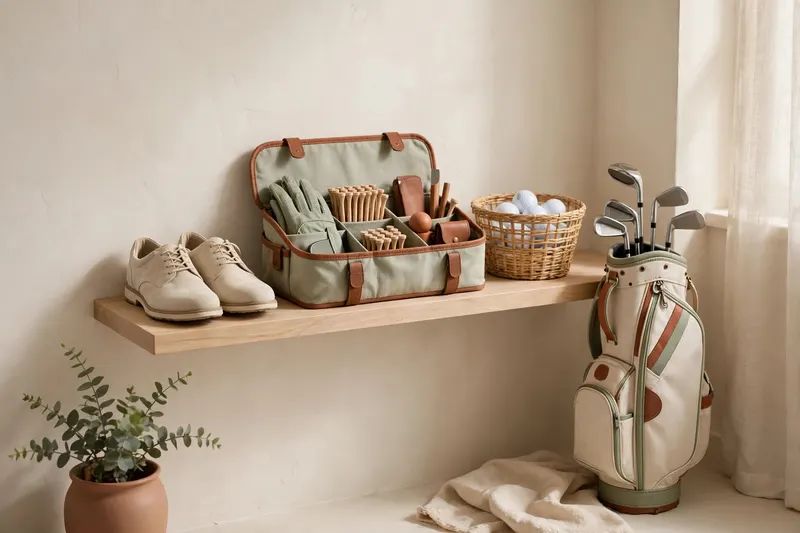
13. Keep a rolling caddy for shoes, balls, and gear
A small rolling cart, about 15 by 12 inches with two or three tiers, holds golf shoes on the bottom, a ball bin and glove case in the middle, and tees, markers, and sunscreen on top. The wheels matter: you can roll the caddy to the door on round day and tuck it back in the closet after. Park it on a boot tray and muddy shoes stay contained. If shoe clutter is a wider problem, our 18 shoe storage ideas for small apartments cover slim racks and door solutions that pair well with a golf caddy.
14. Sort small accessories into labeled bins
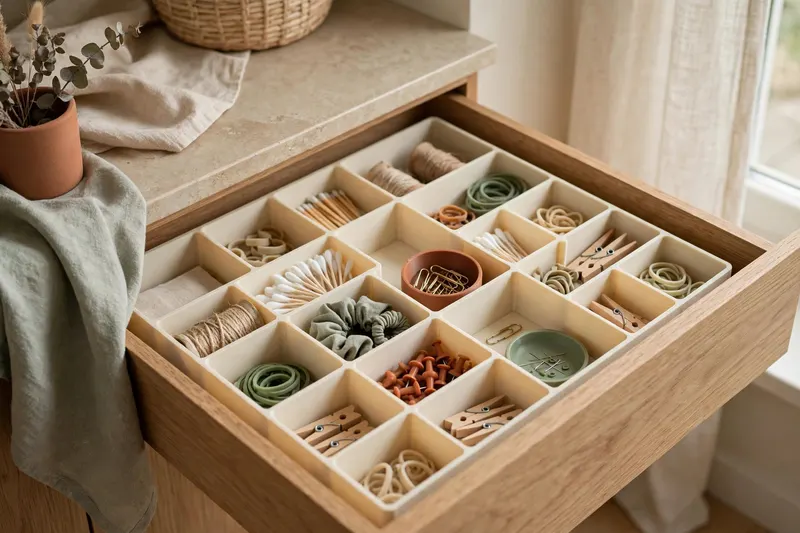
Balls, tees, ball markers, divot tools, and spare gloves are small enough to vanish into a bag pocket forever. Sort them into small labeled bins — one for balls, one for tees and markers, one for gloves and towels — inside a single drawer, shelf box, or the caddy’s top tier. Count your balls when you restock: a standard sleeve holds three, and knowing you have two sleeves in the bin means no more discovering you are short on the first tee.
The pre-round 5-minute grab routine
The best storage system is the one that makes leaving easy. A five-minute routine, done the night before, means you never leave a club behind.
15. Run a 5-minute grab checklist before every round
Stand at your golf nook and check five things: clubs — count the heads, all 14 should be there; balls — at least six in the bin or pocket; glove — one in the bag, one spare in the caddy; towel and tees — towel on its hook, a handful of tees in the pocket; shoes — in the caddy or by the door, not in the bedroom. Five minutes, five checks, and you walk out knowing nothing is missing.
Mistakes to avoid
Leaning the bag against the wall. It falls, it slides, it dents the wall and the clubs. Use a stand or a rack, even a cheap one.
Storing clubs on a damp balcony without cover. Rust starts on clubheads within weeks in humid air. If the bag lives outside, it lives inside a sealed cabinet with a moisture absorber — no exceptions.
Buying a rack before measuring. A rack that doesn’t fit is a return trip a tape measure would have prevented.
Cramming accessories into the bag. A bag stuffed with shoes, balls, and rain gear weighs more, wears faster, and hides the things you need. Accessories belong in the caddy or on a shelf.
Ignoring the lease. Drilling into a wall without checking the rules can cost your deposit. Freestanding stands and adhesive hooks solve the same problem with zero risk.
Frequently asked questions
Can you store golf clubs in a small apartment?
Yes. A stand bag needs only about 12 inches of floor space in a corner, a closet nook, or on a wall rack. Measure the bag first, then choose a slim floor stand, a vertical wall rack, or a two-square-foot closet conversion.
How do I store golf clubs without a garage?
Use a vertical wall rack or a slim floor stand inside the apartment, or a weatherproof cabinet on the balcony. Keep the bag upright, indoors or sealed against weather, with headcovers on and grips off hard surfaces.
Is it bad to store golf clubs on a balcony?
It is fine only inside a sealed, weatherproof cabinet with a moisture absorber. Clubs left open on a balcony face rain, sun, and temperature swings that rust clubheads, fade grips, and warp shafts.
How do I keep golf clubs from getting damaged in storage?
Keep headcovers on woods and putter, use club tubes or a bag with full-length dividers to stop shafts clattering, store the bag upright so grips don’t rest on hard surfaces, and keep everything dry.
Where should golf shoes and accessories go in a small apartment?
Keep them in a small rolling caddy or on one closet shelf with labeled bins — shoes on the bottom, balls and gloves in the middle, tees and small items on top.
Conclusion
Golf clubs don’t need a garage — they need a measured spot, an upright stand or rack, and a caddy for the small stuff. Measure your bag, pick one storage home from these 15 ideas, and protect your clubs with headcovers and dividers. Your floors stay clear and your clubs stay safe. Save this pin for later, and browse more ideas in our storage ideas collection.