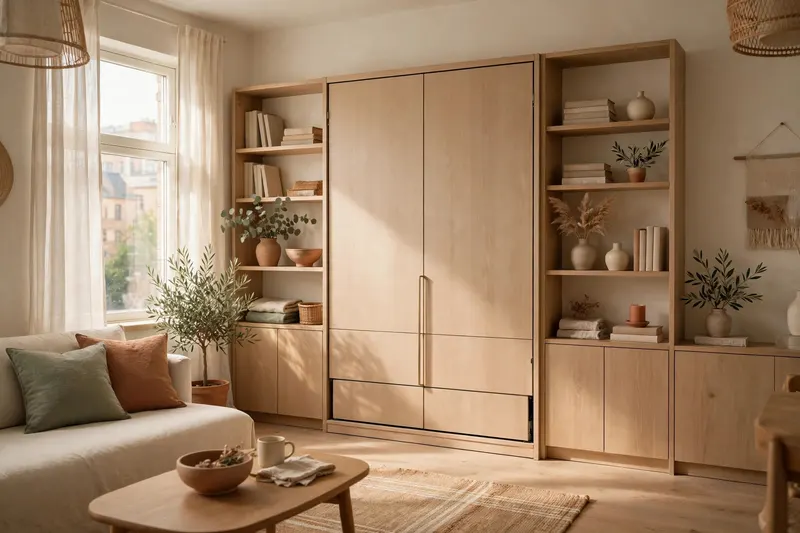
A murphy bed only earns its keep if everything around it has a place to go. The bed itself is the easy part — it folds up and the room is yours again. The hard part is the bedding, clothes, laptop, and book, all of which need a home the moment the bed disappears. That is why small apartment murphy bed storage ideas work best when you treat the whole wall as one piece of furniture. This guide gives you 15 ideas that turn that wall into a wardrobe, a desk, and a linen cupboard — so the bed folds away and everything else has a home.
The murphy bed promise: a bedroom that disappears by day
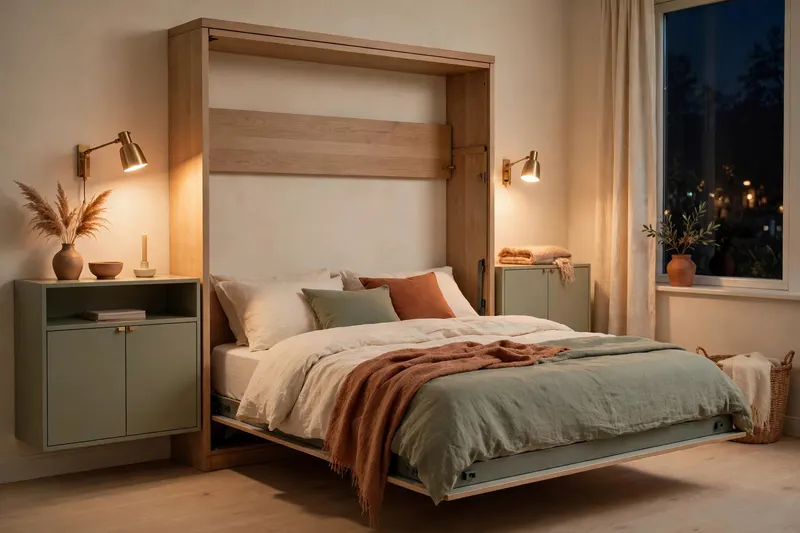
A murphy bed folds vertically into a wall cabinet, freeing the floor underneath for daytime living. In a studio or one-bedroom apartment, that single move gives you back 28 to 35 square feet — roughly a queen bed’s footprint — every morning. But the promise only holds if the wall does double duty as wardrobe, desk, and shelves.
Before you buy anything, measure the wall width, ceiling height, and swing arc. A queen cabinet needs about 65 inches wide and 87 inches tall, plus 80 inches of clear floor in front. Tape the arc on the floor first — a rug, door swing, or radiator inside it means your storage plan has to move. Lag-bolt the bed into wall studs, never drywall anchors alone — the U.S. Consumer Product Safety Commission has recalled murphy beds that pulled away from poorly anchored walls, so renters need written landlord permission and a professional installer.
1. Plan the whole wall as one unit before you buy a single piece
Sketch the wall with the bed cabinet in the center and assign every inch a job: left tower for clothes, right tower for linens, shelf above for books, desk panel on the face. Buying the bed first and improvising later is how people end up with a cabinet blocking their only shelf. Build in phases if money is tight, keeping the same 16-inch depth and finish so the wall reads as one built-in.
Side cabinets: the wardrobes built into the bed wall
The towers flanking the bed hold most of your storage. As deep as the bed cabinet, they never stick out, and you reach them whether the bed is up or down. A pair of 18- to 24-inch-wide towers beside a queen bed turns about 10 square feet of wall into a full wardrobe.
2. Build a full wardrobe tower on one side
Give one tower a hanging rail at 60 inches, a shelf above for folded jumpers, and three drawers below for underwear and socks. A 24-inch-wide tower holds about 25 hangers — enough for a week’s rotation plus work clothes.
3. Add a narrow pull-out tower for shoes and accessories
A 12-inch-wide pull-out with five shallow shelves holds six to eight pairs of shoes, plus belts and scarves up top.
4. Use mirrored cabinet doors to double the light
Mirrored doors bounce daylight around a small room and make the wall look half as deep. Choose frameless mirrors mounted flush on the doors with a recessed pull or push-to-open catch.
Shelving above and around the folded bed
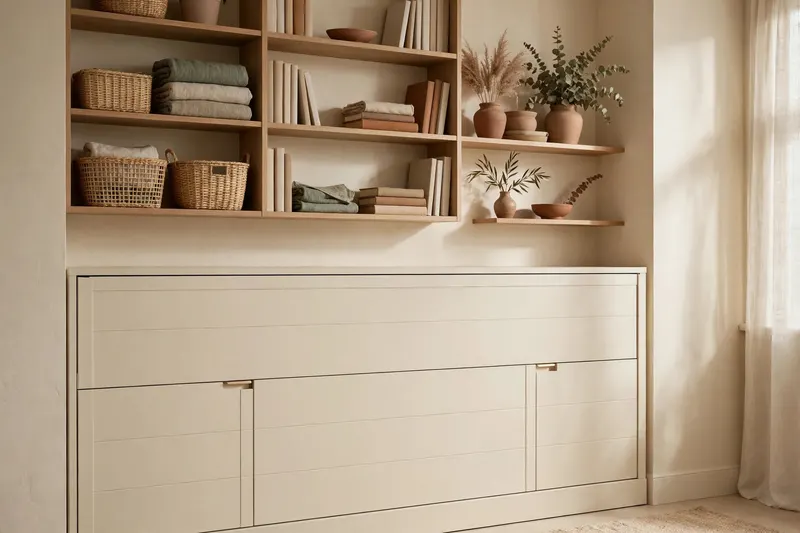
Folded up, the cabinet face is a blank wall roughly 6 feet tall and 5 feet wide, and the strip above it is often the only high storage a small apartment has.
5. Run open shelves across the top of the cabinet
One 12-inch-deep shelf 6 inches above the cabinet top holds books, baskets, and the spare blanket without crowding the mechanism.
6. Fit picture ledges on the folded bed face for display
The flat face of a folded bed suits two or three slim picture ledges, each 4 inches deep, holding photos, a plant, and a couple of books. Keep each ledge under 10 pounds so nothing rattles loose when the mechanism moves.
Fold-down desk combos: work by day, sleep by night
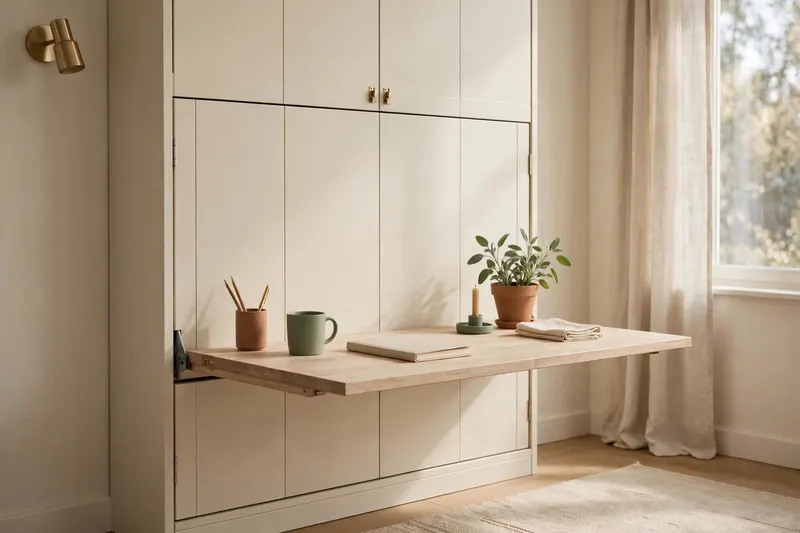
The smartest trick is hiding the desk in the bed itself: when the bed folds up, a desk panel folds down from its face and the room becomes an office by morning.
7. Choose a bed with a fold-down desk on its face
Look for a desk panel built into the cabinet face: when the bed is up, it drops to a 29-inch-high work surface about 48 inches wide — room for a laptop, a notebook, and a mug. A closed laptop can stay on the desk while the bed folds down, but check the weight limit — most panels are rated for 20 to 30 pounds.
8. Pair the desk with a side-cabinet shelf for office supplies
Give it a home base: two shelves in the nearest side cabinet for cables and notebooks. The same thinking applies to other fold-away pieces — our guide to folding furniture storage ideas for small apartments pairs each piece with its storage spot.
Under-bed storage when the bed is down
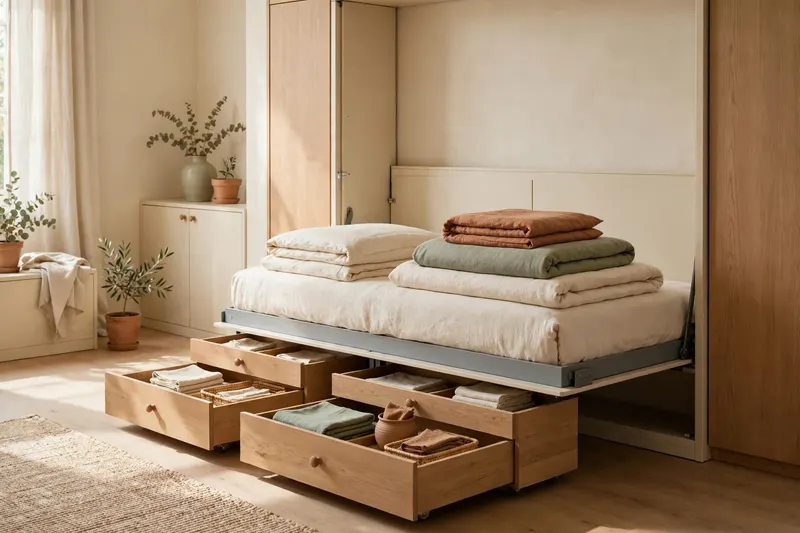
A murphy bed frame sits 10 to 14 inches off the floor — perfect for things you only need at night.
9. Use the bed frame’s own drawers for off-season clothes
Some frames come with two shallow drawers in the base, each about 30 inches wide and 6 inches deep — ideal for off-season clothes, spare sheets, and the extra blanket. Without drawers, slide two flat lidded bins (roughly 32 x 18 x 6 inches) under the frame instead, labels on the ends. Our guide to under-bed storage ideas for small bedrooms covers bin sizes and dust control.
10. Keep a slim rolling caddy for nighttime essentials
A 6-inch-wide rolling caddy under the bed holds what you reach for at night and want gone by day: a phone charger, a water bottle, and your book.
Bedding storage: where the pillows and duvet go by day
A queen duvet, two pillows, and a folded throw take up roughly 6 cubic feet — a large laundry basket’s worth.
11. Give the bedding its own compartment in a side cabinet
Reserve one full shelf in a side tower, about 24 by 18 by 14 inches, for the duvet and pillows alone. Fold the duvet into thirds and stack the pillows on top, and the whole set lifts out in one motion each morning.
12. Store the spare set high and the daily set low
Keep nightly bedding at waist height, between 30 and 48 inches off the floor, so the morning fold-up takes seconds. The spare set — guest bedding, the winter duvet — goes on the top shelf in a labeled bag. For more ways to tame bulky bedding, see our bulky bedding storage ideas for small apartments.
Lighting and power: reading lights that fold away too
Lighting and power need the same fold-away thinking: fixed to the wall, not the bed, so nothing dangles or gets crushed when the mechanism moves.
13. Mount swing-arm sconces on the side towers, not the bed
Two swing-arm sconces, one per side tower at about 48 inches high, fold flat when the bed goes up. Plug-in sconces with a cord channel are renter-friendly, leaving no holes beyond two small screws.
14. Put a power strip and USB ports inside a side cabinet
Run a 6-outlet strip with two USB ports inside the desk-side cabinet, its cord through a small hole in the cabinet back. Phones, the laptop charger, and the lamp all live on that strip, so cables never trail across the floor where the bed folds down.
The 2-minute fold-up routine that keeps the system working
Every idea here depends on one habit — without it, the bedding piles up and the room stops transforming.
15. Follow the same 2-minute fold-up routine every morning
In order: strip the pillows and duvet into the bedding compartment (30 seconds), slide the night caddy under the bed and clear the desk (30 seconds), fold the desk panel up (15 seconds), and lift the bed until the lock clicks (30 seconds). If the routine ever takes longer than three minutes, something has no home — fix the storage, not the bed.
Mistakes to avoid
Buying the bed before measuring the arc. The swing arc decides where the towers and rug go and whether the door still opens — tape it on the floor before you spend a dollar.
Skipping the wall anchoring. A bed not lag-bolted into studs is a safety hazard.
Filling the towers with things you never use. The side cabinets are prime real estate — a box unopened for a year belongs out of the apartment.
Choosing a mattress over 12 inches thick. Most mechanisms are rated for mattresses between 8 and 12 inches.
Forgetting the bedding plan. The bed is the easy purchase — the bedding compartment decides whether you actually fold it up every day.
Frequently asked questions
Can a murphy bed work in a rental apartment?
Yes, with your landlord’s written permission. Choose a freestanding cabinet that bolts into studs with a few lag screws — the holes patch easily when you move out. Avoid units that need cutting into the wall or removing baseboards.
How much storage can you fit around a murphy bed?
A typical queen setup with two side towers and a top shelf holds roughly 25 to 30 cubic feet — about a standard two-door wardrobe plus a small bookcase — covering clothes, linens, and office supplies for one person.
Can you leave bedding on a murphy bed when you fold it up?
Most modern murphy beds let you leave a fitted sheet and a thin duvet on the bed when it folds, as long as the total stays under the manufacturer’s limit — usually 10 to 12 inches with the mattress. Pillows generally need to come off.
How do I keep a murphy bed wall from looking like a big blank box?
Break up the cabinet face with picture ledges, a fold-down desk, or mirrored doors, and match the finish to your wall color.
What is the best mattress thickness for a murphy bed?
Eight to 10 inches is the sweet spot: thick enough to sleep well, thin enough to fold flat with a fitted sheet. Check your unit’s manual first, since piston strength and cabinet depth vary.
The bottom line
A murphy bed hides a bedroom, but the storage wall around it makes the trick work every day. Plan the whole wall as one unit, give the bedding its own compartment, and keep the fold-up routine to two minutes — then the same 100 square feet is a bedroom at night and a living room by day. Save this pin for later, and browse more ideas in our small-spaces category.