Every small apartment has the same problem: nowhere to put things, and nowhere to sit either. Blankets pile on the sofa arm, board games stack on the floor, and the spare chair lives in the way. Small apartment ottoman storage solves both problems in one footprint. An ottoman is a seat, a table, and a storage box all at once. Here are 15 ideas for choosing, filling, placing, and styling one — plus the mistakes to avoid. Below, you will learn what to stash inside, where to place it in each room, and how to pick one that fits your space and budget.
Why an ottoman is the best hidden storage in a small apartment
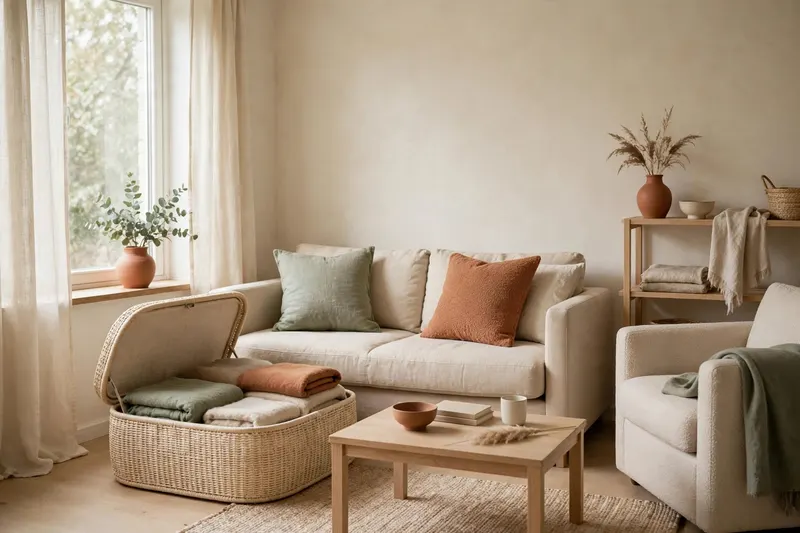
Most storage furniture demands a trade-off: a cabinet eats wall space, a trunk eats floor space, a shelving unit eats visual space. An ottoman asks for none of that. It sits where a footrest or coffee table would sit anyway, so the storage inside it is effectively free. A standard 30-inch square ottoman hides roughly 3 to 4 cubic feet — enough for two folded throws or a stack of board games — and it moves wherever you need it.
Choosing the right storage ottoman: size, lid, and weight
1. Measure the gap, then subtract two inches
Measure the spot first, then subtract two inches on every side — that clearance lets you lift the lid without scraping the wall. For a standard 84-inch three-seat sofa, an ottoman 30 to 36 inches wide looks proportional; over 40 inches it starts blocking walkways. In a bedroom, leave 24 inches between ottoman and bed.
2. Pick a hinged lid for daily use, a lift-off lid for deep storage
Hinged lids stay attached and open one-handed — ideal if you reach for a blanket every evening. Lift-off lids come all the way off, which suits bulky seasonal items. Avoid lids held shut by magnets alone if you plan to sit on the ottoman; they can pop open under weight.
3. Check the weight rating before you sit on it
A storage ottoman is only triple-duty furniture if it can hold a person, so look for a stated capacity of at least 250 pounds. Cheaper cubes rated for 100 pounds or less are footrests only — sitting on one bows the lid within months. Solid wood frames with corner blocks outlast particleboard. Secondhand? Press the lid center: flex or creak means a tired frame.
What to store inside: blankets, games, and clutter magnets
One category per ottoman — store what you use in the room where it lives, and nothing else.
4. Keep two throws and one reading blanket within arm’s reach
Two folded throws and one heavier reading blanket fill a 30-inch ottoman neatly, and they stay clean until the evening chill arrives. Roll rather than fold the throws to save roughly a third of the space. If blankets keep multiplying, our guide to 15 Small Apartment Blanket Storage Ideas shows where the overflow goes.
5. Store board games flat, lids up, in one layer
Board games are the classic ottoman win: flat, heavy, and impossible to stack neatly on a shelf. Lay them flat in a single layer, lids facing up, largest on the bottom — never on their sides, or pieces slide and boxes warp. Most ottomans fit three to five standard game boxes this way. For overflow games, see 18 Board Game Storage Ideas for Small Apartments.
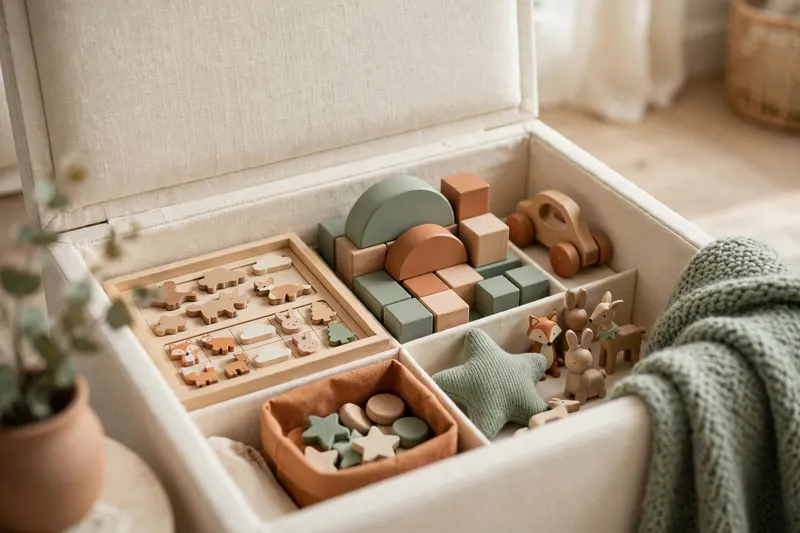
6. Give clutter magnets one labeled home each
Remote controls, charging cables, the dog leash, and the half-finished craft project are clutter magnets because they have no assigned spot. Give each one a small container inside the ottoman — a 10×6×6-inch bin for remotes and cables, a zip pouch for the leash, a fabric tote for the knitting. When everything inside has its own container, the ottoman never becomes the junk drawer it replaced. For kids’ toys, see 18 Kids Toy Storage Ideas for Small Living Rooms.
Ottoman as coffee table, seat, and footrest: triple duty
One piece of furniture, three jobs — here is how to make each one work.
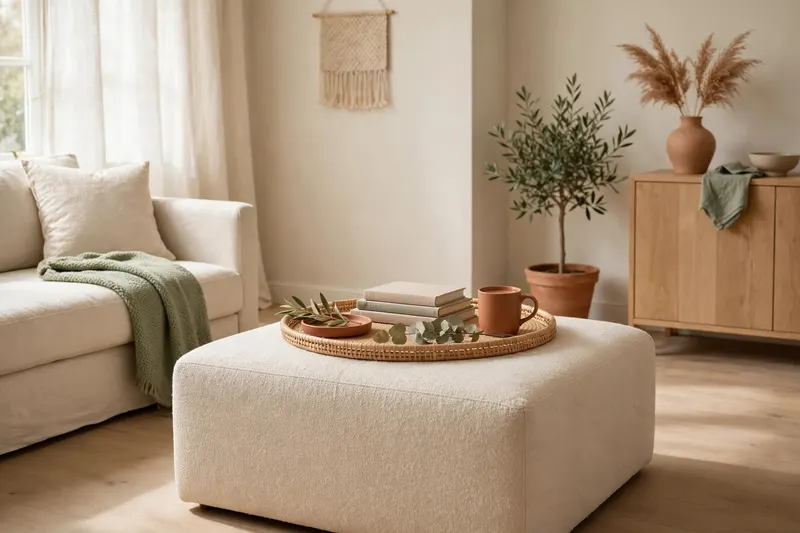
7. Add a tray and it becomes a coffee table
A flat, rigid tray — wood, lacquered, or metal, about 16 to 18 inches across — turns a soft ottoman top into a stable surface for mugs, books, and a vase. Choose a tray with a raised lip so nothing slides off when someone bumps the ottoman, and keep it to roughly half the top so the other half stays available as a footrest. See also 15 Folding Furniture Storage Ideas for Small Apartments.
8. Use it as the extra seat when guests arrive
A sturdy storage ottoman seats one adult comfortably for a dinner party or game night — no unfolding, no fetching a chair from the bedroom. Pull it to the side of the room rather than the center so the sitter joins the conversation instead of blocking the TV. When guests leave, it slides back to its footrest spot in seconds — the cheapest extra seat in a small apartment.
9. Make it the footrest your sofa is missing
Most apartment sofas are too deep or too low for comfortable lounging, and a footrest fixes that instantly. Place the ottoman 12 to 18 inches from the sofa edge — close enough to reach without stretching, far enough to stand up without tripping. Choose a height of 16 to 18 inches, level with the sofa seat.
Placement tricks: living room, bedroom, and entryway
Place it for the job each room needs most.
10. Anchor the living room with a centered ottoman
Center it in front of the sofa like a coffee table, leaving a 14-to-18-inch walkway on the open side. A rectangular ottoman (about 36×20 inches) suits a long sofa better than a square one. Keep the tray half nearest the sofa, footrest half nearest the TV.
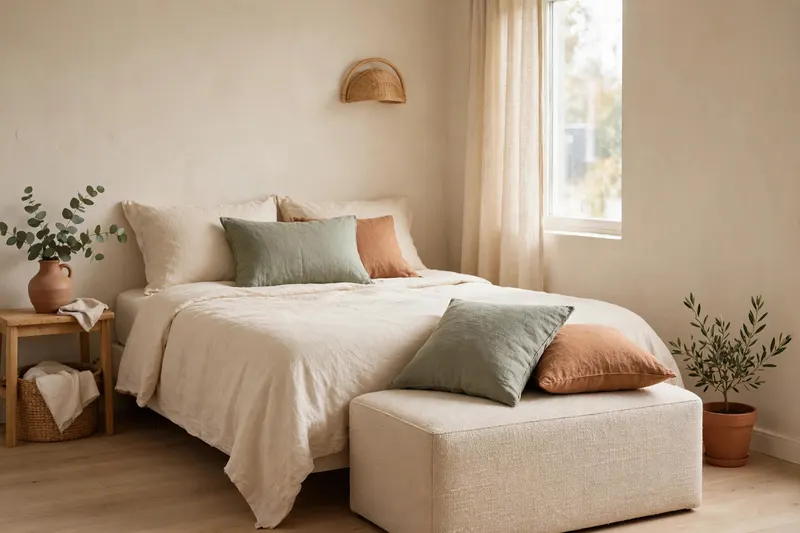
11. Put a slim ottoman at the foot of the bed
In the bedroom, a slim rectangular ottoman — 40 inches wide, 16 inches deep — sits at the foot of the bed without blocking the closet door or the path to the bathroom. Fill it with bedroom things: extra pillows, the spare duvet, and off-season pajamas. Match the fabric to the bedding so the room reads as one calm space.
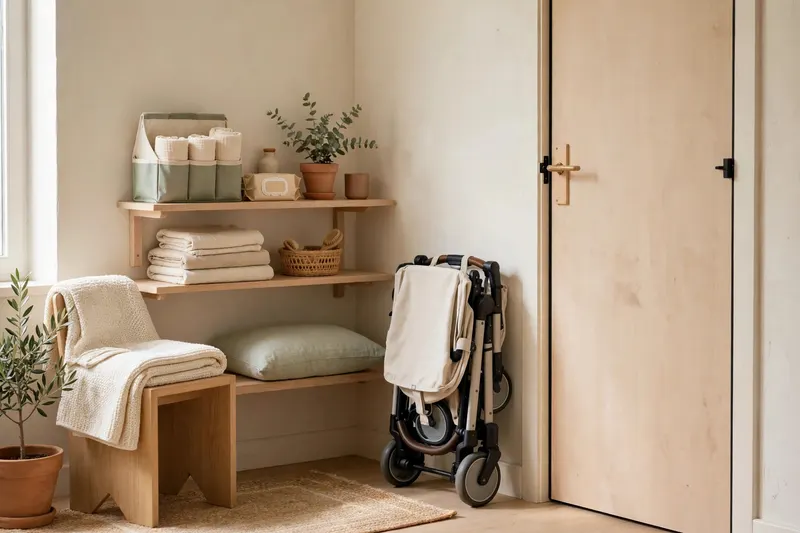
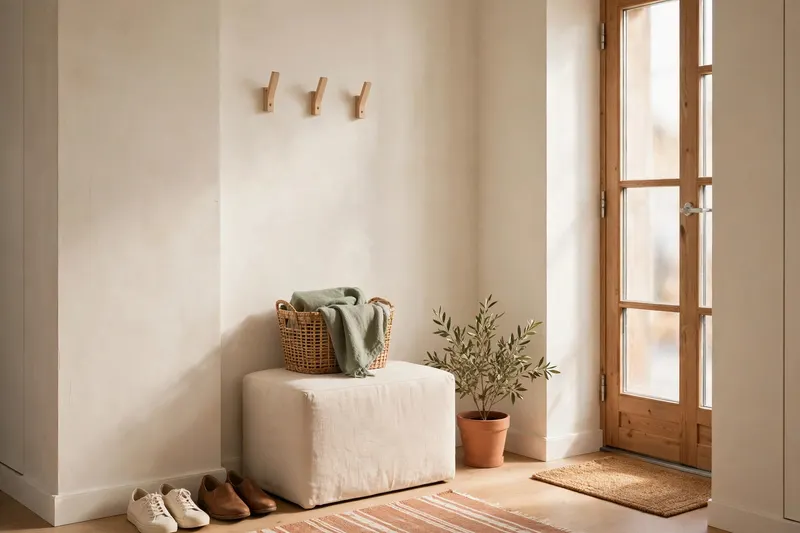
12. Shrink it for the entryway: a cube that holds the out-the-door kit
An entryway ottoman should be a cube — 16 to 18 inches on each side — small enough to tuck under a wall hook rail or beside the shoe rack. Inside it: the dog leash, reusable shopping bags, one umbrella, and gloves and hats. You sit on it to put on shoes, grab the leash from inside, and walk out the door. With no closet at all, pair it with wall hooks — see 16 Entryway Coat Storage Ideas Without a Closet.
Keeping it tidy: the one-category rule
13. Assign one category per ottoman and label it inside the lid
The fastest way to ruin a storage ottoman is to let it hold a little of everything. Assign exactly one category per ottoman — blankets, games, entryway gear — and tape a small label inside the lid naming it. Once a month, pull out anything that does not match the label — that two-minute check is the whole routine. If an item keeps sneaking in, it belongs elsewhere.
Budget finds and DIY upgrades
You do not need to spend much — and the cheapest ones improve fast with an hour of work.
14. Buy secondhand and judge the frame, not the fabric
Thrift stores and marketplace listings are full of storage ottomans for a quarter of retail, and the frame is what matters. Press the lid center, wiggle the corners, open the hinge three times: solid wood frames with tight joints are worth buying even under stained fabric — a $15 slipcover fixes the outside. Skip any ottoman with a cracked particleboard base or a lid that does not sit flush.
15. Upgrade a plain cube with legs, casters, and a tray
A basic fabric cube becomes a custom piece with three cheap upgrades. Screw-on tapered legs (4 to 6 inches, about $12 a set) lift it off the floor so the vacuum fits underneath. And a $15 thrifted wooden tray gives you the coffee-table surface from idea 7. Total: under $40, and every upgrade is renter-friendly.
Mistakes to avoid
Buying for looks before measuring. The most common regret is an ottoman two inches too wide for the gap it was bought for. Measure twice.
Choosing a lid you cannot open one-handed. If opening it takes two hands and a knee, you will stop opening it. Test the lid in the store with a coffee mug in one hand.
Overstuffing it until the lid bows. A packed ottoman strains the hinges and warps the lid. If the lid does not close flat with a gentle press, something needs to leave.
Picking the wrong fabric for the room. Velvet and light linen show every pet hair and coffee ring. With kids or pets, choose a wipe-clean performance fabric or faux leather.
Using it as the only storage in the apartment. An ottoman holds about 3 to 4 cubic feet. It works alongside a closet system and a few shelves, not instead of them.
Frequently asked questions
Can a storage ottoman replace a coffee table?
Yes, if you add a rigid tray and choose a firm, flat-topped ottoman. A soft, tufted top without a tray will not hold a mug steady. A 36×20-inch rectangular ottoman works best, tray covering about half the top.
What should you not store in an ottoman?
Avoid anything heavy enough to strain the hinges, anything damp or perishable, and anything you need daily in another room. Keep documents and valuables elsewhere — an ottoman is easy to carry off.
How much weight can a storage ottoman hold?
It depends on the frame. Budget cube ottomans often hold only 100 pounds and are footrests, not seats. A solid wood-frame ottoman typically holds 250 pounds or more, enough for one adult to sit on comfortably. Always check the manufacturer’s stated capacity first.
How do you keep a storage ottoman from smelling musty?
Air it out monthly, keep a cedar sachet or a small pouch of baking soda inside, and never store damp items in it. If it already smells musty, empty it, wipe the interior with diluted white vinegar, and leave the lid open for a day.
Conclusion
A storage ottoman is the highest-value piece of furniture a small apartment can own: a seat, a table, and a hidden storage box in one footprint. Measure first, assign it one category, and let the tray do the rest. Browse more space-saving ideas in our small-spaces collection and save this pin for later.