A robot vacuum is the best deal in small-apartment cleaning — until you look at its dock. That black plastic box sits against the wall with a cord trailing across the baseboard, and in a small apartment there is nowhere to ignore it. These small apartment robot vacuum storage ideas hide the dock completely while keeping it charging — and most cost less than a single dinner out.
What the dock actually needs: power, clearance, and Wi-Fi
A dock needs three things: an outlet within about 3 feet, clear space in front of it, and a steady Wi-Fi signal.
1. Measure the dock’s real footprint first
Note three numbers: the dock’s width, its depth, and the vacuum’s height on it. Most docks are roughly 12 to 14 inches wide and 5 to 7 inches deep; self-emptying docks can stand 15 to 19 inches tall. Add 2 inches of breathing room on each side.
2. Pick the outlet first, then the hiding spot
The dock’s cord is short, usually 4 to 6 feet, so it must sit close to an outlet. List every outlet with 18 inches of clear wall space in front of it — that is your real list of hiding spots. Check the Wi-Fi at each one too.
Under-furniture dock garages: sofa, console, and bed
The easiest hiding place is one you already own: a dock under furniture is invisible and costs nothing.
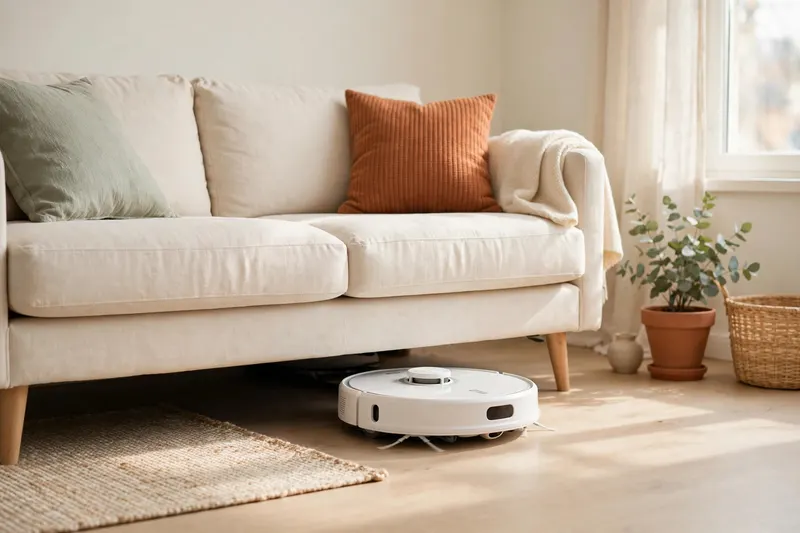
3. Build a sofa dock garage in the dead space behind the legs
The gap under most sofas is only 4 to 6 inches high, but the space behind the back legs is often empty. Slide the dock behind one end of the sofa, vacuum facing out. Leave the dock’s full depth plus 4 inches of approach space, and keep the path clear.
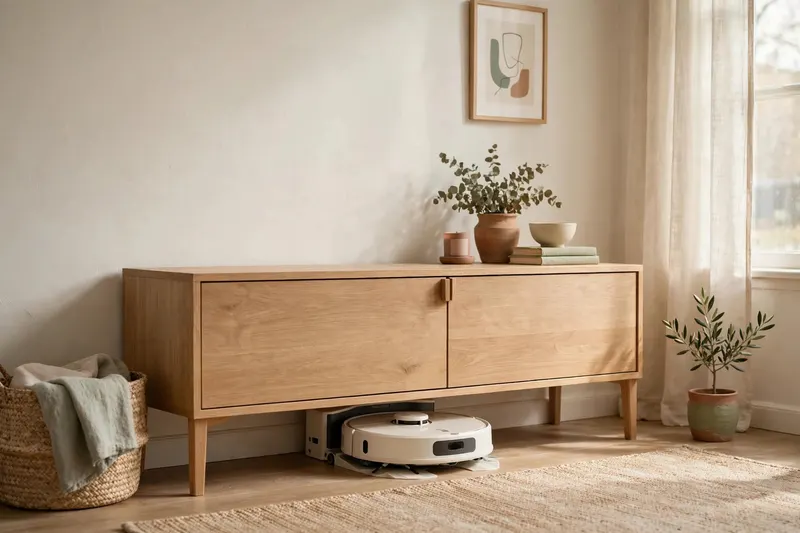
4. Turn a console table or media unit into a charging station
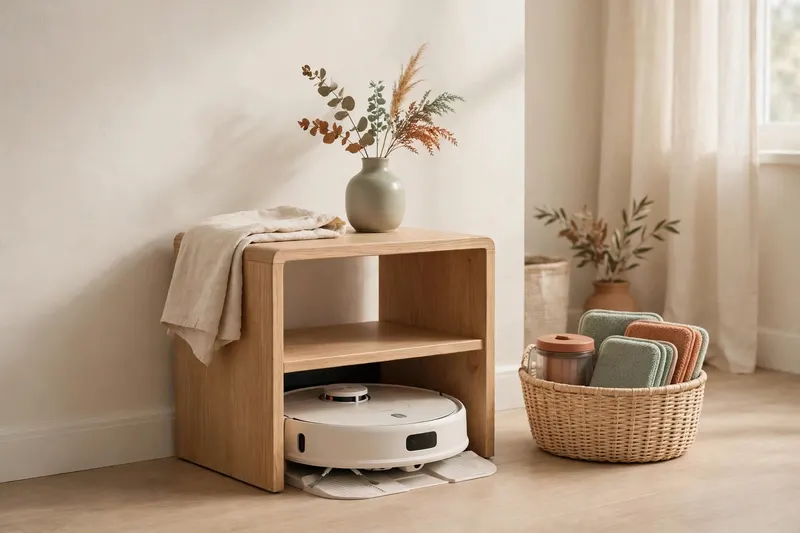
A console table, low media unit, or open bookshelf makes a ready-made dock garage. Place the dock beneath the unit and run the cord up behind a furniture leg. Cut a 1-inch cord hole low in the back panel if it has one. It is the same disguise trick as a small apartment dog crate that looks like furniture: a bulky necessity given a job as a table base.
5. Park the dock under the bed — but only with a low open frame
Under-bed docks work when the bed frame sits at least 7 inches off the floor. The vacuum needs a straight 2-foot run to align itself, so measure from the dock to the bed’s edge. A solid-base platform bed will not work.
The closet dock: charging inside a hall or utility closet
A closet is the most complete hiding place of all: close the door and the dock simply does not exist.
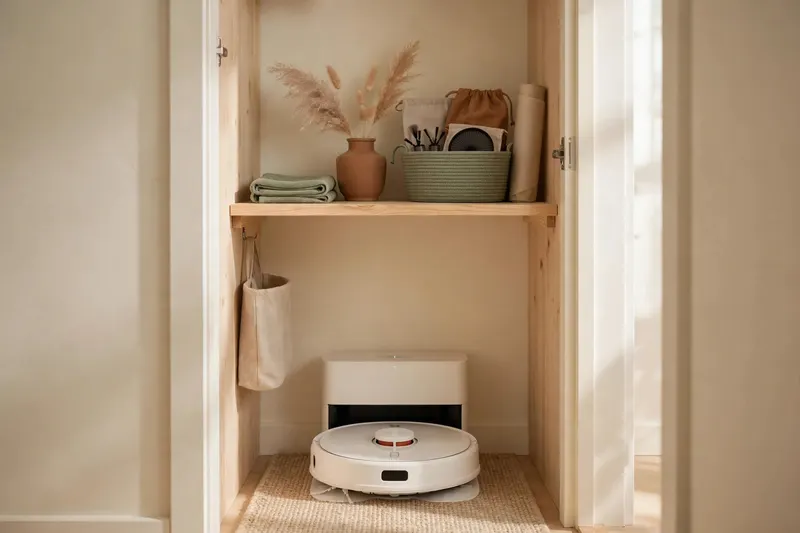
6. Set up a hall closet dock with the door held slightly open
A hall closet dock needs one thing a closed closet cannot give: a gap for the vacuum. Remove the door and hang a curtain, or fit a door stop that holds it open about 8 inches — enough for the vacuum to pass, narrow enough to hide the dock. These hall closet organization ideas for tiny entry closets show how to zone the rest.
7. Use the utility or laundry closet as a vacuum home base
A utility closet already holds cleaning gear, so the dock keeps every cleaning tool in one place. Clear one bay about 18 inches wide, put the dock on a rubber mat, and store spare filters and mop pads on a shelf above it. Test the Wi-Fi first — a small hallway extender usually fixes a weak signal for under $30.
Kick-plate and toe-kick hideaways under kitchen cabinets
The toe-kick — the recessed strip at the bottom of kitchen cabinets — is dead space in almost every apartment.
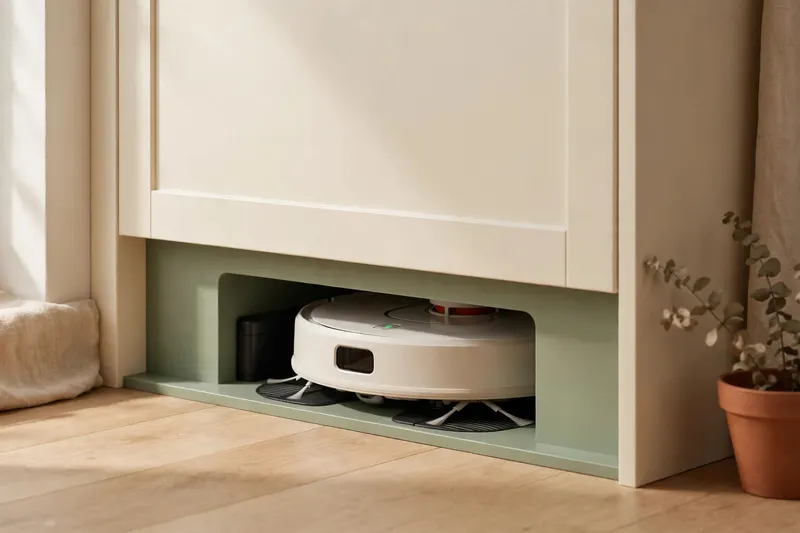
8. Convert a toe-kick drawer into a pull-out dock bay
A toe-kick drawer kit (about $40 to $80) replaces a section of kick-plate with a shallow drawer on runners. Mount the dock inside, notch the back for the cord, and plug it into the outlet behind the neighboring cabinet. Pull it open when the vacuum runs; push it closed and the kitchen looks untouched. Only do this if your kick-plate is removable with screws — otherwise ask your landlord first.
9. Hide the dock behind a removable kick-plate panel
Unscrew one section of kick-plate under a cabinet that holds nothing but dead space, and set the dock behind it, vacuum facing out. Attach the panel with two magnetic catches instead of screws so you can pop it off in seconds. Measure first: the opening needs at least 2 inches more width than the vacuum.
A dock station that doubles as a side table
When no under-furniture or closet spot works, give the dock a piece of furniture of its own.
10. Build a side-table dock cabinet from a nightstand
A cheap nightstand or small cabinet with its back panel removed makes an excellent dock station. Take off the back, cut a vacuum-sized opening in one side, and slide the dock inside facing it. The top holds a lamp, the drawer holds spare filters. Leave 3 inches of open space in front of the dock, and skip cabinets with a center divider. Pair it with these family charging station ideas for small homes.
11. Cover the dock with a plant stand or woven basket shell
If you rent and cannot modify furniture, cover the dock instead of building around it. A tall plant stand with an open base, or a large woven basket with the bottom cut out, slips over the dock. Keep the cover under 5 pounds, and never use a solid box with no exit — it traps heat around the charger.
Cable control: keeping the dock’s cord invisible
A hidden dock with a visible cord is only half hidden.
12. Run the cord through a paintable cable channel and behind furniture
A paintable adhesive cable channel, about 1 inch wide, hides the dock’s cord along the baseboard. Paint it the wall color and it disappears. Clip the cord every 12 inches so it never sags into the vacuum’s path, and coil extra cord behind the dock — never in front, where a loose loop stops docking.
Dustbin and mop-pad storage near the dock
A robot vacuum comes with accessories — spare filters, mop pads, a cleaning brush, and, for self-emptying models, replacement dust bags.
13. Keep a slim caddy for dustbin bags and mop pads beside the dock
A narrow caddy, about 6 inches wide, holds everything the vacuum needs: two spare dust bags, washable mop pads, a spare filter, and the cleaning brush. A tall, slim magazine holder slides into the gap between the dock and the wall. Keep washable mop pads in a mesh bag inside the caddy so damp pads do not smell.
14. Store dirty mop pads in a lidded bin, not on the dock
Used mop pads left on the dock make a hidden dock smell like a mop bucket. Keep a small lidded bin next to the dock and drop used pads straight in after each mopping run. Wash the batch weekly, and wipe a self-washing mop dock’s tray dry after each run.
When the vacuum is running: keeping its path clear
The best-hidden dock is useless if the vacuum cannot get out of it.
15. Give the dock a permanent 2-foot clear zone and a 60-second reset habit
Keep the 2 feet in front of the dock clear: no shoes, no bags, no cables, no pet bowls. Do a 60-second evening reset — shoes to the rack, cables off the floor — and it will dock first time, every time. If a threshold or rug edge sits in front of the dock, add a small rubber ramp (about $10 to $15).
Mistakes to avoid
Hiding the dock in a sealed box. A dock in a closed cabinet with no exit, no airflow, and no path out will overheat, lose Wi-Fi, and strand the vacuum.
Putting the dock on thick carpet. Most docks need a hard, flat surface. On plush carpet the dock rocks, the contacts misalign, and the vacuum pushes the dock across the room. Put a thin hard mat under it if carpet is your only option.
Blocking the dock with a rug edge or a door swing. A rug edge in front of the dock creates a lip to climb, and a swinging door can block its path.
Buying a dock cover before measuring. Dock covers and cabinets come in standard sizes, and docks are not standard. Measure your dock first — a cover half an inch too narrow is a return.
Frequently asked questions
Can I put my robot vacuum dock in a closet?
Yes, if the closet has an outlet (or a cord path to one), a strong Wi-Fi signal, and a way in and out — a door held open about 8 inches, a curtain, or a pet-door-style opening in the closet door. Never seal the vacuum in with the door fully closed while it charges.
How much clearance does a robot vacuum dock need?
Manufacturers usually recommend about 1.5 feet clear on each side of the dock and 4 to 6 feet in front of it. In a small apartment, roughly 2 inches on the sides and 2 feet in front is usually enough, as long as the approach is straight.
Can a robot vacuum dock work under furniture?
Yes, if the furniture leaves at least 5 to 6 inches of clearance for the vacuum to drive in and out, and the dock sits on a hard, flat surface. Sofas, console tables, media units, and open bed frames all work.
How do I hide a robot vacuum dock in a rental?
Use no-drill solutions: slide the dock under furniture, park it in a closet with the door held open, cover it with a plant stand or basket shell, or hide the cord in adhesive channels that peel off cleanly. Skip anything that needs screws or cuts unless your landlord approves it in writing.
Conclusion
A robot vacuum dock does not have to live in the middle of your living room. Measure it, match it to an outlet with good Wi-Fi, and tuck it under a console, in a closet, or behind a kick-plate. Save this pin for later, and browse our storage ideas collection.