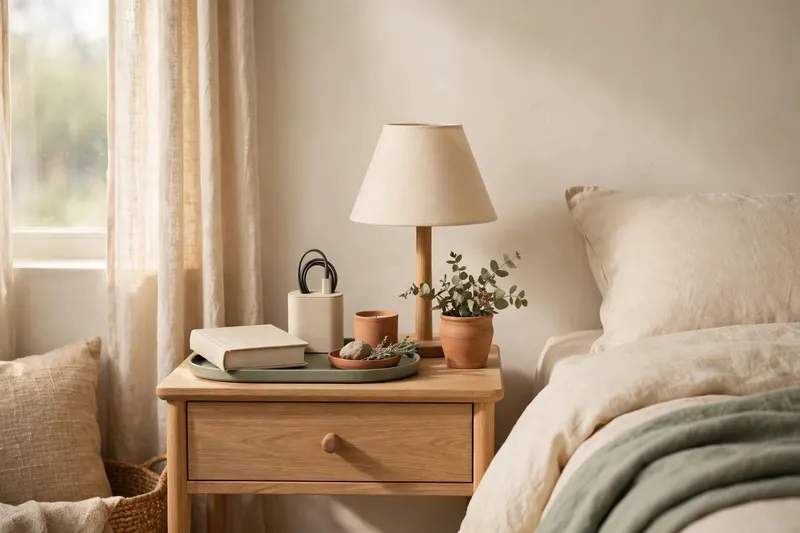
Your nightstand is the smallest piece of furniture in the bedroom, and somehow it collects the most clutter. A phone charger, a half-finished book, a glass of water, lip balm, earbuds, receipts — by bedtime there is barely room to set down a glass. Good small bedroom nightstand organization is not about buying a bigger table. It is about deciding what earns a spot within arm’s reach, giving everything else a zone, and building a two-minute habit that keeps the surface calm. These 15 ideas work for a single drawer, a no-drawer table, or a nightstand barely wider than a book.
The nightstand audit: what actually belongs within arm’s reach
Before you buy a single tray or divider, empty the nightstand completely. Everything comes off the surface and out of the drawer, onto the bed. Then sort it into three piles: nightly essentials, sometimes items, and things that live elsewhere. Most people land on five to seven nightly items: phone, charger, water, book, glasses, lip balm, and a sleep mask or earplugs.
1. Run the arm’s-reach test on every item
Hold each item and ask: did I reach for this from bed in the last week? If the answer is no, it does not belong on the nightstand.
2. Measure your nightstand before you buy anything
Measure the surface and the inside of the drawer — length, width, and height — and save the numbers on your phone. A standard nightstand drawer is roughly 14 inches wide, 12 inches deep, and 3 to 4 inches tall inside, but small-bedroom tables run smaller.
Drawer zones: one drawer, three jobs
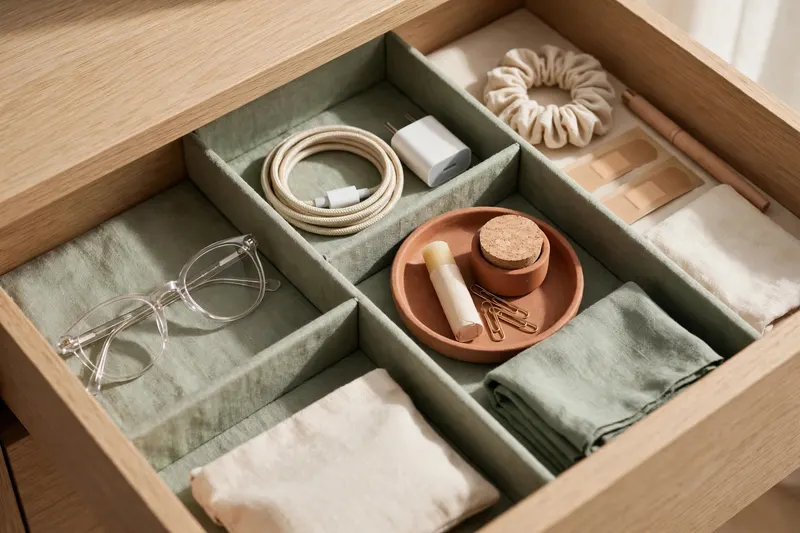
One drawer can hold a surprising amount if it is zoned instead of dumped. Think of it in three zones: front for what you grab in the dark (lip balm, hand cream, sleep mask), middle for the nightly kit (chargers, earbuds, medication), and back for weekly overflow (spare batteries, a notepad, spare earbuds).
3. Divide the drawer with adjustable dividers
Spring-loaded or adjustable dividers (about $8–$15 for a set of four) turn one open box into three or four compartments that stay put. Leave one compartment empty on purpose as a landing pad for the week’s random items.
4. Give every small item a tiny home
Use a small ceramic dish or silicone tray (about 4 × 6 inches) inside the drawer for jewelry, hair ties, and earbuds, and a narrow pencil-style tray along one side for pens and a small flashlight. Our guide to 17 Junk Drawer Organization Ideas That Finally End the Mess uses the same zone-and-container logic at a bigger scale.
5. Move the overflow to the dresser, not the floor
If the drawer will not close easily, something in it belongs in the dresser. Medication goes in a small lidded box on the dresser top; extra books go to the shelf. The drawer should close with one finger and no shoving. For more bedroom-wide strategies, see 17 Small Bedroom Dresser Organization Ideas That Double Your Drawers.
No drawer? Trays, baskets, and risers that add a second level
A nightstand without a drawer is not a lost cause. The storage just has to go up, down, or beside the table instead of inside it.
6. Corral the surface with a single tray
A tray about 10 × 14 inches holds the whole surface kit — lamp base excluded — and creates a visual boundary that stops clutter from spreading. Choose one with a low lip (about 1 inch) in a wipe-clean material like lacquered wood or metal. One tray, not two: two trays on a small table just become two clutter zones.
7. Add a second level with a small riser or shelf
A bamboo riser or small two-tier shelf (about 10 inches wide, 6 inches tall) turns one surface into two: the book and glasses on top, the phone, earbuds, and lip balm underneath. If your table is too small for a riser, a clip-on shelf on the table edge adds a 6-inch ledge for a phone or a glass without taking any surface.
8. Use the space under the table
A small woven basket or fabric cube (about 12 × 10 × 8 inches) under an open nightstand holds the book stack, a spare blanket, or a journal. If your table has no under-space at all, a slim hanging pocket organizer on the bed frame holds a phone, glasses, and a book. Short on floor space entirely? Our roundup of 15 Small Bedroom Nightstand Alternatives That Save Floor Space covers floating shelves and wall-mounted tables.
Charging station without the cable spaghetti
The phone charger is the number-one source of nightstand clutter. The fix is a contained charging spot, not a longer cable.
9. Build a one-cable charging station
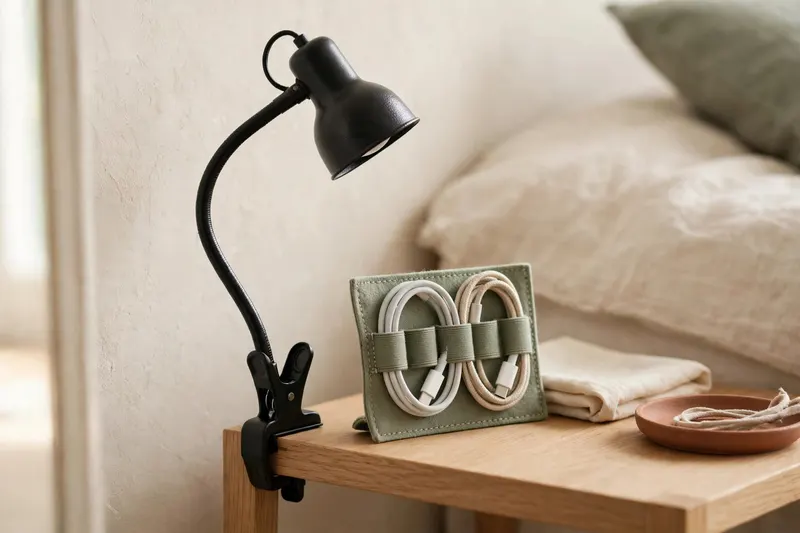
Pick one charging setup and commit to it: a 3-in-1 charging stand (phone, watch, earbuds) takes up about 6 × 4 inches and replaces three separate cables and three plug blocks. Prefer your own cables? Run one short cable (3 feet, not 6) through a clip on the back edge, with the plug block hidden behind the nightstand.
10. Move the power strip off the surface
A small power strip or multi-port USB charger belongs on the floor behind the nightstand, not on the table. Plug everything in there and run only the charging cable up to the surface. For a whole-house version of this system, see 15 Family Charging Station Ideas for Small Homes (End the Cable Chaos).

Vertical add-ons: wall shelves and clip-on lamps
When the table itself is full, the wall is your next storage surface.
11. Mount a small shelf above the nightstand
A floating shelf 12 to 18 inches wide, mounted 12 to 16 inches above the table surface, holds the book stack, a small plant, or a photo frame — everything that does not need to be grabbed in the dark. Renters can use heavy-duty adhesive strips rated for the shelf’s weight or a leaning ladder shelf that needs no holes.
12. Swap the table lamp for a clip-on or wall-mounted light
A table lamp eats roughly a quarter of a small nightstand’s surface. A clip-on lamp on the headboard or shelf frees that space entirely. A clip-on LED reading light costs about $10–$15, clamps to anything up to 2 inches thick, and usually has a dimmer — ideal for reading without waking a partner.
Books, glasses, and the nightly essentials kit
The nightly essentials kit is the set of things you use every single night, and it deserves a fixed home.
13. Keep one book out, not a stack
One book lives on the nightstand. The rest live on the shelf, in the basket under the table, or on the dresser. A stack of three or four books looks intentional for about a day, then becomes a leaning tower that collects cups and receipts.
14. Build a fixed nightly essentials kit
Give the kit one container: a small tray or shallow dish about 8 × 6 inches that holds your glasses, lip balm, hand cream, and sleep mask. Everything in the kit has a fixed position inside the tray, and the tray has a fixed position on the table — back corner, near the wall.

The 2-minute nightly reset that keeps it clear
Organizers and trays only work if the system gets maintained. The nightly reset is the maintenance: a two-minute routine, done right before you get into bed, that returns the nightstand to its morning state.
15. Reset the surface every night in two minutes
Set a timer for two minutes and do exactly four things: return every item to its zone or container, plug in the phone on its stand, put the water glass in its spot, and clear anything that does not belong — the receipt, the hair tie, the mug — into the drawer landing pad or out of the room.
Mistakes to avoid
Buying organizers before auditing. Dividers, trays, and risers solve a specific problem — too many items, no zones, cables everywhere. Buy them before you know what you own and you end up organizing clutter instead of removing it.
Keeping a “just in case” pile on the nightstand. The nightstand is not a junk drawer or a staging area. If an item’s job is “maybe someday,” it belongs in a closet or a drawer somewhere else, not within arm’s reach.
Choosing pretty over practical. A beautiful open basket looks lovely in a photo and hides nothing — you will see the clutter inside it every night. Closed containers and lidded boxes contain the visual noise.
Overfilling the drawer. A drawer packed to the top will not stay organized. Leave about a quarter of it empty.
Ignoring the cable. A charging cable left loose will undo every other idea on this list within a week. Clip it, shorten it, or replace it with a stand.
Frequently asked questions
How do I organize a nightstand with no drawer?
Use a tray to corral the surface, a riser or clip-on shelf to add a second level, and a basket or hanging bedside caddy for the overflow underneath or beside the table.
What should I keep on my nightstand?
Keep only what you use every night: phone and charger, water, a book or e-reader, glasses, lip balm, and a sleep mask or earplugs. Everything else belongs in the dresser or on a shelf. If your table is 16 inches wide or less, aim for four surface items at most.
Can I organize a tiny nightstand without buying anything?
Yes. Start with the audit: remove everything, keep only the nightly essentials, and return the rest to the dresser or shelf. Use a small dish or mug you already own as a tray, and move the power strip to the floor behind the table.
How do I stop my nightstand from getting cluttered again?
Do the two-minute nightly reset every night, and follow the one-in, one-out rule: when something new joins the nightstand, something old leaves the same day.
Conclusion
A calm nightstand is not about a bigger table or more organizers. Audit what earns arm’s reach, zone the drawer, contain the cables, and reset the surface for two minutes each night. Pick three ideas from this list and start tonight — the tray, the charging clip, and the reset are the fastest wins. Save this pin for later, and browse more ideas in our small-spaces collection.