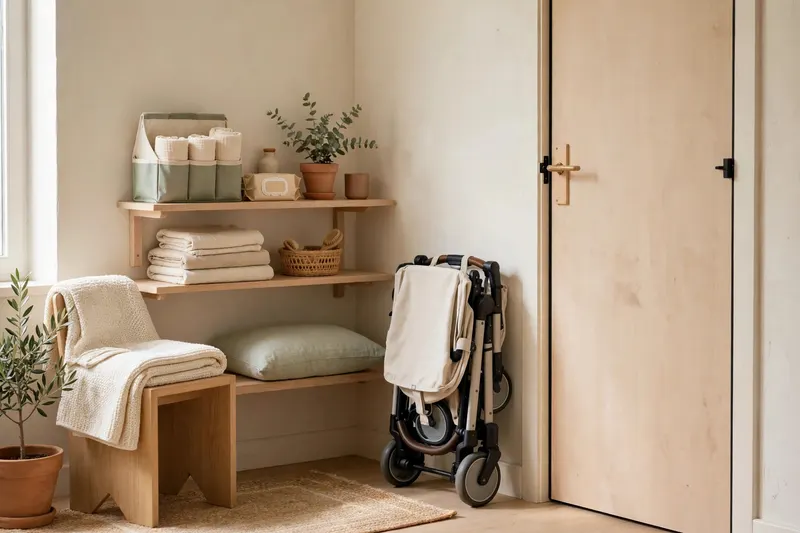
If your front door opens onto a pile of coats, backpacks, and shoes, you are not alone. Kids turn a small entryway into a drop zone in about thirty seconds, and “just give everything a home” only works if that home is at a height a seven-year-old can actually reach. The best small entryway organization families kids can use without help is less about buying more storage and more about building a system a child can follow without thinking: hooks they can reach, cubbies they can see into, and one clear spot for school papers.
These 16 ideas fit a hallway, a no-foyer apartment, or a narrow mudroom — no renovation, no walk-in closet. Work through them one weekend at a time, and the floor pile will start shrinking within a week.
The family entryway audit: coats, bags, shoes, papers
Before you buy a single hook, count what actually lives by your door, sorted into four groups: coats, bags, shoes, and papers. Most families find roughly half the pile is outgrown, out of season, or belongs elsewhere.
1. Count the real load, not the ideal one
Stand at the door at 4 p.m. on a school day and count every item: four coats, five pairs of shoes, three backpacks, two lunch bags, one umbrella, a stack of permission slips. That count is your storage brief. If you have five pairs of daily shoes, you need five cubby slots, not three. Measure the wall too: a typical hallway stretch of 36 to 48 inches fits a four-hook rail and a two-tier shoe shelf, enough for most families of four.
2. Give every category one landing spot — and only one
Each group gets exactly one home: coats on hooks, shoes in cubbies, backpacks on their hook plus one bin, papers in the inbox. When a coat has two possible homes, it ends up on the floor. Tape a small label or colored dot on each spot for the first two weeks so younger kids can match item to home without asking you.
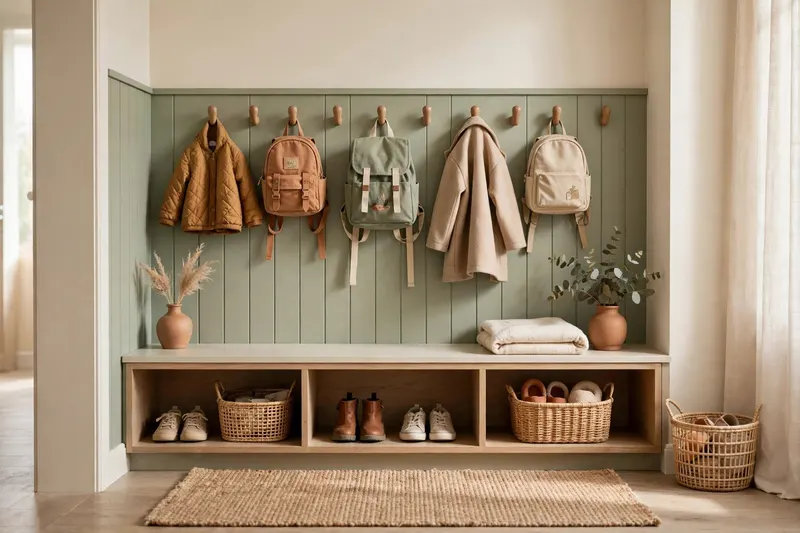
Hooks at kid height: the one change that ends the floor pile
Standard coat hooks sit at 60 to 66 inches — perfect for adults, unreachable for anyone under about ten. That is the entire reason coats land on the floor. A second, lower row changes everything.
3. Mount a second row of hooks at 42 inches
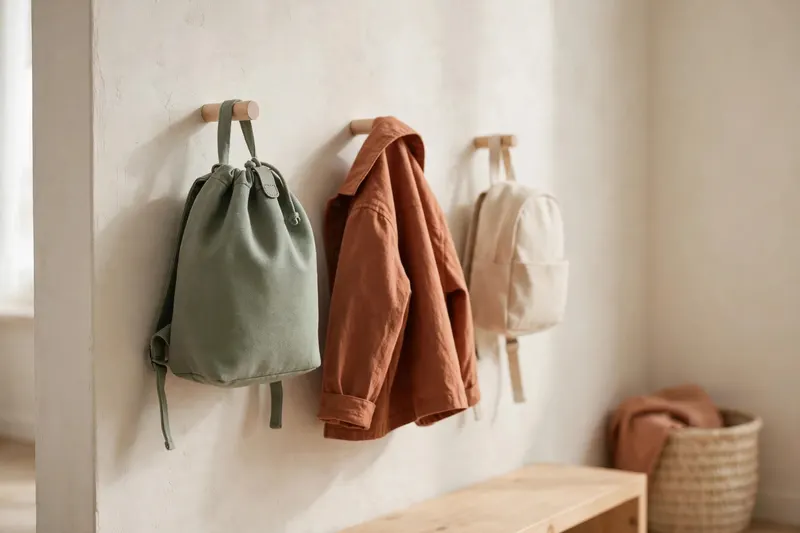
Install sturdy individual hooks or a short rail at 40 to 44 inches high, one hook per child plus one spare. At this height a five-year-old can hang a coat without standing on tiptoes. Use screw-in hooks rated for at least 10 pounds each — a wet winter coat plus a backpack strap is heavier than you think. In a rental, ask your landlord about screwed hooks for heavy coats; adhesive rails rated for 7 pounds per hook work for lighter jackets.
4. Assign hooks by color, not by name
Give each child a hook color — red, blue, green — matched to a colored dot on their backpack and lunch bag. Young kids who cannot read their name yet can still match colors. Keep adult hooks on the upper row and kid hooks on the lower row so nobody reaches past anyone else’s coat. If you need more hook ideas for a home with no closet at all, see our 16 Entryway Coat Storage Ideas for Apartments Without a Closet.
Shoe cubbies sized for small feet (and grown-up boots)
Shoes are the messiest category because they multiply: school shoes, trainers, wellies, sandals, plus the adult pairs. The fix is cubbies sized to the feet that use them, with a hard limit on how many pairs live by the door.
5. Use low cubbies kids can see into
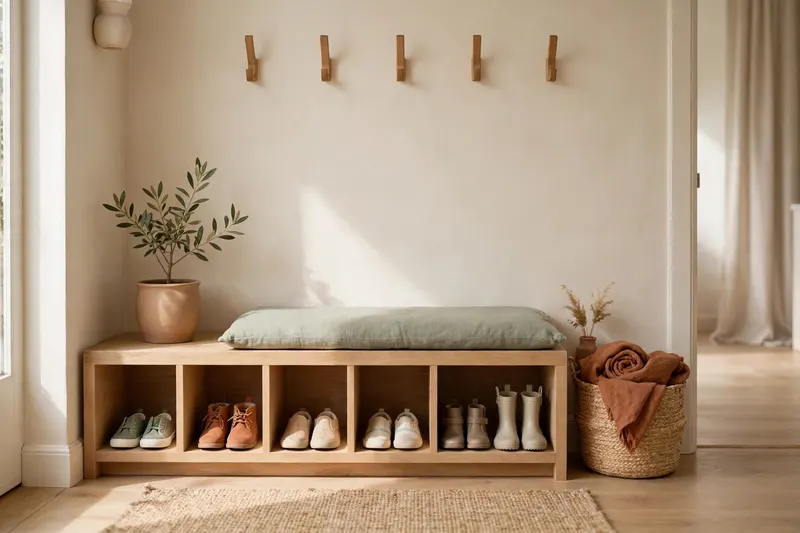
A two-tier open cubby unit, about 24 to 30 inches wide and 12 inches deep, fits four to six pairs of children’s shoes with the openings facing out. A child will not open a lid, but they will slide shoes into an open slot. Leave one cubby empty on purpose: that is where tomorrow’s muddy shoes go.
6. Cap daily shoes at two pairs per person
Two pairs per person live by the door: the pair worn today and the pair for tomorrow’s weather. Everything else — out-of-season shoes, spares, dress shoes — lives in the bedroom closet. Our 18 Shoe Storage Ideas for Small Apartments (No Pile by the Door) covers slim towers and under-bed hiding spots that work alongside cubbies. Enforce the cap with a rule the kids can repeat: “one pair in, one pair out.”
The backpack zone: one hook + one bin per child
The backpack is the single biggest daily object in a family entryway, and it arrives with lunch bags, water bottles, and homework folders attached. It needs its own zone, not a shared pile.
7. One hook plus one bin per child — no sharing
Each child gets one dedicated hook for the backpack and one open-top bin underneath it, roughly 12 by 10 by 8 inches, for the lunch bag, water bottle, and library books. The bin catches everything that used to spill out of the bag onto the floor. Label the bin with the child’s hook color so the zone reads as one unit.
8. Pack bags the night before, at the hook
Make the hook the packing station, not just the storage spot. After dinner, each child stands at their hook, checks the bin, and packs the bag for tomorrow: lunch bag in, water bottle filled, homework folder zipped in. Five minutes at night saves fifteen minutes of morning panic, and the bag never migrates to the kitchen table. A small bench with hidden storage also gives kids a seat while they put shoes on — see our 16 Small Entryway Bench Ideas With Hidden Storage for Tiny Halls.
School papers: the inbox that stops the counter pile
Permission slips, artwork, reading logs, and party invitations arrive daily and have nowhere to go, so they colonize the nearest flat surface. A paper inbox at the door stops the pile at its source.
9. Mount one inbox per child at kid height
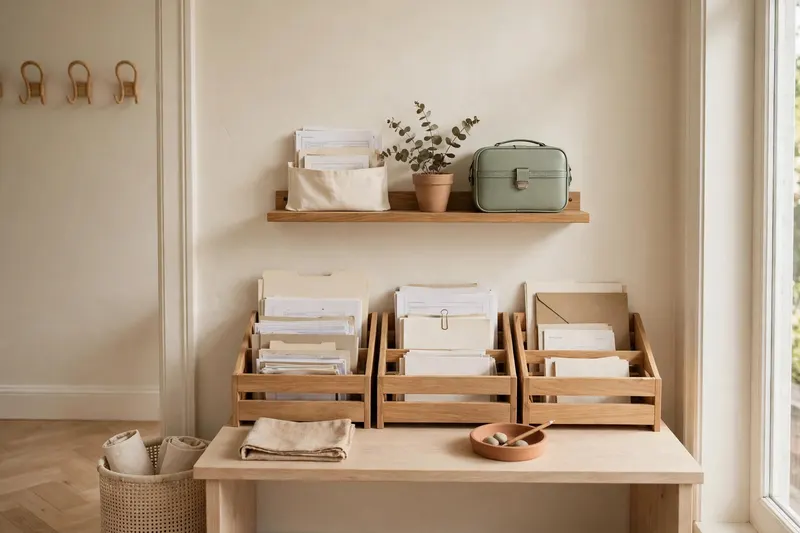
A wall-mounted file holder or small tray per child, mounted at about 48 inches, holds everything coming home from school. The rule is simple: paper goes in the inbox, never on the counter. Each child empties their own inbox with a parent once a week — sign what needs signing, file what needs filing, recycle the rest. Our 15 Entryway Mail and Paper Organization Ideas for Small Homes has wall sorters and weekly routines that pair well with this system.
10. Run a Friday paper purge
Every Friday after school, spend ten minutes at the inbox: sign, file, photograph, recycle. Photograph artwork you want to keep, then recycle the original. Keep a single “keep” folder per child, no thicker than one inch, for report cards and genuinely special pieces. Anything that does not fit in the folder goes.
Seasonal gear rotation for growing kids
Kids outgrow gear faster than adults, and winter coats, wellies, hats, and gloves all arrive at once. A small entryway cannot hold two seasons of gear, so one season lives elsewhere.
11. Swap the whole season in one 30-minute session
Twice a year, pull everything out of the entryway, sort it into keep, outgrown, and store, and swap the off-season gear into a labeled bin on a high closet shelf or under the bed. Do it in one session with the kids trying things on, because a coat that fit in September may not fit in November. Label the bin with the season and the year so you can find it again without opening five boxes.
12. Keep one grab-and-go basket for the current season’s extras
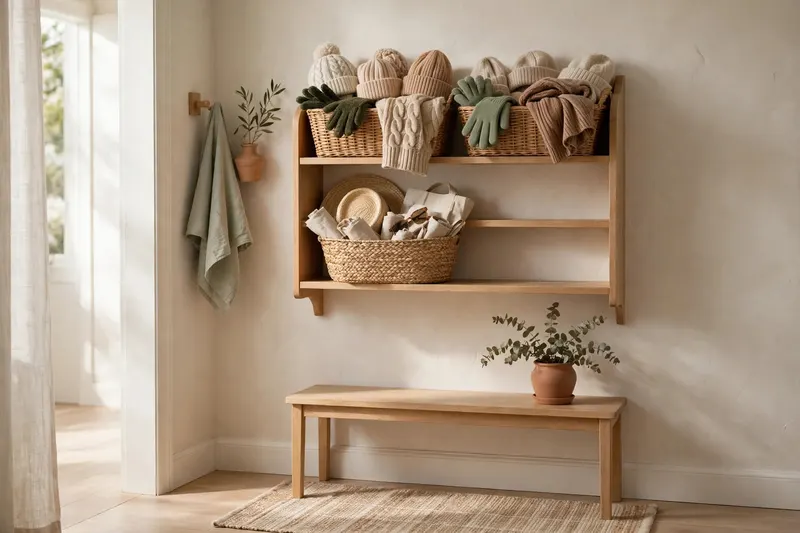
Hats, gloves, scarves, and sunscreen live in one open basket on the shoe cubby or the bench — one basket, not four. When the season changes, the basket’s contents change with it. A 12-by-8-inch basket holds a family’s worth of gloves and hats; anything that does not fit goes into the off-season bin, and the spare umbrella lives here too.
13. Size up the hooks when the kids do
A hook rail that worked for a five-year-old’s light jacket will sag under a twelve-year-old’s heavy winter coat and full backpack. Check the hooks once a year: tighten screws, replace peeling adhesive rails, and move the kid row up six inches if the youngest can now reach the adult row. A hook that fails once teaches a child to drop the coat on the floor instead.
The 5-minute after-school reset
No system survives a tired child at 4 p.m. unless the reset is short, specific, and the same every day. Five minutes, three steps, done before the snack comes out.
14. Shoes off, shoes in, bag on the hook
The reset has exactly three moves, in this order: shoes off and into the cubby, backpack onto the hook, lunch bag into the bin. Post the three steps on a small card at kid eye level for the first month; kids who do it daily stop needing the card within two weeks. Keep the sequence identical so it becomes muscle memory, not a decision.
15. Make the reset a race, not a chore
Time the reset for a week and let the kids beat their own record — most families get it under three minutes once the system is in place. A kitchen timer, a sticker chart, or racing a sibling turns the least fun five minutes of the day into a game. The prize is a clear hallway and nobody tripping over a backpack at 7 a.m.
16. End the day with a two-minute parent check
After the kids are in bed, take two minutes at the door and put right the one pair of shoes, one coat, or one paper out of place. This is not redoing the kids’ work; it is catching the one or two things they missed so tomorrow starts clean. A hallway that starts clean stays clean far longer than one that starts with yesterday’s leftovers.
Mistakes to avoid
Buying storage before auditing. A cubby unit that holds six pairs is useless if your family owns fourteen. Count first, buy second.
Hooks at adult height only. The most common family entryway mistake: if a child cannot reach the hook, the coat goes on the floor, and no reminding fixes a height problem.
One big shared basket for everything. A single basket for coats, shoes, and papers is a junk drawer with a handle. Shared storage is nobody’s responsibility, and the pile returns within a week.
Storing every season at the door. A small entryway cannot hold winter coats and summer sandals at the same time. If the off-season gear is still by the door, the in-season gear has nowhere to go.
Making the system depend on you. If only one parent knows where things go, the system collapses the first time that parent is away. Labels, colors, and a posted reset make the entryway run without you.
What NOT to buy
Skip the tall coat tree — it tips over when three backpacks hang off it, and it eats floor space a small hallway cannot spare. Skip lidded boxes for daily shoes and bags; kids will not open a lid twice a day, and the contents will end up beside the box instead. Skip the over-door hook rack if your door is the main fire exit or a hollow-core interior door that flexes under weight. And skip “complete entryway system” sets before measuring your wall — most are sized for a suburban mudroom, not a 36-inch hallway, and the returns cost more than the hooks you needed.
Frequently asked questions
How do I organize a small entryway with no closet for a family?
Start with the audit: count coats, shoes, bags, and papers, then give each category exactly one home. A low hook rail at 42 inches, a two-tier cubby unit, and one inbox per child cover most families of four in a 36- to 48-inch stretch — no closet required.
Can kids really keep an entryway tidy?
Yes, if the system is built at their height and the reset takes under five minutes. Kid-height hooks, open cubbies they can see into, and a three-step after-school routine are what make it stick; adult-height storage and long clean-up sessions are what make it fail.
How many pairs of shoes should live by the door?
Two pairs per person: the pair worn today and the pair for tomorrow’s weather. Everything else lives in the bedroom closet or a high shelf, and the “one pair in, one pair out” rule keeps the count honest.
What is the best storage for kids’ backpacks in a small space?
One dedicated hook per child at kid height, plus one open-top bin underneath for the lunch bag, water bottle, and library books. The hook holds the bag; the bin catches everything that used to spill out of it onto the floor.
How do I stop school papers piling up in the entryway?
Mount one inbox per child at the door and run a ten-minute Friday paper purge: sign, file, photograph artwork you want to keep, and recycle the rest. The purge is what keeps the inbox from becoming a second junk drawer.
Conclusion
A family entryway works when a child can use it without asking for help: hooks at their height, cubbies they can see into, one bin for their bag, and one inbox for their papers. Start with the audit, install the kid-height hooks first, and add the rest one weekend at a time. Browse our small-spaces category for more, and save this pin for later, so the next school morning starts with a clear hallway instead of a floor pile.