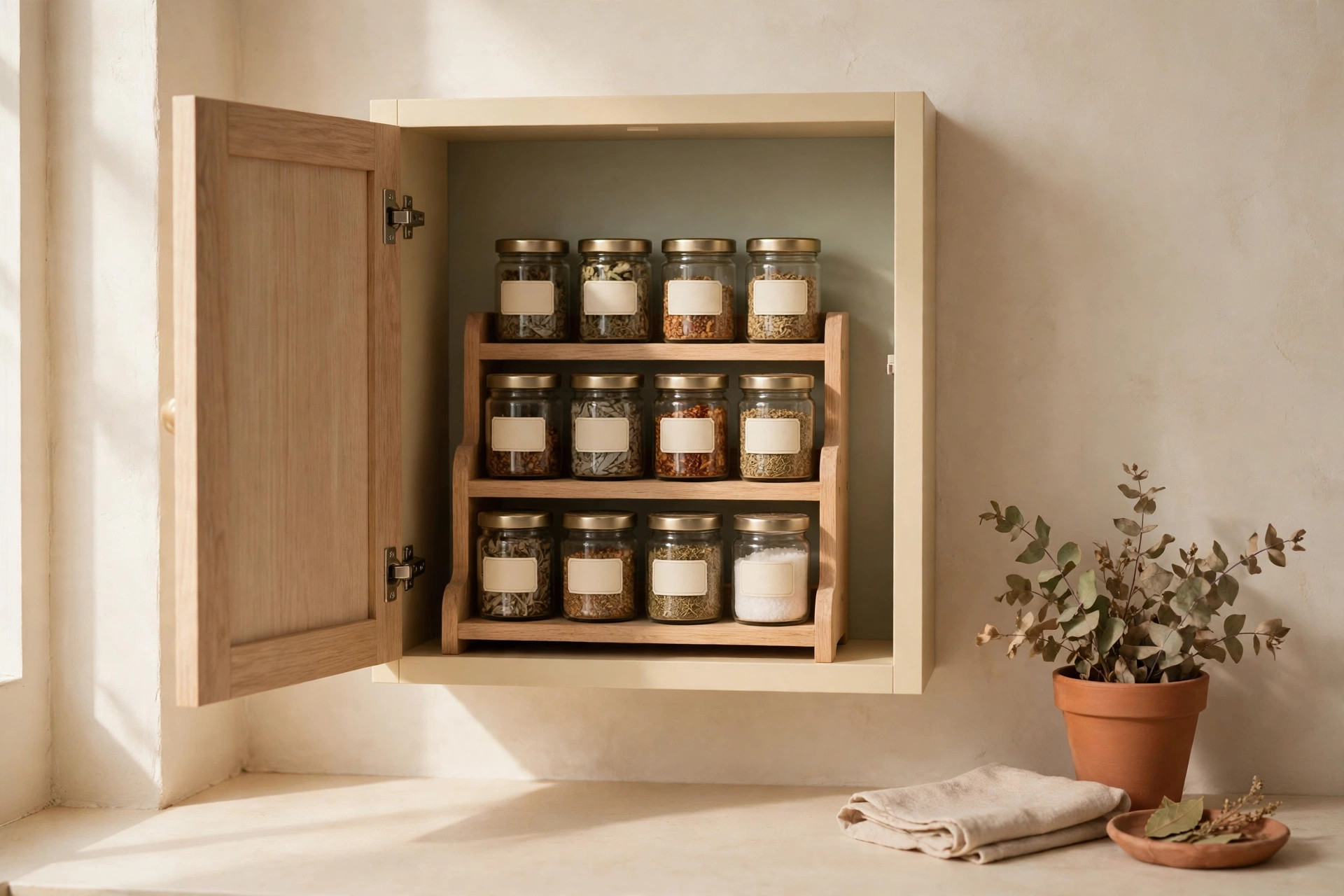
If you cook in a small kitchen, you know the drill: you reach into a dark cabinet for the cumin, knock over the turmeric, and find a jar of something that expired three years ago. These spice storage ideas for small kitchens exist to end that exact ritual. You don’t need more space — you need every jar visible, reachable, and right-sized for how you actually cook. Below are 16 concrete ideas, organized by the five systems that actually work in tiny kitchens: tiered racks, drawer inserts, magnetic walls, decanting, and door-mounted racks, plus the freshness routine that keeps the whole system honest.
The spice audit: what you actually cook with vs what collects dust
Before you buy anything, pull every spice, herb, and blend out of every cabinet and drawer. Sort them into three groups: the daily drivers (salt, pepper, the three or four spices you reach for every week), the occasionals (garam masala, pumpkin pie spice, blends you use monthly), and the dead weight (expired jars, duplicates, that mystery blend from 2022).
Most small kitchens hold 20 to 35 spice containers, and the honest audit usually reveals half haven’t been opened in months. Ground spices peak for about 6 months and fade noticeably by a year — so a two-year-old jar is decoration, not seasoning.
Toss anything you can’t date, anything that smells like dust, and every duplicate. Your target is 15 to 20 jars you genuinely use — that’s the inventory your new system is built around, not the 40-jar fantasy collection.
Tiered racks: seeing every jar at a glance in cabinets
Tiered racks solve the single biggest spice problem in small kitchens: the back row. On a flat shelf, every jar behind the front row is invisible — which is how duplicates and expired jars accumulate.
1. Cabinet tiered riser (9–12 inches tall). The workhorse. A 3-tier plastic or bamboo riser, roughly 12 inches wide and 8 inches deep, fits most standard 12-inch-deep cabinets and lifts the back rows so every label faces you. Tallest jars on the bottom step, shortest on top; roughly $10–15.
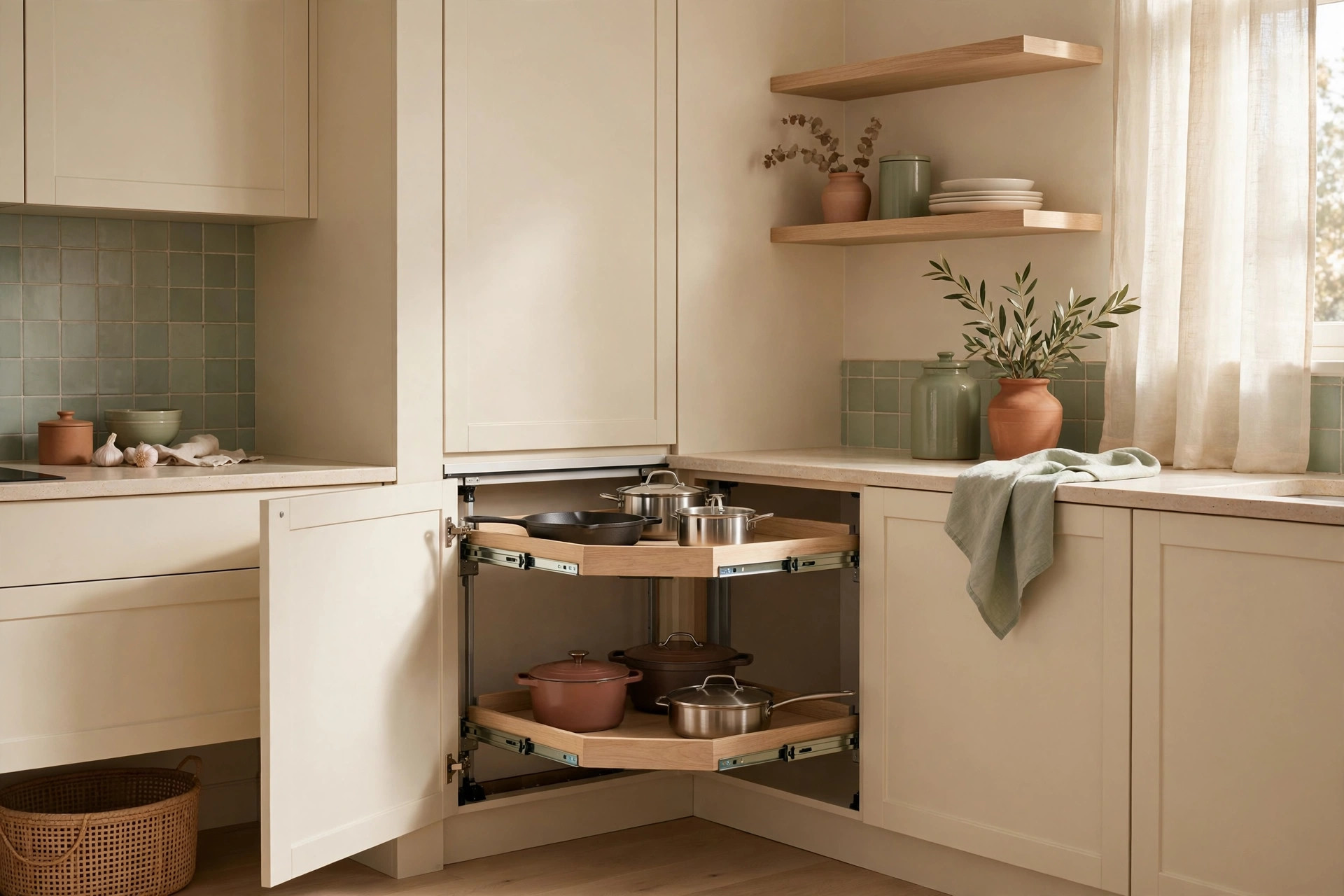
2. Pull-out tiered insert for base cabinets. If your spices live in a deep lower cabinet where you have to kneel and squint, a two-tier sliding drawer on a soft-close track brings the whole shelf to you. Measure the interior width first (most cabinets are 12, 15, or 18 inches wide); a 10-inch-wide pull-out leaves room for the track hardware.
Pair your rack with 18 Small Kitchen Cabinet Organization Ideas That Maximize Every Shelf to make every shelf earn its keep.
Drawer inserts: the cleanest spice system for small kitchens
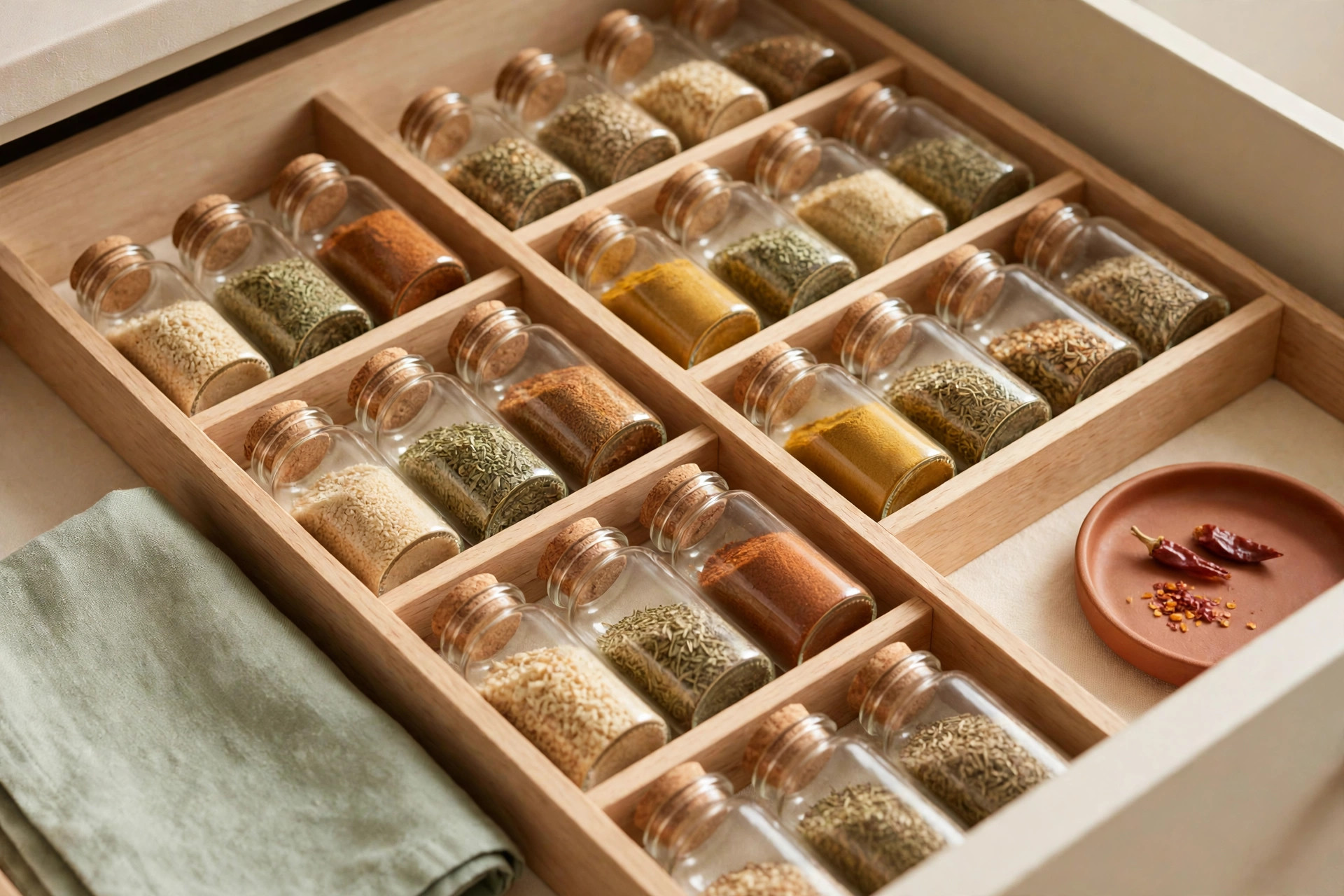
If you have one spare drawer — even a shallow 3-inch one near the stove — this is the cleanest small kitchen spice storage system there is: every jar lies at an angle, label up, in one flat layer. No stacking, no digging.
3. Slanted drawer insert for 4-ounce jars. Look for an expandable bamboo or plastic insert with angled rows sized for standard 4-ounce jars (about 2 inches diameter, 4 inches tall). A 3-row insert holds 18–24 jars in a single drawer. With a 2.5-inch-deep drawer, decant into squat 2-inch-tall jars so lids don’t jam.
4. The two-row rotation drawer. Front row for daily drivers, back row for occasionals. When a back-row jar empties, audit it before refilling — this keeps unused jars from creeping back in.
Magnetic walls and under-shelf strips: zero-counter solutions
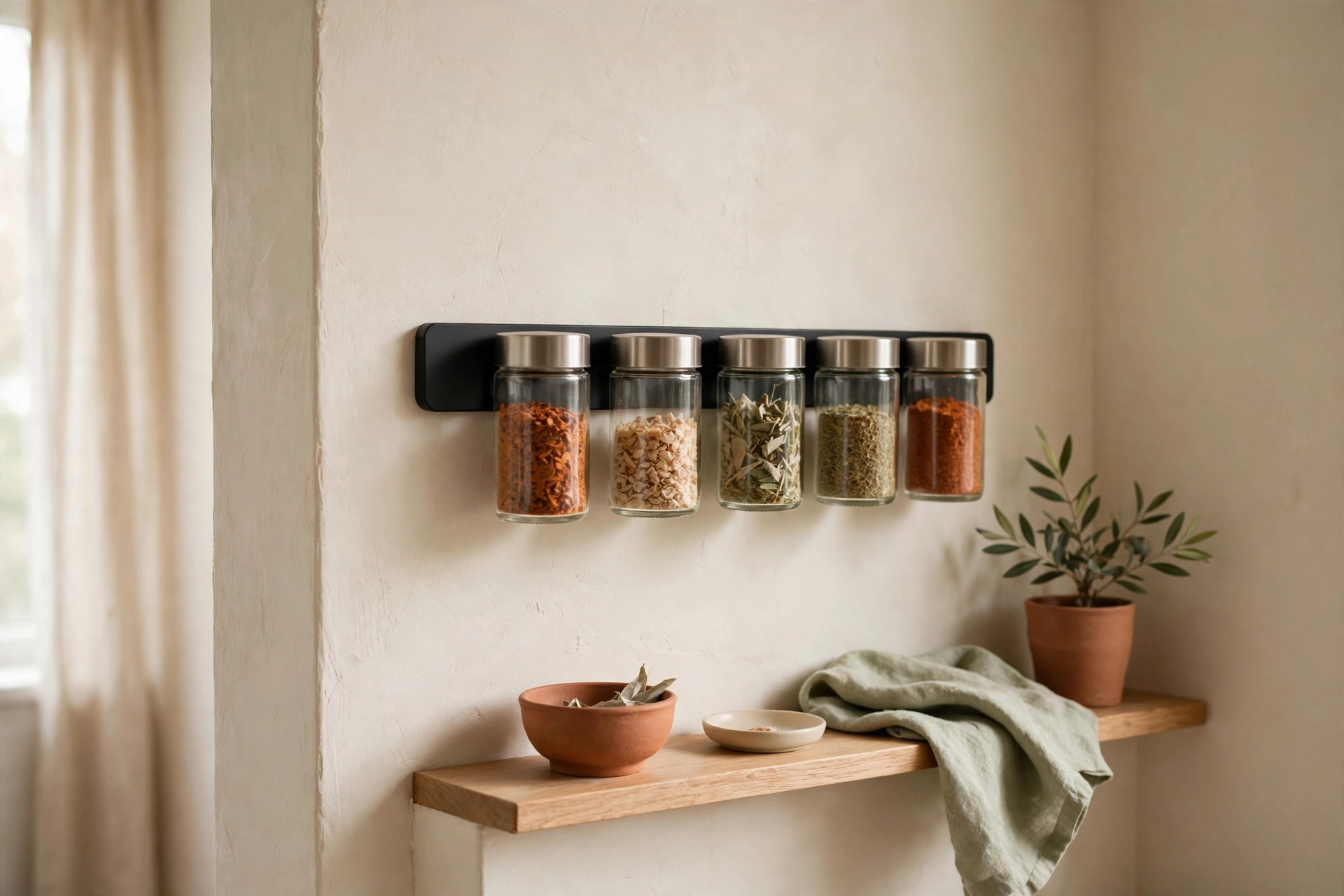
When cabinets and drawers are spoken for, walls and the underside of upper cabinets are free real estate. Magnetic systems use zero footprint and keep spices visible at eye level.
5. Magnetic tins on a wall-mounted steel strip. A 16-inch steel strip on a backsplash or cabinet side holds 8–12 magnetic tins (about 2.5 inches wide). Mount it with adhesive strips instead of screws — it lifts off cleanly at move-out. Keep tins beside the stove, not above it, where heat degrades spices fastest.
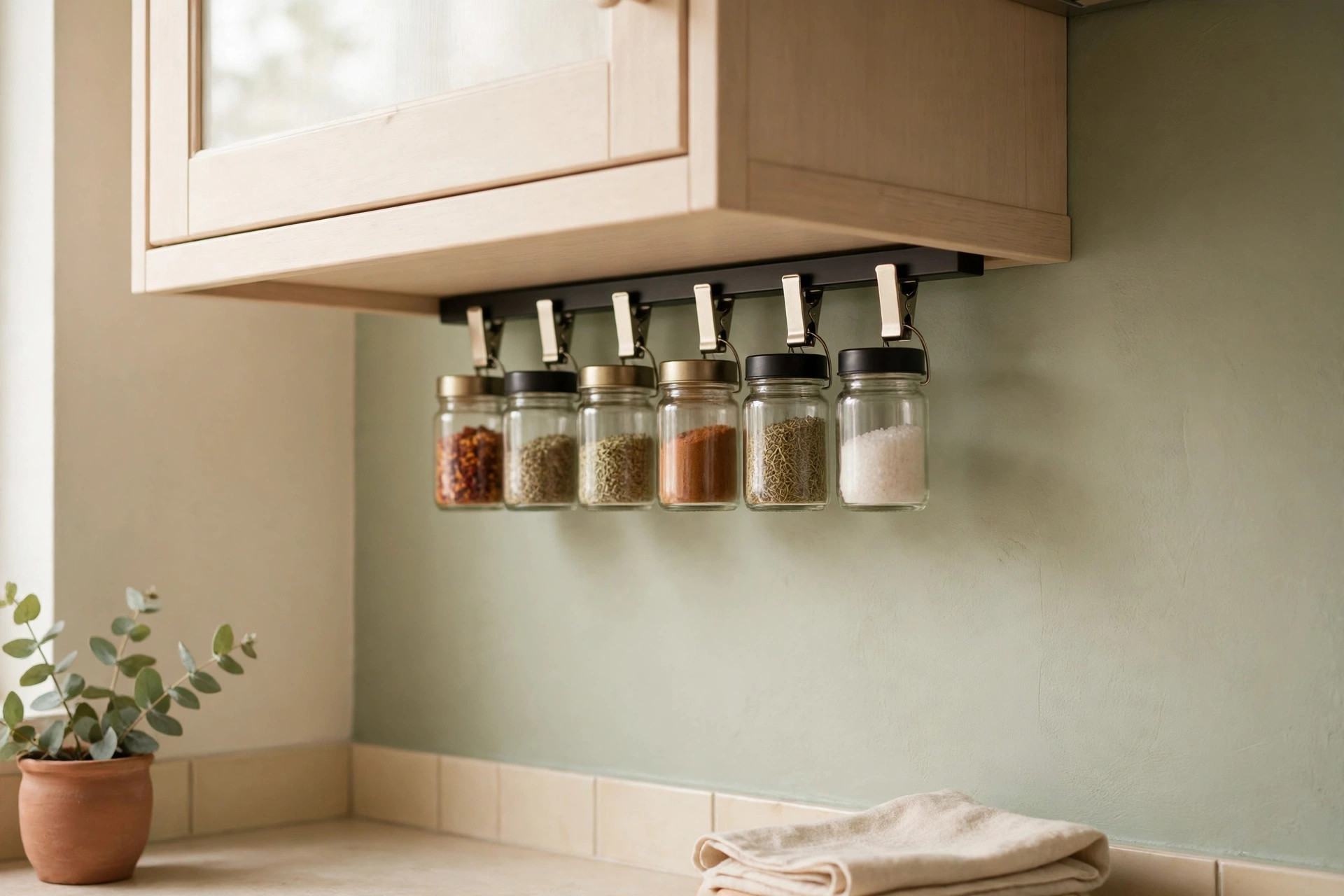
6. Under-cabinet magnetic spice jars. Adhesive or screw-in metal pucks under your upper cabinets hold small magnetic jars (about 2.5 inches tall — measure counter-to-cabinet clearance first). Best for 6–8 daily drivers — salt, pepper, cumin, chili flakes — because reaching overhead for twice-a-year saffron gets old.
7. Under-shelf wire basket for bagged spices. Bay leaves, whole dried chilies, and bulk-bought bagged spices sit neatly in a 10×4-inch under-shelf wire basket that hooks onto a shelf — no screws, no adhesive, freeing the shelf surface for jars.
Beyond spices, 17 Kitchen Wall Storage Ideas for Small Kitchens (No Counter Space Wasted) shows how to layer shelves, hooks, and rails without clutter.
Decanting: uniform jars, real labels, real freshness dates
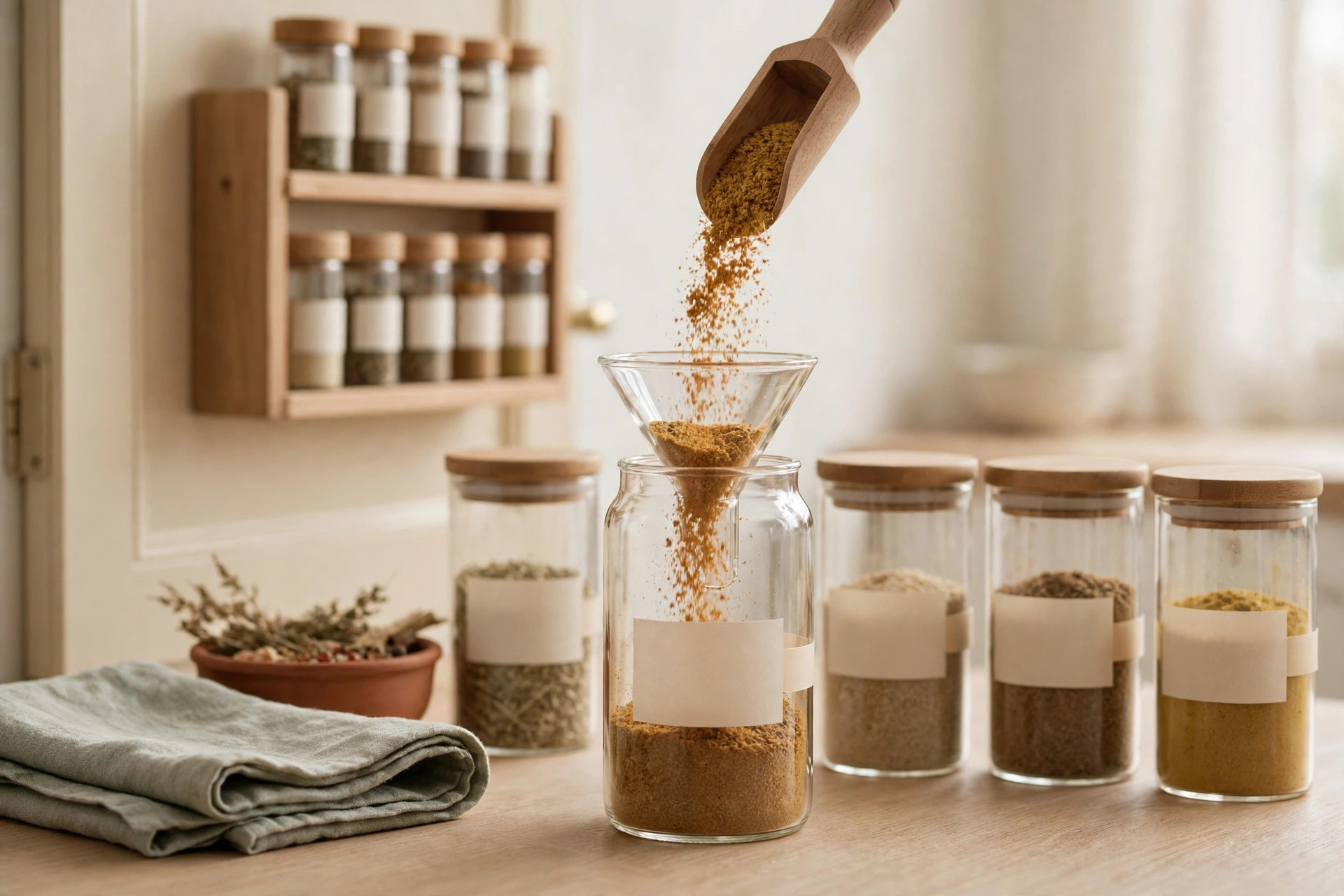
Decanting isn’t about pretty photos — it’s how you know exactly what’s in a jar and how fresh it is. Manufacturer jars come in eleven shapes with unreadable printed dates. Uniform jars change the game.
8. One jar size for all ground spices. Transfer everything into one 4-ounce glass jar size (square for drawers, round for tiers). Consistency means your insert, rack, and door rack fit every jar with zero wasted gaps.
9. Label with the name AND the date. Every jar gets a waterproof label with the name and the decant month (“10/26” in the corner). A $5 label maker or chalk-pen labels work; the date is the non-negotiable part — without it, the freshness check is guesswork.
10. Funnel-and-bag decanting station. Keep three stainless funnels (small, medium, wide), empty jars, and a marker in one drawer. Decanting then takes 60 seconds per jar — if you have to hunt for a funnel, you won’t.
The same logic works for dry goods — 17 Pantry Organization Ideas for Small Pantries (or No Pantry at All) covers matching containers for flour, rice, and snacks.
Door-mounted racks: spice storage inside cabinet doors
The inside of a cabinet door is a vertical wall you’re wasting. A slim rack there holds 10–15 jars at zero footprint — the door closes over your existing shelves.
11. Over-the-door 3-tier wire rack (2.5-inch depth). At 2.5 inches deep it clears the cabinet’s front edge when the door closes. Hang it with the two included hooks — no drilling — and load it with your occasionals. Check hinge clearance first; some inset doors need a half-inch spacer.
12. Adhesive spice clips inside pantry doors. On narrow pantry or tall-cabinet doors, individual adhesive clips (one per standard jar) let you place jars exactly where the door has space. Best on flat, clean laminate — wipe with rubbing alcohol before sticking.
Exotic vs everyday: the two-tier system that stays tidy
The insight that keeps all this hardware working: stop treating every spice equally. Split your collection into two tiers, matched to how often you touch them.
13. The everyday tier: one prime spot. Pick 6–8 weekly-use spices. These earn the best real estate — the drawer by the stove, the under-cabinet magnets, the rack’s front row. They live within one step of where you cook.
14. The exotic tier: one contained zone. Everything else lives in exactly one container: a small bin, one rack section, or one door rack. When it’s full, something leaves before anything new enters. One in, one out.
15. The backup shelf, not the cabinet. Unopened refill bags and bulk buys live in one small “refills” basket — never mixed with active jars, where they become invisible duplicates. Check it before you buy.
16. Quarterly count, not a reorganization. Every three months, spend five minutes scanning your everyday tier and refill basket: toss expired jars, and demote anything untouched in a quarter to the exotic zone. No reorganization — just the count.
The 6-month spice freshness check
No storage makes old spices fresh — so build a routine that retires them on schedule. Ground spices peak for about 6 months and decline by 12; whole spices hold 1–2 years. Heat, light, and air are the enemies, which is why the cabinet above the stove is the worst spot.
Twice a year, open each jar and smell it: fresh cumin is sharp and earthy, old cumin is dust. If you can barely detect anything, it’s done — toss it. Check decant dates as you go; past 12 months for ground or 24 for whole gets composted.
Buy smaller quantities more often. A 2-ounce bag finished in six months seasons better than a pound finished in three years. The USDA’s storage guidance (foodsafety.gov) is a solid reference for timelines across your whole kitchen.
Mistakes to avoid
Storing spices above the stove. Convenient, but the worst spot — heat and steam degrade spices fast. Use a cool cabinet or drawer within arm’s reach instead.
Keeping mismatched jars. Eleven jar shapes mean eleven wasted gaps. Uniform jars aren’t vanity; they’re geometry. You fit roughly 30 percent more jars in the same drawer with one jar size.
Buying the system before the audit. A beautiful 40-jar rack is a commitment to keeping 40 jars. Audit first, buy for the real inventory — most people need half the storage they think.
No dates, no mercy. A dateless jar becomes permanent clutter because you’ll never be sure it’s dead. Date every jar, every time.
Storing in sunlight. Windowsill jars look lovely and go stale in weeks. Spices belong in the dark — cabinets, drawers, or opaque tins.
Frequently asked questions
How should I store spices in a very small kitchen with no pantry?
Use vertical and hidden space: a drawer insert for everyday jars, a door-mounted rack for occasionals, uniform jars so everything fits tight. One contained zone per tier — not jars across three cabinets.
Can I store spices in the cabinet above the stove?
You can, but shouldn’t — it’s the hottest, steamiest spot, and heat plus moisture break spices down fastest. A drawer within one step of the stove gives the same convenience without the damage.
What’s the best container for decanting spices?
One 4-ounce glass jar size across the collection — square for drawers, round for tiers. Glass doesn’t absorb odors like plastic, and uniform jars waste zero insert or rack space.
How long do ground spices actually last?
About 6 months at peak, declining by 12; whole spices last 1–2 years. The sniff test decides: if a jar smells faint or dusty, replace it regardless of the date.
How many spices should a small kitchen keep?
Fifteen to twenty jars covers most home cooking: 6–8 daily drivers, 8–12 occasionals. Over 25? Run the audit again — duplicates and dead jars are hiding in there.
A visible, right-sized spice system means no more digging, no more duplicates, no more cooking with dust. Start with the audit, pick the format that fits your kitchen’s layout, and let the quarterly count keep it honest. Browse the full kitchen collection for more spice storage ideas — and save this pin for later, so the system is there when your next grocery run brings fresh jars.