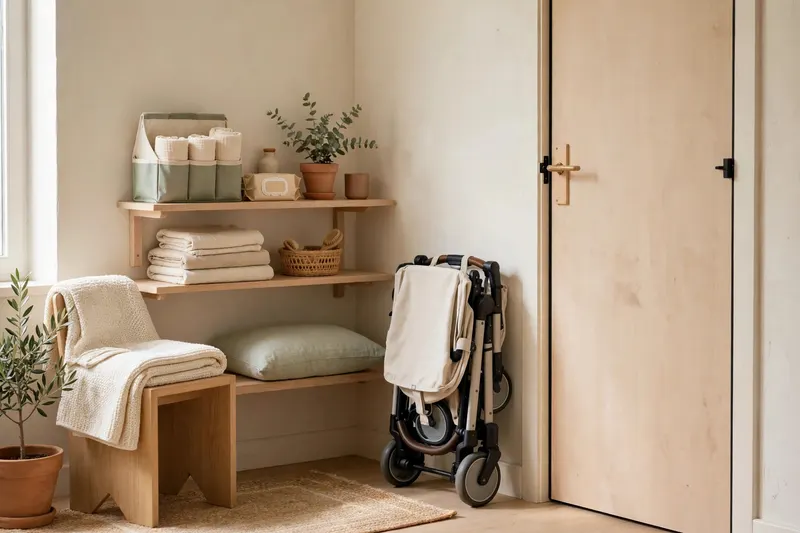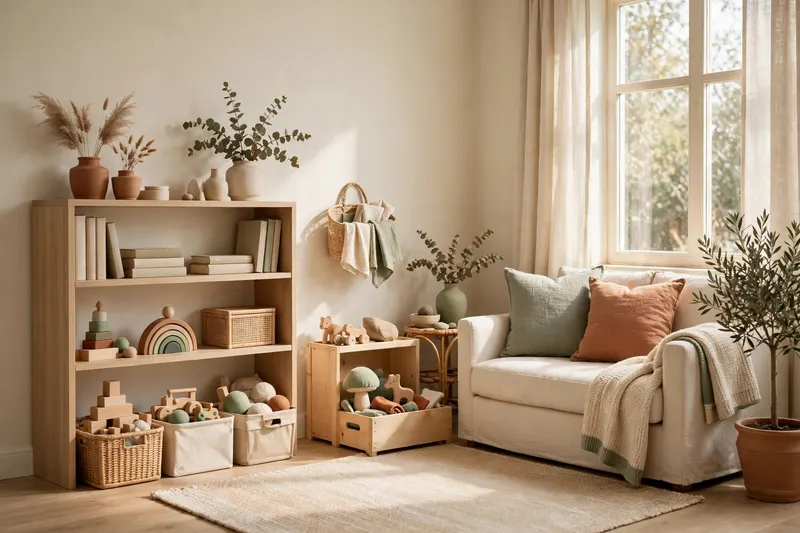
In a small apartment, toys don’t stay in one room. They migrate from the bedroom to the couch, from the couch to the kitchen floor, and into the bathroom by bedtime. If you’ve been searching for kids toy storage ideas small apartment parents can actually stick to, you already know the real problem isn’t the number of toys — it’s that every toy is visible, underfoot, and in the way of adult life. The fix isn’t a bigger home or a playroom you don’t have. It’s a whole-apartment system: low bins your kids can reach on their own, a rotation stash that keeps half the toys out of sight, and furniture that swallows the rest. Start with a single bin tonight.
The toy audit: what they actually play with
Most kids play with about a third of what they own. The rest sits in piles and makes every other toy harder to find. An audit takes one afternoon.
1. Run a two-week play test with masking tape
Put a small strip of masking tape on every toy your kids own. Over two weeks, remove the tape from anything they play with. Anything still taped goes into a holding box in the closet. If nobody asks for it in the next month, it leaves the apartment.
2. Sort the keepers into four activity families
Sort by how kids play, not by toy type or brand: build (blocks, LEGO, magnetic tiles), pretend (dolls, kitchens, dress-up), wheels (cars, trains, ride-ons), and quiet (books, puzzles, colouring). Four families is the sweet spot — few enough that a small child can remember them, broad enough that every toy fits somewhere.
Low open bins: the only system kids maintain themselves
Kids don’t open lids, unlatch boxes, or dig through drawers to put toys away. If cleanup takes more than one motion, it won’t happen — you’ll be doing it. Low open bins work because cleanup is a single move: pick up, drop in, done.
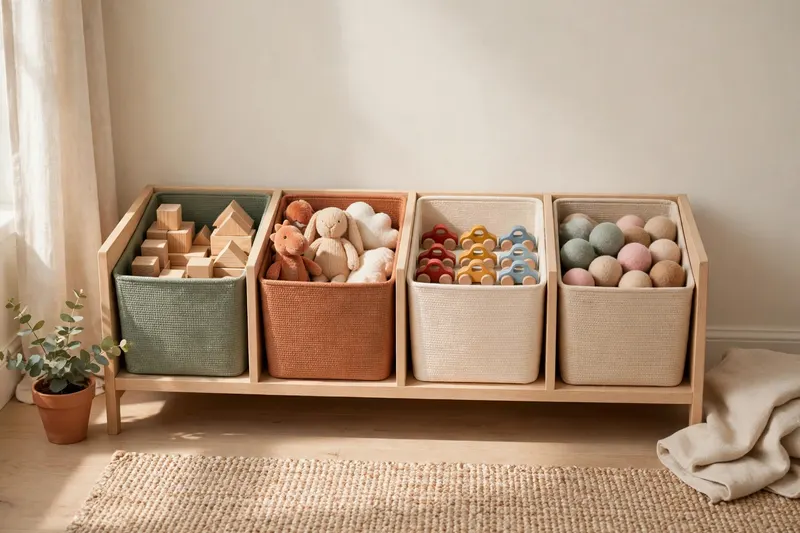
3. Use four open-front bins, one per activity family
Buy four stackable open-front bins, roughly 12 inches wide and 10 inches deep, and assign one to each activity family from the audit. Open-front means the front wall is cut low, so a toddler can see inside and drop toys in without lifting anything over a rim. Place them on the lowest shelf of a cube unit or directly on the floor along one wall.
4. Label bins with photos, not words
Print a 3-by-3-inch photo of an actual toy from each family — a block tower, a doll, a red car, a puzzle — and tape it to the front of its bin. Pre-readers can’t use word labels, and even early readers sort faster by picture. Photo labels also let grandparents and babysitters put toys away correctly without asking you where things go.
5. Cap each bin with the “lid test”
If a bin’s toys pile above its rim, the bin is full — no stacking toys on top, no cramming. That visible limit is the whole point: when the build bin overflows, something leaves the build bin before anything new goes in. Kids understand a full bin far better than a lecture about having too many toys.
Toy rotation: the closet stash that makes old toys new
Rotation is the single highest-impact idea in this list for small apartment toy organization. Half the toys live in a stash, out of sight, while the other half gets played with. Every few weeks you swap them, and the returning toys feel brand new — no shopping required.
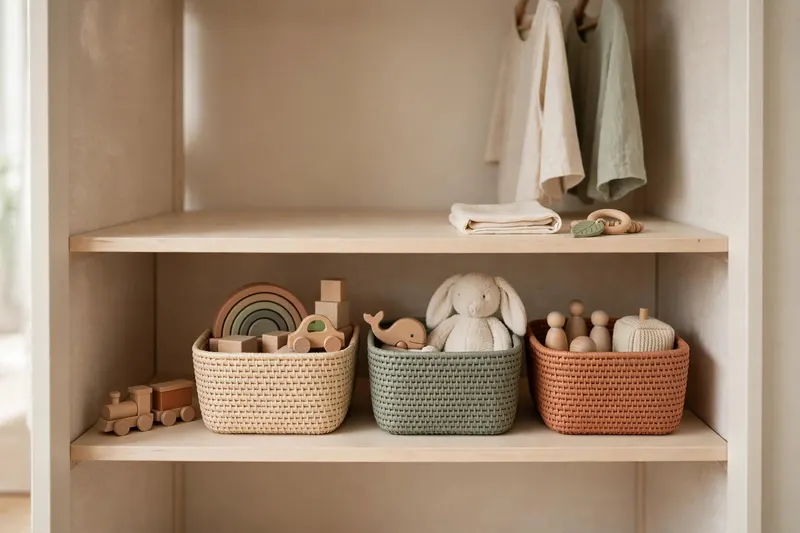
6. Keep the rotation stash in one labelled 66-quart bin
One 66-quart latch bin holds the off-duty half of a typical toy collection. Store it on the top shelf of the kids’ bedroom closet, on top of a wardrobe, or under an adult bed — anywhere out of sight and out of reach. If your closet is already packed, the ideas in 14 Kids Closet Organization Ideas for Small Bedrooms show how to carve out a shelf for exactly this kind of stash without losing hanging space.
7. Swap half the toys every two weeks, on the same day
Pick a swap day — Sunday evening works for most families — and set a phone reminder. Pull the stash bin down, take out the toys that have been resting, and put the current set in. Mix the families: each swap should include something to build, something to pretend with, and something quiet. If a toy comes back from the stash and still gets ignored for two full rotations, it goes in the donation box.
8. Stage a five-minute “toy shop” when the new set arrives
Lay the returning toys out on a blanket on the floor like a little shop and let the kids “discover” them. Five minutes of ceremony turns the same old toys into an event — kids dive in immediately instead of asking for new ones. Keep it short: the ritual is a spark, not a production.
Furniture that hides toys: ottomans, benches, coffee tables
In a small apartment, every piece of furniture has to earn its footprint twice. A storage ottoman is a footrest and a toy vault. A bench is seating and a hiding place for ride-ons. This layer handles the bulky toys that don’t fit in bins, and it makes the living room look like a living room again after bedtime.
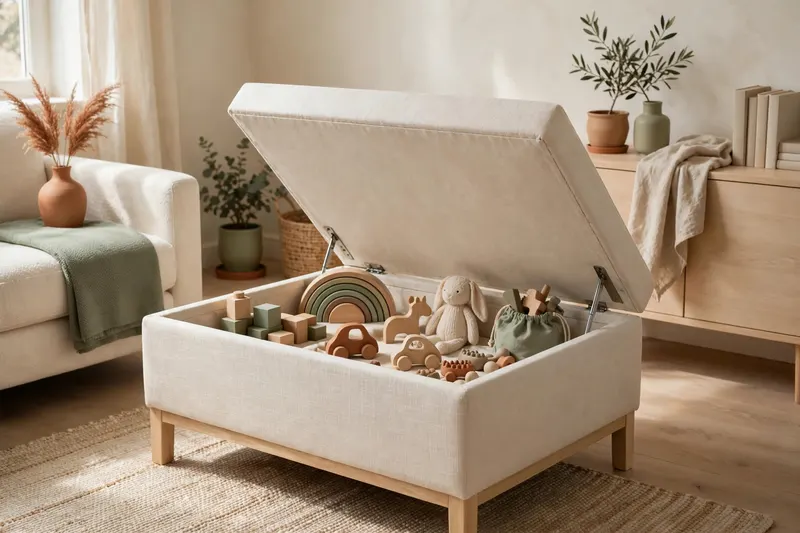
9. Swap the coffee table for a storage ottoman with a safety hinge
A storage ottoman roughly 36 by 20 inches holds about 4 cubic feet — enough for the entire pretend-play set or a pile of stuffed animals. Choose one with a safety hinge that won’t slam on small fingers, and a flat tray top you can flip over for your coffee cup. If you’re comparing ottoman styles, 15 Small Apartment Ottoman Storage Ideas breaks down which shapes hold the most without eating floor space.
10. Put a lift-lid bench against the longest bare wall
A 48-inch storage bench against a wall holds ride-ons, big trucks, and dollhouses — the toys that never fit in bins and always end up in walkways. Add two seat cushions and it reads as seating for visitors, not a toy box. The rule for the bench is the same as the bins: if the lid won’t close flat, something leaves first.
11. Claim the dead space under the sofa
Two flat under-bed bins, about 30 by 16 by 6 inches, slide under most sofas and hold puzzles, game boxes, and colouring books. They’re invisible from standing height and out of toddler sightlines, which also cuts down on “forgotten toy” requests at bedtime. Keep one bin for puzzles and one for games so nothing needs sorting.
Wall storage for books, art, and small toys
Floor space is the scarcest resource in a small apartment, so the walls have to work. The trick is keeping wall storage low enough for kids to reach and shallow enough that it doesn’t swallow the room.
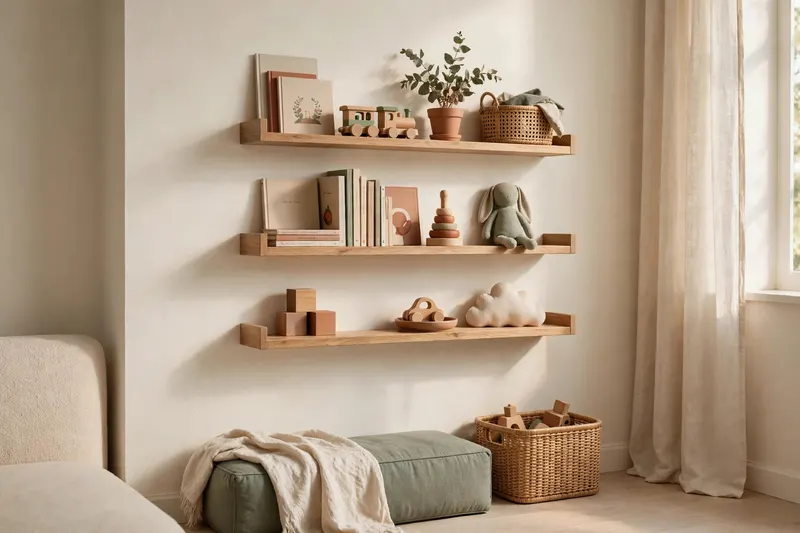
12. Mount two picture ledges at kid height for books and display toys
Two 36-inch picture ledges mounted at 36 and 48 inches high hold forward-facing books — kids pick by the cover, so they read more — plus a row of display-only toys like LEGO builds and favourite figures. Cap the collection at what fits on the ledges: about 20 to 25 picture books. The rest live in the rotation stash. Use renter-friendly mounting strips, or two screws into a stud if your lease allows it.
13. Hang a clear over-the-door organizer for small parts
A clear-pocket over-the-door organizer gives you 24 pockets at kid height for action figures, small dolls, hair accessories, and crayon packs — the small stuff that turns into floor confetti. Hang it on the inside of the kids’ bedroom door or a closet door with over-door hooks, no screws needed. For the building sets that outgrow pockets, 16 LEGO Storage Ideas for Small Spaces covers colour-sorted bins and building trays that keep bricks contained.
The 10-minute nightly toy reset (kids included)
Even the best bins fail without a daily reset. Ten minutes with the whole family beats thirty minutes alone, and kids as young as three can help — if the system is simple enough that they know where everything goes.
14. Run the reset to a 10-minute timer, every night
Set a 10-minute timer after dinner or before bath time and play one upbeat song on repeat. Everyone races to return toys to their bins, ottoman, or bench before the timer ends. When the timer rings, the reset ends, even if a few strays remain. Done beats perfect, and a predictable end keeps kids willing to do it tomorrow.
15. Assign zones, not toy types
Give each person a zone, not a category: one person owns the couch and ottoman zone, one owns the floor and bins, one owns the shelves and ledges. Zones beat categories for speed because nobody walks in circles hunting for “all the blue blocks.” Rotate zones weekly so nobody gets stuck with the worst one every night. End every reset the same way: close the ottoman lid, close the bench lid, and push the bins back against the wall.
When to donate: the one-in-one-out rule that sticks
Toy storage only works if the total volume stops growing. Without an exit route, every birthday and holiday adds a layer, and no bin system can keep up. Donation isn’t a once-a-year purge — it’s a small, constant habit built into the apartment.
16. Enforce one-in-one-out at the front door
Every new toy that enters the apartment means one toy leaves it, chosen by the child who owns it. New birthday gift? The birthday child picks one older toy for the donation box before the new one gets played with. Letting kids choose what leaves matters: it teaches them the trade-off, and they resist far less than when you purge behind their backs.
17. Keep a permanent donation box by the door
A single medium box — a sturdy shopping bag works — lives by the front door, always open, always accepting. Broken toys go straight in the trash, not the box; outgrown or ignored toys go in the box. When the box is full, it leaves the apartment that week: donation drop-off, a neighbour with a younger child, or a local charity collection point. For the bedroom side of the same habit, 17 Kids Bedroom Storage Ideas for Small Rooms shows how a donation station fits into a shared kids’ room without eating play space.
Mistakes to avoid (and what NOT to buy)
- The giant toy chest. One big box teaches kids to throw everything in and dig through it. Four activity bins beat one chest every time.
- Buying bins before the audit. Bins don’t reduce toy volume; they just hide it. Audit first, then buy the bins that fit the keepers.
- Deep toy boxes with heavy lids. Kids can’t lift them, so they leave them open. Open-front bins or safety-hinged lids only.
- Clear bins for everything. Bright plastic in clear boxes reads as clutter from across the room. Use opaque bins for the loud stuff.
- A rotation stash with no swap day. A stash bin without a calendar reminder becomes a forgotten box in a closet. The swap day is the system.
- Toy hammocks and netting. They sag under real weight within weeks, and nobody happily untangles toys from a stretched net.
Frequently asked questions
How do I store toys in a small apartment with no playroom?
Use the whole apartment as the system: low open bins in the living area for daily play, a rotation stash in the bedroom closet, and storage furniture that hides the bulky toys. Most toy storage small living room ideas assume one room does everything — in an apartment, spreading the load across rooms is the smarter play.
How often should I rotate toys?
Every two weeks, on the same day each time. Two weeks is long enough for kids to get bored with the current set and short enough that they still remember what’s coming back from the stash.
Can kids really maintain a toy system themselves?
Yes, if cleanup is one motion and the categories are pictures, not words. Four open-front bins with photo labels plus a 10-minute nightly reset is simple enough for a three-year-old to run.
What size bins work best for kids’ toy storage in apartments?
Open-front bins roughly 12 inches wide and 10 inches deep for daily toys, one 66-quart latch bin for the rotation stash, and two flat 30-by-16-by-6-inch bins under the sofa. Measure your shelf and sofa clearance before buying.
Where should the toy rotation stash go in a rental?
The top shelf of the kids’ closet, on top of a wardrobe, or under an adult bed. Anywhere out of sight and out of reach works — the stash just needs to be inaccessible between swaps, and you need to be able to reach it easily on swap day.
That’s all 17 ideas — one system, not 17 separate projects. Start tonight with the audit and four open bins; add the rotation stash this weekend and the furniture when you can. Your apartment can be a place where kids play hard all day and adults actually relax after bedtime. If toy clutter is one of several small-space headaches, browse the full small-spaces collection for the rest of the room-by-room plan. Save this pin for later so you have the swap schedule handy when you start.