Winter boots are the hardest thing to store in a small apartment. They are tall, wide, heavy, and wet — and unlike sneakers, you cannot stack them in a neat pile or squeeze four pairs onto one shelf. Every rainy day adds a puddle by the door, damp boots leaning against the wall, and a smell that creeps into the entryway. The good news is that small apartment boot storage is a solvable problem, and it does not need a mudroom, a garage, or a bigger apartment. These 15 apartment boot storage ideas treat boots as a separate system from shoes: a drip zone for wet pairs, vertical storage for tall pairs, airflow for drying, and a hiding spot for the rest.
Why boots break small entryways (and the audit that fixes it)
One pair of knee-high rain boots takes up roughly the same floor space as three pairs of sneakers. The fix starts before you buy anything: an honest audit of what you own and wear.
1. Do the 10-minute boot audit
Pull every pair of boots out of closets, under beds, and behind doors. Sort them into three groups: worn weekly in winter, worn monthly, and not worn in a year. Most people find 6 to 10 pairs, but the weekly group is usually just 2 to 3 — one waterproof pair, one everyday pair, and possibly one dress pair. Only the weekly group earns entryway space.
2. Measure your entryway before you shop
Measure the floor strip beside your door — width and depth — and the height from the floor to the lowest hook or shelf. A boot tray that is 30 inches wide will not fit a 24-inch wall. Write the three numbers on your phone.
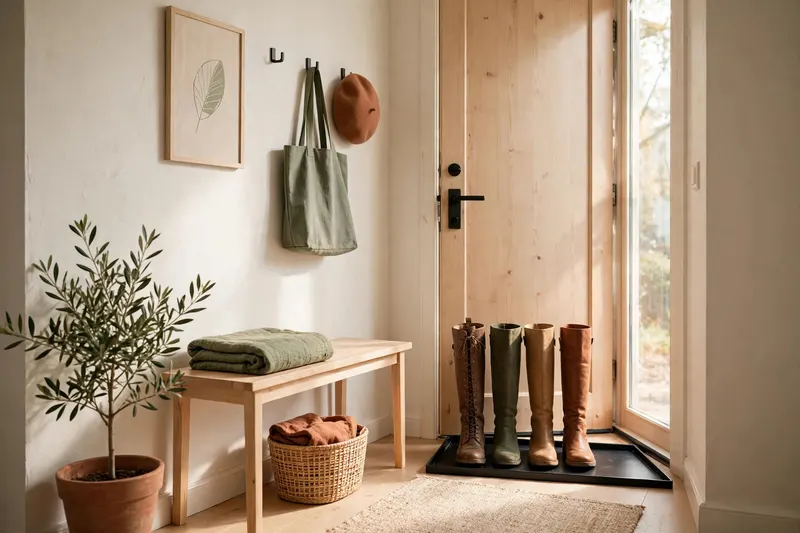
Slim boot trays and drip zones for wet weather
Wet boots need a place to drip that is not your floor. A drip zone is a defined, waterproof area where wet boots live until they dry.
3. Use one slim boot tray per household member
A boot tray is a shallow, rimmed pan — usually plastic or galvanized metal, about 28 to 30 inches long, 14 to 16 inches wide, and 1.5 inches deep — that catches water, mud, and salt. One tray holds two pairs of adult boots side by side. Choose one with a raised grid inside so boots sit above pooled water, and rinse it out once a week.
4. Build a drip zone with a washable rug and a boot mat
If a tray feels too rigid for your space, layer instead: a low-pile, machine-washable rug (about 2 by 3 feet) under a rubber boot mat with a raised edge. The mat catches drips, the rug catches splashes, and both go in the wash when they get grimy. Nothing is fixed to the wall or floor, so the whole zone rolls up for summer storage. Keep it within one step of the door.
5. Add a pebble or slatted tray for heavy snow days
On the worst slush days, a standard tray fills fast. A tray filled with smooth river pebbles, or a wooden slatted tray, lets water drain away from the boot soles while air circulates underneath. Pebble trays are cheap to make — a shallow tray, a bag of pebbles, and a waterproof liner.
Vertical boot storage: tall, narrow, and out of the way
Boots are tall, so storing them flat wastes the floor space small apartments lack. Vertical storage keeps pairs upright, aired out, and out of the walkway.
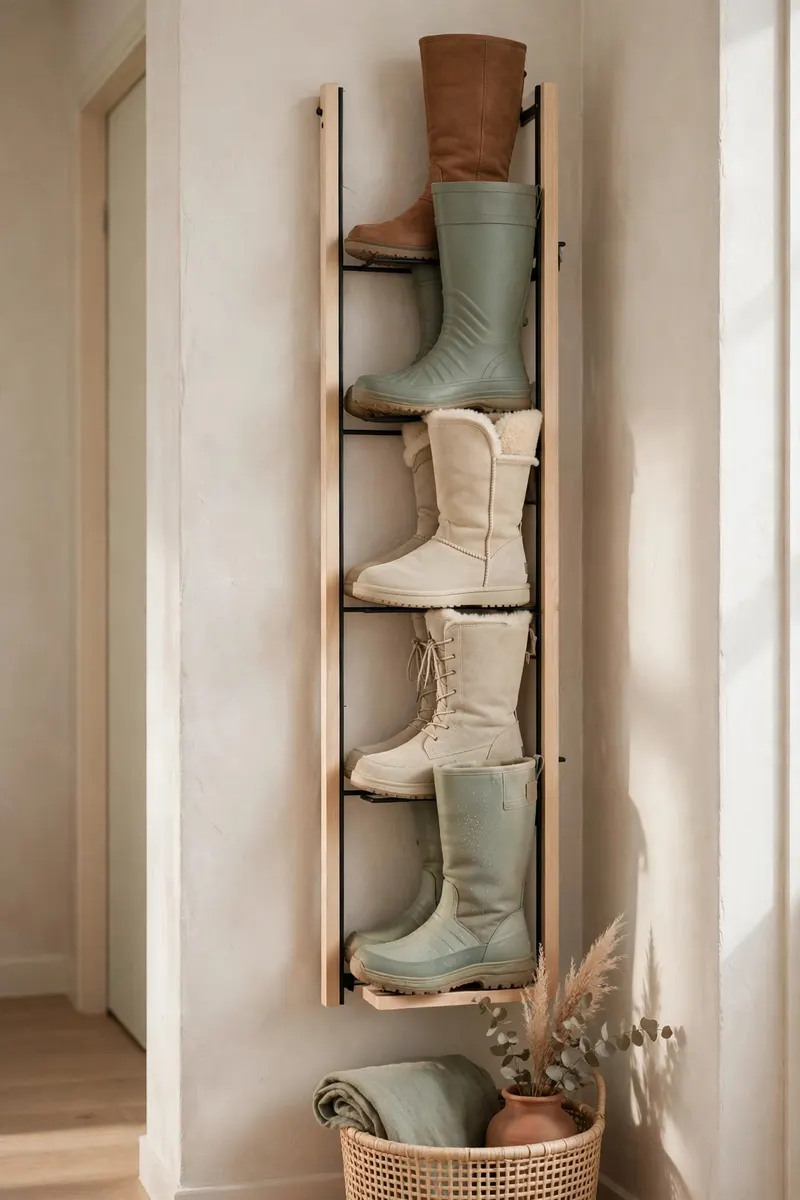
6. Stand boots on a narrow vertical boot rack
A vertical boot rack is a slim frame — usually 10 to 12 inches wide and 30 to 36 inches tall — with pegs or rails that hold boots upside down by their heels or toes. One rack holds 2 to 4 pairs and fits beside a door frame or between a radiator and the wall. Hanging boots upside down also drains water out of the shaft instead of letting it pool at the toe, which is the main reason boots start to smell. Choose a freestanding rack if you rent, and check the weight limit for heavy leather boots.
7. Use boot shapers to keep tall boots upright on a shelf
Tall boots flop over on a shelf, crease at the ankle, and take up twice their width. Boot shapers — foam, plastic, or rolled inserts that slide inside the shaft — hold the boot upright so a pair stands as slim as it does on your leg. Three pairs of upright boots fit in the space two flopped pairs used to need. For knee-high boots, choose shapers at least 12 inches tall.
8. Hang boots from a tension rod inside a closet
A tension rod mounted horizontally inside a closet, about 8 inches below the shelf, creates instant boot storage: clip each boot to the rod with a sturdy trouser hanger or an S-hook through the pull tab, and the boots hang vertically. One 24-inch rod holds 3 to 4 pairs. This works best for lightweight rain boots; heavy leather boots can slip off cheap hangers, so use clips with a rubber grip. Because the rod is tension-mounted, it leaves no holes. Pair this with your 18 Shoe Storage Ideas for Small Apartments plan if your closet is doing double duty for shoes and boots.
Under-bed and closet boot storage for off-season pairs
The boots you are not wearing this week do not belong near the door. Off-season pairs should live under the bed, on a high shelf, or in the back of a hall closet — kept clean, shaped, and easy to find.
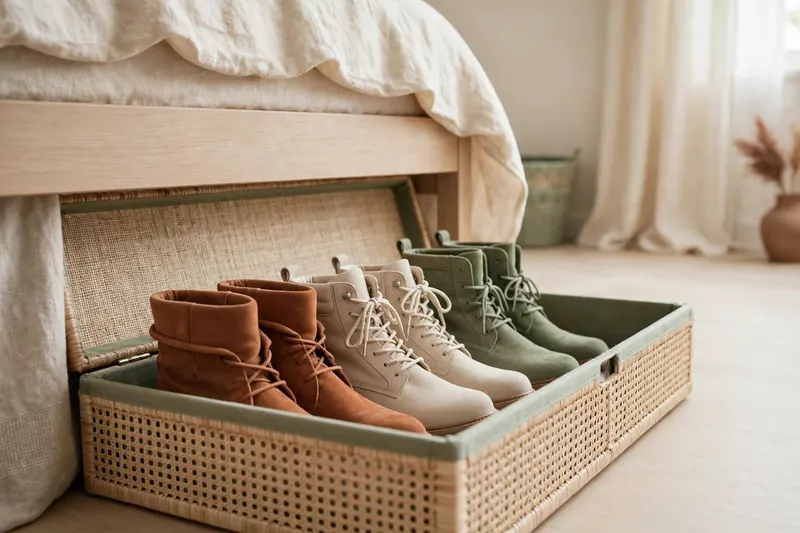
9. Store off-season boots under the bed in labeled bins
A low, flat bin — roughly 32 by 16 by 6 inches — slides under most bed frames and holds 2 to 3 pairs of boots laid on their sides with shapers inside. Label the bin by season (“Winter boots” or “Rain boots”) so you are not opening three bins to find one pair. Add a cedar sachet to control moisture, and stuff the toes with old socks so the shape holds. For more under-bed ideas, see our guide to 15 Bulky Bedding Storage Ideas for Small Apartments, which uses the same low bins and labeling system.
10. Rotate boots seasonally with a top-shelf box
Keep one sturdy lidded box on the top shelf of your hall closet for the boots that are out of season right now. When winter ends, clean each pair, let them dry fully, insert shapers, and pack them in the box with a label facing out. When the first cold snap arrives, swap the box down and move the summer pairs up. This one swap, done twice a year, keeps the entryway from slowly filling with pairs you are not wearing. Our 16 Hall Closet Organization Ideas for Tiny Entry Closets shows how to fit a boot box into a closet that already feels full.
Boot dryers and airflow: stopping the smell
Wet boots do not just make puddles — they grow bacteria, and bacteria make the smell that fills a small apartment. The fix is airflow and drying time, not air freshener.
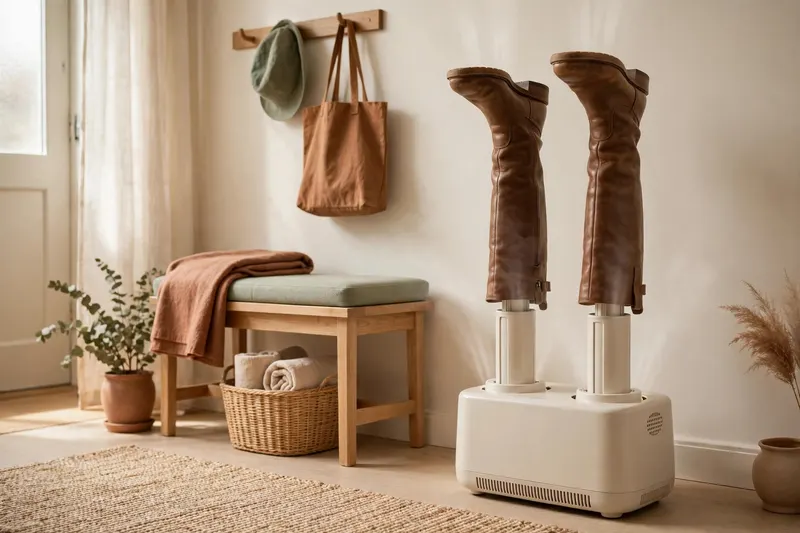
11. Dry boots with a compact boot dryer after every wet day
A boot dryer is a small electric unit with two upright tubes that blow warm, gentle air into each boot. A compact model dries a pair in 1 to 3 hours. Use it after every rainy or snowy day, not just the worst ones — boots that are “a little damp” are exactly the ones that start smelling. The low-tech version works too: stuff each boot with newspaper, replace it after an hour, and stand the boots in front of a fan. Never dry leather boots directly on a radiator or with high heat — it cracks the leather and warps the shape.
12. Give drying boots a ventilated spot, not a sealed corner
Boots stuffed into a closed cabinet or a plastic bin stay damp for days. Drying pairs need open air: a ventilated shelf, a slatted rack, or simply the drip zone with space around each pair. Leave at least an inch between boots so air can move, and crack the nearest window for an hour after a wet commute. If your boots still smell after drying, sprinkle baking soda inside overnight and shake it out in the morning.
Over-door and behind-door boot organizers
The back of a door is free real estate in a small apartment — if you pick the right organizer. The wrong one sags, dumps boots on the floor, and blocks the door from closing.
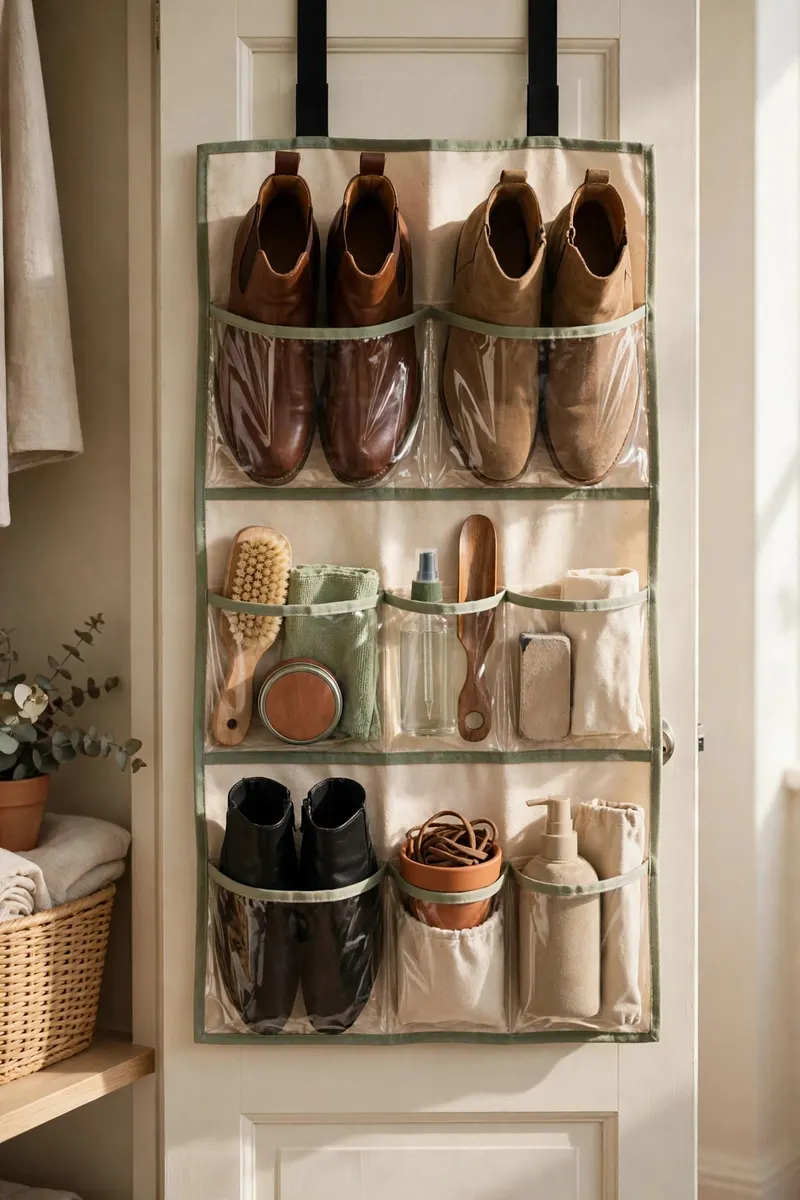
13. Use a sturdy over-door boot rack, not a shoe pocket organizer
Standard over-door shoe pockets are made for flat shoes; boots are too tall and too heavy for them, and the pockets stretch and tear. Instead, use an over-door rack designed for boots: a metal frame that hooks over the door with deep, open shelves or rails that hold 2 to 3 pairs by their shafts. Before you buy, check that the door still closes fully with the rack on it (most racks need about a quarter inch of gap), and that the rack is rated for the weight of your boots.
14. Hang a behind-door hook system for one grab-and-go pair
Mount two or three heavy-duty adhesive hooks on the wall behind your front door, at about knee height, and hang one pair of boots by their pull tabs. This is the grab-and-go pair — the waterproof boots you reach for when it is pouring and you are already late. Adhesive hooks rated for at least 5 pounds each will hold most rain boots; skip them for heavy leather pairs, which need a screwed-in hook. For more behind-door ideas, see our Over-the-Door Organization Ideas for Every Room.
The one-pair-by-the-door rule
Every storage system in this article fails the same way: slowly, one extra pair at a time, until the entryway is a boot pile again.
15. Keep only one pair by the door — and enforce it nightly
Pick one pair — the pair you will wear tomorrow — and let it be the only pair in the entryway overnight. Every other pair lives in its assigned home: the rack, the closet, the under-bed bin. Each evening, take sixty seconds to swap the day’s boots for tomorrow’s pair. This is the same discipline that makes 16 Entryway Coat Storage Ideas Without a Closet work for coats: the system is not the furniture, it is the habit. That is the core of winter boot storage small space planning: one pair out, the rest stored. For more ideas that fit tiny homes, browse the small-spaces category.
Mistakes to avoid
Buying a boot rack before measuring. The most common waste of money is a rack two inches too wide for its wall. Measure first, buy second.
Storing wet boots in a sealed bin. A lidded box is for clean, dry, off-season boots only. A damp pair sealed in plastic will smell within days and can grow mildew.
Piling boots in a heap by the door. A heap crushes shafts, traps moisture between pairs, and turns a five-second grab into a dig.
Ignoring salt stains. Road salt eats leather and leaves white rings on suede. Wipe boots with a damp cloth after a snowy walk, and treat leather with waterproofing spray each season.
Keeping boots you never wear. If a pair has not been worn in a year, it is decoration, not footwear. Donate it and free the space for a pair you actually use.
Frequently Asked Questions
Can I store boots in a small apartment without a closet?
Yes. A slim boot tray by the door handles the wet pair you wear daily, a vertical rack or boot shapers handle the pairs in use, and under-bed bins hold the off-season pairs. You need floor space the size of a doormat and about 6 inches of under-bed clearance.
How do I keep winter boots from smelling in a small apartment?
Dry them completely between wears. Use a boot dryer or stuff them with newspaper and stand them in moving air for a few hours after every wet day. Never store a damp pair in a sealed container, and wash the insoles if the smell persists — that is where most odor lives.
What is the best boot storage for a rental apartment?
Anything that needs no holes: a freestanding boot tray, a tension rod inside a closet, adhesive hooks behind a door, and under-bed bins. All four leave no marks and move with you when your lease ends.
How many pairs of boots should I keep by the door?
One pair — the pair you are wearing tomorrow. Every other pair lives in its assigned storage. Two or more pairs by the door is how an entryway turns back into a boot pile, no matter how good the rack is.
Can I store tall boots under the bed?
Yes, if the bin is low enough and the boots have shapers inside. A 6-inch-high under-bed bin fits most beds, and boots laid on their sides with foam shapers keep their shape for months. Label the bin so you can find the pair you want.
Conclusion
Small apartment boot storage comes down to four moves: a drip zone for wet pairs, vertical storage for tall pairs, airflow so they dry and stay fresh, and an off-season home for everything else. Pick the ideas that fit your entryway, measure before you buy, and keep just one pair by the door — save this pin for later so you can find it when the first snow arrives.